.png)
A Modern Music Marketing Strategy for Independent Artists
So you’ve poured your heart and soul into a new track, hit "publish," and... crickets. It can feel like you’re just shouting into a void. If your marketing efforts aren't bringing in real listeners, trust me, you're not alone.
The old playbook of just blasting your music everywhere and hoping something sticks? It’s officially broken. The "spray and pray" method is a quick way to burn out and waste money.
Rethinking Your Music Marketing Strategy
Let's face it: the digital world is completely saturated with new music every single day. Standing out is tougher than ever, and it's easy to get trapped in a cycle of promoting a track with nothing to show for it but stagnant follower counts and flatlining streams. The problem usually isn't the music itself; it's the lack of a smart, cohesive plan driving the release.
A modern music marketing strategy is less about short-term promotion and more about building a long-term, sustainable career. We're not chasing a single viral moment. We're building a system that consistently connects you with the right people—the ones who will evolve from casual listeners into genuine, die-hard fans.
To really get this right, you need to stop thinking like you're just pushing a product and start thinking about building a world around your music. It all boils down to four key ideas.
The Four Pillars of Modern Music Marketing
Deep Audience Understanding: This means digging deeper than just "fans of indie pop." It’s about finding and connecting with your specific niche. Who are they, really? What do they care about?
Strategic and Safe Placements: Forget blasting your track to a thousand random playlists. The focus here is on quality over quantity. Getting on the right playlists builds real, lasting engagement.
Authentic Content Creation: Your music is only part of the story. You need to tell the rest of it through content that builds a community and lets people connect with you, the artist.
Data-Driven Decisions: Use the analytics you get from platforms like Spotify for Artists to see what's working. Every release should inform the next, helping you refine your approach over time.
So much of this comes back to one thing: a clear identity. If your music isn't getting heard, it's often because there isn't a strong story or brand for people to latch onto. Before you spend a dollar on ads, take the time to build a strong personal brand—it's the foundation for everything else.
The goal is to stop promoting blindly and start building relationships. An effective strategy turns passive listeners into an engaged community that actively supports your journey, buys your merch, and shows up for your live shows.
This mindset shift is especially crucial when it comes to playlisting. Think about it from the curator's perspective: independent curators on Spotify get, on average, over 500 submissions every single week. It's no wonder that generic, copy-paste pitches barely manage a 2-3% approval rate. This is exactly why a targeted, thoughtful strategy is no longer optional for indie artists.
The music marketing landscape has changed dramatically. What worked five years ago is now obsolete. Here’s a quick breakdown of how to adapt your thinking:
Rethinking Your Music Marketing Strategy
Pillar | Outdated Tactic | Modern Approach |
|---|---|---|
Audience Targeting | "My music is for everyone." | Hyper-targeting a specific niche community that will become superfans. |
Playlist Outreach | Mass emailing hundreds of random curators. | Building relationships and pitching to a small, curated list of relevant playlists. |
Content Strategy | Only posting "new music out now!" | Sharing the story behind the music, behind-the-scenes content, and personality. |
Measuring Success | Focusing only on total stream count. | Analyzing listener demographics, engagement rates, and follower growth. |
Seeing the difference? The modern approach is all about depth, authenticity, and smart decisions.
Ultimately, a well-executed plan ensures every single thing you do has a purpose. You’re not just releasing music; you're taking calculated steps toward building a career, one release at a time. If you're ready to put this into action, a great place to start is our guide on how to get more Spotify streams with a smarter strategy.
Crafting Your Pre-Release Playbook
A great song can still fall flat if nobody knows it's coming. A successful release isn't a single-day event; it's the payoff at the end of a carefully planned campaign. The work you do in the weeks and months leading up to release day is what separates a track that makes waves from one that disappears without a sound.
Think of this pre-release period as setting the stage. Instead of scrambling to upload your files at the last minute, you’re deliberately putting all the pieces in place. This gives your music the best possible shot at connecting with the right people and avoids the chaos that so many artists get caught in.
First Things First: Who Are You Trying to Reach?
Before you spend a dime or a minute on marketing, you have to know exactly who you're talking to. The biggest mistake I see artists make is saying their music is for "everyone" or for a huge genre like "indie pop." That's a surefire way to get your message lost in the noise. You have to get specific.
Start by sketching out a listener persona. Go deeper than just age and location and really dig into their world.
Who else is on their heavy rotation? Think specific artists, not just genres.
What blogs, YouTube channels, or online communities are they part of?
What kind of content stops their scroll on TikTok or Instagram?
Where do they actually find new music? Is it a specific playlist, a Reddit forum, or a friend’s recommendation?
Answering these questions helps you find the subcultures where your music will feel like it was made just for them. For example, instead of targeting "rock fans," you might find your ideal listener loves 90s-inspired shoegaze and follows vinyl collector accounts on Instagram. That level of detail makes every other part of your plan ten times more effective.
Define Your Brand and Your Story
Your artist brand isn't just a cool logo or a color palette. It’s the story behind the music and the feeling people get when they listen to it. It’s what makes them care. Your brand should be a genuine extension of who you are and what your music is about.
Your story is your unique selling proposition. It’s what differentiates you from the thousands of other artists releasing music every day. It transforms a song from a simple audio file into an experience.
Consistency is everything here. Your visuals—album art, press photos, social media vibe—need to match the mood of your music. If you're making dark, introspective tracks, a bright, bubbly Instagram feed will just confuse people. Authentic storytelling is what turns casual listeners into true fans.
The game has changed from mass-market broadcasting to highly specific, targeted communication. This timeline shows how we’ve moved from the old "spray and pray" method to the focused approach we have to use today.
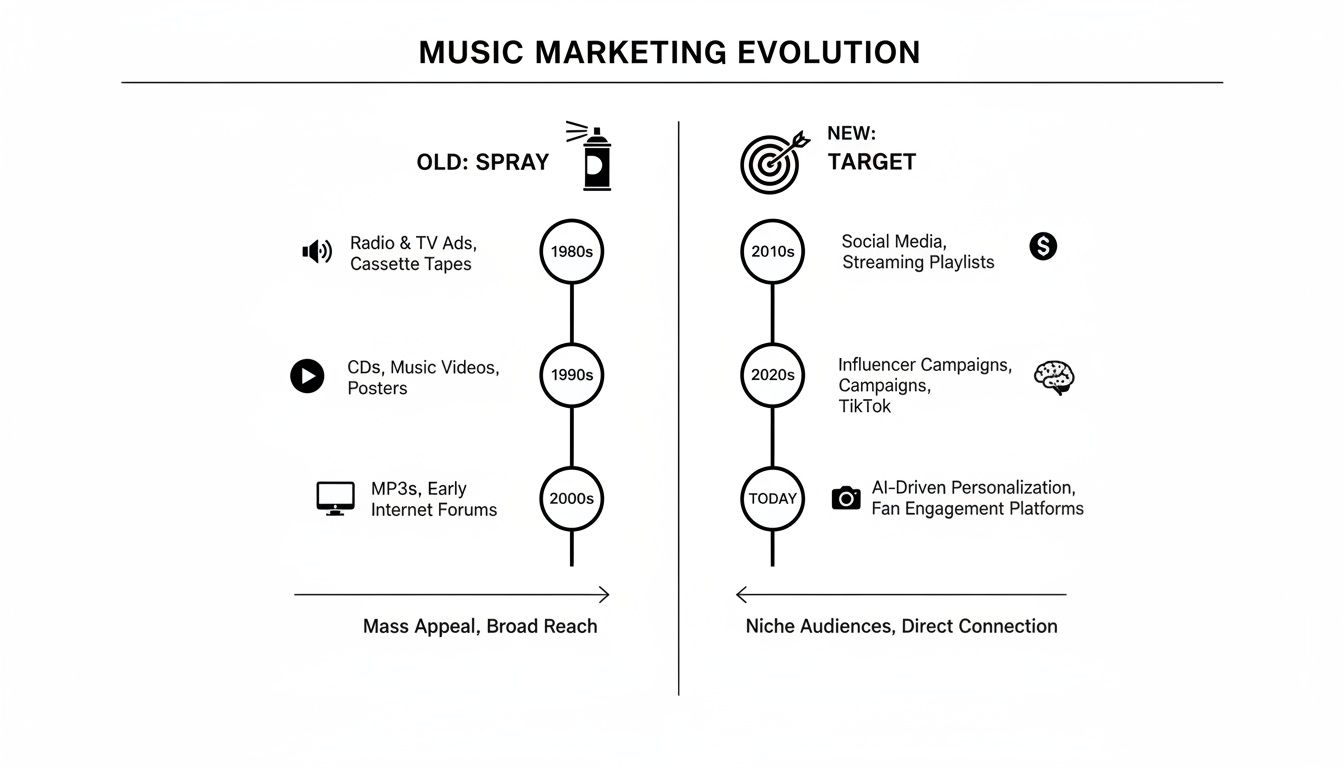
This shift is precisely why nailing down your niche and brand is so important. You can't hit a target you haven't defined.
Map Out Your Release Timeline and Assets
Once you know who you are and who you're talking to, it's time to build a practical schedule. I’ve found that a 6-8 week pre-release runway is the sweet spot. It gives you enough time to get everything done without burning out.
Work backward from your release date and set some clear milestones for yourself.
Finalize & Master Your Track (8 Weeks Out): Get your audio professionally polished. No cutting corners here. This is the foundation for everything.
Create Your Assets (7 Weeks Out): This is the fun part. Start shooting press photos, finalizing your album art, and making any short-form video content you need, like a Spotify Canvas.
Set Up Distribution (6 Weeks Out): Use a service like DistroKid or TuneCore to upload your music and all the metadata. This lead time is absolutely critical if you want a shot at Spotify’s editorial playlists.
Launch a Pre-Save Campaign (4 Weeks Out): Get your pre-save link live and start pushing it everywhere. This helps you hit the ground running with some algorithm-friendly momentum on release day.
Pitch to Playlists & Press (3-4 Weeks Out): Now's the time to start your outreach. Hit up independent playlist curators, music bloggers, and anyone else on your press list.
Schedule Your Social Content (1-2 Weeks Out): Plan and schedule the social media posts that will build that final wave of hype leading up to the big day. As you build out this schedule, having a solid modern social media and content strategy is a total game-changer.
By following a structured playbook like this, you go from being reactive to being proactive. You’re in control, giving your music the professional, strategic launch it deserves.
How to Find and Nurture Your Superfans

Forget chasing millions of fleeting streams. That's a game most independent artists can't win. The real foundation for a sustainable career isn't a one-off viral hit; it's a dedicated core of supporters.
These are your superfans. They don't just add your song to a playlist—they buy the vinyl, rock your t-shirt at a show, and become evangelists for your music, telling anyone who will listen why you're next up. This isn't just about promoting a track; it's about building a genuine community.
The numbers back this up, and they're pretty staggering. Superfans might only account for 2% of an artist's monthly listeners on Spotify, but they can drive a massive 18% of their total streams. And this isn't some tiny niche. Luminate's data shows that about 19% of U.S. music listeners consider themselves superfans. It's a huge, passionate audience just waiting to connect. You can dig deeper into this in a great music marketing report on the topic.
Identifying Your Potential Superfans
So, how do you actually find these people? The good news is they’re probably already in your orbit, hiding in plain sight. It’s time to put on your detective hat and start looking for patterns of high engagement.
Instead of just skimming your analytics, really dig in. Look for the same names and faces that pop up again and again.
Social Media Mavens: Who’s always the first to like, comment on, or share your posts? These folks are your digital street team.
Merch Buyers: Anyone who spends their hard-earned cash on your merch is already deeply invested. Make a note of who they are.
Consistent Streamers: Dive into your Spotify for Artists data. See a small but dedicated pocket of listeners in a specific city? That's a clue.
Live Show Regulars: Do you recognize the same faces in the front row at your local gigs? These are prime candidates for your inner circle.
Once you start spotting these dedicated fans, engage with them directly. It doesn't have to be complicated. A simple reply to their comment or a DM thanking them for their support can make a huge impact. It shows you see them and value their effort.
A superfan isn't just a consumer; they are an active participant in your journey. Nurturing this relationship is one of the most powerful marketing moves you can make because it's built on genuine connection, not algorithms.
Building Your Community Hub
Once you've identified your most engaged fans, the next step is to bring them together. You need to give them a space—a home base—where they can connect with you and, just as importantly, with each other. This is about moving the conversation off the public timeline and into a more exclusive environment where a real community can form.
This "hub" is where you can give your biggest supporters a deeper look into your world. Think about which platform feels right for you and where your fans already hang out.
Discord Server: This is perfect for creating a lively, chat-based community. You can have separate channels for new music discussion, tour updates, or just random hangs.
Private Facebook Group: If your audience is already all over Facebook, this is a no-brainer. It's an easy and familiar place for them to join the conversation.
Patreon or Fan Club: This model is ideal for offering tiered perks. Think exclusive content like early access to music, behind-the-scenes videos, or monthly Q&A sessions with you.
Honestly, the specific platform matters less than the intention behind it. Your goal is to make these fans feel like true insiders. Share demo snippets, ask their opinion on a new t-shirt design, give them the first shot at tickets. This kind of exclusive access is the ultimate reward for their loyalty and will forge an even stronger bond. You can often find great tools that integrate with these community efforts by exploring the best music promotion services.
Navigating Playlist Pitching Without Getting Burned
Playlist pitching can feel like the wild west of music marketing. On one hand, landing your track on the right playlist can be a game-changer, putting your music in front of thousands of potential new fans. But on the other hand, it's an environment crawling with scams, bot-farms, and pay-for-play schemes.
Getting burned isn't just about wasting your marketing budget. Fake streams can get your music flagged by Spotify, potentially leading to strikes against your account or even removal from the platform. The key isn't to blast your song everywhere, but to be surgical and smart about where you focus your energy. It's all about quality over quantity.
The Three Worlds of Playlisting
Before you even think about sending out your track, you need to understand the playing field. Playlists really break down into three distinct categories, and your approach for each one will be completely different.
Editorial Playlists: These are the big leagues—the playlists curated directly by Spotify's internal teams, like Today's Top Hits or RapCaviar. The only way to get on their radar is by pitching your track through your Spotify for Artists dashboard at least a week before release day. It's a long shot, for sure, but one you have to take every single time.
Algorithmic Playlists: You can't pitch for these directly. Playlists like Discover Weekly and Release Radar are generated by Spotify’s algorithm for each user. You influence them by driving real human engagement. Every pre-save, share, and save from your fans sends a signal to the algorithm that people care. This is where a solid pre-release campaign really pays off.
Third-Party (Independent) Playlists: This is where you’ll spend most of your active pitching time. These are playlists built by everyone from music bloggers and record labels to individual fans who just love curating music. While there's massive opportunity here, this is also where the biggest risks are hiding.
The real challenge is figuring out who's legit. Is that playlist with 50,000 followers a genuine community of music lovers, or just a front for a bot farm in a server room somewhere? This is where you need a trusted gatekeeper.
Pitching Smart and Staying Safe
Your number one priority has to be protecting your artist profile. That’s why using a service that vets playlists for you, like SubmitLink, is so critical. It’s built with the same kind of bot detection technology used by major distributors, automatically flagging suspicious curators and giving you a layer of security you just can't get by cold-emailing or sliding into DMs.
Once you know you're pitching to real people, your focus can shift to making your pitch count. Remember, curators are absolutely swamped. Your submission needs to be a breath of fresh air.
A great pitch is concise, personal, and professional. It shows you’ve done your homework and respect the curator’s time and taste. It's not just a transaction; it's the start of a potential relationship.
Your pitch should always include:
A direct link to your song on Spotify.
A quick, one-sentence description of the track's genre and vibe.
A short, personal note explaining why it’s a good fit for their specific playlist. Mentioning another song or artist on their playlist shows you actually listened.
Links to your artist profiles so they can learn more.
This simple approach turns what could be seen as spam into a professional introduction. Even if you get a "no," you might get some valuable feedback you can use to refine your targeting for the next release.
Of course, protecting yourself is an ongoing battle. The more you know about the scammers' tactics, the better you'll be at avoiding them. It’s worth taking the time to learn how to detect fake Spotify playlists and avoid common scams.
Comparing Playlist Pitching Channels
With so many ways to get your music out there, it helps to weigh your options. Each channel has its own set of pros and cons, and knowing them can help you allocate your time and budget more effectively.
Channel | Effectiveness | Risk Level | Best For |
|---|---|---|---|
Spotify Editorial Pitch Tool | Low (highly competitive) | None | All artists; it's a free and necessary lottery ticket. |
Algorithmic Playlists | High (long-term) | None | Artists with an engaged, growing fanbase. |
Vetted Platforms (e.g., SubmitLink) | Medium to High | Low | Independent artists seeking safe, targeted, and scalable outreach. |
Direct Curator Outreach (Email/DM) | Low to Medium | High | Artists with a lot of time for research and a high tolerance for risk. |
"Pay-for-Placement" Services | Very Low | Very High | No one. These are almost always scams or bot-driven. |
Ultimately, a balanced strategy is your best bet. Use the official tools, build your audience to trigger algorithms, and lean on vetted platforms to safely connect with independent curators.
Play the Long Game, Not the Short Spike
It can be tempting to chase a massive, overnight stream count from a shady source. Don't do it. The real goal of your music marketing strategy should always be sustainable growth and connecting with genuine listeners.
Recent data from the US streaming market makes this crystal clear. In the first half of 2025, 'current' music (tracks less than 18 months old) made up only 24.2% of all streams. The other 75.8% was catalog music—older songs with lasting appeal. As reported by Music Business Worldwide, this shows that the most successful music isn't about a fleeting release-week spike; it's about staying power.
This is exactly why a placement on a smaller, highly-engaged niche playlist is often far more valuable than a spot on a huge, generic one. Those dedicated listeners are more likely to save your track, follow your profile, and explore the rest of your music. These are the actions that build a real career.
Think of each quality playlist placement as planting a seed. The right ones will grow into loyal fans who stick with you for the long haul.
Using Content and Ads to Amplify Your Music
Alright, so you've landed some playlist spots and the initial streams are trickling in. Now what? You can't just sit back and hope for the best. This is the moment to pour some fuel on that fire.
A smart content plan is your best tool for this. I'm not just talking about posting a link to your song. It’s about building a world around your music, something that pulls new listeners in and makes them want to stick around long after that first play.
The obvious places for this are short-form video platforms like TikTok and Instagram Reels. But here's where so many artists go wrong: their content just screams, "Go stream my new song!" It feels like a pushy ad, and we’re all hardwired to just scroll right past that stuff.
Your content needs to tell a story. Think of each video as a tiny window into your world as an artist. This approach invites people in, making them feel like they're connecting with you, not just your music. You'll start turning passive listeners into a genuinely curious audience.
Crafting Content That Connects
Your content strategy shouldn't feel like a chore; it should feel like another part of your art. From my experience, the content that performs best almost always comes from authentic storytelling, not overt promotion. It’s about showing, not just telling.
Here are a few content pillars that I’ve seen work wonders for musicians:
Behind-the-Scenes Footage: Share a clip of you figuring out a tricky chord progression, give a quick tour of your messy home studio, or even show the frustrating moment you can't nail a take. That kind of vulnerability is what makes you relatable. It humanizes the music.
Personal Stories & Inspiration: What’s the real story behind your lyrics? Was it a weird dream, a book you read, or a conversation you overheard? Unpacking these little narratives gives your song emotional weight and a hook people can latch onto.
User-Generated Content (UGC): This is a big one. Encourage your followers to use your sound in their own videos. When they do, shout them out! Share their creations. This not only gives you a stream of fresh content but also builds a real community around your track.
The goal is to create content that provides value on its own. The music just happens to be the soundtrack to a compelling micro-story. This subtle shift is what grabs attention and drives real, organic discovery.
Don't ask people to listen to your music. Instead, create content so compelling that they want to find out what song is playing in the background. This is the core of an effective modern music marketing strategy for social media.
Demystifying Paid Advertising
Once you've posted a few videos and you see one or two starting to get some organic traction, it's time to think about putting a little money behind them. Paid ads on platforms like Meta (Facebook and Instagram) and TikTok aren't about "going viral"—they're about precision.
For as little as $5-$10 per day, you can take your best-performing video and show it to a very specific audience. This isn’t a blind “boost post” button press. It's a strategic move to find more people who look exactly like your existing fans.
Your first step should be creating a lookalike audience. This is an incredibly powerful feature where the platform analyzes the people who already follow you or engage with your content, then finds new users with similar interests and online behaviors. Trust me, this is far more effective than just targeting fans of some massive artist in your genre.
Running Smart, Small-Budget Campaigns
Think of your first ad campaign as an experiment. The goal here is to learn, not to get a million streams overnight. To do that, A/B testing needs to become your best friend.
A/B testing is just a fancy way of saying you're running two slightly different versions of an ad to see which one works better. It's simple.
Test Your Creative: Run the same video but with two different captions. Does starting with a question get more clicks than a bold statement?
Test Your Audience: Show the exact same ad to two different lookalike audiences. Does the audience built from your Instagram followers convert better than one based on your Spotify listeners?
Test Your Call-to-Action: Point one ad to your Spotify profile and another to a pre-save link. This helps you figure out what action a new fan is most willing to take.
By isolating one thing at a time, you gather clean, actionable data. After a few days, you can confidently turn off the underperforming ad and put your full, albeit small, budget behind the winner. This cycle of testing and optimizing is how you build an efficient ad machine that drives real results, whether that’s more streams, new followers, or valuable email sign-ups.
Using Data to Guide Your Next Release
A marketing strategy is only as good as the results it gets. Once the release-day buzz settles down, the real work begins: figuring out what actually worked and what didn't. This is where you shift from guessing to making smart, data-backed decisions that will sharpen your entire approach for the next single.
The goal here is to build a simple feedback loop. You plan, you execute, you measure, and then you learn. Every release becomes a real-world experiment, giving you the exact intel you need to make your next music marketing strategy hit even harder.
Diving Into Spotify for Artists
Your Spotify for Artists dashboard is your single best source of truth. It's an absolute goldmine of information, but it's easy to get lost in the numbers. Forget obsessing over the total stream count for a minute and focus on the metrics that tell a story about your listeners.
I always tell artists to start by looking at these three key areas to find real, actionable insights:
Audience Demographics: Where are your listeners? Are there unexpected pockets of support popping up in certain cities? Realizing you have a small but passionate following in a place like Austin could completely change how you plan your next tour or where you target your next ad campaign.
Source of Streams: This one is huge. Are people finding your track through their Release Radar? That's a great sign your pre-save campaign and initial follower push paid off. Is one specific user-created playlist driving most of your plays? That's a curator you absolutely need to build a relationship with.
Playlist Performance: Don't just glance at the number of streams a playlist got you. You have to dig deeper into the listener saves and playlist adds. A high save rate from a smaller, niche playlist is an incredibly powerful signal that you’ve found your people.
Data tells you what happened; insight tells you why it matters. A spike in streams is just a number. But discovering that spike came from a TikTok video using your sound? That's an actionable insight you can build your next content plan around.
Turning Data Into Actionable Steps
Once you've poked around in the data, the next step is turning it into a concrete plan. This is how you go from just looking at results to actively shaping them. Think of it like a post-game debrief—what went right, what went wrong, and how do we play better next time?
Let's walk through a few real-world scenarios and the strategic moves you could make.
Scenario 1: A Playlist Drives High Listener Saves
The Data: Your song lands on a "Late Night Chillhop" playlist. It only drove 500 streams, but you notice it has a massive 40% listener save rate.
The Action: This is a home run. Immediately go find that curator on social media and send a genuine, personalized thank you. Mention their playlist by name. Now, when you have another track that fits that vibe, you've already built a warm connection, which dramatically boosts your chances of getting another placement.
Scenario 2: A TikTok Resonates in a New Country
The Data: A video you made using your sound randomly gets traction in Brazil, leading to a small but clear bump in followers and streams from São Paulo.
The Action: Double down. Make more content that leans into whatever made that first video work. You could even run a small, targeted Meta ad campaign specifically for users in São Paulo who like similar artists. You can test the waters with a tiny budget just to see if you can fan the flames of that emerging audience.
Scenario 3: Low Engagement from a Major Placement
The Data: You landed a spot on a huge playlist with 100,000 followers, but it resulted in very few saves and almost no new followers for your artist profile.
The Action: This is a classic case of a bad fit. The playlist's audience just wasn't your audience. For your next round of pitching, you can safely deprioritize that playlist and focus instead on smaller, more genre-specific ones that have proven they deliver engaged listeners, even if the stream counts are lower.
This constant process of analyzing and adapting is what separates artists who grow sustainably from those who just get lucky. Every data point is a clue, pointing you straight toward your true fans and helping you build a more powerful, efficient marketing machine.
Ready to take the guesswork out of your playlist pitching? SubmitLink connects you with a vetted network of real curators, using bot detection to protect your music and providing the feedback you need to refine your strategy. Start pitching smarter today at submitlink.io.


