.png)
How to Find Playlists on Spotify and Get Real Listeners
Getting your music onto the right Spotify playlists isn't a dark art; it's a skill you can learn. It really boils down to three main approaches: digging into Spotify's own search tools, using specialized third-party platforms, and good old-fashioned direct outreach to curators. Most artists find that a blend of all three works best, letting them build a solid, targeted campaign from the ground up.
Your Strategic Guide to Spotify Playlist Discovery
Landing your music on the right Spotify playlists is less about getting lucky and more about having a smart, repeatable process. Forget just chasing streams for the sake of it. The real goal is to build a targeted list of playlists where your music truly belongs and where real fans are waiting to discover it.
Before we jump into the "how," it’s worth taking a moment to understand the "why." If you need a refresher, this article on why music streaming platforms are crucial for exposure does a great job of laying out the modern music landscape. Thinking this way turns playlisting from a simple promo task into a core part of how you grow as an artist.
The Three Main Ways to Find Playlists
When it comes to actually finding these playlists, your efforts will generally fall into one of three buckets. Each has its own pros and cons, and the best strategy for you will probably mix and match depending on your budget, how much time you have, and what you’re trying to achieve.
Using Spotify's Built-in Tools: This is your starting point. You'll be using the search bar, looking at "Fans Also Like" sections on similar artist profiles, and checking out the "Discovered On" feature. It’s completely free, but it can be a real grind and doesn't always give you a clear path to the curator.
Leveraging Third-Party Platforms: These are services built specifically to bridge the gap between artists and curators. They offer powerful filters, provide contact details, and sometimes even vet playlists for quality, which can save you a massive amount of time.
Direct Outreach to Curators: This is all about building real relationships. You find curators on social media or other channels and connect with them directly. It’s more personal and can lead to more dedicated, long-term support for your music.
The goal isn't just to find any playlist; it's to find the right one. A spot on a small, hyper-engaged niche playlist will almost always do more for your career than a placement on a huge, generic list full of passive listeners.
This chart gives you a quick visual of how these methods work together. You start broad on the platform itself, narrow your focus with specialized tools, and then build real connections.
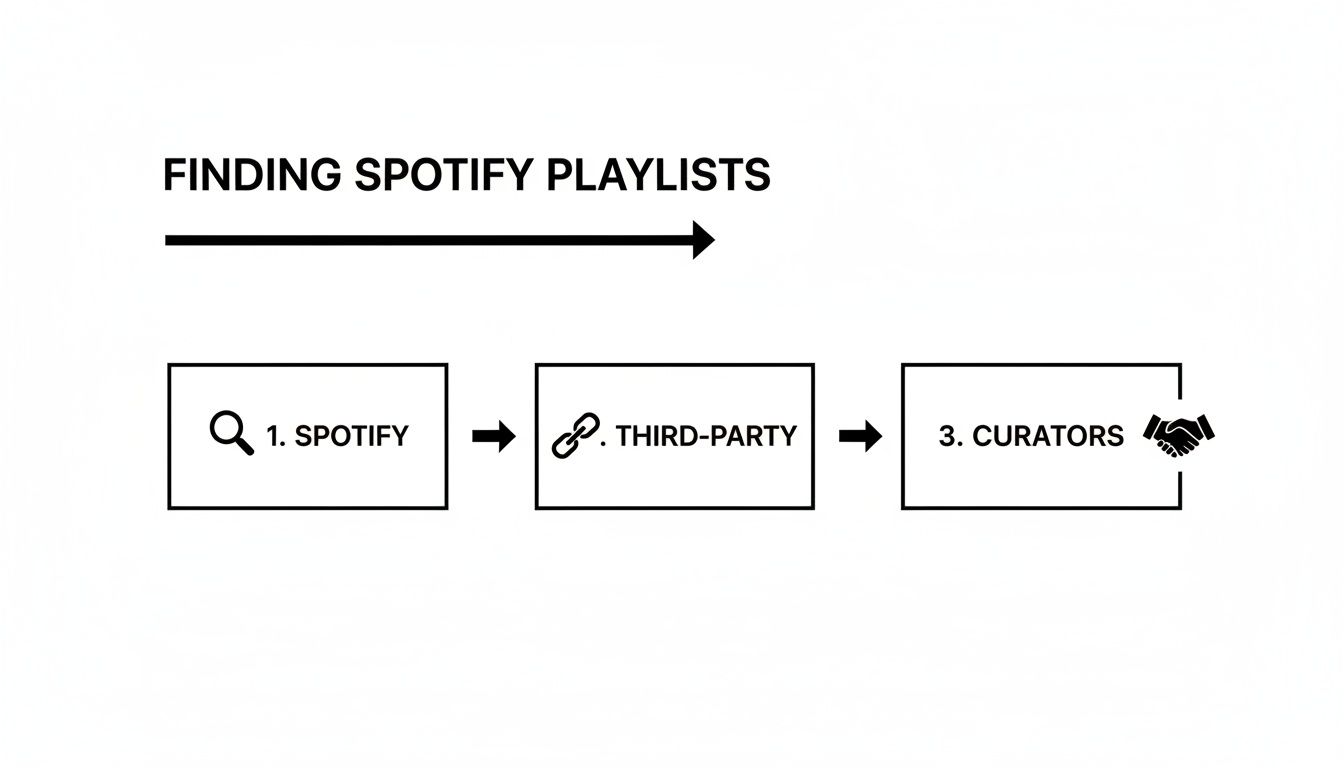
This illustrates that a comprehensive strategy starts with the platform itself, expands with specialized tools, and is strengthened by direct human connection.
To make it even clearer, let's break down how these methods stack up against each other.
Playlist Discovery Methods at a Glance
Method | Best For | Pros | Cons |
|---|---|---|---|
Spotify Native Search | Artists on a tight budget or those just starting their research. | Completely free; direct access to the platform's data. | Time-consuming; lacks curator contacts; hard to verify playlist quality. |
Third-Party Tools | Artists looking to save time and get access to vetted, targeted lists. | Efficient; advanced filtering; provides contact info; often vets for fake streams. | Usually requires a subscription or fee; can be overwhelming with options. |
Direct Curator Outreach | Artists focused on building long-term industry relationships. | Can lead to genuine, lasting support; builds your professional network. | Very time-intensive; requires patience and social skills; low success rate initially. |
Each path has its place in a well-rounded promotion strategy. Starting with Spotify's own tools helps you get a feel for the landscape, while third-party platforms and direct outreach allow you to scale your efforts and build meaningful connections.
Finding Playlists Using Spotify's Own Tools
Before you even think about paying for a third-party service, you need to get really good at using the powerful discovery engine you already have: Spotify itself. Too many artists just type a genre into the search bar and call it a day, but the desktop app is a goldmine if you know where to dig.
The search bar is your starting point, but you have to think like a listener, not just an artist. Instead of just searching for "synth-pop," get creative. What’s the vibe of your music? Try searching for things like "late night drive synth-pop," "80s retro focus," or even "Stranger Things vibes." When you mix genres with moods, activities, or pop culture references, you’ll uncover tons of user-made playlists that a basic search would completely miss.
Digging Deeper with Search Operators
To really narrow things down, you can use search operators. Spotify doesn't shout about these, but the community has figured out a few that work wonders. For example, putting your search in quotes—like "lofi hip hop study"—tells Spotify to find that exact phrase in a playlist's title. This simple trick filters out a ton of irrelevant noise.
Here’s what a typical search for synth-pop playlists might bring up initially.
This first pass gives you a healthy mix of official Spotify lists and user-created ones, which is the perfect place to start your research.
Beyond the Search Bar: Hacking Artist Profiles
Here’s a trick that’s incredibly effective but often overlooked: go investigate the profiles of artists similar to you, especially those who are just a few steps ahead in their careers.
First, pull up the profile of an artist who makes music in your lane.
Scroll down until you find the "Discovered On" section. This is a public list of playlists that are actually sending that artist a significant number of streams.
Click into these playlists. Take a close look at their themes, who curates them, and what other artists are featured. Does your track fit in?
This is like reverse-engineering success. You’re finding playlists that have already proven they are open to your specific sound. It's a direct path to curators who are actively looking for music just like yours. Understanding the scale of Spotify's massive user base helps put into perspective how powerful these placements can be.
Pro Tip: Don't just stalk massive artists. The real sweet spot is finding indie artists in your niche with 10,000 to 100,000 monthly listeners. The playlists they land on are often run by passionate, independent curators who are much more approachable and genuinely excited about finding new music.
This turns every artist profile into a powerful research tool. From there, you can jump to their "Related Artists" or "Fans Also Like" sections and repeat the process, mapping out an entire ecosystem of playlist opportunities. It takes time, no doubt, but the quality of leads you'll get is often way better than what a broad search will ever give you.
Using Third-Party Platforms for a Competitive Edge
While you can definitely find some gems using Spotify’s own tools, the artists who are serious about getting placements rely on dedicated third-party platforms. These services are designed from the ground up to connect musicians with active, legitimate curators, transforming a hunt-and-peck manual search into a targeted mission.
Let's put it this way: digging through Spotify yourself is like wandering through a massive library, hoping you stumble upon the right book. Using a quality third-party tool is like having a specialist librarian who knows exactly where every book is, who wrote it, and whether it’s a good fit for you. It’s all about working smarter.
The Power of Vetted Networks and Advanced Data
What really separates a powerful platform from a simple database is the quality of its information. The best services don't just give you a long list of playlists; they arm you with actionable data so you can make smarter pitching decisions.
This is where you gain a real advantage. You’re no longer just guessing if a playlist is a good fit—you’re using data to back up your strategy. Look for platforms that give you access to crucial metrics like these:
Direct Curator Contacts: You need social media links, email addresses, or submission forms. This removes the frustrating guesswork of trying to figure out how to even contact the curator.
Listener Growth Analytics: A simple but powerful metric. Is the playlist steadily gaining followers, or is it stagnant or bleeding listeners? This tells you a lot about its health and relevance.
Bot Detection Scores: This is non-negotiable. A high bot score is a massive red flag, and landing on a fake playlist can do serious damage to your artist profile.
Investing in a platform with robust vetting isn't just a business expense; it's an investment in your career's integrity. It's the difference between building a real, engaged audience and paying for fake numbers that could get your music flagged or even removed from Spotify.
These tools turn the gamble of finding playlists into a calculated strategy. They provide a layer of security and insight you simply can't replicate using the native Spotify app alone.
Choosing Your Platform Strategy
As you start exploring, you'll find these tools generally fall into two camps. The first is the classic database model—it gives you a massive list of playlists and some filters, but you're still on your own to vet each one and manage all your outreach.
The second, more modern approach is a curated submission service, like SubmitLink. Instead of just handing you a list, these platforms connect you directly to a pre-vetted network of curators who are actively looking for new music. This model takes the grunt work out of the process; you submit your track, and the service does the matchmaking with relevant curators for you.
Many artists end up using a mix of tools, but understanding the different types of the best music promotion services helps you decide where to put your time and money.
For instance, services that are backed by powerful bot detection, like the artist.tools integration used by SubmitLink, offer an essential safety net. They automatically weed out suspicious playlists, saving you from hours of manual research and protecting your music from fake streams. This approach frees you up to focus on what actually matters: making great music and building real connections.
How to Spot and Dodge Fake Playlists
As you hunt for the perfect Spotify playlists, you're going to run into fakes. It's an unfortunate reality of the game. Landing a spot on a botted playlist might give you a temporary ego boost, but it's a completely empty win that can get you in serious trouble with Spotify.
We're talking warnings, stream counts being wiped, or even having your music pulled from the platform entirely.
Think of it this way: real streams are like fans genuinely discovering your music at a local record shop. Fake streams are like filling that shop with mannequins—it looks busy from the outside, but nothing is actually happening. Spotify's algorithm is sharp and easily sniffs out this kind of fake engagement, and it penalizes artists who get caught up in it.
Doing Your Detective Work on a Playlist
Your best defense is to put on your detective hat before you even think about sending a pitch. Every good playlist tells a story of organic growth and genuine listeners. A fake one, on the other hand, is full of plot holes.
First, look at the ratio of playlist followers to the monthly listeners of the artists on it. If a playlist boasts 50,000 followers, but every artist featured is stuck under 1,000 monthly listeners, something is very wrong. Real listeners discover music they like and then follow the artist. Bots just play the track and move on, leaving no real impact.
Next, check the playlist's age and growth trajectory. Did a playlist pop up last Tuesday and suddenly has 100,000 followers? That's almost certainly a scam. Authentic playlists take months, often years, to build a real following. If you can, use a third-party tool to peek at its historical data for a clearer picture.
Key Takeaway: A healthy playlist shows a clear, logical link between its follower count and the listener growth of the artists it features. If the numbers don't add up to a believable story, it's time to back away.
Quick Red Flags to Look For
Once you know the signs, vetting playlists gets a lot faster. Treat it like a quick audit—the more red flags you spot, the greater the risk.
Here’s a quick checklist to help you spot a fake playlist in the wild.
Red Flag Checklist for Spotting Fake Playlists
Use this checklist to quickly evaluate a playlist's legitimacy before you submit your music.
Red Flag | Why It's a Problem | What to Do |
|---|---|---|
Outlandish Titles | Playlists named "Get Famous Quick" or promising "1M Streams Guaranteed" are obvious scams. | Stay away from anything that sounds too good to be true. It always is. |
Anonymous Curator | The curator's profile has no photo, no other public playlists, and zero followers. | Click through to the curator's profile. If it looks like a ghost town, it’s probably a bot. |
Identical Follower Counts | A curator has multiple playlists in different genres, all with nearly the same follower count (e.g., 75,123). | This is a classic sign of someone buying followers in bulk. Avoid their entire network. |
No "Discovered On" Section | None of the artists on the playlist show that playlist in their "Discovered On" section. | This means the playlist isn't generating real, meaningful streams that Spotify recognizes. |
Mismatched Genres | The playlist title says "Chill Lo-Fi," but the tracks are a random mix of death metal and hyperpop. | A lack of curation suggests the playlist was thrown together by bots, not a human with real taste. |
These are just a few of the most common signs. If you see one or two, proceed with caution. If you see several, it’s a definite pass.
For a more in-depth guide, our post on https://www.submitlink.io/post/how-to-detect-fake-spotify-playlists-tips-for-avoiding-scams goes even further. The problem of fake engagement isn't unique to Spotify, either. Reading up on topics like how to identify fake influencer engagement can give you a broader understanding of the tactics scammers use online, many of which apply here.
This kind of vigilance is non-negotiable for a serious artist. It's also why a service like SubmitLink is so valuable. We use bot detection from artist.tools to automatically vet every playlist in our network, creating a safety net that filters out the fakes. This way, you can pitch with confidence, knowing you're reaching real curators and building a real career.
Pitching Your Music and Building Real Relationships
Finding the right playlist feels like a massive victory, but that’s really just the first step. Now for the hard part: the pitch. A generic, copy-paste email is the surest way to land your music in the trash folder. Good outreach is a delicate balance of being professional and being a real human being.
Blasting your track to a hundred curators at once might seem like you’re getting a lot done, but a thoughtful, targeted approach is what actually gets results. You have to remember, a curator’s inbox is a war zone for attention. Your email has to cut through the noise by proving you've done your homework and actually appreciate what they do. This is your one chance to make a good first impression.
Crafting a Pitch That Gets Opened
Your subject line is everything. It needs to be clear, professional, and interesting enough to click on without screaming "spam." Vague titles like "Music Submission" are a no-go, and please, never use all caps.
Get specific and personal right away. A simple formula that works wonders is mentioning your genre and giving a nod to one of their specific playlists.
Submission: [Your Artist Name] - [Your Song Title] (For Fans of your 'Midnight Drive' playlist)
Chillwave track for 'Coastal Vibes': [Your Artist Name] - [Your Song Title]
This tells the curator exactly what they're getting and shows you’re not just firing off emails to a list you bought online. It proves you've actually listened.
Once they open the email, keep it short and sweet. Curators are incredibly busy; they don't have time for your entire life story. A few tight, powerful paragraphs are all you need to make your case.
Pro Tip: Whatever you do, don't attach MP3 files to your email. It’s a huge red flag for spam filters and a quick way to annoy someone by clogging up their inbox. Always, always use a clean streaming link—preferably to your track on Spotify. It makes their job easy.
A little effort to personalize your pitch shows you respect them as a tastemaker, not just as a gatekeeper you’re trying to get past.
From a Single Pitch to a Lasting Partnership
The real goal here isn’t just a one-time placement. It’s about building a network of people who genuinely champion your music. If you start thinking of every pitch as the beginning of a potential relationship, your entire approach changes from chasing short-term wins to building a long-term career.
So, what about the follow-up? This is where you need to be careful. A single, polite nudge after about a week is perfectly fine. Any more than that, and you start to seem pushy, which can burn that bridge for good.
And whether you get added or not, always be gracious. A quick "thanks for your time and consideration" goes a surprisingly long way. If they do add your song, make sure you shout them out. Share the playlist on your socials and tag the curator. It’s a simple gesture that helps them grow and shows you’re a great artist to work with.
For a more detailed breakdown of writing the perfect pitch, our guide on how to submit music to Spotify playlists and get heard dives into specific templates and strategies. Building these connections is a slow burn, but a handful of loyal curators are worth more than a hundred random placements.
Answering Your Top Questions About Spotify Playlists
When you're diving into playlisting, the same questions always seem to pop up. Let's cut through the confusion with some straight answers, based on real-world experience, so you can build a smarter campaign.
How Many Playlists Should I Pitch for a New Release?
This is a classic case of quality over quantity. Don't waste your time blasting your new track to 500 random playlists. Your energy is much better spent on a highly curated list of 50-100 playlists that genuinely fit your sound.
Honestly, a dozen well-researched, personalized pitches will get you further than a thousand generic ones ever could. The goal isn't just to get on any playlist; it's to find curators who could become actual fans of what you do. That focus builds real connections and boosts your odds of getting placed.
Is It Okay to Pay for Playlist Placements?
Let's be crystal clear: you should never pay a curator directly for a slot on their playlist. That's "payola," and it's a fast track to getting your music—and maybe even your entire artist account—in trouble with Spotify. It's just not worth the risk.
What is legitimate is paying for a submission platform or a promotional service. The key difference is what you're paying for.
You’re not buying a placement. You're paying for their tech, their curator vetting process, and access to a network of people who are actively listening. It's a fee for a guaranteed listen and consideration, which is incredibly valuable when everyone is fighting for attention.
How Long Until I Hear Back from Curators?
If you're cold-emailing, the unfortunate truth is that you might not hear back at all. Curators get buried under hundreds, sometimes thousands, of submissions every single week. It's easy for a great track to get lost in the flood.
This is where a dedicated platform really shines. Many services, including SubmitLink, have rules in place that require curators to listen and respond within a specific window, like seven days. That system ensures your music actually gets heard and you get some concrete feedback to work with.
What Is a Realistic Success Rate for Pitching?
When you’re sending emails out into the void, a 1-2% placement rate is pretty standard. That number can feel a bit grim, but it’s a realistic picture of how tough it is to stand out from the crowd.
Compare that to platforms where curators have actively signed up to discover new music. Some of these curated services see average placement rates above 20%. The difference is massive, and it proves the value of getting your music in front of people who are genuinely looking for the next great track.
Ready to find vetted playlists and get guaranteed feedback without worrying about bots? SubmitLink connects you with hundreds of active curators waiting to hear your music. Our platform uses industry-leading bot detection to make sure every placement is legitimate, helping you build a real audience safely. Start your next campaign with SubmitLink.


