.png)
How to Submit to Spotify Playlists A Guide for Indie Artists
Getting your music onto the right Spotify playlists really boils down to two distinct approaches: using the official Spotify for Artists submission tool to get on the radar of Spotify's own editors, and pitching your music directly to the thousands of independent curators out there.
The official route is your shot at the big leagues—the highly coveted editorial playlists. The indie outreach strategy, on the other hand, lets you tap into a massive, diverse ecosystem of user-curated playlists. To really move the needle, you need to be doing both.
Your Blueprint for Spotify Playlist Success
Ever feel like you’re shouting into a void after a new release? You pour your heart and soul into a track, only to see it get buried under the 60,000 other new songs uploaded to Spotify every single day.
The numbers can be pretty brutal. A staggering 87% of tracks never even break 1,000 streams. This isn't usually about a lack of talent; it's almost always a lack of strategy. This is where a smart, targeted pitching plan completely changes the game.
This guide is designed to be that blueprint. We’ll walk through the two essential paths for getting your music playlisted, turning what feels like a game of chance into a system you can actually rely on.
The Two Paths to Playlist Placement
Your journey starts with knowing your options. You can pitch directly to Spotify's in-house team for editorial consideration, or you can build relationships with the massive network of independent curators running their own popular playlists. Each path has its own set of rules and rewards, and you’ll need a different game plan for each.
Success isn't about landing one massive playlist and calling it a day. It’s about consistently getting placements on multiple right-fit playlists. That's what creates a snowball effect of streams, saves, and new followers that builds real, sustainable career momentum.
To get a clearer picture, I've put together a quick comparison of these two methods. Understanding the differences is the first step in building a campaign that works.
Two Paths to Playlist Placement
Method | Target Playlists | Submission Process | Key Benefit |
|---|---|---|---|
Spotify for Artists | Editorial playlists (e.g., New Music Friday, Lorem) | Formal submission through the S4A dashboard at least 1-2 weeks before release. | Algorithmic boost and a chance for massive, career-changing exposure from official Spotify channels. |
Independent Curators | User-created playlists (run by individuals, brands, blogs) | Direct email outreach or using platforms like SubmitLink to find and pitch curators. | Access to thousands of niche playlists and the ability to build genuine, long-term relationships with tastemakers. |
As you can see, both paths are critical. The editorial pitch is your lottery ticket, while indie outreach is your groundwork—the steady, consistent effort that builds your foundation.
Think of the whole process in three core stages: get your track ready, pitch it strategically, and then watch the streams come in.
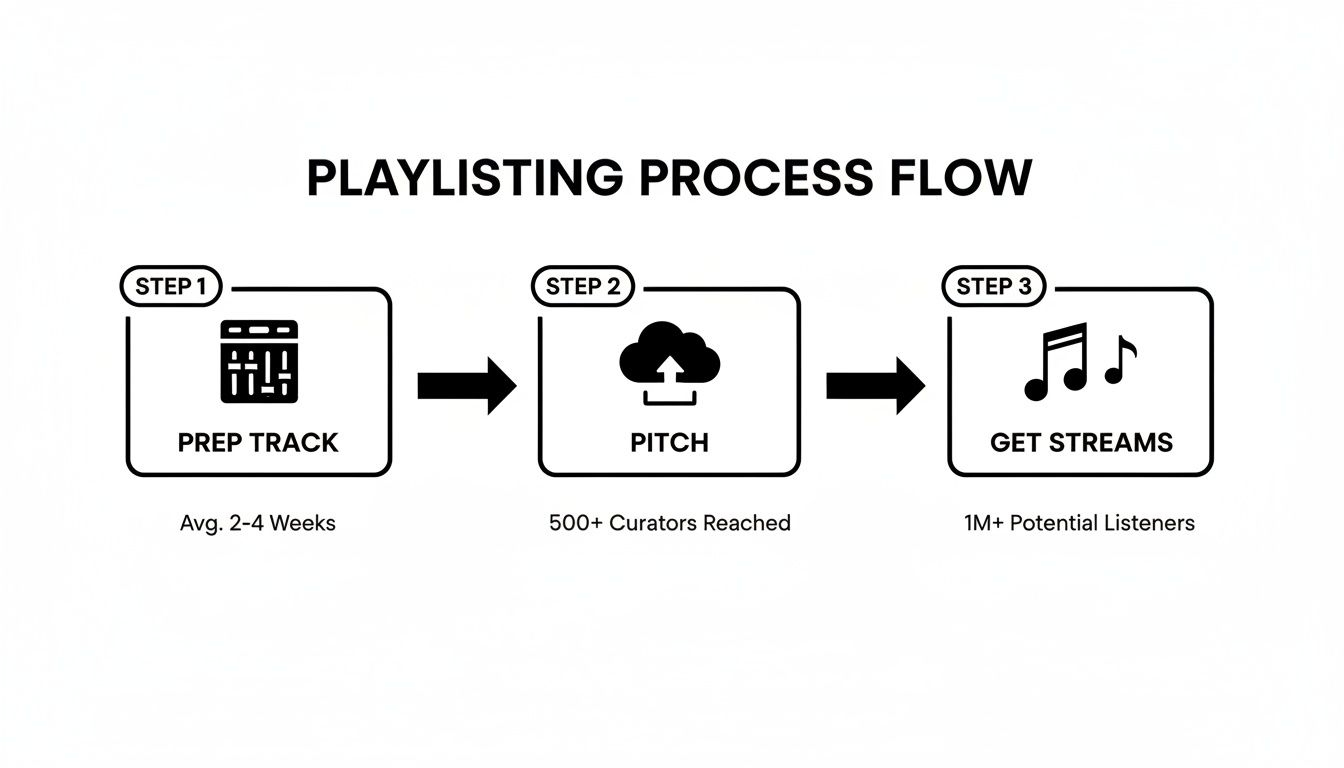
With an estimated 80% of music discovery happening through playlists, mastering this process isn't just a nice-to-have—it’s absolutely essential for any artist trying to grow.
It's a huge ecosystem, with over 4 billion total playlists on the platform. The key is finding the right ones. Tools like SubmitLink are built to bridge that gap, connecting artists directly with vetted curators and helping them build an audience one playlist at a time. If you want to dive deeper into the data, these Spotify statistics from Soundcamps offer a great overview of just how powerful playlisting can be.
Getting Your Track Ready for the Spotlight
Before you even dream of hitting that "submit" button, let's get your house in order. Pitching a track that isn't 100% ready is the fastest way to get ignored. Think of it this way: curators, whether at Spotify or working independently, are looking for any reason to say no. Don't give them an easy one.
First things first: your song needs a professional mix and master. It has to stand tall next to tracks from major labels in terms of clarity, balance, and volume. An amateur mix is painfully obvious and screams "hobbyist," which is an instant red flag for any serious curator.
And don't forget the visuals. Your cover art is the first thing anyone sees. In a sea of tiny squares on a screen, it has to grab attention and immediately sell the vibe of your song. It’s your visual handshake—make it a firm one.
Metadata: Your Song's Digital DNA
Okay, let's talk about the unsung hero of playlisting: metadata. This is the data you feed your distributor (like DistroKid or TuneCore) when you upload your track. It's not just boring admin work; it's the language you use to tell Spotify's algorithms and human editors exactly what your song is and who it's for.
Getting this part right is absolutely critical. If you've made a dreamy synth-pop anthem but lazily tag it as "Pop," you're completely missing the mark. You’re setting your song up to fail before it even gets a chance.
Everything you enter during the upload process populates your Spotify for Artists dashboard, which becomes your mission control for pitching and tracking your music's performance.
This platform is where the magic happens, but it only works if you give it the right ingredients. Be ridiculously specific with the information you provide.
Genre & Sub-genre: Don't just say "Rock." Is it Garage Rock Revival, Indie Rock, or Post-Punk? The deeper you go, the better your chances of finding the right home.
Moods: How does the song actually feel? Pick two or three that truly capture its spirit. Think driving, wistful, euphoric, introspective.
Instrumentation: What’s making the noise? Calling out key instruments like Moog Synthesizer, Fretless Bass, or 808s helps the algorithm connect your sound with similar artists.
Cultural Cues: Is it a Christmas song? A summer anthem? Does it have a specific regional feel, like "Sounds of Detroit"? This context can be a game-changer for niche playlists.
Think of metadata as your song's resume. You're telling Spotify exactly what its qualifications are and what job (playlist) it's perfect for. Precise metadata is your ticket to not only editorial consideration but also crucial algorithmic playlists like Discover Weekly and Release Radar.
Let's imagine you're an artist who makes instrumental, beat-driven music. You wouldn't just tag it "Electronic." You'd get granular:
Genre: Hip-Hop
Sub-genre: Lo-fi Hip-Hop, Chillhop
Moods: Chill, Focus, Rainy Day
Instrumentation: Sampler, Vinyl Crackle, Rhodes Piano
This level of detail sends a crystal-clear signal to Spotify's systems, dramatically improving the odds that your track will land in the ears of listeners who are already primed to love it. Taking the time to nail your presentation and data isn't just a box to check—it's the most important strategic move you can make.
Using the Official Spotify for Artists Submission Tool
This is your one direct line to Spotify's in-house editorial team, so you absolutely have to make it count. Think of the Spotify for Artists submission tool as your single most important piece of pre-release marketing—it’s your official, one-shot audition to land on playlists that can completely change your career.
The whole process hinges on a critical timeline. You must submit your unreleased track at least 7 days before its release date. Hit that deadline, and you unlock a massive benefit: your new song automatically lands on the Release Radar playlists for every single person who follows you.
Don't underestimate how powerful that is. A reported 66% of users listen to personalized algorithmic playlists like Discover Weekly and Release Radar every week. But the editorial playlists are the real holy grail. With over 3,000 official playlists, giants like Today's Top Hits (35+ million followers) can send millions of streams your way from just one placement. You can find more details on Spotify's official support page about pitching music to editors.
Nailing Your Pitch in 500 Characters
Once you get into the submission tool, you’ll find a section to describe your song. You have a razor-thin 500-character limit to make your case. This is not the place for a generic, "Hey, hope you like my new track!" message. You need to be sharp, strategic, and compelling.
Your pitch needs to tell a story. An editor sifts through thousands of these every single day, so give them something memorable to latch onto.
A great pitch usually weaves in these elements:
The Story Behind the Song: What inspired it? Is there a personal story or a unique concept behind the lyrics?
Key Press or Support: Mention any blog coverage, radio play, or significant co-signs you've secured for this release.
Your Target Playlists: Specifically name 2-3 official Spotify playlists you genuinely believe your song fits, and quickly explain why. This shows you’ve done your research.
Your Location: Highlighting your hometown or current city can be a backdoor onto regional playlists like "Sounds of Chicago."
Your pitch is an elevator pitch to a very busy person. Give them the most important information first. What makes your song special? Why should they care? Be direct, be authentic, and be specific.
Choosing the Right Tags for Your Track
Beyond the written pitch, the submission tool will ask you to tag your song with genres, moods, and other descriptors. This data is just as critical as your metadata because it helps editors instantly understand your track's sonic and emotional DNA. Don't rush this part.
Take your time here. Select the tags that honestly represent your music. You're essentially guiding the editor's listening experience before they even hit play.
For instance, if you've got a melancholic indie folk song, your tags might look like this:
Genres: Indie Folk, Singer-Songwriter
Moods: Melancholy, Reflective, Hopeful
Song Styles: Ballad, Acoustic
Instrumentation: Acoustic Guitar, Piano, Strings
This combination paints an immediate picture. An editor can glance at these tags and know exactly what to expect, making it much more likely they'll send it to the right curator on their team.
While the official tool is essential, remember it's only one piece of the puzzle. A truly comprehensive strategy also involves building relationships with independent curators. To make that process easier, it's worth exploring platforms built for Spotify playlist submissions that can connect you with a vetted network of tastemakers. Combining both official and independent pitching gives you the best of both worlds.
Finding and Pitching Independent Curators
Moving beyond Spotify's official submission form opens up a huge, vibrant world of independent playlists. This is where you can connect with highly engaged, niche audiences that are often far more accessible than the big editorial lists. But pitching these curators isn't about filling out a form—it's about building real connections.

Be warned, though: this territory is also full of traps. For every authentic music lover running a fantastic playlist, you'll find dozens of fakes using bots to pump up their numbers. The single most important skill you can develop here is learning to tell the difference.
How to Vet Independent Playlists
Before you waste a single minute pitching—or worse, lose money to a scam—you have to put on your detective hat. A playlist with 50,000 followers looks impressive on the surface, but if only 10 of them are actual people, it’s completely useless to you.
Start by looking for the obvious red flags. Look closely at the playlist's name, its follower count compared to the curator's own profile, and the actual engagement on the tracks. A healthy playlist shows logical follower growth, and the songs on it have a consistent number of saves and plays.
Here are some dead giveaways of a low-quality or fake playlist:
Generic Playlist Names: If it's called "Top Hits 2024" or "Viral TikTok Songs," be skeptical. These are often designed to game the system, not to showcase great music.
Suspicious Follower Counts: A playlist with tens of thousands of followers run by a curator whose personal Spotify profile has just a handful? That's a massive warning sign.
Pay-for-Placement Offers: This is the biggest red flag of all. Any curator who asks for money to place your song is violating Spotify's rules. Just walk away.
To help you get started, use this checklist to spot potential fakes before you even think about hitting 'send' on that email.
Vetting Independent Playlists Red Flag Checklist
Red Flag | What to Look For | Why It Matters |
|---|---|---|
Strange Follower Growth | Sudden, massive spikes in followers overnight or a flatline growth pattern. | Authentic playlists grow organically over time as real people discover and follow them. Bots add thousands of followers instantly. |
Mismatched Genres | A playlist titled "Chill Lofi Beats" that suddenly has a death metal track in it. | Real curators have a specific vibe and taste. A chaotic mix of genres often means it's a "dumping ground" for paid placements. |
No Curator Presence | The playlist isn't linked to any social media, blog, or real person. You can't find any info on who runs it. | Passionate curators are proud of their work and usually have a presence elsewhere. Anonymity is a classic sign of a bot farm. |
Low 'Saves' to 'Follower' Ratio | Use a tool to check playlist stats. If a list has 100k followers but each song has only a few dozen saves, it's suspect. | Real listeners save songs they like. Low saves on a high-follower list indicate the "followers" aren't actually listening. |
A great playlist is more than just a collection of songs; it’s a reflection of a specific taste, mood, or community. The best curators are genuinely passionate, and that authenticity comes through in everything they do.
If you're still on the fence about a playlist's legitimacy, we've got a much deeper guide on how to spot the fakes. You can find it here: https://www.submitlink.io/post/how-to-detect-fake-spotify-playlists-tips-for-avoiding-scams
A Smarter Way to Find Curators
Let's be honest: manually searching for and vetting every single playlist is draining. It’s a numbers game where quality beats quantity every time, but finding that quality is the real grind. This is where dedicated submission platforms can completely change the game.
Platforms like SubmitLink were built to solve this exact problem. They act as a bridge, connecting you with a network of hundreds of curators who have already been screened for authenticity and engagement. Instead of spending all your time hunting for contact info, you can focus on what matters—crafting a great pitch.
These services use powerful systems to make sure you're connecting with real curators running real playlists. SubmitLink, for instance, is backed by artist.tools—the same bot detection system trusted by major players like DistroKid and UnitedMasters. It actively flags and kicks fraudulent playlists out of its network.
This approach doesn't just save you time; it protects your music. Getting placed on a botted playlist won't just get you fake streams. It can also get your track flagged by Spotify's algorithm and potentially taken down—a total nightmare for any artist.
Crafting a Pitch That Gets a Response
Once you've found the right people to contact, your pitch is everything. Remember, independent curators are usually just music fans running a passion project. A personal, respectful, and brief message will get you much further than a generic blast.
When you reach out, always:
Keep it short and personal. Use the curator's name. Mention their specific playlist by name.
Explain the fit. Show them you've actually listened to their playlist and can explain why your song belongs there.
Make it easy. Give them a direct Spotify link to your song. Don't make them work to find it.
Crafting a compelling email is key. If you need some inspiration, checking out guides on proven PR email templates can be a huge help. Your goal is to start a relationship, not just ask for a favor.
The independent playlist game is won with precision and quality. One carefully tailored pitch to the right curator is worth a hundred generic emails. With 80% of all music discovery now happening on playlists, a good placement can lead to 3-5 times more streams. That’s where SubmitLink’s network of over 600 vetted curators offers a serious edge, helping artists see an average 21% share rate. Their system even has real-time fraud detection to alert you to risky placements, which helps prevent distributor strikes—a major threat when 87% of tracks struggle to break 1,000 streams. You can read more about this on Adam Harkus's blog.
Tracking Your Success and Building Momentum
Landing on a Spotify playlist feels incredible, but it's not the end of the road. Think of it as the starting pistol for the next leg of the race. This is where you put on your analyst hat, because the data you collect now is what will fuel your long-term growth and turn a quick spike in streams into a dedicated fanbase.
Your first port of call should always be your Spotify for Artists dashboard. Head over to the "Music" tab, click on your track, and then find the "Playlists" section. This is mission control. Spotify will show you every single editorial and algorithmic playlist that's added your song and, crucially, how many streams each one is driving.
This data is pure gold. You might find that a song you thought was perfect for "Chill Vibes" playlists is actually popping off on "Indie Workout" lists. That’s not a failure—it's incredibly valuable feedback that should completely reshape how you pitch your next single.
Analyzing Your Campaign Data
While Spotify for Artists is a must for tracking official placements, it leaves a big blind spot: your independent pitching efforts. You have no way of knowing who opened your email, who listened, or who just sent it straight to the trash. This is where a dedicated submission platform can make a world of difference in honing your strategy.
Tools like SubmitLink provide real-time tracking from the second you hit "send." You get a clear view of your campaign's performance, letting you see exactly which curators are engaging with your music and which pitches are dead on arrival. That intel is what helps you stop wasting your time and money on outreach that simply isn't connecting.
Tracking playlist success is more than just counting streams. It's about figuring out the why behind your wins and losses. Every single placement—and every rejection—is a piece of the puzzle you can use to build a smarter, more targeted campaign next time.
After running a campaign, you might dig into the data and notice a few things:
Your response rate from Lo-fi curators was sky-high. Great, you've nailed your genre targeting.
You got a bunch of adds from Brazilian playlists. This could be a sign of an emerging international market for your music.
Pitches to vocal-heavy playlists got almost zero engagement. Now you know your instrumental track isn't the right vibe for them.
This level of analysis is also your first line of defense against fake streams. If a placement gives you a massive, suspicious spike in plays but you see no new followers or saves, that’s a huge red flag. Protecting your artist account is critical, so it's worth learning about the benefits of a solid Spotify bot detector to keep your data clean.
Nurturing Curator Relationships
Okay, here’s the most important part: once you get a win, build on it. When a curator adds your song, don't just do a happy dance and move on.
Go find them on Instagram or Twitter. Give them a shout-out in a story, tag them in a post, and thank them for the support. Even better, share their playlist with your own audience to send some traffic their way. It’s a simple gesture, but it shows you're a professional who appreciates their work.
This small act of reciprocation can turn a one-time placement into a real relationship. A curator who feels seen and valued is infinitely more likely to listen to your next release, potentially creating a partnership that can boost your career for years to come.
Answering Your Top Spotify Submission Questions
Diving into the world of Spotify playlisting can feel like navigating a maze. If you’ve got questions, you’re not alone. Getting straight answers is the first step toward building a campaign that actually works. Let’s tackle some of the most common things artists ask when they're figuring out how to submit to Spotify playlists.
How Far in Advance Should I Pitch My Music?
Timing is absolutely crucial. For the official Spotify editorial playlists, the hard deadline is at least 7 days before your release date. No exceptions. You have to submit through your Spotify for Artists dashboard before that cutoff.
But let’s be real—you don’t want to just meet the deadline. I always tell artists to aim for 2-4 weeks in advance. Think about it: Spotify's editors are swimming in thousands of new tracks every single day. Giving them more lead time means giving your song a better shot at being heard.
When it comes to independent playlists, I suggest starting your outreach about 2-3 weeks before the big day. This gives you time to build a little buzz and line up placements so they're ready to go live right when your track drops, giving you that powerful release-week momentum.
Is It Okay to Pay for a Playlist Placement?
Let me be crystal clear: absolutely not. Paying a curator for a guaranteed spot on their playlist is a fast track to trouble. It’s a direct violation of Spotify's terms of service, and more importantly, it’s the biggest red flag for a scam.
Any curator asking for cash is almost certainly running a list full of bots, not real listeners. Those fake streams won't help you; they can actually get your music flagged by Spotify's algorithm and potentially even removed from the platform. It's just not worth the risk. Your focus should be on legitimate outreach or using trusted platforms like SubmitLink that connect you with real, vetted curators.
The goal is to find real listeners, not to buy empty numbers. A placement on an authentic, 1,000-follower playlist is infinitely more valuable than a spot on a fake 50,000-follower list. Focus on genuine engagement, not vanity metrics.
How Many Playlists Should I Pitch To?
When it comes to pitching, think like a sniper, not a machine gun. A scattershot approach of blasting your track to hundreds of random playlists is a waste of time and can actually damage your reputation with curators.
Here’s a simple, effective strategy I recommend for every single you release:
Submit to Spotify's editors. This is non-negotiable. It's your one official shot, so make it count.
Target 30-50 independent playlists. The key here is highly relevant and vetted.
It's far better to send 30 well-researched, personalized pitches to the right people than 300 generic emails that get immediately deleted. Put in the time to find playlists that are a perfect sonic and stylistic fit for your music. That focused effort is what builds real connections and gets real results.
Ready to connect with authentic curators and get your music heard? SubmitLink offers a vetted network of playlist curators, real-time tracking, and AI-powered matching to help you find the perfect home for your sound. Join over 36,000 artists and start your next campaign.


