.png)
Promote Your Music on Spotify and Grow Your Audience
- Jan 11
- 17 min read
If you want to actually promote your music on Spotify and see real results, you need a game plan. It’s not about just dumping your track online and hoping for the best. A solid strategy brings together a polished release, a professional artist profile, and a smart playlisting approach. This is the foundation that makes every other effort—from your social media posts to your ad spend—truly count.
Your Blueprint For Spotify Success
Trying to get your music heard on Spotify can feel like shouting into a hurricane. With millions of tracks uploaded every month, a methodical approach is the only thing that separates success from silence. This guide is a no-fluff playbook for artists who are ready to stop guessing and start building a real career. We're talking about a repeatable system that kicks in long before you ever click "publish."
It all starts with the basics: getting your release ready for the spotlight. This means nailing your metadata so the algorithm knows who to show your music to, getting incredible artwork that makes someone stop scrolling, and using pre-save campaigns to build that crucial day-one momentum. These aren't optional steps; they're signals to Spotify that your music is worth its attention.
The Four Pillars of Spotify Promotion
A killer campaign really just boils down to a few core principles. When you get these right, they work together, creating a snowball effect where each action boosts the next. You wouldn't build a house on a shaky foundation, and the same goes for your music career.
This table breaks down the essentials.
Pillar | Key Action | Why It Matters |
|---|---|---|
Release Preparation | Optimize metadata, artwork, and pre-saves. | Sets your track up for algorithmic success and captures initial listener interest. |
Profile Optimization | Curate your Spotify for Artists profile. | Creates a professional hub for fans and provides crucial data for your strategy. |
Targeted Pitching | Submit to editorial and independent playlists. | Drives the majority of initial streams and introduces your music to new audiences. |
Audience Engagement | Use social media and ads to drive traffic. | Builds a loyal fanbase that supports you beyond a single platform. |
By focusing on these four areas, you create a complete promotional engine that drives streams, engagement, and long-term fan growth.
The Power of Playlisting and External Traffic
Let's be real: playlisting is one of the biggest levers you can pull as an artist. Spotify has around 713 million monthly active users, and independent artists collectively earned over $5 billion in 2024. Getting your music in front of even a tiny slice of that audience is a game-changer. Think about it: a campaign that takes a track from 50,000 to 1,000,000 streams could mean an extra $2,850–$4,750 in gross royalties.
The goal isn't just to get streams; it's to find listeners who will save your tracks, follow your profile, and become long-term fans. Every promotional activity should serve this ultimate objective.
And don't forget to look beyond Spotify. To truly grow your audience, you need to drive traffic from other platforms. Developing a modern video content marketing strategy is a perfect way to do this, helping you build a deeper connection with listeners and bring them into your world.
Preparing Your Release for Maximum Impact
Let's be real: the hard work of a music release starts long before anyone hears the first note. In fact, what you do in the weeks leading up to release day often matters more than the flurry of activity on the day itself. A great campaign is all about building a solid foundation.
Think of it like setting the stage for a big show. You wouldn't invite the audience in while you're still running sound checks and hanging lights, right? The same goes for your music. This pre-launch phase is your chance to make sure that when listeners—and Spotify's algorithm—finally arrive, everything is perfectly in place to turn a casual stream into a dedicated fan.
Nail Your Metadata and Artwork
First impressions are everything, especially in a crowded app. On Spotify, your metadata and artwork are the first things anyone, human or algorithm, will notice. Getting this right is non-negotiable.
Clean, accurate metadata isn't just about spelling your song title correctly. It's about feeding Spotify the rich data it needs to understand who you are and who your listeners are. When you’re uploading through a distributor like DistroKid or TuneCore, sweat the small stuff.
Be Specific with Genres: Don't just put "Electronic." Is it "Synthwave"? "Lo-fi House"? The more specific you are, the better Spotify can match your sound to the right ears.
Tag the Vibe: Use moods like "chill," "melancholy," or "upbeat." This is crucial for landing on contextual playlists that listeners turn to for specific activities or feelings.
Credit Everyone: Make sure every songwriter, producer, and featured artist is listed. This is not only fair for royalty payments but also helps your track show up in more places across the platform.
Your artwork is the visual handshake. It needs to stop someone mid-scroll. Aim for a high-resolution image—at least 3000x3000 pixels—that reflects your brand and the song’s tone. It should be memorable and instantly recognizable.
Build Momentum with Pre-Save Campaigns
A pre-save campaign is your single best tool for building hype. It's simple: fans can save your track to their library before it comes out. On release day, the song magically appears in their collection, driving a massive, immediate wave of streams.
This initial flood of activity sends a powerful signal to Spotify's algorithms. A high number of day-one saves tells the system your track is worth paying attention to, dramatically boosting its chances of landing on algorithmic playlists like Release Radar and Discover Weekly.
Tools like Hypeddit or Feature.fm make setting up a pre-save link a breeze. Once you have it, share it everywhere—on social media, in your email newsletter, and in your bio. Do this for a few weeks before the release to build anticipation and get a real-time read on how much buzz you’re generating.
Claim and Polish Your Spotify for Artists Profile
Your Spotify for Artists profile is your digital storefront. Don't wait until the last minute to claim it; the verification process can take a few days, and you'll want access to its powerful promotional tools well before your release.
Once you're in, it's time for a makeover.
Write a Real Bio: Tell your story. Who are you? What is your music about? Keep it fresh and engaging.
Update Your Photos: A professional header and a few gallery images give fans a look into your world.
Feature Your Artist Pick: As soon as your song is live, pin it to the top of your profile with a short, personal note. It's the first thing anyone sees.
Connect Your Other Hustles: Link your profile to services like Merchbar and Songkick to sell merch and promote tour dates directly.
A polished, complete profile signals to fans and playlist curators that you're a serious artist. It becomes the hub where new listeners can explore your catalog and follow your journey. While these steps are foundational, you can also explore other avenues to boost your reach. For a comprehensive look, our guide on the best music promotion services offers insight into how third-party expertise can fit into your strategy.
Getting Your Music on the Right Playlists
Let's be real: playlisting is the engine of Spotify growth. But landing those key placements is a grind. It's one part smart storytelling and one part relentless, targeted outreach. Think of it as your direct line to the people who can put your music in front of thousands of potential new fans.
Your strategy needs to cover two main fronts: Spotify's own editorial team and the huge world of independent curators. Each requires a slightly different game plan, but you need both to make a real impact.
Pitching to Spotify's Editors
This is your first, and arguably most important, pitch. Using the official submission tool in your Spotify for Artists dashboard is the only way to get your music considered for their flagship playlists—think New Music Friday, Lorem, or any of the big genre-specific lists.
You absolutely have to submit your unreleased track at least seven days before it goes live. But I always tell artists to aim for two or three weeks in advance. It just gives you more breathing room and a better shot. The pitch form itself is where you need to hook them.
Genre & Mood: Don't be vague. Instead of just "Indie," get specific with "Dream Pop" or "Bedroom Pop." Choose moods like "introspective" or "energetic" that genuinely capture the vibe of the song.
The Story: This is your elevator pitch. In just a few sentences, tell them what the song is about. What inspired it? What was unique about the recording process? Keep it concise, personal, and authentic.
Your Game Plan: Briefly mention what else you're doing to push the release. Are you running social media ads? Is there a music video coming? This shows the editors you're invested in your own success.
A good pitch isn't just about filling out a form. It’s about giving an editor the context they need to see where your music fits.
Pro Tip: Don't rush your pitch. Seriously. An editor might sift through hundreds of these a day. A compelling, personal story that gets straight to the point is what will make you memorable.
Finding and Vetting Independent Curators
Once you’ve submitted to the official editors, it’s time to tackle the world of third-party playlists. These are run by bloggers, influencers, and dedicated music fans, and they are absolutely essential for building momentum after your release day.
The tricky part is finding the right ones. A good place to start is right on Spotify. Find a few artists who have a similar sound, go to their profiles, and check out the "Discovered On" section. This will give you a ready-made list of playlists that are already featuring music like yours.
But here’s the rub: manual outreach is a massive time sink. You have to hunt down contact info, craft personalized emails, and follow up endlessly, often with no idea if the playlist is even legitimate.
A Smarter Way to Reach Curators
This is exactly why platforms built for playlist pitching are so clutch. A service like SubmitLink cuts through the noise, connecting you directly with thousands of vetted curators.
Instead of spending hours digging for email addresses, you can use filters to pinpoint playlists that are a perfect fit for your sound. SubmitLink's system is also powered by artist.tools, the same bot-detection tech used by major distributors, which is crucial for steering clear of fraudulent playlists that can get your profile flagged.
This kind of organic, playlist-driven promotion is a cornerstone strategy now. Spotify's algorithms reward real, consistent engagement. Their own data shows that an artist’s top 2% of fans—their "superfans"—drive about 18% of their streams and 50% of ticket sales. You find those superfans on niche, independently-curated playlists where engagement is high, even if the follower count is smaller.
Using a dedicated platform doesn't just save time; it gives you transparency. You can track your submissions, see who's listened, and get guaranteed feedback. That data is gold for refining your pitch and your sound for the next release. For a full breakdown of the process, check out our guide on how to submit music to Spotify playlists and get heard.
By combining a strong editorial pitch with a targeted, data-driven approach to independent curators, you're building a powerful, two-pronged strategy that gives your music the best possible chance to be heard.
Staying Safe: How to Spot Fake Streams and Protect Your Music
It's tempting to chase big stream counts, but here’s a hard truth I’ve learned over the years: not all streams are created equal. As you start promoting your music, you need to understand that the quality of your listeners matters infinitely more than the raw numbers.
Falling for those "100,000 streams for $50" deals can do way more than just drain your wallet. It can put your entire career on the line.
These shady services almost always use bots or click farms to rack up fake plays. Sure, your numbers in Spotify for Artists might spike for a minute, but that artificial activity is a massive red flag for Spotify’s algorithm. They’re smart, and they’re designed to sniff out this exact kind of inorganic behavior. Get caught, and you could see your track removed, your royalties frozen, or even your entire distributor account shut down for good.
The Real Damage of Fake Plays
The biggest risk in Spotify promotion today isn't failing to get noticed—it's getting noticed for the wrong reasons. Low-quality, botted streams poison your data, completely confusing the algorithm about who your real audience is. This can kill your chances of landing on algorithmic playlists like Discover Weekly and Release Radar, which are fueled by genuine listener behavior.
As platforms like Spotify intensify their war on fraud, distributors are getting stricter, too. They have every right to withhold your royalties or pull your entire catalog if they suspect it's tied to artificial streams. When you consider that the average payout is a mere $0.003–$0.005 per stream, a fake campaign that nets you 500,000 plays might only bring in $1,500–$2,500. That's a tiny sum compared to the catastrophic damage of getting your music blacklisted. You can discover more insights about artist payouts and streaming trends to see just how slim the margins are.
The goal is to build a real career on the back of real fans. Legitimate promotion is about connecting your music with actual people who will save your songs, follow your profile, and stick with you for the long haul.
How to Tell the Good Playlists from the Bad
So, how do you spot the scams? It all comes down to doing your homework and trusting your gut. A real playlist curator is a music fan first. They're passionate about a specific genre, mood, or scene and have built an authentic community around it. A fraudster is just trying to sell you follower counts.
Keep an eye out for these classic red flags:
"Guaranteed Placement" Promises: This is the biggest red flag. No credible curator can guarantee a spot. It’s always about whether your song is the right fit for their listeners.
Pay-for-Placement Models: Be very wary of anyone selling playlist spots directly. While platforms can charge a small submission fee to cover a curator's time for listening and providing feedback, services that sell placements based on follower numbers are almost always a scam.
Vague, Generic Playlist Names: A playlist called "Top Hits 2025" with a bizarre mix of death metal, hyperpop, and smooth jazz is highly suspicious. Look for playlists with a clear, niche focus.
Sketchy Follower Growth: If a playlist has 50,000 followers but its tracks have only a handful of saves, or its follower count jumped from 100 to 50,000 overnight, the followers are probably fake.
Legit vs Fake Spotify Promotion Services
To make it even clearer, here’s a quick comparison to help you tell a genuine promotion service from a bot farm in disguise.
Characteristic | Legitimate Promotion (e.g., SubmitLink) | Fake/Botted Promotion |
|---|---|---|
Focus | Connecting artists with real, engaged listeners. | Inflating stream counts with artificial plays. |
Pricing Model | Submission fees for curator review or campaign management. | Sells "stream packages" (e.g., 50k streams for $X). |
Placement | Never guaranteed; based on song quality and fit. | Guarantees placement and specific stream numbers. |
Data & Analytics | Provides transparent data on listener engagement, saves, and demographics. | Offers vague reports with inflated numbers and no real engagement metrics. |
Communication | Professional, clear communication about process and expectations. | Often uses aggressive sales tactics and makes unrealistic promises. |
Playlist Quality | Curators have niche, well-maintained playlists with organic follower growth. | Playlists are generic, have suspicious follower spikes, and low engagement. |
Long-Term Risk | Low risk; helps build a sustainable fanbase. | High risk of track removal, royalty freezes, or account termination. |
Choosing the right partner is crucial for building a lasting career. The safe path might feel slower, but it’s the only one that leads to genuine success.
Vetting Tools and Your Responsibility
If you want to be extra sure, you can use specialized tools to check a playlist's health before you even think about pitching. Bot-detection systems like artist.tools—the same powerful tech that vets every playlist on SubmitLink—can analyze listener data and flag suspicious activity. This gives you peace of mind that your music is being sent to real people.
For an even deeper look at this, our guide on how to detect fake Spotify playlists breaks down everything you need to know.
Ultimately, protecting your music is on you. By investing in legitimate, engagement-focused promotion and carefully vetting every single opportunity, you ensure every stream comes from a potential fan—the only thing that truly matters.
Your 90-Day Spotify Release Promotion Checklist
A great release doesn't just happen on a Friday. It’s the result of a deliberate, sustained effort that starts weeks before your song ever hits the platform and continues for months after. If you want to really promote your music on Spotify, you need a game plan that turns vague hopes into a concrete, timeline-based strategy.
Let’s break down your campaign into 30, 60, and 90-day phases. Think of this not as a rigid set of rules, but as a flexible framework to keep the momentum going long after that initial release-day buzz fades.
We’ll map out your next three months right here.
The First 30 Days: Launch and Initial Push
This first month is all about laying a strong foundation and pulling off a flawless launch. Seriously, the work you do here sets the trajectory for the entire campaign. This is mission control—preparing for liftoff and making sure all systems are a go.
The main goal? Generate a tidal wave of day-one activity. This sends a powerful signal to Spotify's algorithm that your track is something people want to hear.
Here are your core tasks for this critical period:
3-4 Weeks Before Release: Get your final track uploaded through your distributor. As soon as you can, claim your Spotify for Artists profile and submit your song to the editorial team with a carefully written pitch. Don't rush this part.
1-2 Weeks Before Release: It's time to launch your pre-save campaign. Push that link everywhere—across all your socials, to your email list, and in your link-in-bio. Make it impossible to miss.
Release Day: The big day. Announce it on every channel. Update your Artist Pick on Spotify, share the direct track link, and take the time to personally thank fans who pre-saved it.
Week 1 Post-Release: Now the real grind begins. Kick off your independent playlist pitching. Using a platform like SubmitLink can save you a ton of time by helping you find vetted curators who actually fit your genre and vibe.
This initial 30-day window is where you build momentum from scratch. A strong start, fueled by pre-saves and early playlist adds, creates a snowball effect that makes it so much easier to gain traction later.
This timeline gives you a bird's-eye view of the key milestones in your promotion journey, from that first launch day to long-term growth.
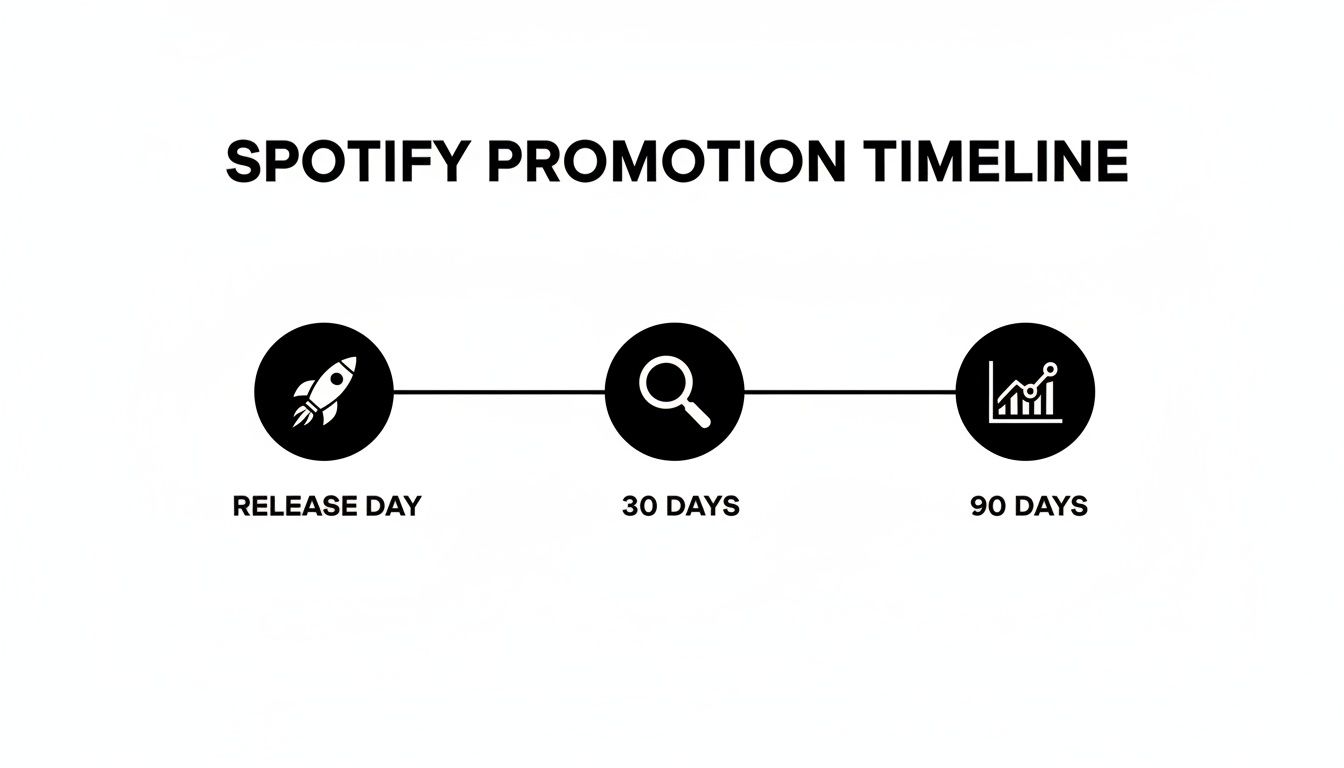
It’s a simple roadmap, but it clearly shows how those early actions directly impact your opportunities for growth down the line.
The First 60 Days: Analyze and Adapt
Okay, your track has been out for a month. By now, you’ve got some real, valuable data trickling into your Spotify for Artists dashboard. This phase is less about shouting from the rooftops and more about precision targeting. It’s time to dig in, figure out what's working, and double down on it.
Your focus shifts from launching to listening—listening to the data and your new audience.
Here’s what your second month should look like:
Dig Into the Data: Open up Spotify for Artists and become a student of your stats. Where are your listeners coming from? Which specific playlists are driving the most streams? What are your top countries and cities?
Follow Up with Curators: If a curator was cool enough to add your song, send a brief, genuine thank-you message. Building these relationships is absolute gold for your future releases.
Optimize Your Social Content: Use your listener demographics to create smarter content. Seeing a sudden spike in listeners from Brazil? Maybe try a post in Portuguese or run a geotagged ad.
Run a Small Ad Campaign: With the data you've gathered, you can now run a highly targeted ad campaign on Instagram or Facebook, sending traffic right to your Spotify track. Focus your budget on the demographics that are already digging your music.
The First 90 Days: Sustain and Plan Ahead
We're in the final phase of the initial campaign. Now it's all about sustaining the momentum you've built and using what you've learned to plan your next move. Remember, a single release is just a stepping stone, not the final destination.
The goal here is to keep your current track alive while setting the stage for what’s next.
Here’s your game plan for month three:
Pitch to New Playlists: Your song might not be "new" anymore, but it can still be a perfect fit for thousands of mood- and activity-based playlists. Keep up the outreach.
Engage New Followers: Head to the "Audience" tab in Spotify for Artists and see how many new followers you've picked up. Connect with them on social media and make them feel like part of your crew.
Share Your Wins: Post screenshots of cool playlist adds or when you hit milestones like 10,000 streams. This keeps your audience invested and shows them you're on an upward trajectory.
Plan Your Next Release: This is crucial. Use every piece of data from this campaign to inform the next one. Which genres worked best? Which curators were the most supportive? Apply these lessons to make your next launch even bigger.
By following this 90-day cycle, you can turn the overwhelming task of how to promote your music on Spotify into a manageable, repeatable process that actually leads to sustainable growth.
A Few Common Questions About Spotify Promotion
Jumping into Spotify promotion for the first time can feel like trying to navigate a new city without a map. There's a lot of jargon, a ton of conflicting advice, and it's easy to feel a bit lost. This section is all about clearing up some of the most common questions artists ask when they start taking this seriously.
Let's cut through the noise and get you some straight answers.
What’s a Realistic Budget for My First Campaign?
This is easily the question I get asked the most, and the honest answer is: it depends. There’s no magic number. Your budget really comes down to your goals and where you are in your career. A brand-new artist is going to approach this differently than an established act with a dedicated fanbase.
But if you’re just starting out and need a practical baseline for a single, here’s a pretty solid approach:
Playlist Pitching: Setting aside $100 to $300 for a platform like SubmitLink is a smart move. That kind of budget can get your music in front of a good number of legitimate, relevant curators who can provide that initial spark. It's often the most direct bang for your buck.
Social Media Ads: You don't need to break the bank here. An initial ad spend of $50 to $150 on Instagram or Facebook can make a real difference. The key is to target "lookalike" audiences of artists who sound like you—this helps drive people who are already primed to like your music straight to your Spotify profile.
The most important thing is to be intentional with your spending. Don't just light money on fire and hope for the best. Start small, watch your Spotify for Artists data like a hawk, and double down on what’s actually working.
Think of your first few campaigns as paid learning experiences. You're not just buying streams; you're buying data.
Seriously, When Will I Start to See Results?
I know you want your song to explode overnight, but real, sustainable growth on Spotify is more of a slow burn than a sudden explosion. You have to be patient.
Here’s a rough but realistic timeline of how things often play out:
The First 1-2 Weeks: This is when you'll see the immediate bump from your pre-save campaign and any early editorial looks you might have landed. It's often the biggest single jump in numbers you'll get right out of the gate.
Weeks 3-6: Now, your independent playlisting efforts should start kicking in. As different curators pick up your track and add it to their lists, you should see a more consistent, steady stream of listeners discovering your music from all sorts of places.
Months 2-3 (and beyond): This is the long game. If your track is connecting with people—meaning they're saving it, not skipping it—you might start to get a boost from Spotify's own algorithmic playlists like Discover Weekly or Radio. That’s the goal, because those placements are powered by real listener behavior and can give a song an incredibly long life.
Don't get discouraged if things feel slow at first. Focus on consistent effort and building a real audience, one listener at a time.
How Do I Actually Know if My Campaign Worked?
Success is about so much more than just a big stream count. A truly great campaign builds a foundation for your next release by growing your audience and giving you priceless data. Chasing streams for the sake of streams is a vanity game.
Instead of obsessing over the total number, keep your eyes on these metrics inside your Spotify for Artists dashboard:
Saves: This might be the single most important number. A "save" is someone adding your song to their library. It’s a massive signal to the algorithm that your music is worth hearing again. A high save-to-stream ratio is a golden ticket.
Followers: Did people actually hit the "Follow" button on your profile? This is the difference between a passive listener and a potential fan who wants to know when your next song drops.
Playlist Adds: Look at how many user-created playlists your song landed on. This is pure, organic, word-of-mouth marketing in action.
Audience Demographics: Where are your listeners? Knowing which cities and countries are digging your music is incredibly valuable for planning your next tour or targeting your next ad campaign.
Trust me, a campaign that gets you 50,000 streams and 1,000 new followers is infinitely more valuable than one that gets 100,000 empty streams and leaves you with nothing to build on.
Ready to connect with real curators and grow a genuine audience? With SubmitLink, you can pitch your music to a network of 600+ vetted playlist curators, all protected by industry-leading bot detection. Start your campaign today and get your music heard by the right people. Learn more at SubmitLink.


