.png)
A Modern Playbook to Promote Independent Music
Chasing a viral moment is a lottery ticket, not a career strategy. For the professional independent artist, success is engineered through a repeatable, data-informed system that builds scalable momentum with every release. This isn't about landing a fleeting hit; it's about architecting a sustainable, long-term business.
This guide is designed for the established artist focused on optimization. We will bypass entry-level advice to concentrate on the strategic frameworks that build a reliable promotional engine—a system that elevates your music while protecting your catalog from the bots and fraudulent services that plague the industry.
Beyond Virality: A Professional Growth Framework
A robust promotional strategy is essential for separating professional artists from hobbyists. This entire approach rests on three core pillars. Mastering these creates a foundation capable of supporting a long-term, profitable career.
The 3 Pillars of Professional Music Promotion
Think of your promotion strategy as a sophisticated business operation. Success requires a strategic integration of audience acquisition, high-level outreach, and continuous data analysis. If one component is weak, the entire system underperforms.
Here's a breakdown of the modern professional framework:
Strategic Audience Asset Development: This transcends simple engagement. The objective is to convert passive listeners on platforms like Spotify into a proprietary audience you control directly. Your email list and direct-to-fan channels are your most valuable assets, insulating you from algorithmic shifts.
Targeted Outreach & Strategic PR: Your music must reach the right industry gatekeepers. This requires diligent research to identify and pitch legitimate playlist curators, music journalists, and media outlets that align with your brand and sound. For guidance on vetting partners, refer to our analysis of the best music promotion services.
Data-Driven Optimization: Every campaign is a source of actionable intelligence. A professional artist analyzes metrics from Spotify for Artists, social media analytics, and ad campaigns to understand listener behavior. This data is the key to refining targeting, optimizing ad spend, and making informed decisions for future releases.
Let's translate this into a high-level strategic overview. Each component has a clear objective and measurable key performance indicators (KPIs).
Core Promotional Pillars for Professional Artists
Pillar | Objective | Key Metric |
|---|---|---|
Audience Development | Convert listeners into owned, monetizable community members. | Email list acquisition cost, follower-to-subscriber conversion rate. |
Targeted Outreach | Secure high-value placements with relevant curators and media. | Playlist save rate, press features from target publications, sync inquiries. |
Data Optimization | Refine strategy based on real listener behavior and ROI. | Spotify save rate, ad conversion rate, listener lifetime value (LTV). |
This table is not a checklist; it's a strategic mindset. It’s about viewing your career as a series of interconnected campaigns where each release leverages the success of the last, compounding your audience and strengthening your algorithmic positioning.
For a professional artist, growth isn't accidental—it's engineered. The objective is to create a repeatable system where each release compounds audience equity and reinforces your standing with platform algorithms.
Ultimately, this framework is about control. It’s about building assets—your mailing list, your direct-to-fan channels, your media relationships—that are immune to platform volatility. The remainder of this guide provides the actionable steps to implement this system.
Your 90-Day Release Blueprint
A release is not a one-day event; it's the culmination of a meticulously executed campaign. For any artist operating professionally, a 90-day runway is the standard for transforming a finished master into a release that strategically advances your career.
This timeline isn't about reactive tasks. It’s about strategically layering efforts—from asset creation to media pitching—so that every action builds on the last. It’s how you replace last-minute panic with calculated momentum.
This professional approach is structured in three core phases: foundation, outreach, and optimization.
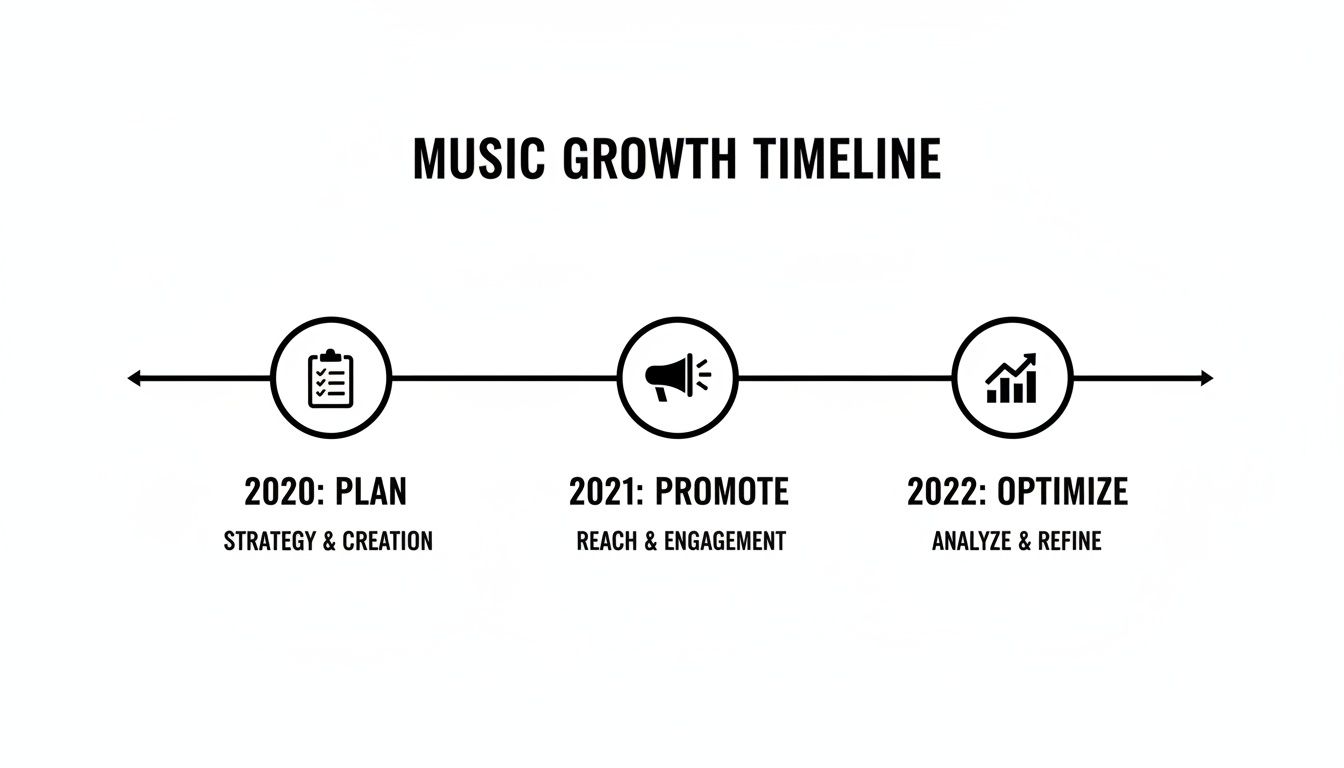
The key takeaway is that promotion is not an afterthought; it is integrated into the production lifecycle from the outset.
The Foundation Phase (90-45 Days Out)
This is where the critical, preparatory work occurs long before public announcement. The objective is simple: assemble and finalize your entire promotional toolkit. Your final masters should be approved and delivered by your engineer at the start of this phase.
With the audio locked, you will construct the entire campaign infrastructure.
Visual Identity Package: Finalize all visual assets. This includes high-resolution press photos, official cover art, and a comprehensive suite of social media graphics (banners, square posts, vertical video templates).
Distribution & Metadata: Upload your track to your distributor (e.g., DistroKid, TuneCore). Scrutinize all metadata, writer splits, and ISRC codes for accuracy. Critically, set your release date a minimum of 4-6 weeks out. This is non-negotiable for proper editorial playlist consideration.
EPK Optimization: Update your Electronic Press Kit. Integrate the narrative behind the new single, incorporate new photography, and list recent career highlights. This is your industry-facing professional resume.
This initial stage is about meticulous preparation. Having all assets finalized before the promotional push begins ensures that during the active campaign period, your focus is entirely on execution, not asset creation.
The Pitching & Outreach Phase (45-15 Days Out)
With your release scheduled and assets compiled, the outreach campaign commences. This phase is dedicated to securing placements with key gatekeepers who can amplify your track on release day.
Your highest priority in this window is submitting your song directly to Spotify's editorial team via your Spotify for Artists dashboard. While the official deadline is 7 days pre-release, the professional standard is 3-4 weeks in advance to ensure thorough consideration.
Simultaneously, you will engage other channels.
Press & Media Pitching: Compile a curated list of music blogs and publications that authentically cover your genre. A targeted, personalized approach is paramount. Send a concise, professional pitch with your updated EPK and a private listening link. Outlets plan their editorial calendars weeks in advance; this is the window to secure coverage.
Third-Party Playlist Pitching: While awaiting editorial decisions, initiate outreach to independent curators. Utilizing a vetted platform like SubmitLink connects you with credible curators managing authentic playlists, which can prime the algorithm before your release date.
Social Content Scheduling: Finalize and schedule your pre-release content calendar. Build anticipation with behind-the-scenes content, artwork reveals, and strategic track snippets to warm up your existing audience.
The Launch & Optimization Phase (Release Week & Beyond)
Release day marks the start of the optimization phase, not the end of the campaign. The first 30 days post-release are critical for capitalizing on initial momentum and leveraging real-world data to inform your strategy.
On release day, mobilize your core audience. Deploy an email campaign and social media posts driving traffic to a single, prioritized streaming link. The call-to-action is clear: stream the track, save it to their library, and add it to their personal playlists. These early user actions are powerful positive signals to the Spotify algorithm.
Following this initial push, your role shifts from promoter to analyst.
Data Analysis: Actively monitor your Spotify for Artists dashboard. Analyze stream sources, listener demographics, and playlist performance. Identify which channels are driving saves and follower conversions.
Community Management: Engage with new listeners across your social platforms. Acknowledge and share press mentions and playlist additions, and foster conversations around the new music.
Strategic Amplification: Identify high-performing placements (e.g., a playlist or blog feature driving significant traffic). Allocate a targeted ad budget to amplify this success, creating a "lookalike" audience to scale your reach. This transforms an organic win into a significant growth driver.
Mastering Spotify Playlist Promotion Safely
Spotify is not merely a music host; it is a complex ecosystem. For the professional artist, mastering this ecosystem is essential, but navigating it safely is paramount for career longevity. The playlist landscape offers immense discovery potential but is fraught with risks, including fraudulent services that can result in your music being removed or your artist profile being penalized.
The objective is not a temporary, artificial stream spike. It's to secure quality placements that provide the algorithm with positive data, enhancing your long-term discoverability. This requires a sophisticated understanding of playlist types and a rigorous vetting process for any third-party promotional service.
Differentiating Playlist Types
Not all playlists hold equal value or function. Each type serves a distinct purpose and requires a unique strategic approach. Misunderstanding these differences leads to wasted resources and can actively damage your standing on the platform.
Editorial Playlists: These are curated directly by Spotify's internal teams (e.g., Today's Top Hits, RapCaviar). Placement can be career-altering, but access is highly competitive. The sole method for consideration is a timely submission through your Spotify for Artists dashboard, ideally 3-4 weeks pre-release.
Algorithmic Playlists: These are personalized playlists generated by Spotify's algorithms (e.g., Discover Weekly, Release Radar). You cannot pitch for these directly. Placement is earned through strong user engagement signals: saves, shares, and additions to personal playlists. These playlists are the reward for a well-executed promotional strategy.
User-Generated Playlists (UGC): This is the largest and most varied category, encompassing playlists from major brands, influencers, and individual users. It's the primary domain of paid promotion services and where diligence is most critical.
For most independent artists, a strategic focus on high-quality, authentic UGC playlists is the most effective path. These placements generate the precise listener data that signals to the algorithm that your music merits broader algorithmic exposure.
Consider high-quality UGC playlists as the catalyst. They generate the initial user engagement data that signals to Spotify's algorithms, "Significant activity is occurring here." The algorithms then leverage these signals to amplify your track's reach through powerful playlists like Release Radar and Discover Weekly.
The Vetting Process for Curators and Services
The growth of independent music has spawned a parallel industry of promotional services, many of which are fraudulent. They promise high stream counts for a low fee, but often deliver bot-driven activity. This can trigger fraud detection systems at distributors like DistroKid or TuneCore, potentially leading to takedowns and frozen royalties. Protecting your catalog is a top priority.
Consider the market context: in 2025, the U.S. Independent Label Music Production industry is projected to reach $668.6 million in revenue, representing a 10.4% compound annual growth rate over five years. Sophisticated artists are leveraging vetted platforms like SubmitLink to connect with legitimate curators, bypassing the risks of artificial streams. With an average 21% share rate on such platforms, a track can achieve authentic placements that convert algorithmic discovery into sustainable growth. For more industry data, consult IBISWorld.
To protect your music, a rigorous vetting process is mandatory. For a detailed breakdown of warning signs, review our guide on how to detect fake Spotify playlists.
Vetting Playlist Promotion Services Checklist
Before allocating any budget, subject every potential service or curator to this verification protocol. This is an essential risk-mitigation strategy. Any red flag is grounds for immediate disqualification.
Verification Point | What to Look For | Red Flag |
|---|---|---|
Guaranteed Placements | Reputable services guarantee a review by curators, not a placement. They offer credits or refunds for non-responses. | Any service promising a specific number of playlists, streams, or followers for a fixed fee. This is indicative of artificial inflation. |
Curator Transparency | The platform should allow you to view curator profiles, analyze their playlists, and review performance stats before submission. | Curator identities or playlist data are obscured until after payment. Blind submission models carry a high risk of fraud. |
Stream Source Analysis | Legitimate playlists exhibit a healthy ratio of followers, saves, and monthly listeners. Tools like Chartmetric can verify this data. | A playlist shows thousands of followers with negligible saves, or its listeners are concentrated in a few obscure, irrelevant geographic locations. |
Bot Detection Integration | Premier platforms, including SubmitLink, integrate with third-party bot detection systems to continuously monitor for fraudulent activity. | The service makes no mention of bot detection or quality control measures, indicating a lack of concern for artist security. |
Ultimately, a platform engineered for artist safety internalizes this vetting process. Using a service like SubmitLink means you are not submitting into a black box. Its system matches your music with curators who have a proven history of supporting your genre, while integrated bot detection provides a critical layer of security. This transforms playlisting from a high-risk gamble into a strategic investment.
Owning Your Audience Beyond Spotify
Viewing Spotify as the final destination for your audience is a critical strategic error. While it is an unparalleled discovery engine, a sustainable music career is built on direct ownership of your fan relationships. This section moves beyond stream acquisition to focus on converting passive listeners into a loyal, monetizable fanbase.
The objective is to build a diversified ecosystem around your music, insulating your career from the volatility of a single algorithm. This requires sophisticated use of paid advertising and content strategies designed to foster genuine community.
This strategic shift is imperative. The independent artist market is projected to grow from USD 160.60 billion in 2025 to USD 170.91 billion in 2026. However, streaming growth is slowing to 6.1% as the market reaches saturation.
In response, savvy artists are diversifying revenue streams. There's a significant focus on merchandise (a market with an 8.45% CAGR) and direct-to-fan sales via platforms like Bandcamp, which allows artists to retain up to 82% of revenue. You can explore these market trends in this Mordor Intelligence report.
Precision Ad Campaigns for Fan Conversion
For a professional artist, vanity metrics like "reach" or "engagement" from paid advertising are irrelevant. The sole metric that matters is conversion. Every dollar of ad spend must be a strategic investment designed to move a listener from a rented platform (like Instagram) to an owned one (like your email list).
This is not about boosting posts for likes; it is about constructing a high-performance marketing funnel.
Optimize for Conversion Objectives: When configuring Meta (Facebook/Instagram) ad campaigns, exclusively use "Conversions" or "Leads" objectives. Avoid "Traffic." This instructs the algorithm to target users who are not just likely to click, but who are likely to complete a desired action, such as an email sign-up or purchase.
The Pixel is Non-Negotiable: Ensure your Meta Pixel is correctly installed across your website, landing pages, and merch store. This is the core of effective ad strategy, enabling you to track user actions and build high-intent retargeting audiences.
Leverage High-Value Audiences: Move beyond basic interest targeting. Create lookalike audiences based on your existing email list, website visitors, or top purchasers. You are instructing Meta to find new users who mirror the behavior of your most valuable existing fans, resulting in significantly higher conversion rates.
This methodology transforms ad spend from a speculative expense into a predictable system for audience acquisition.
Architecting Your Fan Funnel
A high-performance ad campaign is ineffective if it directs traffic to a low-value destination. Sending ad traffic directly to a Spotify profile is a common mistake; it may yield a stream but forfeits the opportunity to establish a direct, long-term relationship.
Instead, a simple, effective funnel is required. Consider this proven lead-generation model:
The Ad: A compelling 15-second video clip from your music video, optimized for Instagram Stories. The call-to-action is specific and value-driven: "Download my unreleased demo track."
The Landing Page: The ad directs users to a clean, single-purpose landing page built with a tool like Carrd or Leadpages. The page's sole function is to capture an email address in exchange for the exclusive content. All other distractions are removed.
The Follow-Up Sequence: Upon subscription, an automated email sequence is triggered. The first email delivers the promised download. Subsequent emails can share the story behind the song, offer a limited-time discount to your merch store, or provide other exclusive content.
The objective is not merely to acquire an email address; it is to initiate a relationship. By providing immediate value, you begin to build a direct connection that is infinitely more valuable than a passive Spotify follower.
This strategy requires a modest budget but yields a tangible asset: an email list of engaged fans whom you can contact directly about new music, tour dates, and merchandise, at no additional cost.
Fostering Community with Exclusive Content
Owning your audience extends beyond a simple email list. It involves creating an environment where your most dedicated supporters feel like insiders, transforming them into brand evangelists.
Platforms like Patreon or even an Instagram "close friends" list are ideal for this.
Tiered Access Models: Offer varying levels of access. A lower tier might provide entry to a private Discord server and pre-sale ticket access. A higher tier could include exclusive Q&A sessions, behind-the-scenes content, or personalized interactions.
Strategic Direct-to-Fan Sales: Utilize Bandcamp for high-impact drops. Leverage events like "Bandcamp Fridays" to release limited-edition vinyl, exclusive EPs, or unique merchandise. This creates scarcity and urgency, driving sales directly to you and maximizing your revenue share.
These methods construct a financial model that complements streaming income, enhancing your career's resilience. By nurturing a core group of superfans, you insulate yourself from algorithmic volatility and build a foundation for long-term success. For more platform options, review our guide on the 12 best sites to promote music for independent artists in 2026.
Amplifying Reach with Strategic PR and Sync
Playlisting and paid advertising are effective for audience acquisition, but they are only two components of a comprehensive strategy. To build true cultural capital—the kind that elevates you from a playlist entry to a recognized artist—you must engage in strategic PR and sync licensing.
This is how you solidify your professional narrative, secure meaningful press coverage, and place your music in film, television, and video games. This is not about vanity metrics; it's a significant investment in your brand's legitimacy that unlocks new audiences and revenue streams. The foundation for all of this is a compelling, professionally articulated story.
Crafting a Compelling Electronic Press Kit
Your Electronic Press Kit (EPK) is your professional calling card. It is the first point of contact for time-constrained journalists, music supervisors, and industry professionals. A generic or poorly assembled EPK will be discarded immediately. A polished, professional EPK signals that you are a serious artist.
Your EPK must be concise, visually appealing, and provide all necessary information efficiently.
Your Narrative: A brief, compelling bio is essential. Go beyond a list of accomplishments to tell your unique story and articulate your artistic mission.
Professional Assets: Include a curated gallery of high-resolution press photos (both landscape and portrait orientations) and your cover art. Ensure these assets are easily downloadable.
The Music: Embed your latest work prominently, with direct links to Spotify and other DSPs. For sync pitching, it is imperative to include private links for high-quality downloads (WAV format only).
Key Info & Links: Conclude with a list of career highlights, recent press mentions, and links to your social media, website, and Spotify for Artists profile.
Your EPK is the gateway to every external opportunity. It must be impeccable.
Identifying and Pitching the Right Media
A "shotgun" approach of mass-emailing generic pitches to hundreds of blogs is ineffective and unprofessional. Strategic success lies in targeted outreach and building genuine relationships with writers who cover your specific niche.
Begin by compiling a highly curated list of publications that align with your genre. Pitching a metal band to a pop blog demonstrates a lack of research. In contrast, a well-crafted pitch to a relevant outlet shows professionalism and respect for the journalist's time.
A personalized pitch to ten relevant, niche outlets will consistently outperform a generic blast to one hundred major publications. Journalists and editors can immediately identify form letters, which are promptly deleted.
When pitching, be brief and direct. Introduce yourself, provide a compelling one-sentence description of your music, and link to your EPK and a private stream. This level of professionalism is what cuts through the overwhelming noise of an editor's inbox.
Navigating the World of Sync Licensing
Sync licensing—the placement of your music in visual media—is a powerful promotional tool and a critical revenue stream. The data is clear: in 2023, the independent music publishing sector reached a global value of €2.57 billion, marking a 5.7% increase and capturing a 26.3% market share, making it the largest single publishing entity globally.
This growth, fueled largely by streaming and media placements, underscores the significant financial potential when you control your rights. You can explore the data in the IMPF Global Market View report.
To be considered for sync opportunities, your music must be "sync-ready." This is non-negotiable.
High-Quality Masters & Instrumentals: You must have the full WAV file of your track and, crucially, an instrumental version. Music supervisors almost always require instrumentals to avoid conflicts with on-screen dialogue.
Clear Ownership: You must control 100% of both the master recording and the publishing rights. If co-writers or producers are involved, clear, documented agreements are essential. Any ambiguity in ownership will nullify a potential deal.
PRO Registration: Your compositions must be registered with a Performing Rights Organization (PRO) like ASCAP, BMI, or SESAC. This infrastructure ensures you are paid royalties for broadcast usage.
You can engage with music supervisors through sync agencies, music libraries, or industry networking. The key is to have your catalog meticulously organized, cleared, and ready for immediate delivery. When a supervisor is on a tight deadline, the artist who is most prepared secures the placement.
Your Top Questions Answered
Building a career as an independent artist requires navigating complex business decisions alongside creative pursuits. This section addresses key strategic questions that distinguish professional artists from hobbyists.
We are moving beyond basic promotion to discuss intelligent capital allocation, meaningful data interpretation, and strategic long-term planning.
What’s a Realistic Budget for a Single Release?
There is no single magic number, but a budget without a clear strategy is wasted capital. A more effective approach is to structure your budget in tiers, with every dollar allocated to a specific, measurable objective.
A reasonable starting budget for a professional single campaign typically falls between $500 and $1,500. The allocation of these funds is critical:
Playlist Pitching (~40%): A significant portion of your budget should be invested in a legitimate playlisting service like SubmitLink. The goal is not merely to accumulate streams but to feed the Spotify algorithm positive, early data from authentic listeners, thereby priming it for algorithmic discovery.
Content & Ads (~50%): This allocation covers visual asset creation (short-form video for TikTok and Instagram) and targeted advertising. Critically, ad campaigns must be optimized for conversions, such as driving email list sign-ups or track saves, rather than generic "exposure."
Contingency Fund (~10%): Always maintain a discretionary fund. This allows you to capitalize on unforeseen opportunities, such as amplifying a social post that gains organic traction or boosting an unexpected press feature.
Structuring your budget this way transforms it from a speculative expense into a strategic tool for measurable audience growth.
How Do I Know if My Campaign Is Actually Working?
Disregard vanity metrics. A high stream count is meaningless without genuine fan conversion. To accurately assess campaign success, analyze the key performance indicators (KPIs) within your Spotify for Artists dashboard that reflect true engagement.
Focus on these three critical metrics:
Save Rate: This is the percentage of listeners who save your song to their library. A save rate of 15-20% or higher is a powerful positive signal to the Spotify algorithm, indicating high user affinity.
Listener-to-Follower Conversion: This metric measures your ability to convert passive listeners into active followers of your artist profile. It differentiates between background listening and genuine fan connection.
Source of Streams: A healthy release will show a diversified stream source profile, including your artist profile, listener playlists, and algorithmic playlists like Release Radar. Over-reliance on a single third-party playlist can be an indicator of low-quality or fraudulent traffic.
A high stream count paired with a low save rate is the classic sign of a failed campaign. It indicates you paid for plays, not fans. True success is measured by the audience you build, not the numbers you rent.
When Should I Hire a Publicist?
Engaging a publicist is a significant strategic investment, typically costing $2,000 to $5,000+ for a single campaign. This investment is justified only when you have a genuinely newsworthy event or narrative. A publicist can leverage an existing story but cannot create one from nothing.
Do not consider hiring a publicist until you meet the following criteria:
You Have a Compelling Narrative: This could be a new album release, a high-profile collaboration, a major tour announcement, or a unique angle that differentiates you. "I released a new song" is not a sufficient story for a PR campaign.
Your Assets are Professional-Grade: Your EPK must be polished, your press photos must be high-resolution and on-brand, and your online presence must be cohesive. A publicist requires professional tools to be effective.
You Have Existing Momentum: You have already laid the groundwork. You have an engaged, if small, audience and data to prove that your music is resonating.
A publicist amplifies existing momentum, securing press coverage that builds credibility. Approaching one without these foundational elements in place is a premature and inefficient use of capital.
Ready to promote your music with confidence? SubmitLink connects you with a network of verified playlist curators, all protected by industry-leading bot detection. Stop gambling on risky promo and start investing in real, sustainable growth. Find the perfect playlists for your music on submitlink.io.


