.png)
How to Create an EPK That Optimizes Your Professional Reach
An Electronic Press Kit (EPK) is the central pillar of your professional brand, a curated digital dossier designed for high-level industry communication. It's the synthesis of your artistic narrative, premier tracks, brand-aligned visuals, and critical acclaim, consolidated into a single, strategic asset. The objective is to provide industry decision-makers—A&R executives, booking agents, playlist curators, and journalists—with an immediate and comprehensive understanding of your project's value and momentum.
Why a Refined EPK is Your Most Critical Business Asset

In the music business, your EPK transcends being a mere resume. It's your digital handshake, the first point of contact that establishes the tone for every professional engagement. For the established artist, it is the single most important tool for brand management and narrative control.
You cannot afford to have key industry players piecing together a perception of your career from a fragmented trail of social media activity and outdated press. When they are forced to conduct their own research, you cede control of the narrative, resulting in an often incomplete or inaccurate representation of your brand.
Control the Narrative and Project Professionalism
A strategically constructed EPK places you firmly in command. It functions as the single source of truth for your music, enabling you to meticulously shape how you are perceived. By curating every photograph, quote, and audio file, you ensure that anyone evaluating your project sees your career through your intended lens.
This is a strategic imperative that achieves several critical objectives:
It demonstrates industry fluency. A sophisticated EPK signals that you understand and respect industry protocols and operate with professional efficiency.
It builds immediate credibility. Leading with significant achievements—a sold-out tour, a high-profile review, a major playlist placement—instantly positions you as an artist with tangible momentum.
It streamlines their workflow. Industry professionals are time-poor. An EPK that provides all necessary assets in one accessible location makes their decision-making process faster and simpler.
A disorganized press kit is a significant liability. It implicitly suggests operational inefficiency. Your EPK is the first opportunity to prove you are a reliable and professional partner.
The Modern Standard for Industry Outreach
The era of physical press packages is over. The digital EPK is not a trend; it is the undisputed industry standard, valued for its efficiency and accessibility.
Digital EPKs are now leveraged in over 90% of music industry pitches. This shift has been shown to boost response rates by as much as 45%, as the information is immediate, interactive, and perpetually current. You can read more about how EPKs have transformed industry communication.
Your EPK must function as more than a cloud storage folder; it must be a dynamic, persuasive pitch—an integral component of any modern music marketing strategy for independent artists serious about scaling their career.
Ultimately, knowing how to create an EPK is non-negotiable. It’s not simply about showcasing your music; it's about presenting a powerful business case for why your artistic enterprise warrants attention and investment.
Assembling the Core Components of Your EPK
Constructing an EPK is an exercise in strategic curation. Every element included must contribute to a compelling narrative of your momentum, quality, and market viability. This is your opportunity to control the story, presenting a polished and intentional package rather than leaving a booker or A&R executive to assemble a fragmented view of your career. Let's move beyond foundational advice and focus on optimizing the core elements that drive industry engagement.
Write a Bio That Functions as an Executive Summary
Your artist bio anchors the EPK's narrative, but it is not a sentimental origin story. Industry professionals require a concise, achievement-focused summary that establishes your credibility and market position immediately. Think of it less as a biography and more as an executive summary of your current career trajectory. The goal is to articulate your unique value proposition and proven track record with maximum efficiency.
A high-impact bio should include:
The Hook: Lead with your single most impressive accomplishment—a major festival performance, a notable collaboration, or a significant critical review.
The Proof: Substantiate your claims with tangible metrics and milestones, such as key playlist placements, sync licenses, or sold-out performances.
The Sound: Succinctly define your musical identity in a way that is both evocative and clearly positions you within the market, avoiding generic clichés.
It is advisable to maintain two versions: a concise paragraph for initial outreach and a more detailed version (approximately 250-300 words) for deeper engagement. This flexibility ensures you are prepared for any context.
Curate Your Music Like a Bespoke Pitch
The music section is the centerpiece of your EPK, and strategic selection is paramount. Presenting an entire album is a tactical error. A busy professional will likely grant you only the first 30 seconds of one track to capture their interest. Therefore, lead with your most potent asset—your primary single or the track that best represents your current sonic direction. Do not make them search for the standout.
A strategic approach includes:
Select 3-4 “Hero” Tracks: These must be your strongest, most polished songs, professionally mixed and mastered. For sync pitching, ensure instrumental versions are available.
Add Strategic Context: Briefly annotate each track, noting any significant playlist features, press accolades, or streaming velocity.
Ensure Seamless Playback: Utilize a clean, embedded player from a platform like SoundCloud or your own website. Forcing a download is a critical misstep.
Your EPK is not a discography; it's a highlight reel. Presenting only your elite tracks creates an impression of consistent quality and simplifies the path to a positive decision.
Use Press Photos and Quotes to Build Credibility
Your visual assets establish your brand identity before a note is played. Low-quality or outdated press photos can instantly devalue an otherwise strong pitch. Investing in a professional photoshoot that yields a versatile portfolio of high-resolution images is a non-negotiable aspect of brand management.
Provide a range of options to meet diverse media needs:
Headshots: Professional, high-quality portraits.
Live Shots: Dynamic images that capture your stage presence.
Artistic/Promotional Shots: Stylized photos that convey your unique brand aesthetic.
Ensure all images are easily downloadable in both high-resolution (for print) and low-resolution (for web) formats.
Press quotes serve as essential social proof, providing third-party validation of your work. Do not simply link to articles. Extract the most impactful sentence from a review and feature it prominently, with clear attribution to the publication. This guarantees your strongest endorsements are seen immediately.
The One-Sheet: Your Executive Briefing
For the time-constrained industry professional, the one-sheet is often the most valuable component of an EPK. This single, well-designed document (typically a PDF) summarizes your entire project at a glance, functioning as the ultimate executive briefing.
This table provides a blueprint for assembling your core assets.
EPK Component Checklist for Professional Artists
Component | Primary Goal | Key Content |
|---|---|---|
Artist Bio | Quickly establish credibility and professional standing. | Hook (biggest achievement), key milestones (placements, tours), and a concise description of your sound. |
Curated Music | Showcase your best work and make an immediate impact. | 3-4 "hero" tracks (professionally mixed/mastered), context for each song (streams, press), and an embedded player. |
Press Photos | Provide high-quality, professional visuals for any use. | A mix of headshots, live shots, and artistic photos, available in both high-res and low-res formats. |
Press & Quotes | Leverage third-party validation to build trust. | The most impactful pull-quotes from reviews and articles, with clear attribution. |
The One-Sheet | Deliver all essential information in a single, digestible page. | Key stats (streams, followers), recent wins (last 6-12 months), short bio, and primary contact info. |
A one-sheet condenses your most critical selling points into a single page, facilitating rapid assessment.
Your one-sheet should distill the most potent information from your full EPK:
Key Stats: Your most impressive streaming data, social media metrics, and audience engagement rates.
Recent Wins: Major achievements from the last 6-12 months, such as playlist additions, press features, or a successful tour.
Short Bio: The concise, single-paragraph bio optimized for impact.
Contact Info: Clear details for your manager, booking agent, or primary point of contact.
This document is ideal for in-person meetings or as a direct email attachment, demonstrating respect for the recipient's time and a high level of organization. As you master how to create an EPK that connects, the one-sheet becomes an indispensable tool.
Weaving Your Story with Data and Social Proof
Your music communicates your creative vision; your data communicates your business viability. For industry professionals, data is not a dry collection of statistics—it is tangible proof of market traction and audience engagement, signaling a sound investment. This section is where your EPK transitions from a creative portfolio into a compelling business proposal, demonstrating to gatekeepers that you have a pre-existing and attentive audience.
A booking agent or label A&R is not merely seeking talent; they are seeking artists who have already demonstrated an ability to connect with an audience. Your objective is to make this connection undeniable.
Frame Your Metrics as Career Momentum
The presentation of your data is as crucial as the data itself. A simple list of figures lacks impact. The key is to add context, transforming each metric into a headline that communicates forward momentum.
For instance, do not simply state:
"500,000 Spotify streams"
Instead, frame it as:
"Proven listener appeal with over half a million organic streams on our latest single."
This subtle linguistic shift reframes the narrative from a static number to a proof of concept. This principle should be applied to all key performance indicators.
Social Media: Instead of "15K Instagram followers," use "Highly engaged fanbase with over 15,000 followers and an average post engagement rate of 8%."
Live Shows: Elevate "Played 20 shows last year" to "Established live draw with a track record of sold-out shows in key regional markets."
This approach demonstrates not just your achievements, but your understanding of their strategic importance, positioning you as a business partner.
Choosing the Right Data to Showcase
Not all metrics warrant inclusion. The goal is to curate a snapshot of your most impressive achievements, not to overwhelm the reader with an exhaustive list of data points. An excess of information dilutes the impact of your strongest selling points.
Focus on the data that directly supports your objective. When pitching a booking agent, your live performance statistics are paramount. When targeting a playlist, streaming velocity and listener demographics are the critical metrics.
Highlighting key social metrics can lead to 35% more media pickups in major markets. These numbers offer concrete evidence of an existing audience, which is a powerful incentive for journalists and promoters.
Lead with your most significant achievements—high-volume streaming numbers, a notable festival performance, a sold-out tour. Presenting these metrics with clean, simple icons can improve information retention by as much as 50% for a busy professional.
Go Beyond Streams and Follower Counts
While Spotify streams and social media followers are foundational metrics, they represent only a fraction of the full picture. To build an irrefutable business case, incorporate data that demonstrates deeper audience connection and professional validation.
Consider adding these powerful data points to your EPK:
Audience Demographics: Include screenshots from your Spotify for Artists or social media analytics, highlighting top listener cities, age ranges, and gender breakdown. This is invaluable data for a promoter planning a tour or a label assessing market potential.
Playlist Placements: Quantify the impact of your playlist features. Mentioning the follower count, such as "Featured on Spotify's 'Indie Chill' editorial playlist (1.2M followers)," immediately conveys the scale of your reach. Honing this skill through a strategic playbook for acquiring Spotify followers can yield significant results.
Press Mentions & Radio Play: Name-drop reputable blogs, magazines, or radio stations that have featured your music. This third-party validation serves as powerful social proof, building immediate credibility.
By weaving these diverse metrics together, you present a holistic view of your project's health and potential. You are no longer just an artist with quality songs; you are a growing brand with a proven, engaged audience—a narrative that opens doors.
Choosing the Right Format for Your EPK
The format of your EPK communicates a message about your professionalism before any content is consumed. A clumsy or disorganized presentation can undermine the most impressive achievements. For established artists, the choice is typically between a dedicated, private page on your official website or a professionally designed PDF.
Each format offers distinct strategic advantages, and the optimal choice depends on your target and objective. This is not merely a technical decision but a branding one that shapes the recipient's entire experience.
The Website EPK: Total Control and Live Updates
Hosting your EPK on a private page of your official website (e.g., ) is the industry gold standard. This approach affords you complete control over your brand narrative and keeps industry professionals within your digital ecosystem.
It allows for the direct embedding of streaming players and high-quality video, creating a seamless and engaging user experience. Professionals prefer not to download files unless absolutely necessary.
Furthermore, a website EPK is a dynamic asset. You can update streaming metrics, add a new press quote, or feature a new single in real-time. This agility is crucial for capitalizing on recent momentum. The primary limitation is that a webpage cannot be attached to an email, which can be a minor point of friction for stakeholders who prefer to archive files locally.
The PDF EPK: Portable and Direct
A polished PDF serves as the modern equivalent of the classic one-sheet, valued for its portability and versatility. It can be attached directly to an email, making it easy for a festival buyer or music journalist to save, print, or share with their team.
A PDF functions as a self-contained snapshot of your career at a specific moment, ideal for targeted pitches where you need to present a concise set of information without external distractions.
The trade-off for a PDF's portability is its static nature. Once sent, it cannot be updated. If your Spotify streams increase significantly, the version in a promoter's inbox is instantly outdated. In a competitive environment, such details can be consequential.
Design and Tech Specs That Actually Matter
Regardless of format, the design must be clean, professional, and consistent with your brand identity. This is a business tool; prioritize readability and fast load times.
Key technical specifications include:
Image Files: Provide both high-resolution (300 DPI, for print) and web-optimized (72 DPI, for digital) versions of your press photos. Use clear, descriptive file names (e.g., ).
Audio Files: Never attach audio files to an email. Use embedded players from SoundCloud or Spotify. If a download is required, provide a private link to a high-quality MP3 (320 kbps) or WAV file.
File Sizes: Maintain a small total file size. A PDF should not exceed 10MB. For larger collections of assets, link to a cloud folder on Dropbox or Google Drive.
This flowchart can help you decide which data points to lead with.
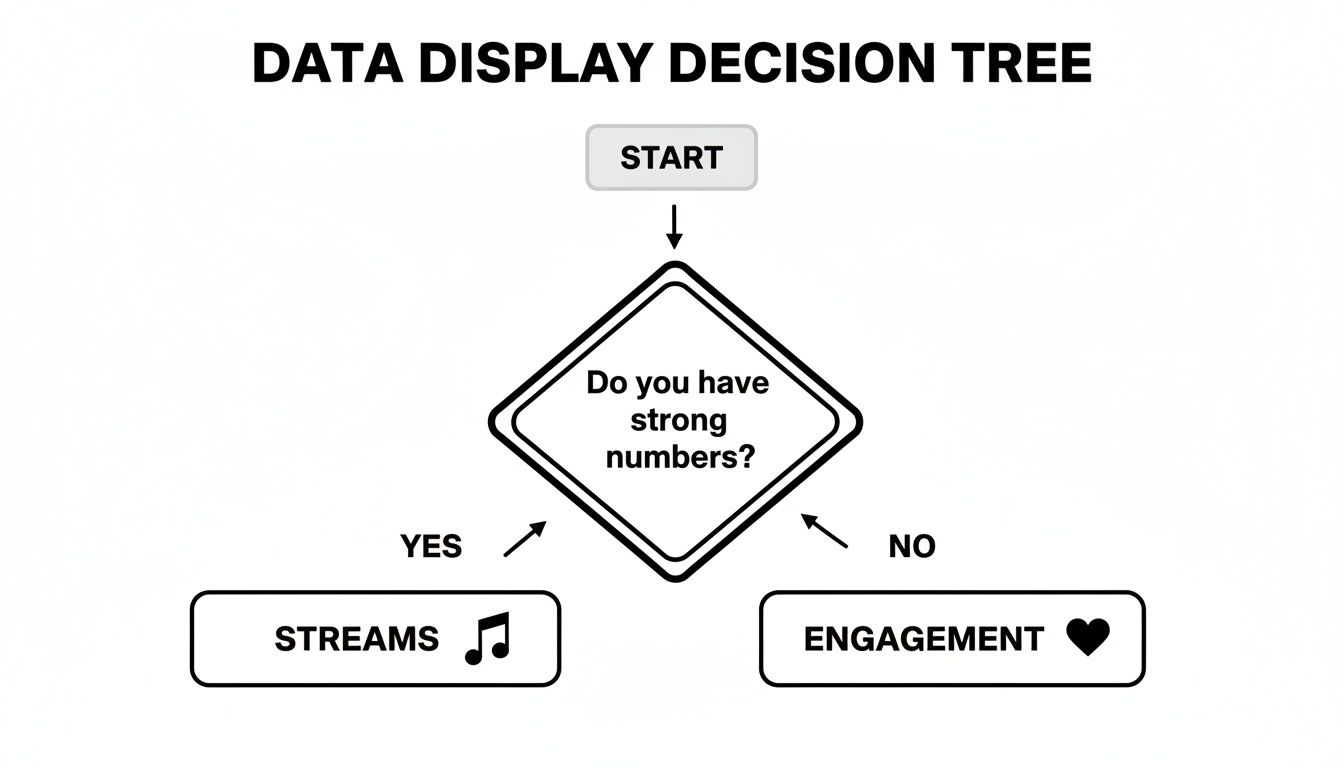
Ultimately, you must lead with your strengths, whether that is quantitative data or qualitative evidence of audience engagement.
The optimal strategy is often a hybrid approach. Maintain a comprehensive website EPK as your central information hub. Then, create a streamlined, one-page PDF version for use as a powerful attachment in initial outreach. This provides both brand control and tactical flexibility.
Tailoring Your EPK for Different Opportunities

Your primary EPK should be considered a master file, a foundation from which tailored versions are created. Distributing a generic, one-size-fits-all document is a common tactical error.
Different industry verticals have distinct priorities. Astute artists maintain a core press kit but customize it for high-value targets. This demonstrates diligence and a respect for the recipient's specific needs. A booking agent's primary concern is ticket sales, not streaming numbers. Conversely, a playlist curator is focused on listener engagement metrics, not your technical rider.
Customizing for Playlist Curators
When pursuing playlist placements, your EPK must unequivocally demonstrate listener engagement. A curator's primary objective is to maintain audience retention. Your task is to provide quantitative proof that your track will achieve this goal.
Optimize your EPK for curators by:
Leading with Key Metrics: Position your most impressive streaming data—monthly listeners, total streams for a focus track, and save rates—prominently at the top.
Highlighting Past Successes: List previous significant playlist placements, including Spotify editorial, major user-generated lists, or influential independent curations. Note their follower counts to provide immediate context.
Sharing Audience Data: A concise screenshot from your Spotify for Artists profile showing listener locations and demographics is invaluable. It helps the curator assess alignment with their audience.
In 2026, this data-driven approach is critical. With an oversaturation of music on DSPs, curators rely on metrics to filter submissions. Industry analysis shows that EPKs citing concrete data—such as '500K+ total streams' or placement on a 'Top 10 Spotify Editorial Playlist'—receive significantly more consideration. You can discover more insights about EPK strategies for 2026 on artistrack.com.
Adapting for Booking Agents and Venues
When securing live performances, digital streaming data is secondary. The sole focus is your ability to draw a physical audience. A booking agent is making a financial investment in your performance; your EPK must de-risk that decision.
Shift your focus to these essentials:
Include High-Quality Live Video: This is non-negotiable. Embed a professionally shot video of a performance to an engaged audience, showcasing your stage presence and energy.
Provide Ticket Sales Data: If you have a history of performing in a specific market, include any available data on ticket sales or attendance. Hard numbers are more persuasive than abstract claims.
Feature Live-Focused Press Quotes: Select reviews that specifically praise your stage presence, audience connection, or the energy of your live show.
A booking agent is focused on one primary outcome: revenue generation. Your EPK must function as a business proposal that proves booking you is a financially sound decision that will sell tickets.
For artists seeking to refine their playlisting strategy, our guide on how to submit music to Spotify playlists and get heard provides advanced insights.
Creating a System for Regular Updates
An EPK's value is directly tied to its currency. Outdated information suggests a loss of momentum or a lack of professionalism. The solution is to implement a systematic update protocol.
A quarterly review of your master EPK is a recommended baseline. However, immediate updates should follow any significant career development.
Update your kit upon the occurrence of any of the following:
Publication of a significant review or press feature.
Placement on a major playlist.
Positive traction for a new single or album.
A sold-out show or the conclusion of a successful tour.
Treat your EPK as a living document that evolves with your career. This discipline ensures you are always prepared to capitalize on new opportunities with a polished, relevant, and powerful asset.
Answering Your Biggest EPK Questions
Even for seasoned artists, optimizing an EPK involves nuanced strategic decisions. Once the core components are in place, refinement is key to ensuring your press kit effectively supports your career objectives. Let's address some of the most common questions from professional musicians focused on elevating their EPK from functional to exceptional.
These are not foundational queries but rather points of strategic optimization for booking superior tours, securing high-profile features, or engaging A&R executives.
Should I Host My EPK on My Website or Use a Dedicated Service?
For a professional artist, your own website is unequivocally the superior choice. Self-hosting provides complete brand control and directs valuable industry traffic to your primary digital hub. A clean, unlisted page (e.g., ) presents a professional image and allows for immediate updates.
While dedicated EPK services can serve as an entry point, their branded URLs and templated designs can appear amateurish at a professional level. The goal is a seamless brand experience, which is best achieved through your own domain.
Your EPK isn't just a folder of files; it's a direct reflection of your brand. Hosting it on your own site sends a clear message: you’re in control of your career and your digital presence. That speaks volumes about your professionalism.
When a booking agent or music supervisor lands on your EPK, they should be immersed in your brand world, not on a third-party platform.
How Often Should I Update My EPK?
Your EPK should be treated as a dynamic document. A quarterly audit is a sound practice, but updates should be executed the instant a significant career event occurs. This ensures you are always positioned to capitalize on new momentum.
Update your EPK immediately following:
A new high-profile press feature or review.
A major playlist addition that is driving streams.
A new single that is gaining traction.
Confirmation of a new agent, manager, or label partnership.
The two most critical elements to keep current are your streaming data and your recent news. Stagnant metrics can imply a stalled career—a perception you must avoid at all costs.
What’s the Biggest Mistake Artists Make With Their EPK?
By far, the most common and damaging mistake is information overload. Industry gatekeepers are time-deficient. They will not sift through multiple bios or an entire album to identify your key assets. Your responsibility is to streamline their path to a "yes."
An effective EPK does not merely present information; it directs attention. Lead with your most compelling material. Your strongest track, most impressive statistic, and most impactful press quote must be positioned for immediate visibility.
This curated, top-down approach demonstrates respect for their time and, crucially, an understanding of how to construct a compelling business case for your music.
Ready to place your music with premier curators? SubmitLink connects you to a vetted network of playlist professionals actively seeking new music. Our platform enables targeted submissions and protects against fraudulent streams, ensuring your growth is authentic and sustainable. Find your next big playlist placement on submitlink.io.


