.png)
Getting on spotify playlists: Proven strategies to grow your listeners
- Dec 30, 2025
- 17 min read
So, you've poured your heart and soul into a new track. The mix is perfect, the master is punchy, and you're ready for the world to hear it. Now what? Getting your music onto Spotify playlists isn't just a "nice to have" anymore—it's a critical part of breaking through the noise.
Let's be real about the numbers for a second. Back in 2017, artists were competing with about 20,000 new tracks uploaded every single day. Fast forward to 2025, and that number has skyrocketed to an estimated 153,000 tracks per day. That's a mind-boggling 666.7% increase. A great song alone just won't cut it.
This playbook isn't about generic advice; it's a modern framework designed to get you real results. Forget chasing a single Hail Mary placement. A truly effective strategy is about understanding the Spotify ecosystem and hitting it from three different angles at once.
The Three Paths to Spotify Playlist Placement
Think of the playlist landscape as having three main roads you can travel. Each one leads to a different kind of listener and requires its own unique map to navigate. Knowing which path to take, and when, is the first step toward building a campaign that actually works.
To make this crystal clear, here’s a quick breakdown of the three types of playlists you’ll be targeting.
Playlist Type | Who Controls It? | Primary Strategy | Potential Impact |
|---|---|---|---|
Editorial | Spotify's official editors | Direct pitching via Spotify for Artists (pre-release) | Massive, immediate stream/follower spike |
Algorithmic | Spotify's algorithm | Generating positive listener data (saves, shares, playlist adds) | Sustainable, long-term organic growth |
Independent | Bloggers, influencers, fans | Direct outreach, curator platforms | Builds initial momentum, sends signals to the algorithm |
Mastering these three pillars gives you multiple ways for listeners to discover your music, moving beyond just hoping for a lucky break.
Why This Three-Pronged Attack Works
The real magic happens when you get these three playlist types working together.
Editorial Playlists: These are the holy grail, curated directly by Spotify's team. A spot on a list like New Music Friday or Lorem can deliver a huge, immediate audience.
Algorithmic Playlists: Think Discover Weekly and Release Radar. These are your engine for steady, organic growth, automatically serving your music to listeners who are likely to love it based on their habits.
Independent Playlists: Run by everyone from major music blogs to dedicated fans, these are absolutely essential for building that initial buzz. They send all the right signals to Spotify’s algorithm.
The secret to long-term success isn't just one big editorial win. It's about using independent playlists to generate the listener data that triggers algorithmic playlists, creating a self-sustaining cycle of discovery.
Your home base for all of this is your Spotify for Artists dashboard. It's where you'll pitch your unreleased music directly to editors and track how your songs are performing across the entire platform.

By understanding how editorial, algorithmic, and independent playlists feed into one another, you're no longer just releasing a song—you're launching a campaign. This guide will walk you through exactly how to do it.
Getting Your Music Ready for the Perfect Playlist Pitch
Before you even dream of hitting ‘send’ on a pitch, you need to get your house in order. Think of it like a pre-flight check for your music career. Making a killer first impression is everything, and that work starts long before you try to get a curator's attention.
A polished track and a professional profile aren't just minor details; they're the bedrock of your entire campaign. Curators, whether they're at Spotify or running their own independent playlists, are looking for artists who take their craft seriously. A sloppy profile or a muddy mix screams "amateur," and that can close the door before you've even had a chance to say hello.
Nail Your Digital First Impression
Your Spotify for Artists profile is your digital storefront, your press kit, and your artist portfolio all rolled into one. The moment a curator is even remotely interested in your track, the very next thing they'll do is click over to your profile. It has to look professional, tell your story, and feel alive.
Make sure these pieces are locked down and looking sharp:
Pro-Level Visuals: Ditch the blurry phone pics. Use high-resolution, professional photos for your profile and header images. The visuals should feel like they belong to the music.
A Bio That Connects: You've got 1,500 characters to tell your story. Don't just list your accomplishments. Talk about your influences, what drives you to create, and what makes your sound unique. Give them something to connect with.
Connect Your World: Add your social media links and official website. This gives curators and potential new fans an easy way to dive deeper into who you are.
Show You're Active with an 'Artist Pick': This is a simple but powerful tool. Use it to pin your new single, an album you're proud of, or a playlist of tunes that inspired you. It proves you're engaged and invested in the platform.
A profile that looks like you care tells curators that you’re serious, which makes them much more likely to take a chance on your music.
Is Your Track Truly Ready?
This might sound like a no-brainer, but it's where so many artists stumble. Your music has to sound like it belongs on the radio or a major playlist, even if you’re just starting out. That means one thing: a proper mix and master is non-negotiable.
Mixing is the art of making sure every part of your song—the vocals, the bass, the synths—has its own space and works together perfectly. Mastering is that final coat of paint, making sure your track is loud enough and tonally balanced to stand right next to a song from a major-label artist. If your track is noticeably quieter or thinner than everything else on a playlist, listeners will hit skip without a second thought.
Your job is to make it incredibly easy for a curator to say "yes." A professionally mastered track that sounds seamless next to other big songs removes one of the biggest reasons they might pass.
The All-Important Pre-Release Timeline
When it comes to Spotify playlists, especially the big editorial ones, timing is absolutely everything. You need to get your music delivered to Spotify via your distributor and then pitched through your Spotify for Artists dashboard at least four weeks before your release date.
Seriously, don't mess with this timeline. It gives Spotify's team of editors enough breathing room to actually listen to your song, see where it might fit, and schedule it if they like what they hear.
Following this schedule also does something else crucial: it helps guarantee your track lands on your followers' Release Radar playlists. Giving Spotify that heads-up ensures that on day one, your core fans will get your new music delivered directly to them, sparking that initial wave of streams.
When you fill out the pitch form in Spotify for Artists, take your time. Be thoughtful with your genre, mood, and instrument tags. In the description box, tell the story behind the song. Do you have a music video planned? A PR campaign? Let them know. This is your one shot to speak directly to an editor—make it count.
Mastering the Art of Curator Outreach
Alright, your track is mixed and mastered, and your Spotify profile looks sharp. You've done the prep work. Now it's time to tackle the most human part of the equation: connecting with independent playlist curators.
This is where the real hustle begins. It's less about a numbers game and more about building genuine connections with people who are just as passionate about music discovery as you are about creating it. Forget about spamming a generic email to a hundred random people. The goal here is to make it incredibly easy for the right person to hear your track and say, "Yes, this fits."
This whole process really boils down to three key stages: polishing your music, optimizing your presence, and then—and only then—pitching your track.
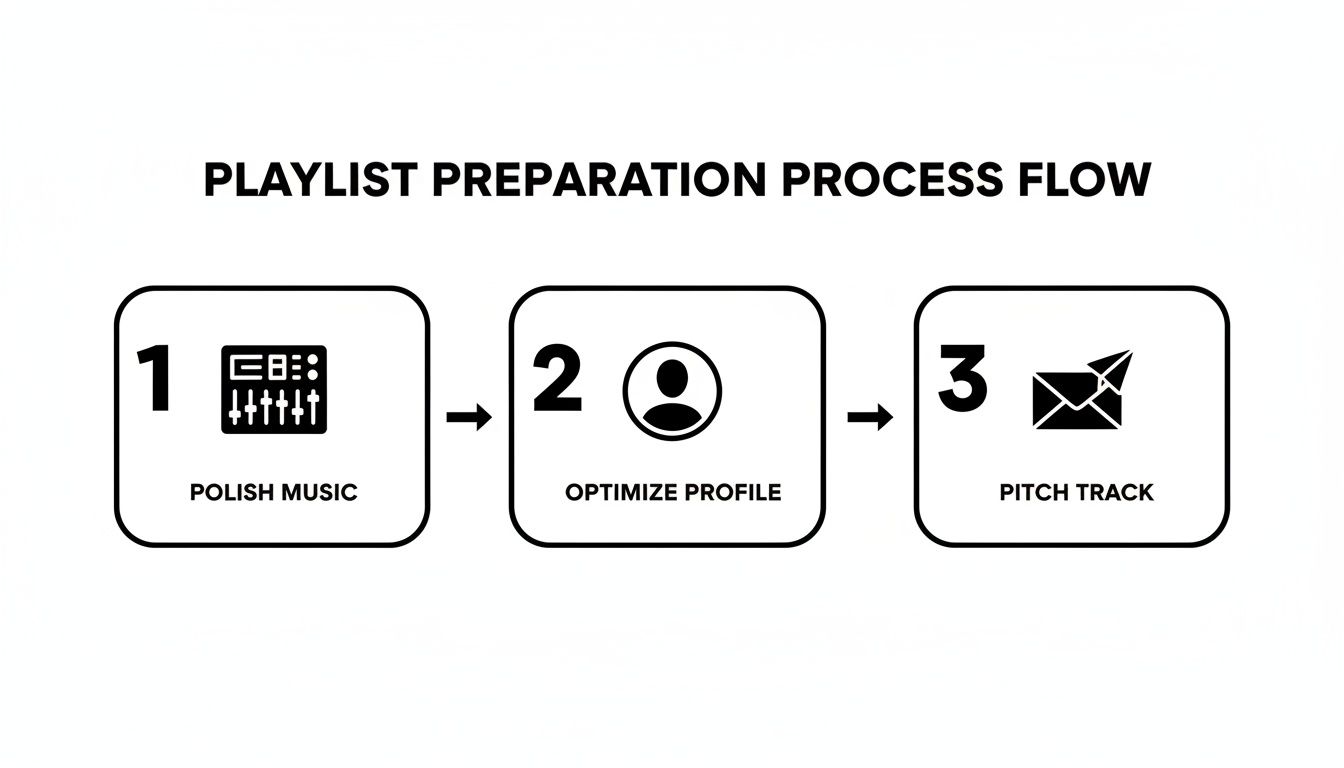
As you can see, outreach is the final piece of the puzzle. Skipping the first two steps is like trying to build a house without a foundation—it just won't hold up.
Finding Playlists That Actually Matter
First things first, you need to find playlists where your music will feel at home. A placement on a niche playlist with 500 highly engaged followers is infinitely more valuable than getting lost on a generic list with 50,000 passive listeners. Why? Because real engagement is the currency that Spotify’s algorithm understands and rewards.
So, where do you find these curators?
Go digging on Spotify. This is your ground zero. Start searching for keywords related to your genre, mood, or artists you sound like. Think "Chill Lofi Beats" or "Indie Summer Road Trip." Pay close attention to playlists created by actual people, not just the big Spotify-branded ones.
Check the "Discovered On" section. This is a pro move. Go to the profiles of artists in your scene. On the right-hand side, Spotify often lists public playlists they’re featured on. It's a goldmine for finding curators who are already into your sound.
Dive into social media. Don't sleep on this. Use Instagram, X (formerly Twitter), and even Reddit to search for hashtags like #spotifyplaylist or #playlistcurator. Many curators are active on these platforms, looking for new music and promoting their lists.
How to Spot a Fake Playlist (and Avoid Getting Scammed)
Once you've got a list of potential playlists, it's time to play detective. This step is non-negotiable. You have to vet these lists to avoid fake, bot-filled playlists that can get your music flagged by Spotify or, even worse, removed entirely. You're looking for signs of life—real, human activity.
A genuine curator builds a community around a specific sound. A fake playlist is just a hollow shell designed to collect submission fees, with no real listeners to be found.
Before you even think about hitting send on that email, ask yourself these questions about every single playlist on your list:
Does the curator actually exist? Look for contact info—an email, a social media link—in the playlist description. A legit curator wants to be found. A lack of contact info is a huge red flag.
Is this playlist alive? A healthy playlist gets updated regularly. If the last songs were added six months ago, it's probably a dead end. Move on.
Does the music flow? A great playlist tells a story or sets a mood. If you see a chaotic jumble of Post Malone next to an unknown indie folk artist, be suspicious. It often signals a list where placement is paid for, not curated.
Writing a Pitch They'll Actually Open
Curators are swimming in submissions. Your email needs to be a life raft, not another drop in the ocean. The quickest way to get deleted is to send a generic, copy-pasted message. Make it personal, keep it brief, and respect their time.
Here’s a simple framework that works:
Subject Line: Be clear and direct. Something like:
The Hook: Lead with a personal connection. Show them you’ve actually listened. Mention a specific song you liked on their list and explain why your track would be a great fit. This single step proves you’ve done your homework.
The Ask: Keep it short and sweet. Introduce yourself and your song in a sentence or two. Describe the vibe. Then, give them a direct, private link to listen (a SoundCloud link is perfect for this).
The Sign-Off: Be polite. Thank them for their time and for curating in the first place. No pressure, no demands.
Let’s look at the difference.
A Pitch That Gets Ignored Subject: Music Submission "Hey, check out my new song! It’s a banger and I think your followers would love it. Here's the link. Let me know if you add it."
This is lazy, impersonal, and gives the curator zero reason to care.
A Pitch That Gets a Listen Subject: For 'Midnight Drive': My new track "Neon Echoes" "Hi Alex, I'm a huge fan of your 'Midnight Drive' playlist—been listening all week. I especially love how you included 'Sunset Rider' by Glass Tides. My new single, 'Neon Echoes,' has a similar synthwave feel, and I thought it might fit the vibe you've created. Here's a private link if you'd like to listen. Thanks for your time and for curating such a great list! - [Your Name]"
See the difference? This pitch is specific, respectful, and builds a connection. It dramatically boosts your chances of not just being heard, but being added.
Riding the Algorithmic Wave for Long-Term Growth
Getting an editorial placement is a huge win, no doubt about it. It can feel like you’ve finally made it, and the stream count shoots through the roof. But that spike is often just that—a spike. It's a flash in the pan.
True, lasting growth on Spotify comes from somewhere else entirely: the platform's incredibly powerful recommendation algorithms. These are the engines working for you 24/7, long after the buzz from a big editorial feature has died down. Think of it this way: an editorial playlist is a massive billboard. Algorithmic playlists are more like a dedicated street team, finding individual listeners who are almost guaranteed to love what you do. This is how you build a real fanbase.
Over time, it's become clear that these algorithmic playlists are the most reliable path to sustained streaming numbers. Spotify’s system powers crucial discovery tools like Release Radar, Discover Weekly, and your Daily Mixes, all curated by machine learning that’s constantly analyzing listener behavior. This creates a powerful compounding effect. A track that does well on a small, niche playlist starts generating saves and shares, which the algorithm picks up on. If those signals are strong enough, Spotify starts feeding it into bigger and bigger algorithmic playlists, and that's when you can really see exponential growth. You can find more great insights on how this works over at magneticmag.com.
The Signals That Actually Move the Needle
Spotify's algorithm isn't some mysterious black box you have to hack. It's a data-driven system that simply responds to how people interact with your music. It's on the lookout for positive signals that a song is connecting. When it sees enough of them, it starts showing your track to more people with similar tastes.
The most important signals are simple, human actions:
Saves: When someone saves your track to their library, it's a huge vote of confidence. It’s one of the strongest signs they want to hear from you again.
Playlist Adds: This is an even bigger deal. A listener adding your song to one of their own playlists tells the algorithm your track belongs alongside their all-time favorites.
Shares: Someone sharing your song on social media or in a message is a powerful, active recommendation.
Low Skip Rate: This is critical. If people are listening all the way through instead of skipping after 30 seconds, it tells Spotify your track is engaging.
These actions create a feedback loop. The more of these positive signals your song gets, the more the algorithm pushes it into playlists like Discover Weekly and Daily Mixes, creating a snowball of organic discovery.
The goal isn't just getting streams; it's about getting quality streams. You want listeners who will save your song, add it to their own playlists, and keep coming back. That's the data that truly makes a difference.
The "Big Fish in a Small Pond" Strategy
This brings us to a crucial insight that so many artists overlook. A placement on a smaller, highly-engaged niche playlist is almost always more valuable than a spot on a massive, generic one.
Let's say you make indie folk music. Getting your song on a playlist with 2,000 dedicated Americana fans will generate far better data than getting lost on a "Chill Hits" list with 200,000 passive listeners.
Why? Because those 2,000 fans are way more likely to save, share, and truly connect with your song. Their high engagement sends a concentrated, powerful signal to the algorithm that your music is a perfect fit for this specific audience.
This is the foundation of a smart algorithmic strategy:
Find Your Micro-Niche: Get granular. You aren't just "indie rock." Are you "dreamy shoegaze," "jangly slacker rock," or "post-punk revival"? Hunt down the playlists that serve that exact community.
Target Hyper-Specific Curators: Use the outreach methods we've already covered to find the curators who live and breathe that niche. Their followers trust them, which means they're more likely to give your track a real listen.
Drive High-Quality Engagement: Once you land on one of these lists, the listeners are already primed to like what you do. This leads directly to higher save rates and lower skip rates, feeding the algorithm exactly the kind of data it loves to see.
This targeted approach provides the initial spark. Once Spotify sees your track killing it within a small but passionate community, its system gains the confidence to start testing it with a much wider audience, turning that small win into major, long-term momentum.
Using Platforms to Streamline and Safeguard Your Campaign
Manually reaching out to curators is one of the best ways to build real relationships, but let’s be real—it’s a massive time suck. Digging through Spotify, checking out playlists, hunting for contact info, and then writing a unique email for every single one? That can easily turn into a full-time job.
This is exactly where modern submission platforms can be a game-changer. Think of a service like SubmitLink as a bridge. Instead of spending days on manual research, you get access to a network of curators who have already been vetted. You can filter by genre, mood, and even listener location to find the right home for your track, letting you get back to what actually matters: making music.
But saving time is only part of the equation. The digital music world is full of traps, and none is more costly than the fake, bot-driven playlist.
The Hidden Danger of Fake Playlists
Landing your song on a playlist with tens of thousands of followers feels like hitting the jackpot. But if those "listeners" are actually bots, you’re walking right into a problem. These fake playlists use automated accounts to rack up fake streams, making them look popular when they're anything but. This is a huge violation of Spotify's rules.
The fallout can be brutal. Spotify has gotten incredibly good at spotting this kind of fake activity, and if your track gets flagged, you could face:
Your song being removed from the platform entirely.
A strike against your artist account. Get a few of these, and your whole catalog could be pulled down.
Zero royalties for any of the streams, as they'll be deemed fraudulent.
One bad placement can derail all your hard work. That's why learning how to spot a fake playlist is a non-negotiable skill for any artist serious about building a career.
How to Spot a Bot-Filled Playlist
Protecting your music starts with knowing the warning signs. Fake playlists almost always leave a trail of clues. Before you even think about submitting your track, do a quick audit and keep an eye out for these red flags.
Here’s a simple checklist to help you identify and steer clear of fraudulent playlists that can do more harm than good.
| Red Flags for Spotting Fake Spotify Playlists | | :--- | :--- | :--- | | Red Flag | What to Look For | Why It's a Problem | | Mismatched Numbers | A playlist boasts 50,000 followers, but the curator's own profile only has 100. Or, you notice the songs on the list have suspiciously low play counts. | A real curator with a huge following almost always has a matching social presence. Low stream counts on a high-follower playlist is a classic sign the "audience" isn't actually listening. | | Generic Names | Vague, keyword-stuffed titles like "Top Hits 2025" or "Pop Music Now." | Legitimate curators often have creative, branded names that reflect a specific taste or community. Generic names are usually just designed to game the search algorithm. | | Suspicious Growth | You see a playlist jump from 1,000 to 30,000 followers in a week with no obvious promotion behind it. | Organic growth is slow and steady. A sudden, massive spike is the clearest indicator that the followers were bought and are almost certainly bots. | | Chaotic Tracklist | The playlist is a random jumble of genres—death metal right next to lo-fi hip-hop—with no vibe or theme connecting them. | This usually means it’s a "pay-for-play" list where the curator adds any song for a fee. It provides zero value for actual music discovery and won't find you any real fans. |
Investing your time or money into a bot-driven playlist doesn't just waste resources—it actively puts your artist career at risk. Always prioritize placements with real, engaged listeners, no matter how small the playlist seems.
Using Technology to Your Advantage
This is where a trusted platform becomes an indispensable part of your toolkit. Good services like SubmitLink have powerful bot detection systems running in the background, constantly scanning for these red flags. For instance, the system used by SubmitLink—the same one trusted by major distributors like DistroKid—monitors listener data and follower patterns to flag suspicious activity before you ever hit submit.
This creates a much safer world for artists trying to get heard. You’re not just guessing; you’re tapping into a network of curators who have already been checked for authenticity.
This kind of protection is crucial, especially now. The independent artist sector earned over $5 billion in Spotify royalties in 2024 alone, making up nearly half of all payouts on a platform that has grown to 696 million monthly users. If you want to dive deeper into how indie artists are making waves, explore these Spotify statistics on soundcamps.com.
By mixing smart, personal outreach with protective technology, you can build a playlisting campaign that finds you real fans, drives authentic streams, and grows your career—all while keeping your music safe from takedowns.
Turning Placements into Long-Term Relationships
Getting your track onto a playlist is a huge win. That initial spike in streams feels incredible, but here’s a pro tip: the real work starts after you land the spot. What you do next can turn a fleeting moment of exposure into a genuine career catalyst.
As soon as you get that notification, your mindset needs to switch from pitching to relationship-building. This is your chance to transform a short-term win into a sustainable part of your music strategy.
Look Beyond the Stream Count
Open up your Spotify for Artists dashboard. It’s easy to get mesmerized by that big, bold stream number, but the real gold is buried a little deeper. True growth isn't just about plays; it's about engagement.
You need to dig into the analytics to understand what’s actually happening with your music. Are you building a real audience or just getting empty plays?
Listener Demographics: Where are your new listeners? What's their age? This tells you if your music is hitting the audience you intended and helps you target future ads and promotions more effectively.
Sources of Streams: This is a big one. When you see streams coming from "Algorithmic playlists" or "Other listeners' playlists," it's a fantastic sign. It means your initial placement is doing its job and triggering wider, organic discovery.
Saves and Playlist Adds: These are your money metrics. A high save rate is a powerful signal to Spotify's algorithm that people genuinely love your track. This is the kind of listener behavior that gets you noticed by editorial playlists and lands you on Discover Weekly.
This data helps you figure out which playlists drive real, engaged fans, so you know exactly where to focus your energy next time around.
From a Placement to a Partnership
Think of a successful placement as a warm introduction, not a one-time transaction. The curator who featured your song is now a real person in your network—someone who already gets what you're doing. Fostering that connection is one of the smartest moves you can make.
Don't just let the moment pass. Building a rolodex of curators who you can circle back to with new music is an absolute game-changer for an indie artist.
A simple, genuine thank-you note can be the most effective networking tool you have. It turns a one-time placement into a lasting professional relationship built on mutual respect and a shared love for music.
The first step is easy: send a short, personal follow-up email. Thank them for the support, let them know you appreciate it, and then go share their playlist on your social media—and make sure to tag them!
This small act of reciprocity shows you're a pro who values their platform. Keep them in the loop on future releases, but don't spam them. A quick, friendly check-in every few months goes a lot further than constant demands. This approach is how you turn a successful pitch for getting on Spotify playlists into a genuine connection that can support your music for years to come.
Your Top Spotify Playlisting Questions Answered
When you're diving into the world of Spotify playlisting, a few key questions always seem to pop up. Let's get them answered so you can build your campaign with confidence.
What's This Going to Cost Me?
This is the million-dollar question, and the answer really runs the gamut. Pitching directly to Spotify's own editors through your Spotify for Artists dashboard? That's 100% free.
When you start reaching out to independent curators, things get a bit more varied. Some will have free submission forms, while others use paid review services. A word of caution: if someone is promising a guaranteed spot on a huge playlist for a hefty fee, that's a massive red flag. You're likely dealing with bots.
Platforms like SubmitLink offer a transparent middle ground. You might pay a small fee, usually around $2–$5, for a premium submission. This doesn't buy you a spot; it buys you a curator's time to actually listen and give you feedback, which is incredibly valuable.
How Quickly Will I See Results?
Once your track gets added, you'll likely see an initial bump in streams within the first 24 to 48 hours. But don't get too focused on that immediate spike. The real wins happen over the next few weeks.
Keep a close eye on your Spotify for Artists data. Are you seeing a sustained increase in daily listeners? Are people saving your track and following your profile? That's the stuff that matters. The best-case scenario—getting picked up by Spotify's algorithmic playlists—can take a few weeks to kick in as the platform gathers data on how listeners are reacting to your song.
The initial stream count is just vanity. The real victory is when your song lands on algorithmic playlists like Discover Weekly. That means real people are genuinely loving your music.
Is It Possible to Get Playlisted with Zero Followers?
Yes, absolutely. A big following is nice, but it's not the be-all and end-all. At the end of the day, curators are looking for one thing: fantastic music that fits the vibe of their playlist.
Your follower count doesn't matter if the song is a perfect fit. A well-produced track, a professional-looking artist profile, and a thoughtful, personal pitch can open doors, even if you're starting from scratch. Let your music and your professionalism do the talking.
Ready to connect with real curators and grow your audience the right way? SubmitLink provides a transparent platform with built-in bot detection, so you can trust that every stream is from a real listener. Start your playlisting campaign today.


