.png)
Your Guide to Free Spotify Playlists Submission
- Dec 31, 2025
- 12 min read
Getting your music on Spotify playlists for free isn't just a game of chance—it's about having a smart, prepared strategy. The artists who succeed consistently are the ones who master a two-part approach: they pitch their unreleased tracks directly through Spotify's own system and they build real relationships with independent curators who champion their unique sound.
Preparing for a Successful Playlist Pitch
Before you even think about sending out your music, you have to lay the groundwork. Honestly, this is where most artists stumble. Getting these foundational pieces right from the start dramatically boosts your chances of actually getting noticed in an inbox flooded with submissions.
Your single most powerful tool here is your Spotify for Artists profile. If you haven't claimed it yet, stop reading and do that right now. This is your command center and your direct, official line to Spotify's editorial team. It's the only way to submit an unreleased song for official playlist consideration, and it's completely free. Skipping this is like leaving your best song off the album.
Your Digital Music Resume
Next up, you need a professional Electronic Press Kit (EPK). Think of it as your music resume. It's a clean, single destination where curators can find your bio, high-res photos, social links, and of course, your music. A slick EPK tells a curator you're serious and makes their job a whole lot easier, which is always a good thing.
It's also critical to know your sonic identity inside and out. Don't just label yourself "indie pop." Get specific. Are you "dream pop," "synth-pop," or "bedroom pop"? Knowing your micro-genre helps you pinpoint the right curators—the ones who will genuinely love your music—instead of just spamming everyone and hoping for the best. For a deeper dive, you can explore more proven strategies here: https://www.submitlink.io/post/getting-on-spotify-playlists-proven-strategies-to-grow-your-listeners.
The entire pitching process really boils down to three key phases: getting prepared, finding the right people, and then making your pitch.
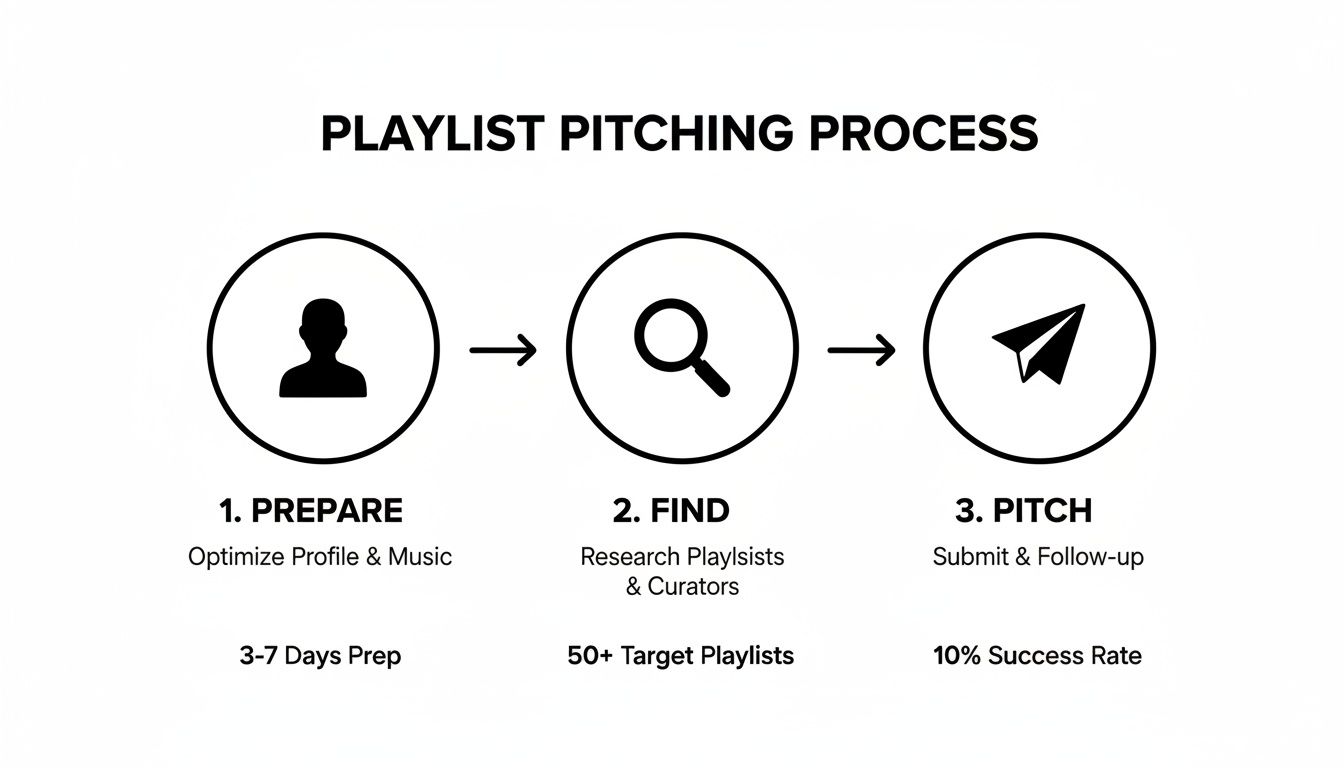
As you can see, everything starts with that prep work. You can't effectively find and pitch curators without it.
Free Playlist Submission Channels at a Glance
To make it clearer, here’s a quick breakdown of your main options for free submissions.
Submission Method | Best For | Effort Level | Potential Impact |
|---|---|---|---|
Spotify for Artists Pitch Tool | Unreleased music; direct access to Spotify's editorial team. | Low | High (Algorithmic & Editorial) |
Direct Curator Outreach | Released music; building long-term relationships. | High | Varies (Can be very high) |
Third-Party Submission Platforms | Discovering a wide range of curators quickly. | Medium | Varies (Quality can differ) |
Each channel has its place, but your success in any of them depends on the preparation we're talking about.
Final Technical Checks
Lastly, don't overlook the technical side of things. Your professionalism should extend all the way to the audio file itself. Before you send anything, make sure your track is properly mixed, mastered, and exported in a high-quality format. Taking a few minutes to choose the best audio format for your track shows curators you respect their time and their ears.
A successful free spotify playlists submission campaign is built on a solid foundation: a complete Spotify for Artists profile, a professional EPK, a deep understanding of your niche, and a high-quality audio file. Get these right, and you're already ahead of the pack.
Pitching Directly to Spotify's Editors
Getting your song onto an official Spotify editorial playlist can be a game-changer for any artist. It’s the kind of break that can put you in front of millions of new listeners overnight. The best part? Spotify has built a direct, completely free submission pipeline for every single artist, and it all happens right inside your Spotify for Artists dashboard. This isn't about backdoor connections; it's about using the system effectively.
The sheer scale of these playlists is hard to wrap your head around. While there are over 4 billion playlists created by users, the 3,000+ playlists curated by Spotify's own editorial team hold immense power. A placement on a monster playlist like Today's Top Hits, with its 35 million followers, can transform a song from an unknown track into a global hit.

Nail the Timing: The Submission Window
Timing is absolutely everything when it comes to the official pitch. You can only pitch unreleased music. As soon as you upload your track through a distributor like DistroKid or TuneCore and it gets delivered to Spotify, it will pop up under the "Upcoming" tab in your Spotify for Artists account. That’s your cue to get to work.
Pro Tip: Submit your track for playlist consideration at least seven days before your release date. I can't stress this enough. This gives the editors a fair window to listen and review your pitch. Honestly, the earlier, the better.
How to Write a Pitch That Clicks
When you select your song to pitch, Spotify asks for a lot of details. Don't just rush through this part. This metadata is how your song gets filtered and discovered by the right editor who’s looking for exactly your sound.
Here’s what to focus on:
Genre and Mood: Be precise. Instead of just "Pop," think deeper. Is it "Synthpop," "Indie Pop," or "Dream Pop"? The same goes for mood. Is it "melancholy," "energetic," or "introspective"? Honesty and accuracy are key.
Instruments and Cultures: List the main instruments. If there’s a distinct cultural influence or you recorded it in a specific city that shaped its sound, add that info. It provides valuable context.
Your 500-Character Story: This is your elevator pitch. You have 500 characters to tell an editor why they should care about your song.
Think of it as a short, direct message to a real person. Talk about the story behind the lyrics, any unique production techniques, or the inspiration for the track. Are you dropping a music video on release day? Do you have a press feature lined up? Mention it! This shows you're serious and have a plan.
For more on what editors look for, this guide on how to get on Spotify editorial playlists is a great resource.
By taking the time to craft a thoughtful pitch, you’re turning a simple submission form into a compelling professional proposal. You're giving your music the best possible shot at being heard by the people who can make a real difference.
How to Find Real Independent Curators
Once you've submitted to Spotify's editors, it's time to explore the vast world of independent curators. This is where you can find some incredible opportunities. These are the music bloggers, dedicated fans, and niche tastemakers who build loyal followings around very specific sounds. Getting on their radar requires a bit more detective work, but it can be a game-changer for an emerging artist.
You're essentially shifting gears from a formal application to a more personal, organic search. The goal isn't just to find any playlist; it's to find the right playlists—ones that are a perfect fit for your sound and run by real people who are genuinely passionate about music discovery. Remember, quality always beats quantity here. A single placement on a small, highly engaged playlist is worth more than a dozen adds to massive, bot-filled lists.
Uncovering Curators on Spotify
The best place to start your hunt is right inside the Spotify app itself.
Think about artists who make music similar to yours. I'm not talking about superstars like Taylor Swift, but your peers—artists who are maybe just a few steps ahead of you in their journey. Head over to their artist profiles and scroll down until you see the "Discovered On" section. This is an absolute goldmine. It shows you exactly which independent playlists are featuring artists in your niche right now.
When you find a playlist that looks promising, it's time to do a little digging on its creator.
Check the Profile: Click on the curator’s name. A lot of them will link to their Instagram, X (formerly Twitter), or a personal website right in their Spotify profile description.
Look for Contact Info: Many curators who are open to submissions will put an email address or a link to a submission form directly in the playlist's description text. Read it carefully.
Analyze the Content: Does the playlist have a clear, consistent vibe? Is it updated often? A list that hasn't been touched in six months is probably a dead end.
This initial groundwork will help you build a solid, targeted list of playlists that actually make sense for your music.
Vetting Playlists and Avoiding Scams
Okay, so you've found some playlists. Now for the most important part: making sure they're legit. The playlisting world, unfortunately, has a shady side filled with botted lists that promise fake streams for a fee. Getting involved with these can do serious damage, potentially even getting your music pulled from Spotify. Your job is to spot the red flags before you even think about reaching out.
A playlist with 50,000 followers but only a few dozen saves is a massive warning sign. Same goes for a list where the featured artists have weirdly low monthly listener counts despite being on such a "huge" playlist. Real engagement is what matters, not inflated follower numbers.
Always check the playlist’s overall health. Look at the follower-to-save ratio. Does the curator's own follower count seem to have jumped up overnight? That's suspicious. The tracklist itself can also tell you a lot. If it's full of unknown artists who all have suspiciously high, perfectly rounded stream counts, you should be very skeptical.
Learning how to detect fake Spotify playlists is an essential skill for any artist navigating the scene today. It protects your music and ensures you're putting your time and effort into real growth, not scams that could tank your artist profile. And whatever you do, never pay for a placement that guarantees a certain number of streams—that is the biggest red flag of them all.
Writing Outreach Emails That Get a Response
So you've done the legwork. You found a curator whose playlist is a perfect home for your new track, and you've confirmed they're legit. Now comes the moment of truth: the pitch.
This is where so many artists get it wrong. Firing off a generic, copy-paste email is the fastest way to get your music ignored. Your outreach needs to be personal, professional, and respectful of the curator's time.
Think of it less as asking for a favor and more like starting a conversation. Independent curators are music lovers, first and foremost. Show them you appreciate the work they've put into their list, and they’ll be much more inclined to give your song a listen. This simple shift in mindset—from "what can you do for me" to "I think we like the same music"—makes all the difference.
A little prep work goes a long way. Before you even think about hitting "compose," find the curator on social media. Follow them, engage with a post or two. This small gesture shows you see them as a real person, not just a stepping stone.
Your Subject Line is the First Test
In a sea of submissions, your subject line is your handshake. It has to be clear, professional, and immediately tell the curator what they’re looking at. Forget the hype and clickbait; it just screams spam.
A good subject line is all business, giving them the key details without even opening the email.
This works: Music Submission: Your Artist Name - "Your Song Title" (Indie Pop)
This doesn't: 🔥🔥 CHECK OUT THIS BANGER!!! 🔥🔥
The first one is clean and sortable. It gives them your name, the song, and the genre, which helps them organize their inbox. The second one is a one-way ticket to the trash folder.
Breaking Down the Perfect Pitch Email
Once they open the email, you've got maybe 30 seconds to make your case. Keep it brief. Curators are busy people wading through hundreds of these emails a week. Your message needs to be scannable and straight to the point.
Always start with a personal touch. Mention their playlist by name and maybe point out a specific song you love on it. This proves you’ve actually listened and aren't just spamming a list of contacts you bought online.
Pro Tip: Personalization is everything. A simple sentence like, "I've had your 'Midnight Drive' playlist on repeat—the new track from The War On Drugs you added fits the vibe perfectly," shows you've done your homework and respect their taste.
Next, get to your pitch, but keep it tight. In one or two sentences, explain why your song is a good fit for their playlist. Connect it to the mood, theme, or sound. And crucially, always provide a private streaming link (SoundCloud is great for this). Never, ever attach an MP3 file.
Mastering the art of writing cold emails that genuinely get replies is a huge part of this process, turning a hopeful shot in the dark into a real connection.
Following Up Without Being Annoying
You sent the email. A few days go by... nothing. Don't sweat it, and definitely don't bombard them with messages. Life happens.
A single, polite follow-up after a week or so is perfectly fine. The key is to be casual and friendly. Just reply to your original email to keep the context.
Something simple like, "Hey [Curator's Name], just wanted to gently bump this up in your inbox. Hope you have a great week!" is all you need. If you don't hear back after that, it's time to move on. Pestering a curator is the fastest way to get blacklisted for any future releases.
Tracking Your Pitches and Measuring Success
Pitching playlists without a system is like shouting into the wind—you have no way of knowing if anyone even heard you. If you want your free spotify playlists submission efforts to actually pay off, you have to track your outreach and figure out what’s working. A bit of simple organization can turn a frustrating guessing game into a real strategy.
The easiest way to start is with a basic spreadsheet. Something like Google Sheets or Excel is perfect for building a little command center for your entire campaign. This isn't about becoming a data scientist; it’s just about getting organized.

This simple setup will keep you from accidentally spamming the same curator twice (a major turn-off) and helps you spot patterns, like which types of playlists are actually responding to your music. Think of it as your single source of truth for your entire outreach.
What to Put in Your Tracking Sheet
You want your spreadsheet to be something you can update in seconds. At a bare minimum, create columns for these key pieces of info:
Playlist Name: The specific playlist you're targeting.
Curator Contact: Their name and the email address you pitched.
Submission Date: The day you sent the first email.
Follow-Up Date: When you sent a follow-up (if you did).
Status: A simple dropdown menu works great here. Use options like "Pitched," "Followed Up," "Declined," or "Accepted."
Notes: This is your spot for personal reminders. Jot down things like, "Curator mentioned they love synth-pop" or "Playlist has high engagement."
Having this laid out gives you a bird's-eye view of your entire campaign, letting you see exactly where everything stands at a glance.
Connecting Your Pitches to Actual Growth
Just tracking your emails is only half the job. The real magic happens when you connect those pitches to what's actually happening with your music. This is where your spreadsheet and your Spotify for Artists account become best friends.
Once a curator adds your song, update the status to "Accepted" in your sheet. Now, pop over to your Spotify for Artists dashboard and click on the 'Playlists' tab under the 'Music' section. This is where the real data lives.
Spotify for Artists will show you exactly which playlists are driving streams, listeners, and—most importantly—saves. Compare this data with your spreadsheet. You might be surprised to find that a small, hyper-niche playlist with 5,000 followers is getting you more saves and new fans than a much larger one with 50,000.
This feedback loop is what separates amateurs from pros. It tells you which curators are connecting you with a real, engaged audience. With that insight, you can start refining your pitching strategy, doubling down on the types of playlists and curators that bring genuine growth. Every pitch you send will be smarter than the last.
Answering Your Top Playlist Submission Questions
Even with a solid plan, a few questions always seem to pop up when you're deep in the submission trenches. Getting these sorted out can save you a ton of headaches and help you pitch with more confidence. Let's dig into some of the most common ones I hear from artists.
How Long Should I Wait Before Following Up?
This is a classic. You've sent the perfect pitch, and now you're just staring at your inbox. The key is to strike a balance between being persistent and being a pest.
My go-to rule is to wait at least one full week before sending a follow-up. Remember, these curators are absolutely buried in submissions, so giving them some breathing room is just good etiquette.
When you do follow up, keep it simple. Reply directly to your original email—don't start a new thread—with a quick, polite nudge. Something like, "Just wanted to gently bump this in your inbox in case it got buried" works perfectly. If you don't hear back after that one follow-up, it’s time to let it go and focus your energy elsewhere. This approach shows you respect their time, which keeps the door open for your next release.
Can I Pitch a Song That’s Already Out?
This is a big one, and the answer really depends on who you're talking to.
Official Spotify Editors: This is a hard no. For the official, editorial playlists, you can only pitch unreleased music directly through your Spotify for Artists dashboard. They don't make exceptions here.
Independent Curators: Yes, absolutely! Most independent curators are more than happy to check out music that's already been released.
The strategy just shifts a bit. Instead of building hype for a future release date, your pitch needs to focus on why your track is a perfect fit for their playlist's specific vibe and listeners right now. You’re selling them on the current moment, not a future one.
The single biggest mistake I see artists make with free submissions is sending out generic, copy-paste emails. Curators can spot a template from a mile away, and it immediately tells them you haven't done your homework or respected their work.
What's the #1 Mistake to Avoid?
Beyond the generic emails, the most damaging mistake is not vetting the playlists you're pitching to. It’s so easy to get starry-eyed over a playlist with 50,000 followers, but if that list is packed with bots, it can do more harm than good.
A sudden surge of fake streams can get your music flagged by Spotify’s algorithm, which can lead to nasty penalties or even getting your track removed. Always, always do your due diligence. Check for real engagement—look at the listener-to-follower ratio, the curator's social media presence, and the other artists on the list. Your time is far too valuable to waste on fake playlists that won't get your music in front of a single real person.
Ready to connect with real, vetted curators without all the guesswork? SubmitLink offers a transparent platform to pitch your music to a network of verified playlist owners. We help you avoid bots and build genuine connections to grow your audience. Find your perfect playlist match on SubmitLink today.


