.png)
How to Get a Song on Spotify: A Professional Artist's Guide
- Jan 22
- 15 min read
You've finalized the master, the creative is approved, and the track is ready for global distribution. But what is the optimal strategy for getting your song on Spotify? The direct path is closed; a digital music distributor is the required intermediary to correctly format and deliver your assets.
This isn't merely a technical requirement. It's the foundational step in ensuring your release is presented professionally, indexed correctly by global systems, and primed for both listeners and Spotify's critical discovery algorithms.
Building a Bulletproof Release
Securing a live track on Spotify is straightforward. Engineering a release for maximum impact is a different discipline entirely. For the professional artist, this isn't about mere presence; it's about executing a strategic launch that signals quality and career intent from the first stream. It begins with establishing a solid foundation long before the upload process.
The Pre-Flight Checklist
Before your music interfaces with a distributor, your core assets must be in order. These are not just administrative checkboxes; they are the fundamental components that ensure your track is presented professionally and, crucially, is traceable across global music infrastructures.
Professional Mastering for Streaming: Your track must be mastered specifically for streaming platforms. This is distinct from mastering for CD or vinyl. A streaming master optimizes loudness (measured in LUFS) and dynamic range to align with Spotify's normalization process, preventing the distortion or quiet playback that degrades the listener experience. Submitting an unmastered file is an amateur oversight.
High-Resolution Artwork: Your cover art is your visual signature. It must be a perfect square, at a minimum of 3000x3000 pixels, and delivered in a high-quality format like TIFF or PNG. Anything less compromises your visual branding and appears unprofessional in a competitive landscape.
The All-Important Codes: Two key identifiers are required. An ISRC (International Standard Recording Code) serves as a unique digital fingerprint for your specific recording. A UPC (Universal Product Code) identifies the entire product (e.g., the single, EP, or album). While most distributors can generate these, owning your own ISRC prefix offers greater long-term control over your catalog's metadata.
Choosing the Right Distributor
Selecting a distribution partner is a critical business decision. The lowest-cost option is seldom the optimal choice for a career-focused musician. Evaluate partners based on the tools and analytics they provide for growth, not just their basic upload service.
Consider the strategic implications. How do they manage royalty splits and payments? How robust are their analytics dashboards? Do they offer integrated access to Spotify's promotional tools like Marquee or Showcase? A top-tier distributor functions as a business partner, providing the infrastructure necessary to execute a serious campaign.
A professional release strategy begins with a critical truth: getting your song on Spotify is the starting line, not the finish line. The strategic imperative is achieving cut-through among the millions of other tracks uploaded monthly.
The platform is an intensely crowded space. With a catalog that has surpassed 126 million songs, gaining traction is a monumental task. Data indicates that a staggering 87% of tracks on Spotify receive fewer than 1,000 streams. This statistic, which you can read more about at soundcamps.com, underscores why a calculated release strategy is not just advantageous—it's essential for viability.
Timing Your Release for Maximum Impact
Once your assets are prepared and your distributor is selected, the final foundational element is timing. It is imperative to allow a lead time of at least four weeks prior to your release date. This window is non-negotiable for a professional campaign.
This timeline allows your distributor ample time for processing and delivery to Spotify. More critically, it ensures you receive the song's URI code in advance. This identifier is the key that unlocks your ability to pitch to Spotify's editorial team via your Spotify for Artists account and to launch a pre-save campaign. These two actions are vital for capturing both editorial and algorithmic attention at launch. This is how you ensure your release isn't just live; it's primed for discovery.
Crafting an Unforgettable Editorial Pitch
Your Spotify for Artists pitch represents the most direct channel of communication with Spotify's editorial team. This is your singular opportunity to contextualize your music, convey your narrative, and demonstrate that you are a serious artist. Executing this pitch flawlessly is an essential component of any professional release.
When you submit that pitch, you are doing more than completing a form. You are officially placing your unreleased song into a specialized dashboard accessed by over 100 global editors. It serves as your formal application for editorial playlist consideration, but it also guarantees your track lands on the Release Radar playlists for all of your followers. A well-crafted pitch can fundamentally alter your track's trajectory from the moment of release.
The Anatomy of a Winning Pitch
Success in this context is not about poetic prose; it's about delivering clear, compelling, and accurate data. Editors review thousands of submissions weekly. They require concise, professional information that allows them to quickly ascertain where your song fits within the vast Spotify ecosystem.
Consider your music the product and your pitch the specification sheet. Be precise. Detail the song's genre, mood, instrumentation, and any relevant cultural touchstones. Utilize the provided tags to strategically align your track with specific playlists you have already researched.
This is what you'll see inside your Spotify for Artists dashboard, where you can manage everything and see who's listening.
The data here is invaluable. Leverage these audience insights to shape the narrative you present in your pitch.
Writing a Narrative That Connects
The core of your pitch is the 500-character description. This is your opportunity to articulate your vision. Do not waste characters on generic pleasantries. Instead, construct a compelling narrative.
Key elements to include:
The Song's Backstory: What is the narrative behind the track? A specific event, emotion, or creative experiment? A compelling origin story enhances memorability.
Your Artistic Trajectory: Briefly contextualize who you are. Mention a recent professional achievement, a notable collaboration, or a unique aspect of your sound to build credibility.
Your Marketing Plan: This is critical. Demonstrate your commitment. Mention confirmed press coverage, social media campaigns, a music video premiere, or tour dates. This proves you are an active partner in driving listeners to their platform.
Your pitch is not a request for a favor; it is a business proposal. You are demonstrating to Spotify that you are investing in your own career and will be a valuable partner in retaining users on their platform.
For those serious about mastering this process, we delve deeper in our guide on how to get on Spotify editorial playlists in 2023.
Submission Timing Is Everything
When you pitch is as critical as what you pitch. While the absolute minimum deadline is seven days before release, the professional standard is three to four weeks in advance.
This lead time serves two functions. First, it provides editors a realistic window to listen and consider your music without being rushed. Second, it guarantees your track is processed in time to appear on your followers' Release Radar playlists on day one—a significant source of your initial stream velocity.
Missing this window means forfeiting one of your most effective promotional tools. Submitting early is a signal of professionalism and respect for their internal processes, positioning your release for a stronger launch.
How to Influence the Spotify Algorithm
While securing a major editorial placement is a significant achievement, sustained, long-term success on Spotify is driven by the algorithm. For the professional artist, learning to work with this system is not optional—it is a core component of a modern release strategy. The algorithm is your first audience; it constantly analyzes user interactions with your track to determine if it's worthy of broader exposure.
Your primary objective is to generate a cascade of positive signals that communicate to Spotify, "Listener engagement with this song is high." The initial 28 days post-release are your proving ground. During this period, the algorithm is most attentive, tracking key metrics to assess your song's potential.
The Metrics That Matter Most in the First Month
The algorithm is not a mystical entity; it's a system that responds to specific user behaviors. By understanding its priorities, you can design a release campaign that encourages these critical actions from your audience.
Spotify scrutinizes user engagement during the crucial 7 to 28-day window. Key signals include:
Save Rate: The percentage of unique listeners who save your track. A high save rate is one of the most powerful indicators of quality and listener intent.
Skip Rate & Completion Rate: These are inversely correlated. Your skip rate must remain below 30% to be considered for algorithmic discovery. A high completion rate builds the algorithm's confidence in your song's quality.
Repeat Listens: A user returning to a track multiple times is a potent signal of genuine affinity. This behavior directly fuels algorithmic playlists like Discover Weekly and Radio.
This flow chart outlines the essential process for pitching your track within Spotify for Artists—a crucial first step for activating both editorial and algorithmic consideration.
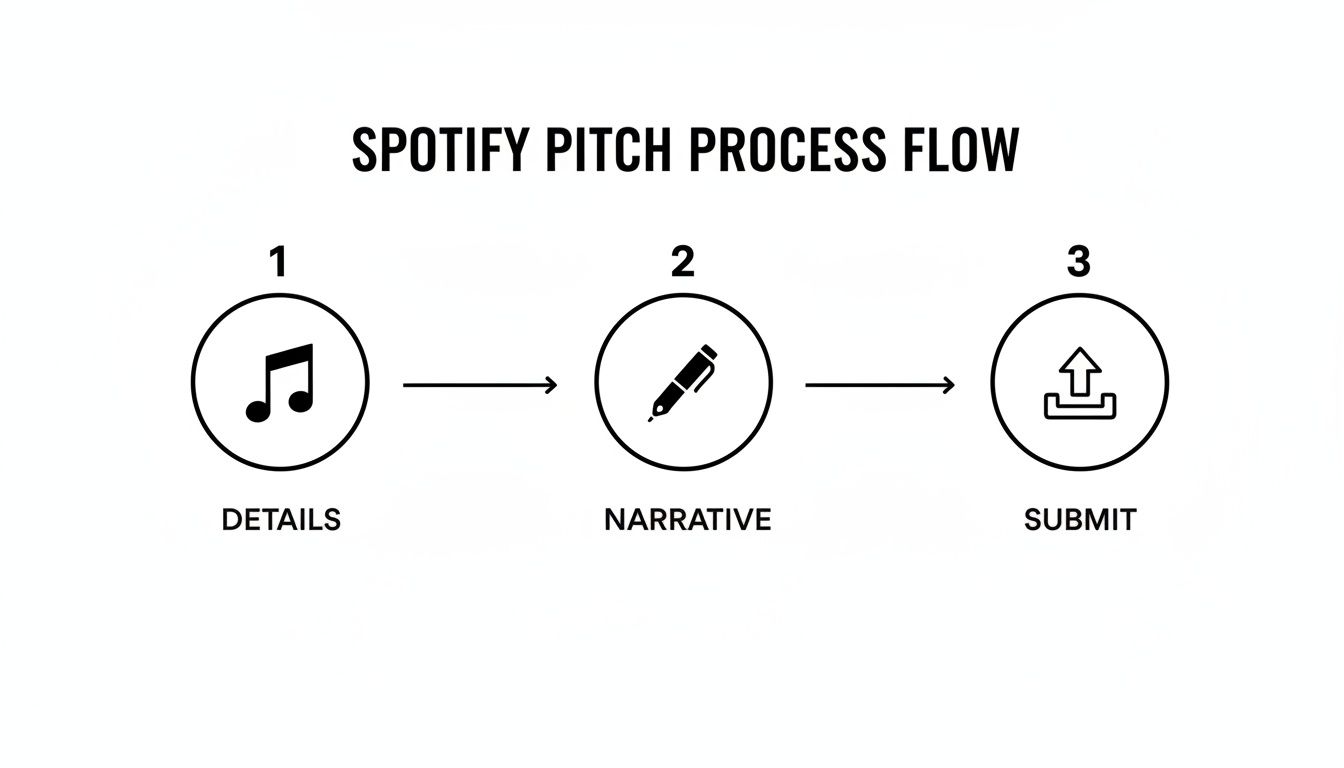
As illustrated, providing detailed metadata and a compelling narrative are foundational. This information helps Spotify categorize your song before it begins tracking listener data.
To help focus your efforts during the critical launch week, here is a breakdown of the most important signals and how to optimize for them.
Key Algorithmic Signals and How to Boost Them
Metric | What It Signals to Spotify | Optimization Tactic |
|---|---|---|
Saves | Long-term listener interest; intent to add to a permanent collection. | Execute a pre-save campaign. Use direct calls-to-action in release day content asking fans to "save" the song. |
Playlist Adds | High-quality curation signal; your song belongs alongside other tracks a user values. | Encourage your audience to add the track to their personal playlists and share them on social media. |
Full Listens (Completion Rate) | The track is engaging and retains attention. Low skip rates are critical. | Ensure the song's intro is compelling. Target promotion accurately to the most receptive audience to minimize skips. |
Repeat Listens | Genuine satisfaction and high replay value; the song has staying power. | Drive initial traffic from your core audience (email list, superfans) who are most likely to listen on repeat. |
Follows | An investment in you as an artist, signaling long-term fan potential. | Leverage release day as a key moment to ask listeners to follow your artist profile on Spotify for future updates. |
By focusing on these specific actions, you are not just promoting your music; you are actively communicating with the algorithm in its own language.
Architecting Your Algorithmic Campaign
Your entire release campaign should be engineered to generate these metrics. This requires moving beyond passive link-sharing. You must actively guide your audience toward the actions that carry the most algorithmic weight.
A well-executed pre-save campaign is your optimal opening move. It builds anticipation while guaranteeing your track is automatically saved to fans' libraries for day-one streaming. This delivers a crucial burst of positive signals—saves and initial plays—from your most dedicated supporters at the moment of launch.
The core of an algorithm-focused strategy is to mobilize your audience to take actions that Spotify registers as high-quality engagement. Every save, playlist add, and full listen is a vote in your favor.
Do not underestimate the power of your owned channels, particularly your email list. Distributing a direct-to-Spotify link to your subscribers on release day drives immediate, high-intent streams. This audience is already invested, making them far more likely to listen completely, save the track, and add it to a personal playlist.
Creating Content That Drives Action
Your social media content must have a clear objective. It should not merely announce the release; it needs a specific call-to-action that encourages algorithm-friendly behaviors.
Stop using the generic "listen now." Be specific. Ask your audience to "save the track and add it to your favorite playlist."
This precise language is crucial. A "save" signals long-term interest. An add to a user-generated playlist is an even stronger signal, telling Spotify your song fits with other music that person already values. For a comprehensive strategy, consult our full guide on how to increase Spotify streams with a proven playbook for growth.
Consider these content strategies:
Video clips asking fans to share screenshots of your song in their personal playlists, which you can then reshare.
Behind-the-scenes content about the song's creation, culminating in a direct link and a clear request to save it.
Interactive polls or questions on Instagram Stories related to the song's theme to drive engagement and maintain visibility.
When you architect your promotional plan around these key algorithmic triggers, you transform your audience from passive listeners into an active force for discovery. This is how you provide your music the best possible opportunity to find a larger audience and achieve sustained platform growth.
Diving into Independent Playlist Outreach
After executing your Spotify for Artists pitch, the next strategic layer is the vast ecosystem of independent curators—tastemakers, bloggers, and genre specialists who have cultivated dedicated followings. For any serious artist, engaging with this network is non-negotiable. It is the primary method for penetrating niche markets, building authentic audiences, and sustaining momentum post-release.
However, this landscape is fraught with risk. It is saturated with fraudulent services selling placements on bot-infested playlists. These "playlist farms" generate artificial streams, which can lead to severe penalties from your distributor and even jeopardize your Spotify account. A professional strategy is required, one that prioritizes authentic connections and real listeners over inflated metrics.
Spotting a Real Curator vs. a Playlist Farm
The single most important skill to develop in this domain is differentiating a genuine tastemaker from a fraudulent operator. A real curator has invested years building an audience around a specific sound. A playlist farm is a business model designed to exploit artists' ambitions for worthless, botted plays.
These are the clear indicators of a fraudulent service:
They Guarantee Placement: No legitimate curator will ever guarantee a placement. Their reputation is built on editorial integrity, and they only feature music that meets their quality standards and aesthetic.
Disproportionate Followers to Engagement: A playlist with 100,000 followers where every track has fewer than 1,000 plays is a major red flag. Use tools like Chartmetric to analyze historical data. Sudden, exponential follower growth is a strong indicator of purchased followers.
"Pay for Placement" Models: This is the most definitive sign. While legitimate platforms may charge a submission fee to compensate curators for their time, any service selling a guaranteed placement for a flat fee is almost certainly fraudulent.
The objective of independent playlisting is not to purchase streams. It is to connect with real listeners who will save your music, follow your artist profile, and become long-term fans. A placement on a 1,000-follower list with an engaged audience is infinitely more valuable than a placement on a 100,000-follower list populated by bots.
How to Approach Vetted Outreach the Right Way
Manually finding and vetting individual curators is an inefficient use of a professional artist's time. For those with a promotion budget who require efficiency and security, utilizing a trusted submission platform is the optimal approach. These platforms serve as a bridge, connecting you directly to a network of verified curators.
Services like SubmitLink are engineered to provide this secure and transparent connection. They employ sophisticated, continuous bot detection systems to eliminate fraudulent playlists, protecting both your music and your investment.
Examine the curator marketplace on a professional platform. You can filter by genre and immediately access the metrics that matter.
Note how each listing displays follower count, average streams per track, and the curator's acceptance rate. This level of transparency is essential for making strategic, data-driven decisions with your budget.
Writing a Pitch That Curators Will Actually Read
Once you have identified target playlists, the pitch itself is the final determinant of success. Curators are inundated with submissions. A generic, copy-pasted message will be immediately discarded.
Personalization is paramount.
Follow this simple framework for a professional pitch:
Reference Their Playlist: Begin by naming the specific playlist you are targeting. Better yet, mention a specific artist or song on it that you admire. This proves you have done your research and are not mass-emailing.
Articulate the Fit: Briefly and clearly explain why your song belongs on their playlist. Avoid vague compliments. Be specific: "The melancholic synth lead and driving 808s in my track would fit perfectly alongside The Midnight and Timecop1983 on your 'Synthwave Dreams' playlist."
Ensure Ease of Access: Do not make the curator work to find your music. Include a direct link to your EPK (Electronic Press Kit) and provide both a private streaming link (SoundCloud is standard) and your Spotify pre-save link.
Consider every pitch as the initiation of a professional relationship. Even if a curator declines this track, a respectful and well-crafted message places you on their radar for future releases. Maintain a record of your submissions, follow up politely but sparingly, and always respect their time. This is how you convert a one-off campaign into a valuable professional network that can support your entire career.
Turn Up the Volume with Paid Advertising
While a robust organic strategy is foundational, a strategic ad budget can serve as a powerful accelerant. For the professional artist, paid advertising is not about purchasing low-quality streams; it's about surgically targeting and acquiring real listeners who are likely to become long-term fans.
Executed correctly, this approach feeds high-quality engagement data into the Spotify algorithm. This creates a powerful feedback loop, stimulating further organic discovery and activating algorithmic playlists like Discover Weekly and Radio. The objective is clear: find your target audience, introduce them to your music, and convert them into Spotify listeners.
Running Ads on Facebook and Instagram
Meta Ads (covering Facebook and Instagram) remains a highly effective channel for driving targeted traffic directly to your Spotify profile. The platform's audience-building capabilities are exceptionally powerful, allowing for precise targeting far beyond basic demographics.
The success of your campaign hinges on your audience targeting. The most effective strategy involves building custom audiences based on fans of stylistically similar artists.
Artist Stacking: Instead of targeting a single, large mainstream artist, create a more refined audience by layering several smaller, niche artists from your specific subgenre. This allows you to reach high-affinity listeners who are more likely to convert.
Lookalike Audiences: If you have an existing email list or website visitor data, you can upload this to Meta to create a "lookalike" audience. The platform analyzes the characteristics of your current fans and finds new users with similar profiles and online behaviors.
Your ad creative must be as sophisticated as your targeting. A high-quality, vertical video clip of 15-30 seconds, showcasing the most compelling section of your song, is mandatory. A static image of your cover art is insufficient in today's media landscape.
Once you have your audience and creative, direct traffic efficiently. While smart links offering multiple streaming options have their place, for a campaign focused on Spotify growth, link directly to the track on Spotify to minimize friction.
Using Spotify's Own Promo Tools
In addition to social media, Spotify offers its own powerful advertising tools that allow you to reach listeners directly within the platform. While not suitable for every budget or release, they can provide significant impact when deployed strategically.
Spotify Marquee
Marquee is a full-screen, sponsored recommendation that is served to listeners who have previously demonstrated interest in your music. It is an excellent tool for converting casual listeners into engaged fans.
When to Use It: Most effective for launching a new album or EP. Marquee is designed to drive engagement with a full project, not just a single.
Who to Target: You can target your "reachable audience" (users who have actively streamed your music) or expand to audiences of similar artists.
How to Measure Success: Look beyond simple stream counts. The key metric is the intent rate—the percentage of users who viewed the Marquee and subsequently saved or playlisted a track from the new release.
Spotify Showcase
Showcase is a newer format that places a sponsored banner at the top of a user's Home feed. Unlike Marquee, Showcase can be used to promote any track from your catalog at any time, not just new releases.
This makes it an ideal tool for reigniting a track with existing momentum or for re-engaging your audience between release cycles. If a song is gaining traction on Discover Weekly, for example, Showcase can be used to amplify that momentum.
Both Marquee and Showcase require a significant budget and should be deployed with clear, measurable goals. Consider them high-impact instruments for capitalizing on momentum you have already built through organic and other paid channels.
A Few Lingering Questions
Even with a meticulously planned strategy, certain tactical questions inevitably arise during a release cycle. For an artist focused on building a sustainable career, clarifying details around timing, budget, and risk mitigation is paramount. Let's address some of the most common professional inquiries.
How Far in Advance Should I Plan My Spotify Release?
While a distributor can technically deliver your music to Spotify within a few days, a professional timeline requires a 4-6 week lead time before your release date. This window is not arbitrary; it is essential for properly executing a multi-faceted campaign.
This extended timeline is necessary to sequence your promotional efforts correctly.
The primary driver is the pitch to Spotify's editors. You must submit your track via the Spotify for Artists dashboard at least 3-4 weeks before it goes live. This provides your only opportunity for official playlist consideration and, more importantly, guarantees placement on your followers' personalized Release Radar playlists on release day—a critical source of initial, targeted streams.
This window also provides the necessary time to:
Run a multi-week pre-save campaign to generate early algorithmic signals.
Develop and schedule all social media assets (video, graphics, stories) to avoid last-minute execution.
Conduct outreach to press, influencers, and independent playlist curators to coordinate features to coincide with your release.
Releasing a track with only a few days' notice is a strategic failure, leaving your most effective promotional tools unused.
What Does a Professional Release Actually Cost?
Distribution fees are merely the cost of entry. A professional artist must budget for the entire campaign, not just the digital delivery.
A realistic budget for a single release should account for several key line items:
Professional Mixing & Mastering: This is non-negotiable and typically ranges from $200 to over $1,000, depending on the engineer's caliber. It is essential for ensuring your track is sonically competitive.
High-Quality Cover Art: Allocate $100 to $500+ for a designer who can create compelling, brand-aligned visual assets.
Promotion Budget: Set aside $300 to $2,000+ for vetted playlisting campaigns and targeted advertising on platforms like Meta.
This should be viewed as an investment in a capital asset—your music. It is the necessary cost to execute a professional launch in a competitive market.
Are "Free" Music Distributors a Good Idea?
For a career-oriented artist, "free" distribution services are almost always a poor strategic choice. These business models must generate revenue, typically at the artist's expense.
In exchange for a "free" upload, you are often sacrificing:
A significant percentage of your royalties, often as high as 15-20%.
Access to robust analytics, leaving you without the data needed to make informed business decisions.
Access to essential promotional tools, as many do not support the Spotify for Artists pitching feature, effectively barring you from editorial consideration.
Paying for a reputable distributor is not an expense; it is a foundational business cost. It protects your revenue, provides essential promotional tools, and ensures your release is handled professionally.
What’s the Big Deal with Fake Streams?
Engaging with artificial streams—whether intentionally or through a disreputable third-party service—can have severe, career-damaging consequences. Spotify's fraudulent activity detection algorithms are highly sophisticated, and the penalties are stringent.
If fraudulent activity is detected on your account, you can expect:
Removal of all artificial streams, nullifying any perceived growth.
Withholding of royalties associated with the fraudulent activity.
Strikes against your account, which can ultimately lead to the permanent removal of your entire catalog from the platform.
This is precisely why rigorous vetting of any third-party promotional service is critical. Authentic, sustainable growth is the only viable path. Utilizing platforms with integrated bot detection is not a luxury feature; it is an essential insurance policy for your music and your professional reputation.
Ready to amplify your next release with a network of verified, high-quality playlist curators? At SubmitLink, we connect professional artists with tastemakers who drive real, engaged streams. Our platform, backed by industry-leading bot detection, ensures your music reaches genuine listeners, protecting your catalog and maximizing your impact. Join over 36,000 artists and start building a sustainable audience today at https://submitlink.io.


