.png)
How to increase spotify streams: A Proven Playbook for Growth
- Jan 9
- 17 min read
Before you even think about running ads or pitching to playlists, you need to get your house in order. Trying to boost your Spotify streams without a solid foundation is like trying to build a skyscraper on sand. It just won't work.
This initial setup—the unglamorous but absolutely essential stuff—is what separates the artists who gain traction from those who get lost in the noise.
Build Your Foundation for Spotify Growth
Let's be real: your music and your Spotify presence are your digital storefront. If the product isn't top-notch and the shop looks messy, potential fans will just scroll on by. The goal here is to create a professional ecosystem that not only grabs a listener's attention but also signals to Spotify's algorithm that you're a serious artist.
It all begins with the music itself. A professionally mixed and mastered track isn't a luxury anymore; it's the price of admission. With tens of thousands of songs hitting the platform every single day, you're competing directly with major label artists for a spot in those coveted playlists. A muddy mix or a quiet master will stick out like a sore thumb and earn you an instant skip.
Polish Your Digital Identity
Your Spotify for Artists profile is your home base on the platform. Claiming it and filling it out completely is probably the single most impactful thing you can do for free. When someone discovers a song they love, this is the first place they'll go to see what you're all about.
This is the main dashboard where you'll manage everything.
Think of it as your digital press kit, constantly working for you. A complete, professional-looking profile should have:
High-Resolution Photos: Your header and avatar need to look sharp and represent your brand. No blurry phone pics.
An Engaging Bio: Tell your story. Who are you? What drives your music? Write it in your own voice and don't be afraid to let your personality shine through.
Social Media Links: Make it dead simple for new fans to connect with you on Instagram, TikTok, YouTube, or wherever you hang out online.
Artist Pick: This is prime real estate. Use it to pin your new single, shout out a playlist you’re on, or promote an upcoming show.
The Unseen Engine: Metadata
Metadata is the invisible engine that helps Spotify figure out what your music is and who to show it to. When you upload your tracks through a distributor, every single field is important. We're talking primary artist, featured artists, songwriter credits, the works.
Getting this right ensures you get paid correctly, but just as importantly, it feeds the algorithm the right signals. Tagging your song as "Dream Pop" and "Indie Rock," for example, tells Spotify exactly which rabbit holes to send your music down.
"Getting the foundation right is about controlling the controllables. You can't control whether an editor loves your song, but you can control the quality of your master, the professionalism of your profile, and the accuracy of your data. Nail these, and you give your music a fighting chance."
This groundwork is more critical than ever. The streaming world isn't just for the big players anymore; independent artists can absolutely carve out a real career. Spotify's own reports show they've paid out record-breaking sums to rights holders, which tells you the user base is massive and still growing. That means more opportunities for artists in every niche, but only if their foundation is solid enough to compete. You can dig into more of the numbers on Spotify's user growth over at backlinko.com.
Before you move on to the more active promotional strategies, it's worth taking a moment to audit your own setup. Think of the following table as your pre-flight checklist.
Your Spotify Growth Foundation Checklist
These are the absolute essentials you need locked in before launching any campaign to grow your streams. Go through them one by one.
Element | Why It Matters | Action Item |
|---|---|---|
Professional Master | Ensures your track sounds competitive in playlists and radio alongside major artists. A bad master is an instant skip. | Invest in a professional mastering engineer or use a reputable AI mastering service as a budget-friendly alternative. |
Complete S4A Profile | Your profile is your digital storefront. An incomplete profile looks unprofessional and misses conversion opportunities. | Upload high-res photos, write a compelling bio, and link all your socials. |
Artist Pick Feature | This is the first thing fans see on your profile. It's a prime call-to-action spot. | Pin your latest release or a key playlist to direct fan attention immediately. |
Accurate Metadata | Correct data ensures you get paid properly and helps Spotify's algorithm recommend your music to the right listeners. | Double-check all artist, songwriter, and genre information with your distributor before your next release. |
Nailing these fundamentals doesn't guarantee a viral hit, but it ensures that when opportunity strikes—whether from an algorithmic playlist or a fan's discovery—you're ready to capture that momentum.
Develop an Unmissable Release Strategy
Getting your music and profile in order is the essential groundwork, but your release strategy is what lights the fuse. Tossing a new track onto Spotify and just hoping for the best is a surefire way to get lost in the noise. To really drive streams from day one, you need a smart, deliberate plan that builds buzz and shows Spotify’s algorithm that people are waiting for your song.
The most critical ingredient here? Time. I see so many artists rush this part, and it's a huge mistake. You need to get your final, mastered track uploaded to your distributor—think DistroKid or TuneCore—at least three to four weeks before you want it to go live. That buffer isn't just for breathing room; it's the runway you need for your most important pre-release moves.
This simple flow shows how everything connects: the music itself, your artist profile, and the data behind it all working together to set you up for discovery.
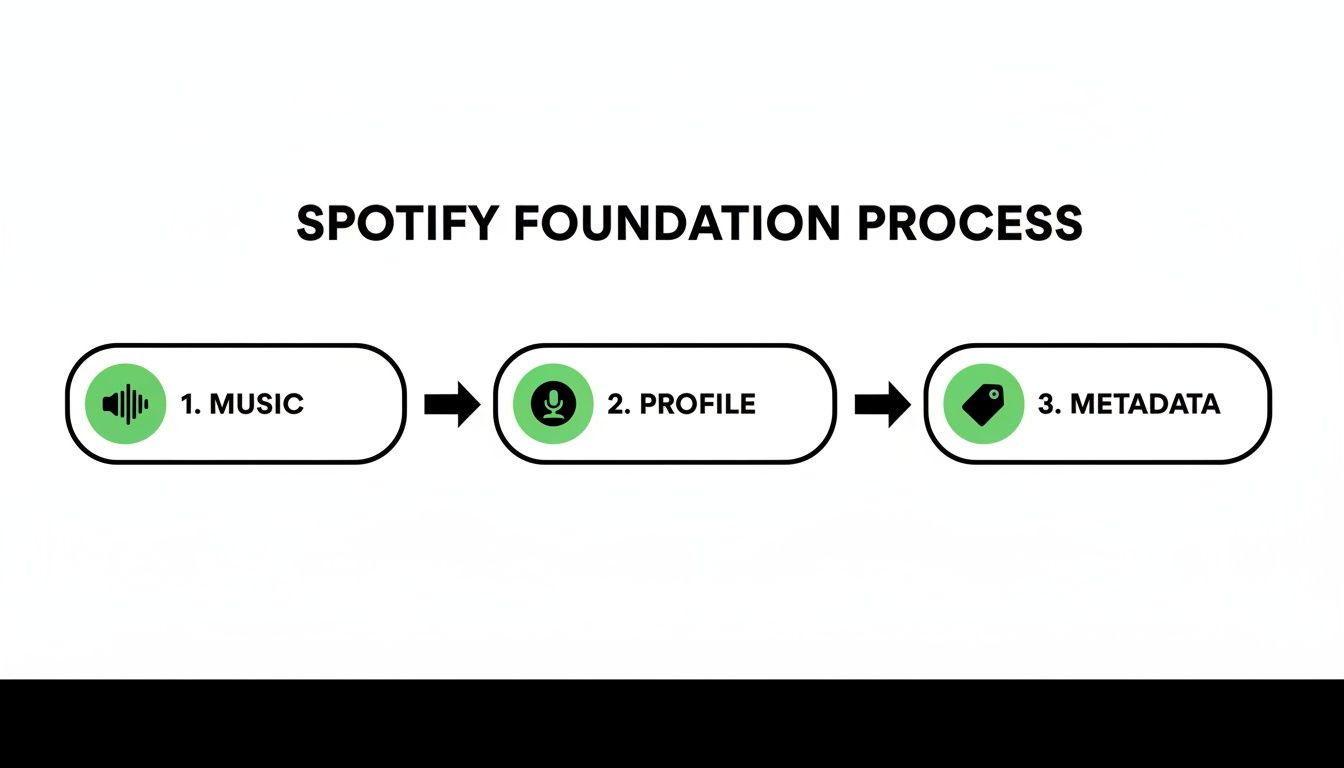
As you can see, a great song is only part of the equation. It needs to be presented with a polished profile and clean, accurate metadata to have a real shot.
Pitching Directly to Spotify Editors
That 3-4 week window gives you access to your single best shot at landing on a big, official playlist. As soon as your distributor sends the track to Spotify and it pops up in your Spotify for Artists dashboard, you can pitch it directly to their editorial team. This is a free, incredibly powerful tool that too many artists either ignore or rush through.
Your pitch is your chance to sell the story behind the song. You have to be specific and make it compelling.
Genre and Mood: Don't be vague. Nail down the specific genres, subgenres, and moods that fit your track. This helps editors instantly see where it belongs.
The Story: What's the song about? Was there a cool story behind how it was made? Did you work with someone interesting? Give them something memorable.
Your Hustle: Briefly outline your marketing plan. Mention if you're running social ads, have a blog premiere lined up, or are doing a video release. It shows you’re serious about supporting your own music.
The goal is to make the editor's job as easy as possible. A clear, well-written pitch that shows your professionalism will always stand out from the crowd. For a complete walkthrough on this, check out our guide on how to submit music to Spotify playlists and get heard.
The Power of the Pre-Save Campaign
While you wait to hear back from the editors, it’s time to get your fans excited. This is where a pre-save campaign comes in, and it's a game-changer. Think of a pre-save as a digital pre-order. When a fan hits that pre-save button, your song automatically gets added to their library the second it's released.
Pre-saves send a massive signal to the Spotify algorithm. A flood of pre-saves tells Spotify there’s serious demand for your track before it’s even out, which can give it a huge algorithmic boost right at launch.
It’s easy to set up a pre-save link with services like Hypeddit or Feature.fm. Once you've got your link, plaster it everywhere:
Pin it to the top of your social media profiles.
Drop it in your email newsletter with a personal note.
Make short-form videos teasing the track and tell everyone to "hit the link in bio to pre-save."
Look at your release strategy like a timeline. By planning your moves weeks ahead—from the initial upload to your pre-save push and your editorial pitch—you’re creating multiple waves of momentum. This coordinated effort is what drives that all-important day-one stream velocity and sets your track up for success.
Master the Art of Smart Playlist Pitching
Getting your music onto playlists is, without a doubt, one of the fastest ways to boost your Spotify streams. But it's a game of strategy, not luck. A single good placement can put your sound in front of thousands of new listeners overnight, but you have to know how to play the game.
The key is understanding the different kinds of playlists out there and having a smart, targeted plan for each.
A healthy growth strategy means you’re aiming for all three major types of playlists on Spotify.
Editorial Playlists: These are the big leagues, curated directly by Spotify's internal team. Landing on a major one like Today's Top Hits or Chill Hits can absolutely change your career in a day. The only way to get their attention is through the official pitching tool in your Spotify for Artists dashboard.
Algorithmic Playlists: Think Discover Weekly and Release Radar. These are pure magic, created automatically for every single user based on what they listen to. You can't pitch them directly, but you can influence them by getting on other playlists, driving pre-saves, and getting a good buzz going right after release.
User-Curated Playlists: This is where the real hustle happens. These lists are built by independent curators—from music bloggers and influencers to record labels and just plain passionate fans. Getting placements on dozens of smaller, niche user playlists sends powerful signals to Spotify's algorithm.
Finding and Vetting Third-Party Curators
The world of user-curated playlists is like the Wild West—it's vast and mostly unregulated, which means you need to be careful. Your mission is to find legit curators with real, engaged listeners who can actually help you grow.
Thankfully, there are platforms designed to bridge this gap, connecting artists like you with a whole network of vetted curators. For instance, a service like SubmitLink lets you sift through thousands of playlists, filtering by genre, mood, and even listener data to find the perfect home for your track.
A well-organized workspace like this is essential for tracking your outreach and managing multiple playlist submissions effectively.
Once you’ve found some promising playlists, it’s time to do a little detective work. You need to look for red flags that scream "scam" or "bots."
A tell-tale sign of a fake playlist is a massive follower count with shockingly low engagement. If a playlist has 50,000 followers, but the songs on it are stuck with fewer than 1,000 plays, it’s almost certainly a dud. Stay away—bot-driven streams can get your music pulled from Spotify entirely.
This whole ecosystem thrives because playlist culture is how people discover music now. Spotify users have created billions of playlists, making curation a core part of the listening experience. That's why outreach is a non-negotiable part of any artist's strategy. You can dig into more data on how songs climb the Spotify charts over at chartmasters.org.
Crafting Outreach That Actually Gets a Reply
When you reach out to a curator, whether through a platform or directly, personalization is everything. These folks are swamped with submissions every single day. A generic, copy-pasted message is a one-way ticket to the trash folder.
Your pitch needs to be short, sweet, and respectful of their time.
Use their name. It’s a tiny detail that instantly shows you’ve done some basic research.
Name their playlist. Tell them exactly which playlist you have in mind for your song.
Explain why it fits. This is the most important part. Mention an artist or two on their playlist and draw a quick parallel to your sound. It proves you’ve actually listened.
Keep it brief. A few well-crafted sentences are all you need. Drop a direct link to your track on Spotify, and don't forget to say thank you.
Navigating Paid Placements Safely
Many indie artists turn to paid playlist pitching to speed things up, and when done right, it can be a fantastic investment. But let’s be clear: you're not buying streams. You're paying for a curator's time and consideration.
Reputable platforms make sure their curators are verified and guarantee you’ll get feedback, even if it’s a pass. The goal is to build real relationships and get your music in front of real ears. For a deeper dive, our guide on getting on Spotify playlists offers proven strategies to grow your listeners.
The smart way to approach paid pitching is to start small. Set a modest budget, test out a bunch of different playlists, and track your results like a hawk. The most important numbers aren't just stream counts—it's the save rate and follower growth you see in your Spotify for Artists dashboard. That’s the data that proves you’re not just getting plays, you’re gaining fans.
Amplify Your Music Beyond Spotify
Landing on a great playlist is a huge win, but don't pop the champagne just yet. Too many artists see a playlist add as the finish line when it’s really just the starting gun. If you want to build real, sustainable momentum, you need to start driving your own traffic to your music.
This is how you get the Spotify algorithm to pay attention. When Spotify sees listeners flooding in from your Instagram, TikTok, or a blog feature, it logs those as high-intent streams. These aren't passive listeners; they made a conscious choice to click a link and hear your song. That kind of off-platform buzz is often the final push a track needs to land on massive algorithmic playlists like Release Radar and Discover Weekly.
Dominate Short-Form Video Content
Right now, TikTok, Instagram Reels, and YouTube Shorts are the most potent music discovery tools on the planet for indie artists. It's not an exaggeration. A single, well-made video can put your song in front of hundreds of thousands of new ears, completely for free.
The trick is to create content that feels native to the platform—it needs to be short, punchy, and built around the best part of your song. Forget about a big production budget; all you need is your phone and a spark of creativity.
Find Your Golden Snippet: Comb through your track and find the most infectious 8-15 second clip. This is your hook. It could be a killer vocal run, a weird synth lead, or a driving drum fill. Everything you create will revolve around this sound.
Pull Back the Curtain: People are fascinated by the creative process. Share clips of you tracking vocals in your closet studio, a screen recording of the project file in your DAW, or just you noodling on the guitar part. It builds a genuine connection.
Start a Simple Trend: You don't need a viral dance challenge. Think simpler. Create a relatable video concept that’s easy for others to recreate with your sound. Something as simple as "this song is for anyone who..." can work wonders.
If you want to scale up your promotional content, you can learn how to create AI video that captivates and converts. This can be a game-changer for generating more creative assets to A/B test on platforms like TikTok, Reels, and Shorts.
Run Smart, Cost-Effective Ad Campaigns
Paid ads can feel intimidating, but they're more accessible and affordable than you might think. With platforms like Meta (for Facebook and Instagram), you can run super-targeted campaigns on a shoestring budget to send listeners straight to your Spotify. The goal isn't to spend a fortune; it's to gather data and generate high-quality streams that teach the algorithm who your fans are.
A Meta conversion campaign is your secret weapon here. Instead of just paying for fuzzy metrics like video views, you're telling the algorithm to find people who are most likely to click your link and actually listen on Spotify. Even a small budget of $5-$10 per day can provide a massive lift and invaluable audience insights.
Pro Tip: Whatever you do, don't just "boost post." Take the time to set up a proper conversion campaign in Meta Ads Manager. Your conversion event should be "View Content" on your landing page. This is the single most important detail to make sure your ad spend is actually driving streams.
Your ad creative can be simple. Grab a short video clip that's already performing well organically and pair it with a direct call to action like, "Listen to my new single on Spotify." Just make sure the link goes directly to your track in the Spotify app to reduce friction.
Combining organic social buzz with targeted, low-budget ads creates a powerful flywheel. Your organic content builds social proof and community, while the ads guarantee your music reaches a hand-picked audience of potential new fans. Every stream you drive from these outside sources proves your song's relevance to Spotify, dramatically increasing its chances of getting picked up and amplified to a much wider audience. You’re no longer just waiting for a lucky break—you’re actively building your own.
Use Your Data to Drive Real Growth
All the work you put in—pitching playlists, running ads, posting on social media—creates one thing that’s absolutely priceless: data. Your Spotify for Artists dashboard isn't just a vanity board for stream counts. Think of it as a detailed road map showing you what’s working, who’s actually listening, and where you should point your efforts next.
Shifting to a data-driven mindset is what separates artists who see temporary stream spikes from those who build sustainable, long-term growth. Stop guessing and start analyzing.
Figuring Out Your Audience and Stream Sources
First things first, get comfortable with the main sections of your analytics. The "Audience" tab is a goldmine. It breaks down your listeners by age, gender, and their top cities and countries.
Let's say you think your fanbase is mostly in your hometown, but you suddenly see a huge spike in listens from Austin. That's a massive clue. It tells you to maybe target your next Meta ad campaign there or start searching for Austin-based playlist curators.
The "Music" tab is just as important, especially the "Playlists" section. This is your performance report card, showing you exactly which playlists are sending listeners your way.
Don't just fixate on the total streams from a playlist. Pay close attention to the save rate. A high save rate sends a powerful signal to Spotify's algorithm that people are actively adding your song to their own libraries—a clear sign you've found a real fan.
A playlist that gets you 1,000 streams with a 20% save rate is often way more valuable than one with 5,000 streams and a 2% save rate. The first one is building your core audience; the second might just be background noise. For a deeper dive, you can even explore detailed changelog chat playlist analytics to see how different curators perform.
Getting into a "Test and Learn" Groove
Data isn't about finding one secret trick; it's about making small, consistent improvements over time. Use your analytics to run little experiments, see what happens, and adjust your approach.
Try different hooks: When you promoted on TikTok, did the video using the chorus get more clicks to Spotify than the one with the verse?
Compare playlist vibes: Did that indie pop playlist give you a better save rate than the chill-out list?
Analyze your ad creative: Did a simple video of you performing outperform that slick, highly-edited graphic in your Instagram ads?
This constant feedback loop is what helps artists break through plateaus. If you want to get really good at this, it’s worth mastering social media analytics and reporting to connect the dots between your content and your stream count.
Before you dive in, it helps to understand the key metrics inside your Spotify for Artists dashboard. This table breaks down what they mean and how you can actually use them to make smarter decisions.
Key Spotify for Artists Metrics and What They Mean
Metric | What It Tells You | How to Improve It |
|---|---|---|
Streams | The total number of times your song has been played for over 30 seconds. | Increase visibility through playlists, social media promotion, and ads. |
Listeners | The unique number of people who have streamed your music. | Reach new audiences through targeted ads and playlist pitching to new genres. |
Saves | The number of times listeners have added your song to their library or liked it. | Create "save-worthy" music; prompt fans on social media to save your track. |
Save Rate | The percentage of listeners who save your song after hearing it. | Pitch to highly relevant playlists where listeners are more likely to be true fans. |
Source of Streams | Where your plays are coming from (e.g., playlists, your profile, algorithmic). | Analyze top sources; double down on what works (e.g., if playlists are high, pitch more). |
Top Cities/Countries | The geographic locations where your listeners are concentrated. | Target ads to top cities; look for touring or collaboration opportunities there. |
By regularly checking these numbers and asking "why," you turn promotion from a guessing game into a calculated strategy for growth.
The financial side of this is directly tied to your goals. According to Spotify’s own data, an artist starts approaching significant annual royalties somewhere around 4–5 million monthly listeners or 20–25 million monthly streams. Those numbers aren't meant to be intimidating; they just show the scale required to turn music into a career.
For an independent artist, this means you have to consistently find high-intent listeners and turn them into repeat fans. That's only possible when you let the data guide your way.
Answering Your Top Spotify Growth Questions
Trying to get more streams can feel like shouting into the void. You're doing the work, but it’s tough to know what's actually moving the needle, what's a waste of time, and how long this whole process is supposed to take. Let's clear up some of the most common questions I hear from artists who are trying to find their footing.
How Long Does It Really Take to Increase Spotify Streams?
This is the big one, and the only honest answer is: it depends. There’s no magic number of days or weeks. Real growth isn't an overnight viral moment; it’s a slow burn, built by doing the right things consistently over time. Think of it like a snowball—it starts small, but with every push, it picks up more snow and gains unstoppable momentum.
You can definitely see a nice little bump within a few weeks of a well-planned release. If you nail your pre-save campaign, submit a strong pitch through Spotify for Artists, and get a few third-party playlist adds, you could easily see your first few thousand streams on a new song. That's a fantastic start.
But the real, lasting growth—the kind that builds a career—is measured in months, not days. The momentum truly starts to build after a solid 6-12 month period of consistent releases, strategic pitching, and smart promotion outside of Spotify. Each new song is another entry point for a new fan and another lesson for the algorithm about who, exactly, your audience is.
A quick but crucial warning: be extremely skeptical of any service promising instant results or guaranteeing a specific stream count. These are almost always fueled by bots. Not only will you gain zero real fans, but you also risk getting your music flagged or even removed from Spotify entirely. This is a marathon, not a sprint.
Are Paid Playlist Placements a Waste of Money?
They absolutely can be—if you’re not smart about it. But when you approach them with the right strategy, paid placements can be a powerful tool for getting a targeted boost.
The key is to completely reframe your thinking. You are not buying streams. You are paying for a real, human curator's time and effort to listen to your track and decide if it’s a good fit for their audience.
The biggest mistake is getting lured in by playlists with massive follower counts but zero real engagement. The only way to go is with reputable platforms that connect you with verified curators. This ensures your music is heard by real, active listeners and that you get genuine feedback.
Here’s a smart way to dip your toes in the water:
Start small. Don't dump your whole budget on one huge playlist. Spread a smaller amount of money across 5-10 smaller, laser-focused playlists that fit your sound perfectly.
Get niche. Pitching your ambient track to a generic "Chill Hits" playlist is a total long shot. You'll get much better results by targeting specific lists like "Ambient Focus" or "Late Night Study."
Track what matters. Forget the stream count for a second. Jump into your Spotify for Artists account and watch your save rate and follower growth. A high save rate is gold—it’s proof positive that you've found people who truly connect with your music.
If a paid campaign brings you real fans who save your music and follow your profile, it was money well spent.
What Is the Biggest Mistake Artists Make with Spotify Promotion?
Without a doubt, the most common and damaging mistake is the "release and pray" method. So many artists pour their hearts into a song for months, upload it, hit publish... and then just hope for the best. That’s like buying a lottery ticket and calling it a retirement plan.
A successful release isn't a single moment; it's a full-blown campaign that kicks off weeks before your song ever sees the light of day. It’s a coordinated attack on all fronts:
Pre-Release: Getting your music to your distributor at least four weeks early is non-negotiable.
Pitching: Taking the time to write a killer pitch for Spotify's own editorial team.
Buzz-Building: Driving early listener interest with a pre-save campaign.
Playlist Outreach: Hitting up third-party curators so your campaign is ready to go on release day.
Off-Platform Push: Using your social media to funnel your existing fans over to Spotify.
The other huge misstep is forgetting that no amount of promotion can fix a bad product. All the marketing genius in the world can't save a song that’s poorly produced, mixed, or mastered. Your music is the foundation. A great song with a weak promo plan might get overlooked, but a weak song with a great promo plan will just get skipped faster. Make incredible music first, then give it the strategic push it deserves.
Ready to find the right playlists for your music without the guesswork? SubmitLink connects you with a network of over 600 vetted curators across every genre. Our platform helps you avoid bot-filled playlists and get your music in front of real listeners, with guaranteed feedback on every submission. Join over 36,000 artists and start your next campaign today at https://submitlink.io.


