.png)
Strategic Music Promotion on Spotify: An Optimization Guide for Professional Artists
- Feb 2
- 14 min read
To meaningfully advance your music career on Spotify, you must move beyond foundational tactics and adopt a systematic approach to growth. This involves optimizing your on-platform presence, executing strategic playlist outreach, and leveraging targeted off-platform promotion to build sustainable momentum.
The objective is not a fleeting spike in streams, but the cultivation of a loyal, high-value audience that supports your career for the long term.
Moving Beyond Foundational Spotify Promotion
As an established artist, you've mastered the fundamentals. You have a trusted distribution partner and a verified Spotify for Artists profile. This guide is not a primer for beginners; it is a strategic playbook for professionals ready to optimize their methodology and scale their impact. We will bypass introductory advice to concentrate on the sophisticated tactics that drive tangible results for serious musicians with a defined budget and a career to protect.
Today's challenge is not merely being heard, but being heard by the right audience, consistently. This requires a paradigm shift from passive hope to active, data-driven strategy—the difference between simply releasing a song and launching a comprehensive campaign engineered to capture listener data and activate Spotify's powerful algorithms.
Adopting a Growth-Oriented Mindset
A professional framework treats each release as a business asset, not just a creative work. You are not merely chasing play counts; you are building an audience that will save your tracks, follow your profile, and ultimately invest in your merchandise and live performances.
This strategy is built on several core principles:
Protect Your Investment: Your music catalog and Spotify profile are invaluable assets. Compromising their integrity with high-risk tactics like purchasing artificial streams or engaging with bot-infested playlists can lead to content removal and jeopardize your hard work.
Focus on Data, Not Vanity: A million streams from a bot farm are worthless. In contrast, 10,000 streams from an engaged audience that saves your music and follows your profile are invaluable. We are focused on acquiring high-quality data.
Build Sustainable Momentum: True growth is not predicated on a single viral moment. It is about implementing a repeatable system where each release builds upon the last, systematically increasing your baseline listenership and monthly audience.
Consider this guide a strategic briefing, designed to provide an actionable plan that aligns with your professional ambition. We will delve into the nuances of using vetted tools and intelligent tactics to expand your reach, protect your catalog, and convert casual listeners into dedicated fans. This is the methodology for building a career, not just chasing streams.
Mastering Your Pre-Release Strategy
Success on Spotify is largely determined long before a track goes live. For any serious artist, the pre-release window is the most critical phase for priming both the platform's algorithm and its human editors for your new music.
A polished, professional presence signals to every visitor—from a potential new fan to an industry tastemaker—that you are an artist worthy of their attention. This requires meticulously refining every touchpoint on your Spotify for Artists profile until it functions as a strategic hub, not a passive landing page.
Optimizing Your On-Platform Presence
Treat your Spotify profile as your digital storefront; it must instantly convey your brand, narrative, and professionalism. Begin with your artist bio. This is not just for fans; it is often the first point of reference for playlist editors, A&R scouts, and journalists.
Dispense with the long-form biography. You need a concise, impactful narrative that highlights career milestones, press features, and the story behind your current project. Keep it sharp, professional, and update it with every release cycle to maintain relevance.
Beyond the bio, several elements are non-negotiable:
Artist Pick: This is prime real estate. Use it strategically to funnel listeners to your latest single, a pre-save link, or an off-platform destination like your merchandise store or tour schedule. It is a powerful, fully controlled call-to-action.
Canvas Videos: These short, looping visuals are far more than aesthetic embellishments. Spotify's data confirms that tracks with a Canvas experience up to a 145% increase in shares, alongside significant lifts in saves and playlist adds. Commission a compelling, high-quality visual that captures the song's essence without being distracting.
This entire process is about establishing a robust foundation for real, sustainable growth.
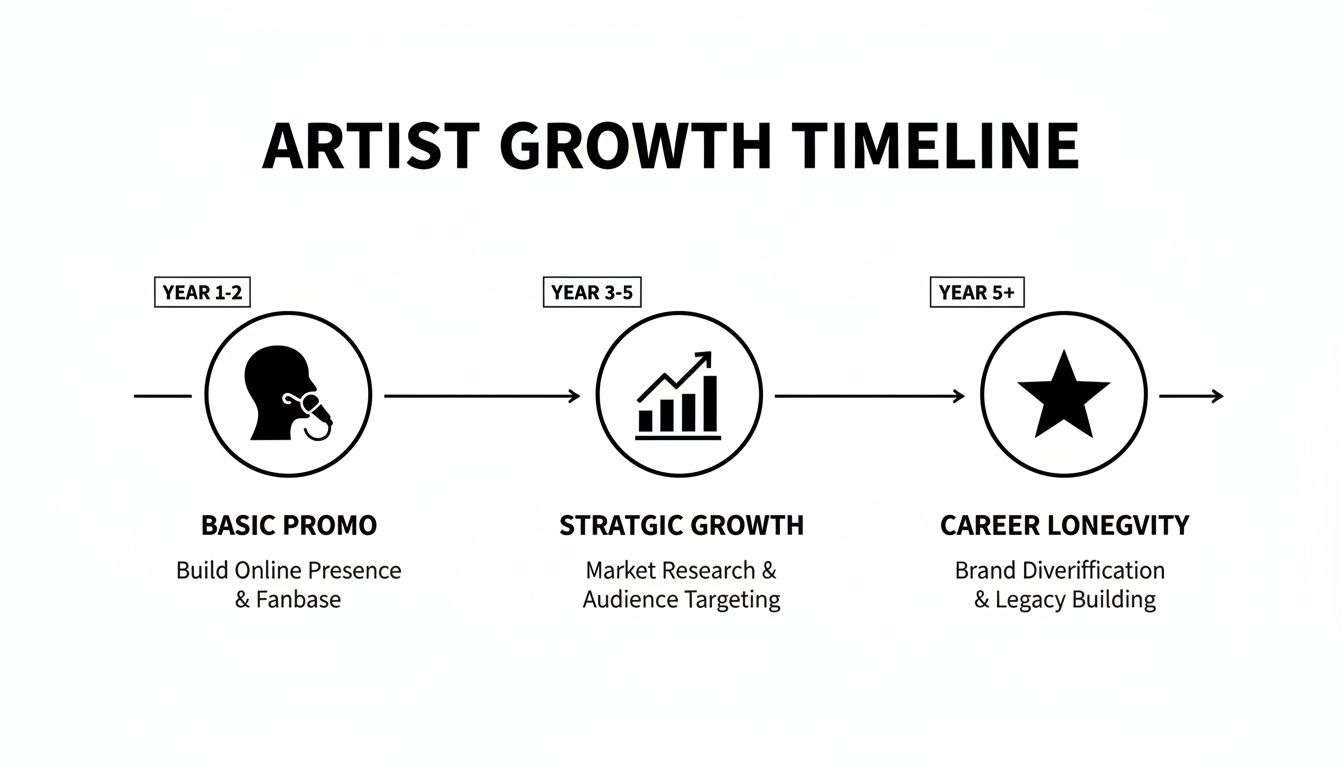
As illustrated, proper initial setup is the launchpad for building lasting momentum.
This checklist provides a strategic timeline designed to build momentum systematically during the critical pre-release window.
Your Pre-Release Optimization Checklist
Timeline | Core Task | Key Objective |
|---|---|---|
4 Weeks Out | Submit final track & artwork to your distributor. | Ensures your track is in Spotify's system in time for pitching. |
3 Weeks Out | Submit your editorial playlist pitch via Spotify for Artists. | Gives editors maximum time to review your music. |
2 Weeks Out | Launch your pre-save campaign. | Builds early audience engagement and guarantees day-one streams. |
1 Week Out | Create and upload your Canvas video. | Boosts key engagement metrics like shares, saves, and adds. |
Release Week | Update your Artist Pick to feature the new single. | Drives immediate traffic from your profile to the new track. |
Adhering to this timeline maximizes your release's potential to gain traction, both with the algorithm and with key industry stakeholders.
The Editorial Pitch Timeline and Strategy
With your profile optimized, the next crucial step is pitching for editorial playlist consideration. Timing is paramount. You must submit your track through your Spotify for Artists dashboard at least three to four weeks pre-release.
This lead time is non-negotiable, as it provides editors a realistic window to review your song amidst thousands of daily submissions. A last-minute submission is a guaranteed missed opportunity. This is also the opportune moment to learn how to set up a Spotify pre-save and capture that vital early momentum.
When composing your pitch, understand your audience. Spotify's editors are industry professionals seeking compelling narratives from artists who have a clear strategic plan.
Your pitch must be a concise, powerful narrative. Do not simply describe the song's genre; articulate why it matters. Mention supporting press coverage, influencer campaigns, or a music video premiere you have secured. This context demonstrates a robust marketing plan, making your track a more secure and attractive proposition for their playlists.
You are not merely requesting a placement; you are demonstrating that your release is supported by a promotional engine. A compelling pitch, combined with a polished profile, sets the stage for a successful release day.
A Professional's Guide to Playlist Pitching
With pre-release essentials secured, the focus shifts to gaining listenership. Playlist placements are the primary engine of Spotify growth, but the landscape is fraught with noise and potential risks. A professional approach eschews broad, untargeted outreach in favor of a calculated, dual-pronged strategy targeting both Spotify's editorial team and the vast network of independent curators.
Mastery in this domain involves transforming a gamble into a system. It requires crafting a pitch that commands an editor's attention while navigating the complexities of third-party playlists to avoid fraudulent, bot-driven placements that can harm your profile.
Nail Your Official Spotify Pitch
As emphasized, submitting your track via Spotify for Artists 3-4 weeks early is a fundamental requirement. However, what distinguishes a professional submission from the slush pile is the narrative. Spotify's editors are curating not just songs, but artists with a clear vision and demonstrable momentum.
Your pitch must connect these dots. A generic description like, "Check out my new indie pop song," will be summarily dismissed. A more substantive pitch is required:
"My new single, 'City Lights Fading,' is a melancholic synth-pop track exploring the emotional dissonance of leaving a beloved city. With its driving 80s drum machine and ethereal vocal layers, it is an ideal fit for playlists such as 'sad indie' or 'Night Drives.' The release is supported by a targeted ad campaign and a premiere on the XYZ music blog."
The distinction is clear. This pitch demonstrates an understanding of their curation environment and a proactive plan to support the music. For a deeper dive, consult our full guide on how to submit music to Spotify playlists and get heard.
Tackling the World of Independent Curators
Beyond Spotify's ecosystem lies a vast landscape of independent curators—a primary driver of discovery but also a source of significant risk. The challenge is not finding playlists, but discerning legitimate curators from fraudulent ones.
Fake playlists, populated by bots, are more than a waste of capital. They can trigger Spotify's fraud detection system, potentially leading to track removal or a strike against your account from your distributor. Maintaining catalog integrity is paramount.
A systematic vetting process is essential. Key red flags include:
Disproportionate Follower-to-Engagement Ratio: A playlist with 100,000 followers but negligible monthly listeners on its top tracks is a clear indicator of artificial inflation.
Generic Naming and Art: Lists with titles like "Top Hits 2025" and generic stock imagery are often operated by bot farms.
Suspicious Artist Composition: If a playlist features unknown artists with uniformly inflated stream counts, it is likely a closed network of fraudulent accounts.
Manual vetting is inefficient and time-consuming. Consequently, most serious artists leverage professional platforms for this critical task.
Using Vetted Platforms for Safe and Smart Outreach
For artists with a dedicated budget, utilizing a professional platform is the most intelligent and secure method for playlist outreach. Services like SubmitLink provide direct access to a network of verified, human curators, eliminating the risk and guesswork from the process.
These platforms employ sophisticated bot-detection technology, often trusted by major distributors, to automatically flag and filter fraudulent playlists. This ensures your investment is directed exclusively toward reaching authentic listeners who have the potential to become genuine fans.
This is not an exercise in purchasing streams. It is an investment in acquiring positive data points—the saves, follows, and adds to personal playlists that signal to Spotify's algorithm that your music is resonating with real listeners.
Playlists remain a cornerstone of Spotify discovery, with over 4 billion in existence. Independent lists are vital for discovery, particularly as independent artists now claim half of all royalties from Spotify's $11 billion in 2025 payouts.
However, the risk of bot-heavy playlists leading to takedowns is real. Employing a service with built-in, distributor-trusted bot detection is the optimal way to protect your catalog. With access to hundreds of active curators, a 21% average share rate, and a system for tracking every submission, you can build valuable relationships and achieve sustainable growth.
By implementing a secure and repeatable outreach system, you transform playlisting from a game of chance into a core component of your music promotion strategy.
Driving Off-Platform Traffic to Fuel Growth
Securing a significant playlist placement is a catalyst, not a conclusion. For a professional artist, sustainable growth is driven by demonstrating an ability to bring an off-platform fanbase to Spotify. Driving your own traffic sends a powerful signal to the algorithm: this music has an engaged audience beyond the platform's confines.
This action is a primary trigger for powerful algorithmic playlists like Discover Weekly.
This is not about indiscriminately sharing "listen now" links. It is about constructing an intelligent, multi-channel system where external marketing efforts generate a direct and positive impact within Spotify. The objective is to create a feedback loop where off-platform buzz translates into the on-platform data—saves, shares, follower growth—that Spotify's algorithm is programmed to reward.
Tapping Into Your Owned Channels
Your most potent promotional assets are your owned audiences: your email list and social media followers. These are individuals already invested in your work, and mobilizing them on release day is a critical first step.
Your email list, in particular, is an invaluable asset. An announcement to a dedicated subscriber base can initiate a significant wave of day-one streams, saves, and personal playlist adds. This initial surge of high-quality engagement is precisely what captures the algorithm's attention.
On social media, you must move beyond static "new release" announcements. Create content that provides context and compels followers to engage.
Go Behind the Scenes: Share short-form video content from studio sessions or discuss the lyrical meaning behind a specific passage. A brief video detailing a unique production technique can foster investment before the first note is heard.
Tell a Story: Utilize Instagram Stories or TikTok to construct a narrative around the release. Employ polls, Q&A sessions, and countdown timers to build authentic anticipation, making your audience feel like active participants in the launch.
The goal is to position your Spotify link as the natural culmination of a compelling narrative, not just another piece of content in a feed. Every shared asset should be designed to drive a specific, high-value action on Spotify.
Using Paid Ads to Scale Your Spotify Growth
After activating your core audience, paid advertising is the most direct method for reaching new, highly targeted listeners. Platforms like Instagram, Facebook, and TikTok offer sophisticated tools for identifying individuals who mirror your existing fanbase. The focus is not on vanity metrics but on driving high-intent traffic to your Spotify profile or track at an efficient cost.
A standard tactic is to run a "conversion" campaign optimized for link clicks, directing users to a smart link with Spotify as the primary destination. For a more advanced approach, create short video ads (15-30 seconds) featuring the most compelling section of your song.
Targeting is crucial. A strong starting point is to build lookalike audiences from your email list or Instagram followers. You can also directly target fans of stylistically similar artists. For example, if your music aligns with The War on Drugs or Bon Iver, you can serve ads directly to their followers. For further ideas on budget allocation, review our guide on the best music promotion sites for artists.
By methodically testing ad creative, copy, and audience segments, you can build a predictable engine for driving new listeners to Spotify. This transforms your marketing budget from an expense into a direct investment in audience growth, continuously feeding the algorithm with positive signals.
Using Data to Optimize Your Long-Term Strategy
The influx of streams marks not the end of a campaign, but the beginning of the optimization phase. For any artist focused on a sustainable career, data is the single most valuable asset.
Moving beyond vanity metrics like total stream counts is essential for converting your promotional budget into long-term growth. This is where you analyze performance, refine your approach, and ensure that each subsequent release benefits from the intelligence gathered. Your Spotify for Artists dashboard is your mission control for this analysis.

Reading the Data That Defines Success
Disregard the aggregate stream count for a moment and focus on the metrics that truly matter. These data points reveal listener behavior and the quality of the audience you are reaching.
Prioritize the following:
Listeners vs. Streams: This ratio is a primary indicator of audience health. If 100,000 streams come from only 10,000 listeners, each person is listening an average of 10 times—a strong sign of deep engagement. Conversely, 100,000 streams from 95,000 listeners suggest passive, low-quality plays.
Saves: A listener saving your track is a powerful algorithmic signal. It indicates an intent to listen again and is a key factor in triggering algorithmic playlists. A high save rate from a specific playlist placement validates that it is connecting with the right audience.
Adds to Playlists: This is an even stronger endorsement. When listeners add your song to their personal playlists, your music transitions from background noise to an integral part of their listening habits.
These metrics allow you to assess the quality of your streams, not just the quantity.
Analyzing Your Stream Sources
Navigate to the "Source of streams" tab in your dashboard to calculate the true ROI of your promotional activities. This section details precisely where your plays originate, allowing you to identify which channels deliver engaged, high-value listeners.
Your streams will be categorized as follows:
Source Category | What It Means for You |
|---|---|
Listener's own playlist | The gold standard. These are your emerging superfans. |
Algorithmic playlists | Confirmation that your promotion is successfully triggering Discover Weekly, Radio, etc. |
Editorial playlists | A successful outcome from your official Spotify pitch. |
Third-party playlists | The direct result of your independent curator outreach efforts. |
Artist Profile & catalog | Listeners are actively seeking you out and exploring your broader discography. |
If a third-party playlist drives thousands of streams but yields zero saves, followers, or adds, it is almost certainly a low-quality or bot-driven list. Cease all investment in that source, blacklist the curator, and reallocate your budget.
Conversely, if a smaller playlist generates a high save rate and a corresponding increase in followers, you have identified a valuable partner. Nurture this relationship for future releases.
By meticulously tracking these sources, you can systematically identify which promotional channels—a specific ad campaign or a playlist curator network—are delivering real fans. This enables you to double down on effective strategies and eliminate wasteful spending.
This data-driven feedback loop transforms your strategy from guesswork into a calculated science. Independent artists are a dominant force, securing half of all royalties from Spotify's record $11 billion 2025 payouts. With 696 million monthly users and algorithmic playlists accounting for 66% of usage, the potential for organic growth is immense. Effective promotion can elevate a track's internal score into the 20-30 range—a key trigger for algorithmic boosts that can generate 12-13 streams per listener from high-quality sources. You can discover more insights about the independent artist economy and learn how to leverage these algorithmic sweet spots.
Calculating Your True Campaign ROI
Armed with this granular data, you can move beyond simple cost-per-stream calculations to measure what truly matters: your cost to acquire a fan.
Begin tracking these advanced metrics for every campaign:
Cost Per Follower (CPF): Total campaign spend / New followers gained.
Cost Per Save (CPS): Total campaign spend / Total saves generated.
Follower-to-Listener Ratio: New followers / New listeners.
Imagine Campaign A delivered streams at $0.004, while Campaign B cost $0.008 per stream. Superficially, Campaign A appears twice as efficient. However, if Campaign B also generated followers at a cost of $1.00 each while Campaign A generated none, its long-term value is demonstrably superior.
This is how you optimize for sustainable growth, not just ephemeral metrics.
Common Spotify Promotion Questions from Pro Artists
Even for seasoned professionals, navigating Spotify promotion can be a complex endeavor. Introductory guides often overlook the nuances that are critical when investing significant time and capital into a release. Here, we address the high-level questions most pertinent to career-focused artists.
How Much Should I Really Budget for a Spotify Campaign?
Frame your promotion budget as an investment in data acquisition, not just stream volume. There is no single correct figure; instead, approach it in tiers based on the strategic priority of the release.
A solid entry point for a single is $300-$500. This is sufficient to secure placements on a selection of vetted, mid-tier independent playlists via a professional service. The objective is not to chart, but to gather an initial wave of critical data on listener demographics, save rates, and source attribution.
For a priority release—one supported by a music video and a broader marketing plan—a budget in the $1,000-$2,500 range is more appropriate. This level of investment allows for targeting more influential curators and running a concurrent social media ad campaign to drive external traffic, a key signal for the Spotify algorithm.
The key is to start with a test budget and analyze the data meticulously. Move beyond cost-per-stream to evaluate your cost-per-follower and playlist save rates. Once you identify which channels and curators deliver genuinely engaged listeners, you can scale your investment with confidence.
How Do I Actually Spot and Avoid Fake Playlists?
Protecting your music from fraudulent, bot-filled playlists is non-negotiable. Manual vetting is a time-intensive process involving screening for red flags like disproportionate follower-to-listener ratios, generic playlist branding, and curators soliciting direct payment for "guaranteed" placements—a direct violation of Spotify's terms.
Your time is more valuable in the studio. The most efficient and reliable method is to utilize a platform with built-in fraud protection, which is the only way to truly safeguard your investment and maintain a positive standing with your distributor.
Professional pitching services are essential for this purpose. They employ sophisticated bot-detection systems—the same technology relied upon by major distributors like DistroKid—to automatically filter out fraudulent playlists before your campaign begins.
This provides two layers of mission-critical protection:
Proactive Filtering: It prevents fraudulent placements at the source, ensuring your budget is spent reaching real listeners.
Account Safety: It helps you avoid takedown notices or account strikes from your distributor, which can have severe career repercussions.
What Does a "Good" Outcome Look Like for a Paid Campaign?
A successful campaign generates sustained momentum, not just a transient spike in streams. The real ROI is measured in the long-term metrics that follow the initial push.
The primary indicators of success are a noticeable increase in saves, adds to listeners' own playlists, and new followers. This positive engagement signals to Spotify's algorithm that your track has merit, increasing its likelihood of being featured on powerful algorithmic playlists like Discover Weekly and Radio.
The true sign of a successful campaign is the "long tail" effect: weeks after your paid placements have concluded, your daily stream count should stabilize at a new, higher baseline. This indicates you have successfully converted new listeners into a core group of fans who are now exploring your back catalog. On a pitching platform, a 20%+ placement rate is a strong benchmark. The ultimate goal is always conversion—turning a temporary playlist feature into a long-term listener.
At SubmitLink, we provide the tools to execute this professional-grade strategy with security and precision. Our platform connects you with a network of vetted human curators, all backed by industry-trusted bot detection to protect your music. Stop gambling on unverified playlists and start building a reliable system for audience growth. Learn how SubmitLink can safeguard and amplify your next release.


