.png)
A Professional Artist's Guide to Spotify Curator Playlist Strategy
A Spotify curator playlist is a collection of songs selected by an individual, ranging from Spotify's own editorial team to a dedicated independent music expert. For a professional artist, these playlists represent one of the most critical marketing channels for audience development and algorithmic influence.
However, a successful playlisting strategy is not about chasing random placements. It's about engineering a sophisticated, scalable promotional system that drives sustainable growth and protects your catalog.
Beyond the Basics of Spotify Playlist Curation
As an established artist, you understand the fundamentals. This guide bypasses introductory concepts to deliver a strategic framework designed for career optimization. It's about leveraging playlists as a powerful marketing channel where success is dictated by precision, data analysis, and diligent risk management.
We will reframe your approach to both editorial and independent curators, demonstrating how a sophisticated, combined strategy is essential for building and protecting your brand. The objective is to move beyond arbitrary placements and build a promotional engine that fuels genuine listener discovery while signaling your music's value to Spotify's algorithm.
The Modern Spotify Playlist Ecosystem for Professional Artists
The playlist landscape is comprised of distinct categories, each requiring a tailored strategy to maximize the return on your promotional budget. For a professional artist, every dollar invested must serve a clear purpose—whether it's driving audience acquisition, gathering performance data, or generating positive algorithmic signals.
Here is a strategic breakdown of the primary playlist types and their roles within a professional artist's campaign.
Playlist Type | Curated By | Strategic Objective | Potential Impact |
|---|---|---|---|
Editorial | Spotify's internal teams | Secure high-visibility placements that validate your track's momentum. | Massive exposure, powerful algorithmic validation, and industry credibility. |
Independent | Individuals, brands, agencies | Build foundational traction, target niche audiences, and gather performance data. | Social proof, targeted streams, and the engagement signals Spotify's editors look for. |
Algorithmic | Spotify's automated system | Influence the algorithm to place your music in personalized user playlists. | Long-term, organic discovery and sustained catalog streams. |
The most effective campaigns leverage independent playlists to build a compelling case for editorial consideration. Strong performance on a select group of well-vetted, third-party lists provides the empirical data needed to demonstrate to Spotify's editors that your music resonates with listeners.
Think of it this way: Independent playlists are where you build your case. Editorial playlists are the courtroom where you present it.
Ultimately, mastering the spotify curator playlist environment means building a promotional engine. This requires a discerning eye, a commitment to rigorous due diligence for every opportunity, and the understanding that one high-quality placement on a smaller, authentic playlist is infinitely more valuable than a dozen high-risk gambles on lists with inflated follower counts. This is how you protect your assets and build an enduring artistic brand.
How to Vet Curators and Avoid Getting Burned
The greatest risk in modern music promotion isn't rejection—it's placement on a fraudulent playlist. A single engagement with a bot-driven list can corrupt your data, waste your marketing budget, and jeopardize your entire catalog's standing with streaming platforms.
This necessitates an investor's mindset. Every spotify curator playlist you target is an investment, and due diligence is non-negotiable. It extends beyond surface-level metrics like follower counts to a deep analysis of the digital health of every potential partner to protect your music.
This decision tree outlines a strategic approach, whether you are targeting major editorial playlists or building foundational momentum with independent curators.
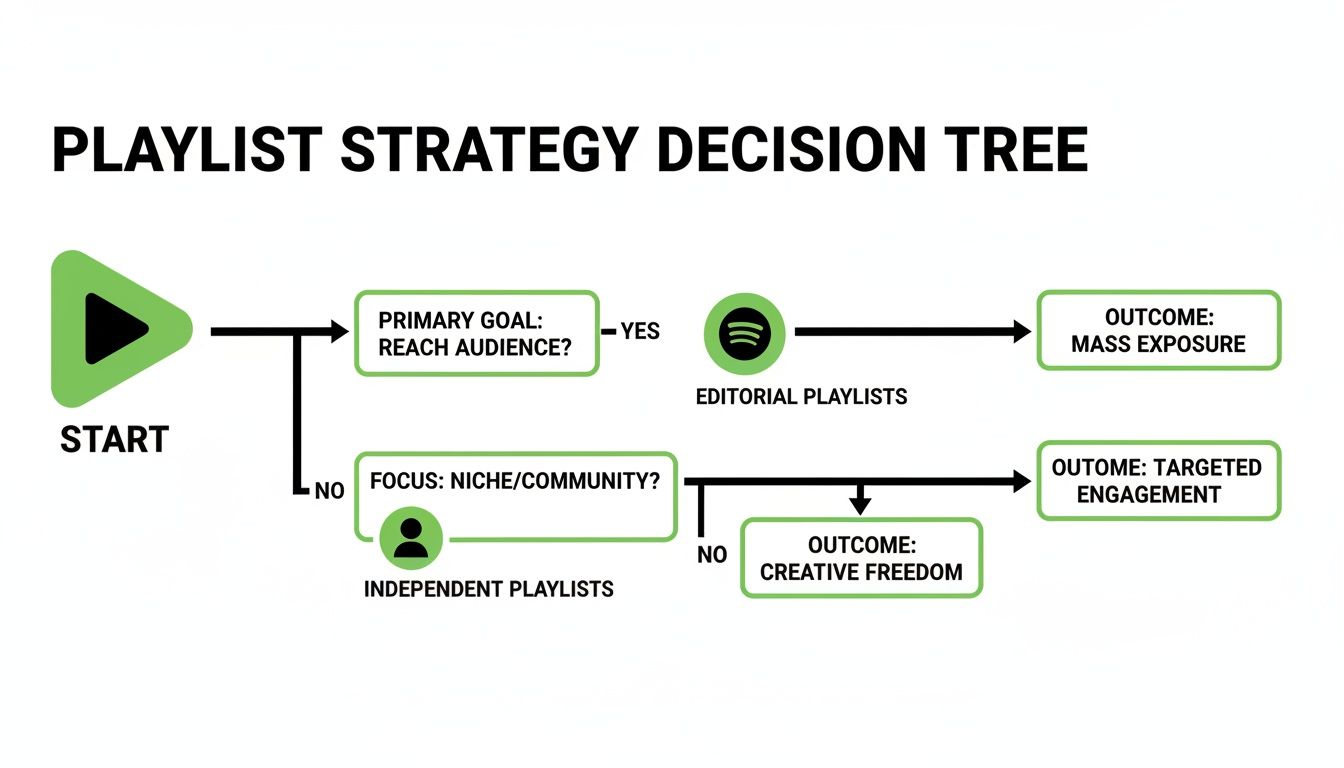
As illustrated, the path to official Spotify playlists is often paved with a compelling narrative of fan engagement generated on high-quality independent lists.
Sizing Up a Curator's Digital Footprint
Your vetting process should begin well before you analyze their Spotify profile. A legitimate curator with a genuine audience almost invariably maintains a broader digital ecosystem around their brand.
Key indicators of legitimacy include:
A Professional Website or Active Social Media: Serious curators maintain a professional online presence. Look for consistent branding, recent activity, and evidence of a real community.
Real Audience Engagement: Analyze the quality of engagement, not just the quantity. Are comments generic ("nice track!") or are they substantive contributions from other artists and music enthusiasts? Authentic dialogue is a significant positive indicator.
Clear Submission Rules: Professionals operate with established processes. Vague submission guidelines or an invitation to simply "DM me" can signal a low-value, unprofessional operation.
If a curator's online presence is limited to their Spotify profile, it constitutes a major red flag. The risk is too high to proceed.
A playlist without a verifiable digital presence is like an investment with no prospectus. The potential for hidden risks is simply too high for a professional artist's promotional budget.
Using Data to Verify a Playlist's Health
This is the critical stage where you differentiate playlists with organic listeners from those inflated by bots and click farms. Placement on a fraudulent list doesn't just waste your budget; it can lead to takedowns by your distributor.
Considering that 68% of Spotify users discover new artists via playlists, verifying playlist health is paramount. Modern tools allow you to access a playlist's complete follower history, enabling you to distinguish between steady, organic growth and suspicious, overnight spikes. A playlist's health score—which indicates the percentage of artists on the list who have it in their 'Discovered On' section—is another crucial metric. If a playlist isn't driving discovery, it isn't driving real streams.
Here is a simple framework for verifying a playlist's vitals:
Analyze Follower Growth Charts: A smooth, gradual upward trend indicates organic growth. A sudden, massive jump in followers is a classic sign of bot activity.
Check the 'Discovered On' Metric: This is one of the most reliable indicators available. If a playlist is genuinely contributing to artist discovery, it will appear in the "Discovered On" section of their profiles within Spotify for Artists. Its absence suggests a lack of real listeners.
Look at Track History and Turnover: Does the curator regularly update the playlist? A static playlist is a dead playlist, indicating an inactive curator and a disengaged audience.
This level of due diligence is no longer optional. For a more detailed examination of these tactics, review our guide on how to detect fake Spotify playlists and avoid scams. Protecting your music from fraudulent streams is the single most critical action you can take to ensure long-term career viability.
Mastering Your Curator Pitching Strategy
Once you have identified and vetted a list of high-quality curators, the next phase is the pitch. This is a frequent point of failure for many artists.
Effective pitching is not about mass-emailing a generic template. That approach is not only ineffective but can damage your professional reputation. The goal is to establish a professional, repeatable process that ensures your music is heard. This requires moving beyond simple mail-merge personalization.
Every communication you send must present a concise, compelling argument for why your track is an ideal fit for their specific Spotify curator playlist.
Crafting a Professional and Concise Pitch
Curators are inundated with submissions, often receiving hundreds or thousands of emails weekly. Your pitch must be differentiated by its efficiency and respect for their time.
Dispense with lengthy artist narratives or appeals for a "chance." Such content typically results in immediate deletion. The key is to provide all necessary information for a swift, informed decision. Shift your mindset from that of a petitioner to a professional colleague offering a high-quality track that will enhance their playlist and resonate with their audience. This confidence is palpable and professional.
The Anatomy of an Effective Outreach Message
A successful pitch is structured for clarity and ease of use, which increases the likelihood of a listen.
A proven, effective formula includes:
A Specific, Informative Subject Line: Eliminate ambiguity. "Submission: [Your Artist Name] - [Your Song Title] (For [Playlist Name])" is optimal, presenting all critical information upfront.
A Brief, Personalized Introduction: Demonstrate that you have done your research. Mention the playlist by name and state in a single sentence why your track aligns with its specific sonic identity.
The Core Pitch (The "Why"): This is your one-to-two-sentence elevator pitch. Define the genre, mood, and feel of your track. Referencing one or two well-known, comparable artists provides an immediate sonic reference point.
A Clear, Direct Link: Provide a single, clean Spotify link to the track. Avoid attachments, download links, or landing pages with multiple options. One click to listen is the goal.
A Professional Closing: Keep it brief. "Thank you for your time and consideration" is sufficient and professional.
Your pitch email is your professional handshake. A concise, well-researched message communicates that you are a serious artist who understands the industry, respects the curator's role, and is confident in the quality of your music.
Ultimately, effective outreach is about systemization. While a platform like SubmitLink can manage the heavy lifting of vetting and delivery, understanding these communication principles is essential for building meaningful industry relationships. Whether executed manually or through a service, a strategic approach ensures every submission reinforces your professional standing.
For a more detailed analysis of the submission process, refer to our guide on how to submit to Spotify playlists for additional best practices.
Measuring the True ROI of a Playlist Placement
Securing a spot on a Spotify curator playlist is not the endpoint; it is the beginning of the data analysis phase. The real value is derived from analyzing the performance data that the placement generates.
Dismiss vanity metrics like follower counts, which are often misleading. True ROI is measured by key performance indicators (KPIs) that directly influence the Spotify algorithm: skip rates, save rates, and listener source data. This is the language the algorithm understands, and fluency is essential for sustainable growth.

This data-centric approach is what distinguishes a professional promotion strategy from an amateur one. It is how you identify curators who deliver genuinely engaged listeners—the kind that send powerful, positive signals to Spotify and increase your probability of landing on algorithmic playlists like Discover Weekly.
Key Metrics That Define a Successful Placement
Once your track is live, your Spotify for Artists dashboard becomes your primary analytical tool. Focus on the metrics that reveal genuine listener interaction rather than raw stream counts.
These core metrics provide the most accurate assessment of performance:
Save Rate: This is arguably the most critical positive signal. A listener saving your track to their library is a direct indication of high engagement and a powerful driver for algorithmic playlist consideration.
Skip Rate: A high skip rate, particularly within the first 30 seconds, is a significant negative signal that indicates a poor audience fit. Excessive skips can actively harm your track's algorithmic standing.
Playlist Adds: When listeners add your song to their own playlists, it signifies a transition from passive discovery to active engagement. This is a powerful endorsement of your music.
Source of Streams: Analyzing where your streams originate validates a placement's effectiveness. A significant percentage of streams should be directly attributable to the curator's playlist, confirming its legitimacy and activity.
Monitoring these KPIs allows you to establish performance benchmarks, transforming your promotional budget from speculative spending into a series of calculated, strategic investments.
Think of a playlist placement as a focus group. It’s not just about getting heard; it’s about gathering intelligence on who connects with your music and why. You then use that data to make your next move even smarter.
Translating Data into Actionable Strategy
Performance data is only valuable when it informs future decisions. A playlist that delivers a low skip rate and a high save rate has identified a valuable audience segment. This is a clear signal to cultivate that curatorial relationship and seek out others with similar listener profiles.
Conversely, a placement that generates a brief stream spike followed by a high skip rate is a failed investment. It is critical to identify these underperforming assets quickly, disengage, and reallocate your budget. This disciplined approach prevents you from funding campaigns that are actively damaging your algorithmic reputation.
The playlisting ecosystem is vast. An estimated 68% of Spotify users utilize playlists for music discovery. With tools tracking over 12 million curators, your ability to analyze performance data is your primary competitive advantage. User-generated playlists alone drive 36% of all listening hours on the platform—more than double the share of Spotify's editorial lists—proving the immense power of the independent sector. For further analysis, you can discover more insights on the best playlist discovery tools for artists at artist.tools.
By adopting an analytical mindset, your playlisting efforts evolve from a series of disconnected gambles into a cohesive, intelligent promotional engine that drives long-term growth for your entire catalog.
How to Scale Your Strategy with a Vetted Network
Manual outreach is effective for establishing initial, high-value relationships, but it is not a sustainable model for a growing career. As your release frequency increases, the time invested in finding, vetting, and pitching individual curators becomes a significant operational bottleneck. This necessitates a transition from a manual process to a system engineered for both volume and quality.
Effective scaling requires simultaneously achieving three objectives: access to a large pool of legitimate curators, a reliable feedback loop, and integrated risk management. Simply increasing the volume of cold outreach is an inefficient strategy that yields diminishing returns and increases your exposure to fraudulent playlists.
Your scaling options—hiring a PR agency, utilizing a curated platform, or building an in-house system—each present different trade-offs in terms of cost, time investment, and control.
Choosing Your Scaling Model
For a professional artist, selecting a scaling model is about optimizing the balance between efficiency and quality control. PR agencies can offload the work but often lack transparency and come with high retainer fees. Building an in-house team represents a significant operational and financial commitment. Consequently, curated submission platforms have emerged as a powerful solution.
A high-quality platform provides immediate access to a pre-vetted network of curators, effectively outsourcing the most labor-intensive aspect of the process: due diligence. Instead of spending days investigating a single curator, you can select from a roster of hundreds who have already passed a rigorous screening process.
However, not all platforms are created equal. The critical differentiators are the quality of the curator network and the robustness of the platform's protective safeguards.
A scalable strategy isn't just about sending more pitches. It's about creating a system that makes your outcomes better and more predictable as you invest more into it. That requires a network built on solid verification and data, not just open access.
The Power of a Pre-Vetted Network
A pre-vetted network fundamentally alters the playlist pitching dynamic, shifting the process from one of speculation and risk to one of confidence and efficiency. You are no longer searching for a needle in a haystack but selecting from a catalog of verified partners.
This model offers significant strategic advantages:
Built-in Risk Management: Premier platforms integrate robust bot detection and fraud monitoring. A system like SubmitLink, for example, is backed by the same bot-detection technology trusted by major distributors, adding a critical layer of security to your campaigns. You are operating within an ecosystem designed to filter out bad actors.
Guaranteed Feedback: A primary frustration of manual outreach is the lack of response. A vetted network often mandates curator feedback, ensuring you receive a response for every submission. This closes the communication loop and provides valuable data, even from rejections.
Transparent Metrics: You gain access to meaningful performance data, such as average acceptance rates and genre specializations, allowing you to move beyond vanity metrics like follower counts and make smarter, data-driven investment decisions.
The sheer scale of the independent curator landscape—over 12 million curators across major platforms—makes a vetted system a practical necessity. User-generated playlists on Spotify drive 36% of all listening hours, which is 2.5 times the impact of official editorial playlists. Tapping into this power requires a tool that can effectively filter the noise and connect you with curators who deliver measurable results.
By leveraging a platform with these safeguards, you transition your playlisting from a series of high-effort gambles to a scalable, predictable marketing channel. This enables you to execute high-volume campaigns with the transparency and measurable ROI that a professional career demands, all while protecting your assets as you grow.
Integrating Playlisting into Your Release Campaign
An effective Spotify playlist strategy cannot exist in isolation; it must be a fully integrated component of your comprehensive release plan. Treating playlisting as a separate, last-minute activity is a strategic error. For maximum impact, your curator outreach must be synchronized with your PR, social media, and advertising efforts to create a self-reinforcing cycle of momentum.
This integrated approach elevates a simple playlist placement from a stream source to a strategic asset. Each placement serves as social proof—a third-party endorsement of your music that can be amplified across all your marketing channels. The goal is to build a snowball effect, where each small victory fuels the next.
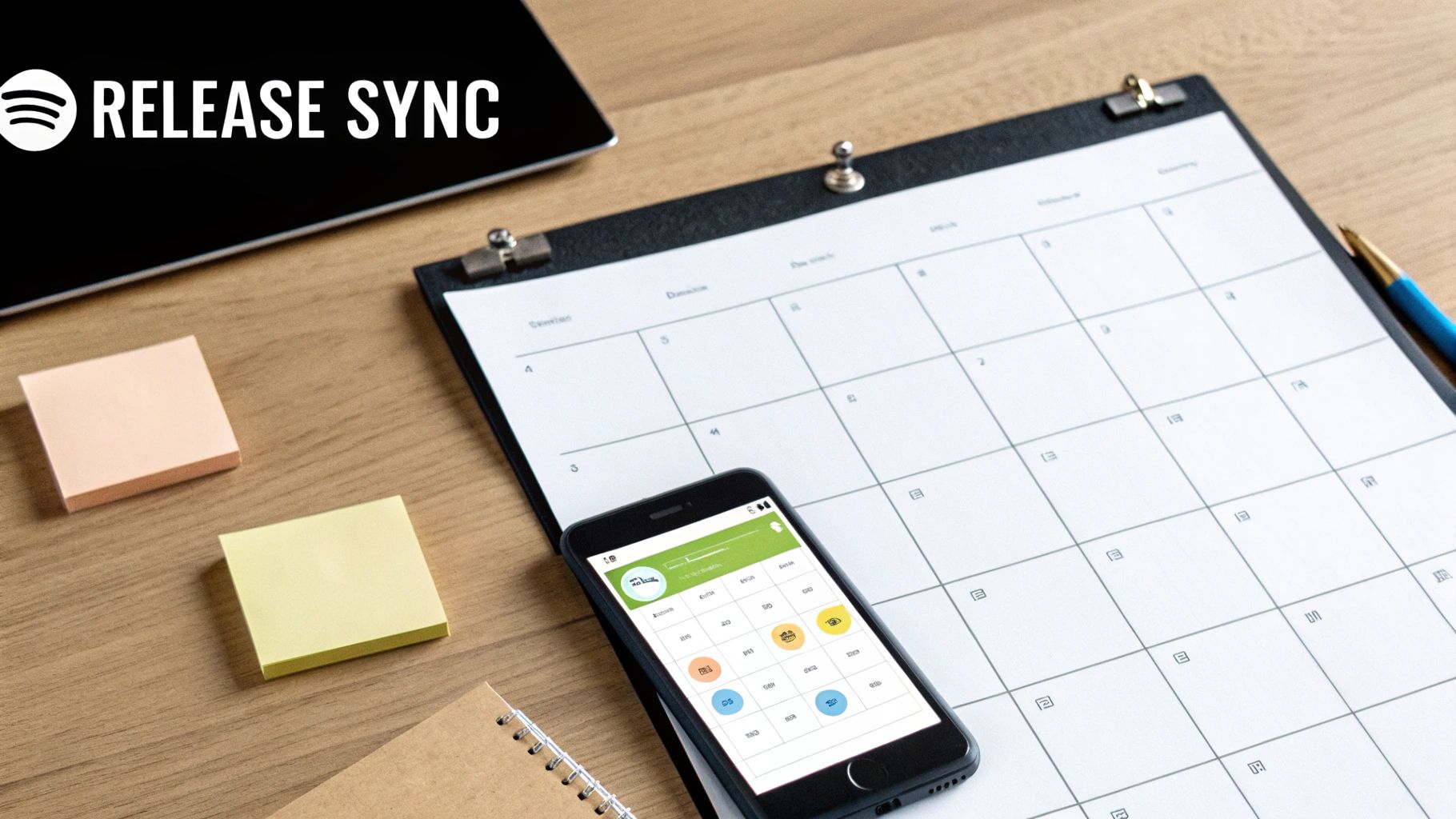
By weaving your spotify curator playlist campaign into your master plan, each placement contributes not just to stream counts but to the long-term development of your audience and brand.
Synchronizing Your Campaign Timeline
Timing is critical in a release cycle. Playlist pitching should be meticulously scheduled to build anticipation and peak on release day, ensuring you capitalize on all potential streams, data points, and algorithmic opportunities.
A standard professional timeline for playlisting integration:
4-6 Weeks Pre-Release: The research and preparation phase. Begin identifying and vetting curators and assemble your pitch assets.
2-4 Weeks Pre-Release: Initiate outreach to your priority list of independent curators. This lead time is crucial for securing placements that go live concurrently with your track's release. For a deep dive into making the most of this window, check out our guide on how to presave on Spotify and maximize your release day impact.
Release Week: Focus on follow-ups and monitoring initial placements. This is also the optimal time to submit to Spotify's editorial team via your Spotify for Artists dashboard, leveraging early traction from independent playlists as proof of concept.
Leveraging Placements as Marketing Assets
Consider every playlist placement a modern-day press clipping. An addition by a respected curator is an endorsement that should be immediately amplified across your channels. This creates a positive feedback loop: promoting the placement drives more engagement, which in turn creates more opportunities.
Treat each placement as a strategic win. A screenshot of your track in a popular playlist shared on social media is not just a celebratory post; it's a piece of targeted marketing that reinforces your track's momentum and credibility.
Furthermore, the data generated from these placements is invaluable. Listener demographics and geolocations from a successful placement can directly inform your ad targeting on platforms like Meta or TikTok. If a lo-fi playlist in Brazil generates high save rates, you have identified a new, high-potential market to target with your advertising budget. This is how you create a cohesive marketing engine where every component works in concert, maximizing the efficiency of your budget and building a truly global audience.
Your Top Questions, Answered
Even for seasoned professionals, nuances in playlisting strategy can raise questions. Here are concise answers to common inquiries regarding budgets, realistic outcomes, and influencing Spotify's editorial process.
How Much Should a Professional Artist Budget for a Playlist Campaign?
Frame this not as "buying streams," but as a strategic investment in audience acquisition and data gathering. For a single track, an initial budget of $300 to $1,000 is a reasonable starting point.
This range allows for meaningful engagement with a significant number of vetted, mid-tier independent curators. It is sufficient to test various playlist niches and identify what resonates, particularly when using platforms with a pay-per-submission model. This ensures complete control over your budget, focusing your investment on curators who deliver genuine, engaged listeners.
What's a Realistic Stream Count from an Independent Curator?
The focus must be on the quality of streams, not the raw quantity. A high-quality placement on a legitimate playlist with 20,000 engaged followers might yield 2,000 to 8,000 genuine streams over several weeks. These numbers should not be underestimated.
The most important metric isn't the total stream count. It's the high save rate and low skip rate that come with them. A shady playlist that sends 50,000 bot streams will wreck your algorithm, while 2,000 streams from people who truly love your sound is pure gold.
How Can Indie Placements Help Me Get on Editorial Playlists?
Spotify's editors are data-driven. Strong, organic performance on high-quality independent playlists is one of the most powerful signals you can provide.
When the algorithm detects that your track is generating high save rates, low skip rates, and numerous additions to personal libraries, it flags the song as having significant listener appeal. This empirical data serves as undeniable proof of concept, making your track a far more compelling and lower-risk proposition when you submit it for editorial consideration via your Spotify for Artists dashboard.
Ready to move from speculative outreach to strategic partnerships with trusted curators? SubmitLink provides access to a network of hundreds of vetted playlist partners, protected by industry-leading bot detection. Eliminate risk and build a more intelligent promotion strategy backed by verifiable data. Find your perfect playlist match on SubmitLink today.


