.png)
How to Get More Spotify Listeners A Guide for Artists
- Jan 3
- 17 min read
Your Spotify profile is your digital business card, your press kit, and your fan club headquarters all rolled into one. Before you even think about promotion or pitching, getting this foundation right is non-negotiable. It's the first impression you make on potential fans, playlist curators, and industry folks, so make it count.
Building Your Foundation on Spotify for Artists
Think of your Spotify for Artists profile as your storefront. If the windows are dirty and the shelves are empty, no one's coming inside. A polished, complete profile signals that you're a serious artist, which is the first hurdle to clear when trying to win over listeners and curators.
This idea of a strong home base isn't unique to Spotify; you can see similar general strategies for rapid platform growth that work everywhere. It all comes down to building a brand, not just a place to dump your tracks.
Craft a Compelling Artist Bio
This is your story, so tell it. Your bio is the perfect spot to turn a casual listener into a real fan by giving them something to connect with. Ditch the stiff, third-person press release style. Write like you talk and let your personality shine.
Your Origin Story: Where did you come from? What moment lit the fire for you to make music? People love a good backstory.
Your Sound, Your Words: Go beyond just listing genres. Use vivid language to describe your music and influences. Help someone who's never heard you before feel what your music is about.
What's Happening Now: Got a new album on the way? A tour coming up? Mention it! Showing momentum makes people want to jump on board.
Remember, only the first few sentences show up as a preview. Hook them in right away, and they’ll be much more likely to hit that "Follow" button instead of clicking away.
Strategically Use Your Artist Pick
That Artist Pick section at the top of your profile is prime real estate, but it’s amazing how many artists let it gather dust. It’s your billboard, letting you pin a track, album, or playlist right where everyone can see it.
Your Artist Pick is so much more than a spot for your latest single. Use it to announce tour dates with a ticket link, show off a cool collaboration, or share a playlist of your biggest influences. It's a living part of your profile that you should be updating all the time.
For instance, when you drop a new single, pin it there. Land a spot on a big playlist? Pin that playlist to show off the social proof. If you've got a gig in Nashville, you can even create a custom graphic with the date and time and link it to the ticket page. This keeps your profile from feeling static and gives fans a reason to keep checking back.
The Power of High-Quality Visuals
Your profile picture, header, and image gallery are non-negotiable. Nothing screams "amateur" faster than blurry, low-res photos. It's worth investing in a real photoshoot, but at a minimum, use a good camera and get some clean shots that truly reflect your brand.
Your visuals need to match your sound. If you're an indie folk artist, your photos shouldn't look like they belong to a trap producer. This cohesion helps build a strong, memorable identity around your music.
Engage Listeners with Canvas
Don't sleep on Canvas. This feature lets you add a short, 3-8 second looping video to your tracks, and it makes a huge difference. Spotify's own data shows that tracks with a Canvas get more shares and saves. It's a simple way to grab someone's attention beyond just the album art.
You can create simple but eye-catching loops from music video clips, animations, or even abstract visuals that fit the song's mood. The goal here is to make your track an experience, turning a passive stream into something far more immersive and unforgettable.
Planning Your Release for Maximum Impact
Just tossing your music onto Spotify and crossing your fingers is a surefire way to get lost in the noise. A successful release isn't about luck; it's a calculated campaign designed to build the kind of momentum the Spotify algorithm loves to see. The real work to grow your listeners begins weeks, sometimes months, before your track even hits the platform.
It all starts with one of the most critical steps in the entire process: pitching your song directly to Spotify's editorial team. This is non-negotiable. You have to submit your track through the Spotify for Artists dashboard at least a week before it goes live, but honestly, that’s cutting it close. The artists I see getting results are giving editors four to six weeks' notice.
That longer lead time is your best shot at getting a real listen from the people who curate major playlists like Fresh Finds or Lorem. Rushing this is probably the single biggest rookie mistake I see artists make. Give them time to live with your track.
Nailing Your Pitch to Spotify Editors
When you submit your song, you get a tiny text box to make your case. This is your one shot to grab an editor's attention, so don't blow it with something generic like, "Here's my new song, hope you like it!"
Think of this as your elevator pitch. You need to tell a compelling story, and you need to do it fast.
Vibe & Instrumentation: Get specific. Don't just say "rock song." Is it a "gritty garage-rock track driven by a fuzzy bassline" or a "melancholic indie-folk tune built around acoustic guitar and cello"? Paint a picture.
Artist Comps: Name 1-2 artists you genuinely sound like. This is a mental shortcut for curators, immediately telling them where you might fit in their world.
Your Story & Momentum: Have you been featured on a blog? Are you about to head out on tour? Mention any recent wins or upcoming plans to show that you're an active, working artist with a story.
You have mere seconds to communicate the song's entire vibe and prove it deserves a spot on a high-traffic playlist. Make every word count.
The Magic of a Pre-Save Campaign
While the editors are considering your pitch, your job is far from over. Now it's time to rally your fans with a pre-save campaign. A pre-save is exactly what it sounds like: it lets your listeners save your track to their library before it's even out, so it appears automatically for them on release day.
Setting one up is simple with tools like DistroKid's HyperFollow or other smart link services. Once you have your link, you need to push it everywhere—on social media, in your email newsletter, and on your website.
So, why bother? Because a wave of saves and streams right at midnight on release day sends a massive signal to Spotify's algorithm. It tells the system there’s a built-in audience waiting for your music, which can be the trigger for landing on powerful algorithmic playlists like Discover Weekly and Release Radar.
The goal for release day is to create a huge spike in activity. A well-executed pre-save campaign is how you manufacture that spike, essentially telling Spotify, "Hey, pay attention to this one."
Why You Should Use the "Waterfall" Strategy
The old-school album cycle—disappearing for a year to record, then dropping 12 songs at once—is becoming less effective in the streaming era. Today, it’s all about consistency, which is where the waterfall strategy comes in.
Instead of one big drop, you release a series of singles over several months, with each new song getting bundled with the previous ones. It looks something like this:
Month 1: Release "Single A."
Month 2: Release "Single B" as a 2-track single that also includes "Single A."
Month 3: Release "Single C" as a 3-track EP, now with both A and B.
This strategy keeps you constantly in front of your audience and, more importantly, keeps you feeding new music to the Spotify algorithm. It gives you multiple "at-bats" for pitching to editorial playlists and builds a slow, steady drumbeat of engagement that keeps fans hooked. You're growing your listener base piece by piece, not just hoping for one massive, high-stakes splash.
The potential audience for this has never been bigger. Spotify's user base has absolutely exploded, hitting 696 million monthly active users as of Q2 2025. That's a mind-boggling 102% increase in less than five years. With an addressable market that has literally doubled, a smart release strategy is your key to cutting through the noise. You can dig deeper into these numbers by exploring the latest Spotify statistics and trends.
Navigating the World of Playlist Pitching
Getting your music onto the right playlists can be a rocket ship for your streaming numbers. It's one of the fastest ways to get in front of new ears. But let's be real—this territory is also a minefield. For every legit curator who genuinely wants to find the next great track, there are a dozen fake, bot-filled playlists that can get your music flagged or even your entire artist account shut down.
Successful pitching isn't about carpet-bombing every email address you can find. It’s a game of strategy and targeted outreach. It all starts with knowing how to spot the fakes from the real opportunities, because protecting your music and your reputation has to come first.
Spotting and Avoiding Fraudulent Playlists
The promise of a quick jump in streams is incredibly tempting, I get it. But the risk of getting tangled up with a bot-driven playlist just isn't worth it. Spotify's algorithms are smarter than ever at sniffing out artificial streams. If your track gets flagged, you could see it pulled down, have your royalties withheld, or get a formal strike against your account.
Here are the dead giveaways of a fraudulent playlist that you need to run from:
Pay-for-Placement Guarantees: This is the big one. Real curators never guarantee a spot for cash. Some submission platforms charge a small fee for their time to review your track, which is fine. But a flat-out promise of "pay us $50 and you're in" is a scam. Period.
Fishy Follower-to-Stream Ratios: A playlist with 50,000 followers where every song has less than 1,000 plays is a massive red flag. The math just doesn't add up. Use a tool like Chartmetric to check a playlist's follower history—if you see a giant, unnatural spike overnight, those are likely paid bots.
Super Generic Playlist Names: Scammers love titles like "Global Top Hits 2024" or "Viral TikTok Songs." They're trying to trick you with keywords. Authentic playlists curated by real people usually have more creative, vibe-specific names that show some personality.
A Total Genre Mash-up: If you see a playlist that throws death metal, ambient synth, and country pop together, it's not a thoughtfully curated list for real listeners. It's just a dumping ground for anyone who pays the fee.
When you're checking out a playlist, trust your gut. If the curator’s profile looks sketchy, the engagement feels off, or the communication is unprofessional and pushy, just walk away. Your artist account is way more valuable than a short-lived, fake stream count.
To make it even clearer, here’s a quick rundown of what to look for versus what to avoid.
Red Flags vs Green Flags in Playlist Curation
This table is your quick-glance guide to vetting playlist opportunities. Think of it as a checklist to run through before you even think about sending that pitch email. It helps you separate the time-wasters and scammers from the curators who can actually make a difference.
Characteristic | Red Flag (Avoid) | Green Flag (Proceed with Caution) |
|---|---|---|
Payment Model | Guarantees placement for a fee ("pay-to-play"). | May charge a small submission fee for review, with no guarantee of placement. |
Follower Growth | Sudden, massive spikes in followers overnight. | Steady, organic growth over months or years. |
Engagement | Very high follower count but suspiciously low plays on recent songs. | Follower count is proportional to the average number of plays per track. |
Curation Style | A chaotic mix of completely unrelated genres. | A clear, consistent theme, mood, or niche genre. |
Curator's Presence | Anonymous or fake-looking social media profiles. | An active, public profile (social media, website) showing a passion for music. |
Communication | Unprofessional, spammy emails with spelling/grammar errors. | Personalized, professional communication that shows they've listened. |
Always remember, even with all the green flags, you still need to do your homework. But this framework will help you immediately filter out the most obvious scams.
Building Genuine Connections with Curators
Once you've trained your eye to spot the fakes, you can focus on what really matters: finding and connecting with real, passionate curators. These are the people who can become true advocates for your music. Unlike a bot farm, a great curator has built an audience that trusts their taste, which means a placement with them brings you real, engaged fans—not just empty numbers.
Your release timeline plays a huge part in this, especially if you’re also trying to get the attention of Spotify's official editors. Think of your strategy like this:
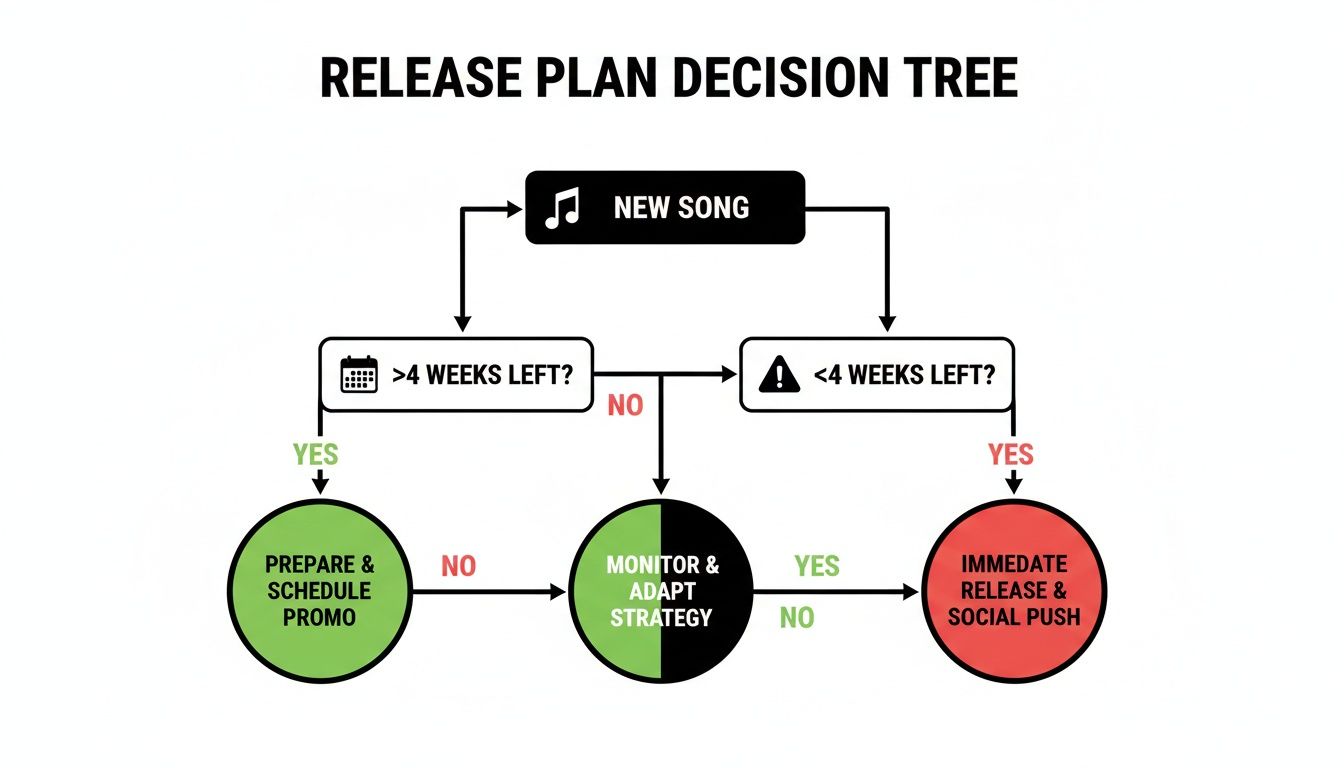
As you can see, giving yourself more than four weeks before release day is the sweet spot. It gives you plenty of time to pitch to both editorial and independent playlists without feeling rushed or desperate.
The secret to actually getting a response is personalization. Curators get buried in hundreds of submissions every week. A generic, copy-pasted email is a one-way ticket to their trash folder.
Do Your Homework: Actually listen to their playlist. In your email, mention a specific artist or song you liked and explain (briefly!) why your track would be a great fit alongside it.
Keep it Short & Sweet: Get to the point. Introduce yourself, drop the link to your unreleased track, and write a one- or two-sentence pitch that nails the song's vibe and genre.
Make Their Life Easy: Always, always use a direct Spotify link (you can get this for your unreleased track in Spotify for Artists). Don't make them download files or hunt for your music.
Using Trusted Platforms for Safe Outreach
Let's be honest, finding and vetting curators one by one can feel like a full-time job. That's where trusted submission platforms can be a lifesaver, acting as a bridge between you and a network of verified curators. They're designed to filter out the scammers so you can focus on legitimate opportunities.
These platforms essentially do the dirty work for you. They use their own systems to check for bots and verify that the playlists in their network are driven by real, engaged listeners. They provide a much safer and more efficient way to get your music out there. For a more detailed look at this approach, you might find our guide on getting on Spotify playlists using proven strategies to grow your listeners helpful.
Using a reputable platform saves you a ton of time, but more importantly, it adds a crucial layer of security to your promotion. This frees you up to focus on what you do best: making great music and building a real connection with fans.
Feed the Algorithm by Driving External Traffic
Landing a great playlist is a huge win, but it’s really just one piece of the puzzle. If you want to build sustainable growth and get more listeners on Spotify, you have to prove your music has a life outside the platform. The goal is to create a powerful feedback loop: real-world buzz from outside Spotify drives discovery inside Spotify.
When the algorithm sees people clicking through from your Instagram Stories, your email newsletter, or a blog feature, it takes notice. This isn't just passive listening from a playlist; it's a clear signal that people are actively seeking out your song. This kind of traffic is exactly what wakes up powerful algorithmic playlists like Discover Weekly and Release Radar.
Get Seen and Heard with Short-Form Video
Right now, TikTok and Instagram Reels are arguably the biggest music discovery engines on the planet. A song can blow up and pull in millions of streams overnight, but you don't need to go viral to make a real difference. Consistently creating solid, engaging video content is non-negotiable for any artist today.
The trick is to make your music the star of the show without coming off like a walking advertisement. You have to create content that feels natural on these platforms—jump on a trend, share a bit of your creative process, tell a story that connects with the song's lyrics.
Create Your Own "Sound": Snip a catchy 15-second part of your track and upload it so others can easily use it in their own videos. Make it the hookiest part.
Show, Don't Just Tell: Ditch the static "new song out now" posts with your album art. Instead, show yourself writing the hook, explain the real story behind a specific lyric, or film a moody visual that captures the song's vibe.
Ride the Trend Wave: Find a popular video format or meme and put your own spin on it with your track as the soundtrack. This lets you tap into a pre-existing conversation and helps new people find you.
Knowing how these platforms work is a massive advantage. For a deeper dive, it’s worth understanding the TikTok algorithm to see what kind of content gets pushed to more people.
Run Targeted Ads on a Lean Budget
The thought of running paid ads can be intimidating, but you don't need a massive budget to see results. You can run incredibly specific campaigns on Instagram and Facebook for as little as $5 per day. The point isn't to reach everyone; it's to reach the right people.
The most effective approach I've seen is targeting fans of artists who sound like you. Set up your ad to target people who follow 3-5 artists in your specific niche. You can also create "lookalike" audiences based on people who already follow you or visit your website.
Your ad needs to be visually arresting. Use a short clip from a music video or a high-energy live performance. The goal is to stop their scroll and make them think, "Whoa, I need to hear the rest of this."
This kind of direct-to-fan advertising helps you find genuine listeners who are far more likely to save your song, follow your profile, and dig into your back catalog.
Rally Your True Fans with Email
Never underestimate the power of your email list. It's one of the few promotional channels you actually own. These aren't just followers; they're people who have explicitly asked to hear from you. They are your core, and on release day, you need to rally them.
The moment your song is live, send out an email. Keep it simple and give them a clear mission with two specific asks:
Go stream the new song right now.
Save it to their library or add it to one of their own playlists.
This coordinated burst of activity from your most dedicated fans sends a massive spike of positive data to the Spotify algorithm. It’s an authentic, powerful signal that real people are excited about your music. And while you're exploring ways to drive traffic, checking out some of the best free music promotion sites for artists in 2025 can open up even more avenues.
By pulling in listeners from different sources, you're building a much healthier, more sustainable way to grow. You’re not just hoping for a lucky playlist placement; you're actively building a real audience and proving to Spotify that your music demands to be heard.
Turning Data Into Dedicated Fans
It’s an amazing feeling to see a huge spike in your streams, right? But what happens when that big playlist feature ends? The real goal here isn't just getting one-time plays; it's about turning those casual listeners into a dedicated fanbase that actually sticks around for the long haul.
This is where you shift from chasing temporary numbers to building a real, sustainable career. By getting to know who is listening, where they're from, and how they found you, you can make smarter moves that build genuine loyalty. Your Spotify for Artists dashboard is your playbook for this.
Unlocking Your Listener Data
Your Spotify for Artists dashboard is overflowing with information, and honestly, it can be a bit overwhelming at first. The trick is to focus on a few key areas that give you truly actionable insights. Don't just glance at the numbers—look for the stories they're telling you about your audience.
Jump into the "Audience" tab. This place is a goldmine. I'd recommend paying close attention to these three sections:
Source of Streams: This tells you how people are finding your music. Is it from your artist profile? Their own playlists? Or is it Spotify’s algorithmic and editorial machine? This is critical information.
Listener Demographics: Here's where you see the age, gender, and location of your listeners. Knowing your top cities is non-negotiable for planning tours or running targeted social media ads that actually work.
Listeners Also Like: This is my personal favorite. It shows you what other artists your fans have on repeat. It's a perfect cheat sheet for finding potential collaborators or figuring out who to target in your ad campaigns.
If you're curious about how these taste profiles come together, you can even explore tools like the Spotify Pie Chart and how it works. It's a fun way to visualize the genre DNA of your listeners, which can spark some interesting creative ideas.
Identifying Your "Super Listeners"
Let's be real: not all streams are created equal. Spotify has a special term for your most die-hard fans: "super listeners." These are the people who don't just passively hear your song; they actively seek you out. They visit your profile, save your tracks, and add your music to their personal playlists.
Spotify's own data shows that super listeners might only be 2% of an artist's monthly audience, but they drive an incredible 18% of total streams. These people are the core of your fanbase.
Think of them as your champions. They're the ones who buy merch, show up to your gigs, and tell their friends about your music. Your mission is to figure out who these people are and serve them better, because they are the foundation you can build a career on.
Converting Casual Streams into Active Fans
Okay, so you know who's listening and how they found you. Now what? The next step is to build a bridge that moves them from being passive listeners to active fans. This is all about creating a real connection and giving people a reason to do more than just hit "play."
Your data should directly guide your actions. For instance, if you see a huge jump in streams from an editorial playlist, you have a limited window of opportunity to capture the attention of all those new ears.
Here are a few practical ways to nurture that deeper engagement:
Be Direct. On social media, don't just post "new song out." Instead, try something like, "If you're digging the new track, please hit 'Follow' on Spotify and save it to your library. It helps more than you know!" A clear call-to-action works.
Build a Hub. Create a dedicated space for your core fans on a platform like Discord or a private Facebook Group. This is where you can share behind-the-scenes content and give them early access to news. Make them feel like insiders.
Engage Your Top Cities. If your data shows a massive following in Chicago, run a targeted ad for listeners in that area. Better yet, plan a show there. Making your fans feel seen is one of the most powerful ways to turn them into lifelong supporters.
By consistently checking your data and taking action on what you find, you create a powerful growth loop. You attract new listeners, turn them into engaged fans, and then use the insights from those fans to find even more people just like them.
Got Questions? Let's Talk Spotify Growth
When you're trying to grow your audience on Spotify, you're bound to run into some tough questions. It's easy to get bogged down by all the conflicting advice out there. Getting straight answers helps you put your energy where it actually counts, so let's clear up a few of the most common hurdles artists face.
How Long Does It Really Take to See Growth?
This is the big one, isn't it? While everyone wants a magic number, the honest answer is that you should expect to see real, meaningful traction after three to six months of consistent work.
Sure, a lucky playlist add can give you a quick spike in streams, but sustainable growth is a slow burn. It’s built on the back of great music, a professional-looking profile, and a steady drumbeat of promotion. Think of it less like a lottery ticket and more like building a snowball. Each release adds another layer, and over time, that momentum really starts to build.
What's a Realistic Promotion Budget for an Indie Artist?
You don’t need a major label budget to make a dent. For a single campaign, starting with $50 to $100 is a perfectly reasonable and effective starting point for an independent artist. Seriously, you can get a lot done with that if you're smart about it.
It’s not about how much you spend, but how you spend it. I'd take a small, laser-focused ad campaign over a huge, scattershot one any day of the week.
That initial budget could fuel a small but mighty social media ad campaign targeting fans of artists who sound like you. Or, it could cover a few submissions to reputable playlisting services. The key is to start small, see what moves the needle, and then reinvest what you earn back into your next campaign. That's how you scale without going broke.
How Can I Spot a Fake, Botted Playlist?
This is a crucial skill to develop. Getting tangled up with a bot-fueled playlist is worse than a waste of money—it can get your music flagged or even pulled down by Spotify. Thankfully, the fakes usually leave a trail of breadcrumbs.
Keep an eye out for these tell-tale signs of bot activity:
The Numbers Don't Add Up: A playlist has thousands of followers, but the songs on it have weirdly low stream counts or very few saves? Huge red flag.
Generic, Keyword-Stuffed Titles: Be cautious of playlists with names like "Top Hits 2024" or "Viral Pop Songs." They’re often designed to trap desperate artists, not serve real listeners.
Genre Whiplash: If a playlist jumps from death metal to lo-fi beats to country pop, it’s a mess. No real person listens like that.
A legit playlist almost always has a cohesive theme, an engaged community of listeners, and a curator with a real, verifiable online presence. Always trust your gut—if an offer seems too good to be true, it is.
Ready to connect with real curators and leave the bots behind? SubmitLink offers a vetted network of playlist curators, all protected by industry-leading bot detection. Start pitching your music with confidence. Find your next authentic playlist placement at https://submitlink.io.


