.png)
Your Guide to the Best Spotify Playlist Promotion
- Jan 7
- 16 min read
Getting your music on the right Spotify playlists starts long before you send your first pitch. The real secret is laying the groundwork so that when a curator does click on your profile, they see an artist who’s ready for the spotlight. It's about combining a killer track with a professional presence that makes them want to listen.
This isn’t just about streams; it’s about making a solid first impression on both real people and Spotify’s algorithm. You have to get your track and profile in shape before the campaign even begins.
Setting the Stage for a Successful Campaign
Think of it this way: you wouldn't show up to a job interview in your pajamas. Pitching your music to curators who get hundreds of submissions a day is no different. A polished, professional presence shows you’re serious and makes it incredibly easy for them to say "yes" to adding your track.
Your Spotify for Artists profile is your musical resume and storefront, all in one. It’s the first place a curator or a potential new fan will land. It needs to be sharp.
High-Resolution Imagery: Your profile picture and header photo need to be professional and high-quality. No blurry phone pics or generic graphics.
A Compelling Artist Bio: This is your elevator pitch. Tell your story, describe your sound, and mention any recent wins. Keep it engaging but to the point.
Linked Socials and Tour Dates: Connect all your social media accounts and list any upcoming shows. This proves you’re an active artist building a community.
Your Spotify for Artists dashboard is command central for all of this. It’s where you control your entire brand, from your bio to your short Canvas videos.
Don't Skip on Sonic Quality
Looks are one thing, but the technical quality of your music is everything. Curators are protective of their playlists—they’re a reflection of their own taste and brand. They simply won’t add a track that sounds amateurish or poorly produced.
A professional mix and master is non-negotiable. It ensures your song has the clarity, punch, and volume to stand side-by-side with tracks from major label artists. Understanding the technical side is part of navigating the modern music industry, which has various use cases for musicians where audio quality is paramount. An unpolished track is an instant "no," no matter how brilliant the songwriting is.
Build Some Early Social Proof
Let's be real: curators are more likely to listen to a track that already has a little bit of life in it. An artist with zero monthly listeners or a song with only 12 streams can look like a risky bet. Before you go all-in on a big promotion, you need to get the ball rolling yourself.
Your goal isn't to fake thousands of streams. It's about showing a baseline of real, human engagement. Get your friends, family, and social media followers to stream and save your new song right when it drops. That first wave of activity is the social proof you need.
This small but crucial step tells curators that people are already connecting with your music. It creates a tiny snowball that can turn into an avalanche, making your track a much more attractive pick for any playlist. This foundational work is what separates a decent campaign from the best Spotify playlist promotion.
Choosing Your Spotify Promotion Strategy
Alright, your artist profile is looking sharp and the track sounds amazing. Now for the real work: getting people to hear it. Navigating Spotify promotion can feel like walking through a minefield of bogus offers and dead ends, but with the right approach, you can find genuine opportunities.
There are really three main ways to go about this. Each has its own rhythm, its own costs, and its own potential payoff. Let's dig into them so you can figure out what makes the most sense for you, your music, and your budget. The goal is always to find real listeners, not just numbers on a screen.
DIY Outreach To Independent Curators
This is the ground game. You're the one doing the digging—scouring Spotify for playlists that fit your sound, hunting down the curator's contact info on social media, and sending out personalized emails one by one. It’s a serious grind, no doubt about it.
The huge upside? You're building real relationships. When a curator genuinely connects with your music, they can become a long-term supporter of your career. The flip side is the massive time sink. Cold outreach is tough, and you have to be prepared for a low success rate—often less than 5% of your emails will even get a reply, let alone a placement.
For artists on a shoestring budget, this is a great place to start. If this is you, check out your guide to free Spotify playlists submission to get a feel for the process.
Using Curated Submission Platforms
Think of platforms like SubmitLink as a bridge. They connect you directly to a big network of playlist curators who have already been vetted and are actively looking for new tracks. Instead of spending days hunting for contacts, you get access to a curated pool of opportunities.
This is a fantastic middle ground that balances cost, effort, and results. You get a few key advantages here:
It’s fast. You can pitch your track to dozens of on-genre playlists in the time it would take you to find and email just a few curators on your own.
They’re vetted. Good platforms have systems in place to weed out the fake, bot-filled playlists, which protects your investment and your Spotify account.
You get feedback. Many services guarantee a response, so you’re not just sending your music into a black hole.
The main drawback is that it’s less personal than a direct one-on-one email. But for most independent artists who value their time and need a reliable way to get their music out there, this is often the most effective strategy.
Hiring Full-Service Promotion Agencies
This is the "white glove" service. You hire an agency, and they handle everything—the strategy, the outreach, the reporting. They tap into their private network of contacts to land you placements.
The obvious pro is that it’s completely hands-off for you. The cons? Cost and a potential lack of transparency. These campaigns can easily run into the thousands, and it can be hard to know exactly who they're pitching to or what kind of quality you're getting. This route is typically best for established artists or those with a serious budget to back them.
The Bottom Line: It doesn't matter which path you take if you forget the main goal: finding engaged listeners. A placement on a 5,000-follower list with people who actually listen every day is worth a hundred times more than a spot on a 100,000-follower list full of bots.
This flowchart helps visualize whether you're truly ready to start spending time or money on promotion.
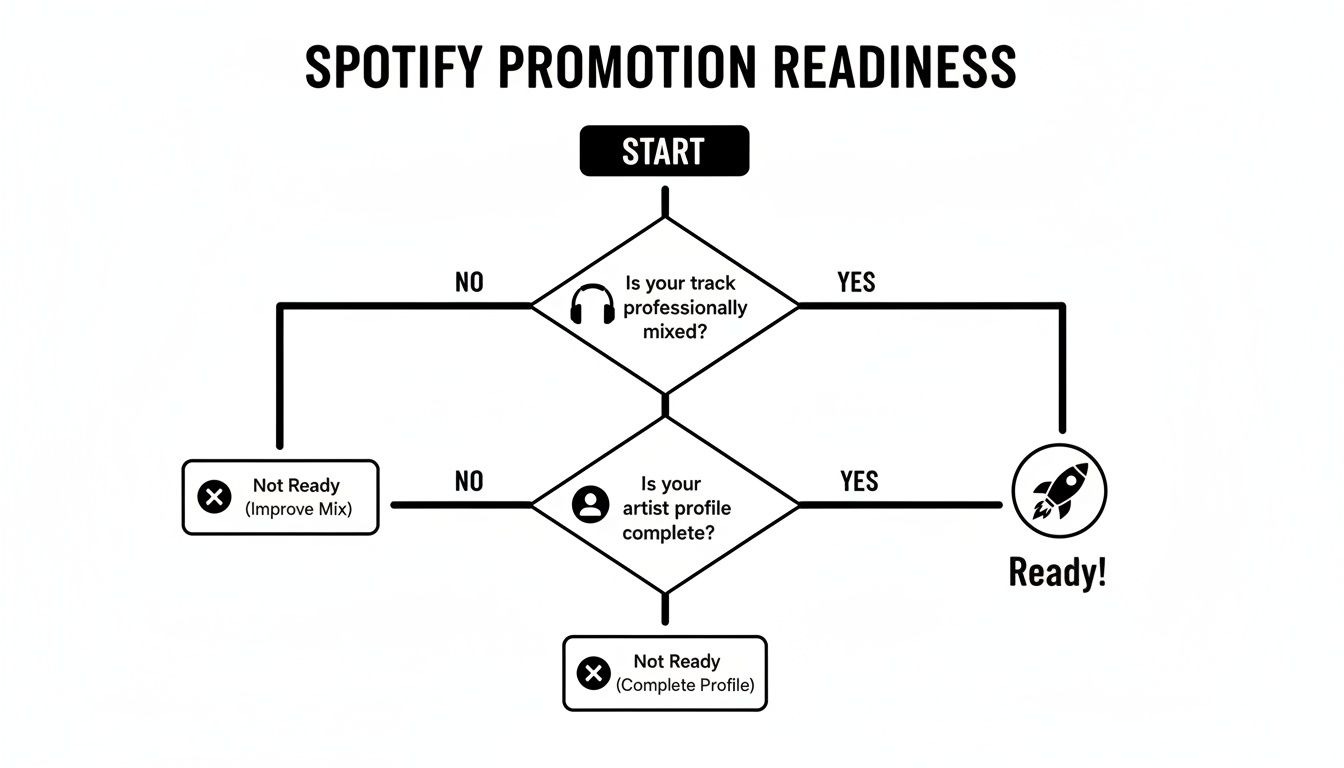
As you can see, it all comes back to the fundamentals. A pro-quality track and a complete artist profile are the absolute, non-negotiable starting line.
Comparing Spotify Promotion Methods
To make the choice clearer, here’s a quick breakdown of how these three approaches stack up against each other.
Method | Average Cost | Time Investment | Control Level | Best For |
|---|---|---|---|---|
DIY Outreach | Free (time only) | Very High | Total | Artists on a tight budget who are willing to do the legwork. |
Submission Platforms | $$ (per campaign) | Low | High | Independent artists who value their time and need results. |
Promotion Agencies | $$$$ (retainers) | Very Low | Low | Major label artists or those with significant financial backing. |
There's no single "best" method—only the best method for you right now. Your budget, timeline, and career goals will point you in the right direction.
How To Spot Fake Playlists And Vet Curators
No matter which strategy you choose, you have to develop a good B.S. detector. Fake playlists don't just waste your money; they can get your music flagged by Spotify for suspicious activity, which is a nightmare you want to avoid.
Keep an eye out for these classic red flags:
Super Generic Names: Be skeptical of playlists called "Top Hits 2024" or "Viral Pop Now." Real curators are usually more creative.
Weird Follower Jumps: A playlist that goes from 500 to 50,000 followers overnight is almost certainly using bots.
Mismatched Numbers: If a curator has a dozen huge playlists but only 12 followers on their personal Spotify profile, something's not right.
Learning to spot quality engagement is a universal skill. In fact, many of the same principles apply across different formats, and looking into ways to promote audio content like podcasts can give you a broader marketing perspective. At the end of the day, authenticity is always the most valuable metric.
Crafting a Pitch That Curators Actually Read
Okay, you’ve done the legwork of finding real, legitimate playlists and weeding out the fakes. Now comes the part that trips up so many artists: the pitch. A great pitch isn't just a request for a placement; it's the start of a relationship. You're showing a curator you respect their work and their time.
I can't tell you how many generic, copy-paste emails land in curator inboxes every single day. They are the fastest ticket to the trash folder. Curators are music fans first and foremost, people who have poured countless hours into building something they're proud of. They can spot a lazy, impersonal pitch from a mile away.
Personalization Is Your Secret Weapon
Before you even think about typing a subject line, do your homework. Seriously, listen to the playlist you're pitching. Does your track actually fit the vibe, the genre, the energy? Mentioning a specific song you enjoyed from their list is a simple move that immediately shows you've done more than just glance at the title.
This one detail can be the difference between getting ignored and getting a listen. It proves you're not just carpet-bombing a list of contacts but are carefully choosing playlists where your music can genuinely connect with an audience.
Think of it this way: curators aren't just gatekeepers; they're your potential biggest fans. Your goal is to make them feel like you’re sharing music with a friend who has great taste, not just treating them like another number on a spreadsheet. A little respect for their craft goes a very, very long way.
Anatomy of a Perfect Pitch Email
Whether you're sending a cold email or filling out a submission form, the key ingredients of a solid pitch don't change. Keep it short, be professional, and make it ridiculously easy for them to act on your request.
Here’s what every good pitch needs:
A Compelling Subject Line: It needs to be clear and professional. "Submission: [Your Artist Name] - [Your Song Title] (For [Playlist Name])" is perfect. It’s direct and tells them everything they need to know. Skip the clickbait or all-caps nonsense.
A Personal Intro: Lead with a genuine, brief compliment about their playlist. This is where you mention that specific track you liked.
The Quick Pitch: In one or two sentences, nail down your track's sound. Giving them a quick "sounds like" comparison to one or two well-known artists is a great shortcut that gives them an instant frame of reference.
The All-Important Link: Make it frictionless. Give them a direct Spotify link to your song. Never, ever make them hunt for it.
Every single extra click you force a curator to make is a reason for them to give up. For a deeper look at different submission strategies, check out our guide on how to submit music to Spotify playlists and get heard.
An Example of What Works
Let's break down a pitch that actually works. Notice it's personal but doesn't waste anyone's time.
Subject: Submission: Fever Dream - "Midnight Drive" (For your 'Late Night Lofi' playlist)
Body:Hey [Curator's Name],
I'm a huge fan of your 'Late Night Lofi' playlist—the placement of that recent L'indécis track was perfect.
I just released a new song called "Midnight Drive" that I thought would be a great fit. It has a similar chill, instrumental vibe with a bit of a melancholic synth melody. Think along the lines of a more relaxed Tycho or early Bonobo.
You can listen to it here: [Direct Spotify Link]
Thanks for your time and for curating such a great collection of music.
Best,[Your Name]
This is it. It’s respectful, it gives helpful context, and it gets right to the point. This is the simple formula for the best Spotify playlist promotion.
Streamlining Your Outreach With Smart Tools
Let’s be real: manual outreach works, but it can be a massive time-suck. This is where a good platform can give you a serious edge, speeding up the discovery process without sacrificing the quality of your pitch.
Services like SubmitLink use AI to analyze your track’s unique sonic profile and match it with the most relevant playlists in their vetted network. This can save you dozens of hours of painstaking research, letting you focus your energy on the playlists that are truly the best home for your music.
For indie artists, landing on a monster playlist like Today's Top Hits, which has over 35+ million followers, can mean millions of streams practically overnight. A placement like that can rocket a track into Spotify's powerful algorithmic playlists like Discover Weekly. But even consistent placements on smaller, highly-engaged playlists can build incredible momentum over time.
In the end, it doesn't matter if you're going the DIY route or using a platform. The core principles never change: do your research, respect the curator, and keep your pitch personal and professional.
Alright, let's talk about the money. You’ve poured your heart into a track, but now comes the tricky part: how much should you actually spend to get people to hear it? When you start looking, you'll see a dizzying array of promotion packages, from a few bucks to thousands of dollars. It’s easy to feel lost.
But here’s the thing: this isn't about having the biggest budget. It's about being the smartest with the budget you have.

Think about it this way: a super-targeted $5 submission on a platform like SubmitLink to a niche playlist that perfectly fits your sound can bring in more dedicated listeners than a generic $500 package promising "mass exposure." It’s the classic quality-over-quantity game. Your goal is to find real fans, not just rack up empty streams.
Calculating Your Cost Per Stream
To figure out if your money is working for you, the most direct metric is Cost Per Stream (CPS). This simple calculation cuts through all the marketing fluff and tells you exactly what you’re paying for each listen.
Cost Per Stream (CPS) = Total Campaign Cost / Total Streams Generated
Let's say you spend $100 on a campaign, and it brings in 5,000 new streams. Your CPS is $0.02 ($100 / 5,000 streams). Now you have a baseline. You can use this number to compare different services, playlists, or even your own DIY efforts.
Some of the most effective playlist campaigns achieve impressive results and can get that number incredibly low. I’ve seen real-world examples where an indie band’s $350 campaign secured 23 playlist placements, pulling in 62,939 streams. That’s a CPS of just $0.01. That's how you make every dollar count.
Thinking Beyond Streams to Cost Per Follower
While CPS is a great starting point, streams are temporary. A true fan is someone who wants to hear what you do next. That's why I always tell artists to track their Cost Per Follower (CPF)—it gives you a much better picture of the long-term value of your campaign.
A new follower is a signal that someone is invested. They'll see your next single in their Release Radar, which makes your next promotion cycle way easier and cheaper. This metric helps you see which campaigns are actually building a fanbase, not just generating background noise.
To figure this out, you just need to check your follower count in Spotify for Artists before and after your campaign.
The Math: Total Campaign Cost / New Followers Gained
For Example: If that same $100 campaign also got you 250 new followers, your CPF would be $0.40.
See the shift? You’re no longer just "paying for plays." You're making a strategic investment in your music career. Each follower is an asset that will pay off for years to come.
Setting a Realistic Budget for Your Campaign
So, what’s the magic number? Honestly, there isn't one. But there is a smart way to approach it, especially if you're an independent artist.
Start Small and Test the Waters. For a new release, set aside a modest test budget—maybe $50 to $150. Use this to try out a few different curated submission platforms or send a small batch of DIY pitches. Don't go all-in right away.
Analyze the Early Data. Give it a few weeks, then dive into your Spotify for Artists dashboard. Look at your CPS and CPF for each source. Which playlists drove the most saves? Which ones led to adds on other listeners' personal playlists?
Double Down on What Works. Once you've identified the playlists or services that are actually delivering engaged listeners, you can confidently put a bigger chunk of your budget there for your next single.
This step-by-step process stops you from throwing money away on things that don't work. It allows you to build a promotion strategy based on your own real data. Ultimately, the best Spotify playlist promotion isn't a one-off expense—it's a smart, ongoing investment in your growth as an artist.
Turning Placements Into Long-Term Fan Growth
Landing your track on a great playlist feels like a massive win, and it is. But here’s the thing: it’s not the finish line. Think of it as the starting pistol for a much bigger race.
A short-term spike in streams is nice, but the real magic happens when you use that initial momentum to get Spotify's powerful recommendation algorithms to notice you. This is how you turn a temporary boost into a self-sustaining engine that finds new fans while you sleep.
Your goal is to move from being a guest on someone else's playlist to earning a permanent home in your new fans' personal libraries.
What Spotify's Algorithm is Listening For
The most powerful playlists on Spotify aren't run by people; they're built by code. Playlists like Discover Weekly and Release Radar are responsible for an incredible amount of music discovery, and your mission is to send them the right signals to get your music included.
Think of the algorithm as a super-attentive listener. It's watching how people interact with your song after hearing it on a playlist. Do they save it? Add it to their own workout mix? Or do they skip it within the first 30 seconds?
These positive interactions are the fuel for algorithmic discovery. They tell Spotify, "Hey, people don't just hear this song—they actively love it."
The Signals That Matter Most
Not all streams are created equal in the eyes of the algorithm. An active, engaged listen is worth far more than a passive one. When your song gets placed, your focus needs to shift immediately to encouraging these specific actions from new listeners.
Saves: This is a huge one. When a listener saves your track to their library, it’s one of the strongest positive signals you can get. It shows they want to hear the song again.
Playlist Adds: Even better. When someone adds your song to one of their own playlists, it’s a direct, personal endorsement.
Low Skip Rate: A low skip rate is crucial. It tells the algorithm that your song fits the vibe of the playlist and holds the listener's attention.
Shares: When a listener shares your track on social media or sends it to a friend, it’s a sign of high-level engagement.
Getting these signals from real people is everything. This is why working with a platform like SubmitLink that has built-in bot detection is so important. Fake streams from botted playlists generate zero valuable engagement data. Worse, they can actively poison the well by showing Spotify that "listeners" aren't saving or engaging with your track at all.
The best Spotify playlist promotion isn't just about getting on lists; it's about what happens after you get on them. Your job is to convert that initial exposure into the kind of genuine listener behavior that makes the Spotify algorithm take notice.
How to Actively Encourage Fan Engagement
You can't just sit back and hope people save your track. You have to be proactive. The moment you see your song get added to a new playlist, treat it as a call to action.
One of the smartest moves is to run a small, targeted social media ad campaign. You can create an ad targeting fans of the playlist you were just added to, or fans of similar artists. The goal isn't just clicks—it's to explicitly ask people to listen and save the song on Spotify.
Another simple but effective tactic: thank the curator publicly on social media and tag them. This not only builds a bridge for future placements but also alerts your own followers to the new spot, encouraging them to stream and engage with it there.
Spotify’s algorithmic playlists need this kind of authentic promotion to work their magic for you. Statistics show that playlist adds, high save rates, and low skip rates are the most important metrics for indie artist growth. Discover Weekly alone has powered over 2 billion hours of listening by matching these exact engagement patterns.
Meanwhile, Release Radar will test new songs on non-followers, but only if the track gets high saves and repeat listens from your existing fans in the first 24-48 hours. This makes an early playlist campaign absolutely critical. If you want to dive deeper, you can learn more about why authentic promotion is so vital to these complex systems.
This feedback loop is the core of sustainable growth on Spotify. A great placement drives real engagement, that engagement feeds the algorithm, and the algorithm introduces your music to thousands of new potential fans. It’s a powerful cycle that all starts with that first, well-earned spot.
Answering Your Top Spotify Promotion Questions
Jumping into the world of playlist promotion can feel like navigating a minefield. You’ve got questions about how long to run a campaign, what a "good" outcome looks like, and the risks involved. Let's clear up some of the most common concerns artists have when they're trying to get their music heard.
Getting these answers straight is what separates a smart, effective campaign from a shot in the dark. It’s all about being informed and making the right moves.
How Long Should I Run a Campaign?
Think of a good promotion campaign as a slow burn, not a firework. For a new single, the real work starts long before anyone hears the first note. You should be hitting up curators 3-4 weeks before your release date.
This lead time is essential. It gives real people time to actually listen to your track and fit it into their schedule. Landing a few placements that go live on release day is the magic ingredient for triggering Spotify's Release Radar algorithm, which is a huge boost.
Once the song is out, keep the campaign running for at least another 4-6 weeks. This is your window to build momentum and show the algorithm that listeners are engaging. For older tracks, you can run smaller, targeted campaigns every few months to breathe new life into them. It's a marathon, not a sprint.
The artists who really succeed are the ones who treat promotion as a constant. A steady presence on the right playlists keeps your music discovering new ears, building a real fanbase long after that initial release-week excitement fades.
What Is a Good Playlist Placement Rate?
This is a numbers game, but quality will always trounce quantity. If you're grinding it out with DIY cold emails to legitimate curators, landing even 1-5% of them is a solid win. It's a tough, time-consuming process.
That’s why many artists turn to vetted platforms. On a service like SubmitLink, for instance, the average placement rate hovers around 21%. That's because you're connecting with curators who are actively looking for new music to feature.
Instead of blasting your track to hundreds of random playlists, focus your efforts. A well-researched, targeted list of 50-100 playlists that perfectly fit your sound is the way to go. Securing just 5-10 spots on smaller, niche playlists with real, engaged listeners is infinitely more valuable than getting added to 50 botted lists that will wreck your data.
Can Spotify Ban Me for Using a Service?
The short answer is yes, but it’s all about why. Spotify absolutely takes action against artists, but only when they're caught using services that generate fake streams from bots.
Spotify's algorithms are frighteningly good at spotting this stuff. If your track gets flagged for artificial streams, it can get pulled down, and you might even get a strike from your distributor. This is exactly why you have to be incredibly careful about who you work with.
Legitimate promotion that gets your music in front of real people is what Spotify wants. The best promotion services are built on a foundation of authentic, human-curated playlists. When real listeners discover your music organically, you're playing the game the right way. To really get a handle on this, you should understand the basics of avoiding fake playlists and their growth risks and how to protect your music.
Ready to connect with real, vetted curators and grow your audience safely? At SubmitLink, we use advanced bot detection and AI matching to help you find the perfect playlists for your music. Start your next campaign with confidence.


