.png)
Your Professional Guide to Indie Music Promotion
- Jan 27
- 14 min read
Forget the conventional wisdom about "getting your music out there." For the established artist, indie music promotion is not about shouting into the void; it's the strategic development of a scalable, data-driven system to optimize audience growth and, critically, protect your catalog for the long term.
It's time to shift from tactical execution to strategic ownership. This guide is your blueprint for engineering that system.
Building Your Indie Promotion Engine
As an artist operating at a professional level, you're beyond the fundamentals. You've cultivated your sound, you understand the industry's landscape, and you have a defined budget to invest in measurable growth. The challenge is no longer about getting heard—it's about optimizing reach, safeguarding your assets, and building a sustainable career.
This is where the concept of a "promotion engine" becomes essential.
Envision your music career as a high-performance vehicle. Disconnected efforts—a social media post, a random playlist pitch—are like sporadic taps on the accelerator. A promotion engine is the entire integrated system, a finely calibrated machine where every component synchronizes to generate consistent, powerful momentum.
The Shift from Tactics to Strategy
The outdated notion of "getting lucky" or "being discovered" is irrelevant in the modern market. Today’s industry doesn't reward chance; it rewards artists who operate with the precision of a business principal. This requires a fundamental shift in mindset.
Instead of chasing ephemeral viral moments, the objective is to construct a reliable system that predictably converts your promotion budget into tangible results: a larger fanbase, increased stream velocity, and diversified revenue.
Your Position in the Modern Music Economy
The power dynamic has irrevocably shifted. Independent artists have reached a critical milestone, now commanding over 50% of all music consumed on major streaming platforms. This is not an anomaly; it's the direct result of sophisticated, accessible tools enabling artists to compete on a global scale without traditional gatekeepers.
This new paradigm presents both a significant opportunity and a complex challenge. While access is democratized, the market is more saturated than ever. Your professional advantage will not stem solely from artistic quality—it will be forged by a more intelligent promotional strategy.
This guide provides the framework to build that strategy. We are bypassing generic advice to focus on actionable systems designed for serious artists ready to scale. By its conclusion, you will understand how to transform your promotion from a series of disparate tasks into a potent engine for growth.
To begin, it's crucial to understand how the core promotional channels integrate.
Modern Indie Promotion Pillar Comparison
Here is a high-level analysis of the main pillars of a modern promotion engine, comparing their strategic function, primary metrics, and key risks.
Promotion Pillar | Strategic Focus | Primary KPI | Key Risk to Mitigate |
|---|---|---|---|
Spotify Playlist Pitching | Algorithmic & Editorial Triggering | Streams, Saves, Listener Growth | Fake playlists, bot activity, payola schemes |
Social Media Marketing | Community Building & Fan Activation | Engagement Rate, Follower Growth | Algorithm changes, low organic reach, burnout |
Digital PR & Blogs | Building Credibility & Third-Party Validation | Placements, Referral Traffic | Low-impact blogs, high cost for little return |
Email & SMS Marketing | Direct Fan Relationship & Monetization | Open/Click Rate, Conversion Rate | List fatigue, low subscriber count |
Paid Advertising | Targeted Audience Growth & Conversion | Cost Per Result (e.g., CPC, CPA) | Ad fraud, poor targeting, high ad spend |
Touring & Live Shows | Deepening Fan Connection & Revenue | Ticket Sales, Merch Sales | High upfront costs, logistical challenges |
Each pillar is a vital component of your engine. The strategic advantage lies in their synchronization, with each channel feeding and amplifying the others. As you refine your own engine, you might find our guide on the best sites for music promotion to grow your audience to be a useful resource.
Mastering the Spotify Ecosystem
Treating Spotify as a mere digital storefront is a strategic error. It is a dynamic ecosystem, driven by the dual forces of sophisticated algorithms and the subjective tastes of human curators. Success is not a matter of luck; it is about systematically understanding and influencing both.
This is not theoretical—it directly impacts your bottom line. With streaming constituting a commanding 69% of the recorded music industry and generating over $20 billion, your ability to navigate this platform is paramount. An effective promotion strategy must be engineered to satisfy the machine while connecting with the key human decision-makers.
Priming the Algorithm for Discovery
Spotify's discovery engines, such as Release Radar and Discover Weekly, are not arbitrary. They are powerful systems that operate on a clear principle: they follow positive engagement signals. Your objective is to generate those signals with high velocity from the moment of release.
Consider it akin to igniting a fire. A single match on damp wood is ineffective; you require dry kindling and a strong initial spark. A weak launch fails to register before the algorithm's attention moves on.
The requisite initial spark is generated by three key factors:
Pre-Saves: This is your primary signal to Spotify's algorithm. A significant volume of pre-saves indicates pre-existing demand, placing your release on the algorithm's radar before day one.
First-Day Stream Velocity: The stream volume within the first 24-48 hours is arguably the most potent signal you can send. A substantial initial spike communicates that the track has immediate resonance.
Listener Engagement Signals: Raw stream counts are only one part of the equation. The algorithm assigns significant weight to saves, shares, and personal playlist adds, as these actions indicate a deeper listener connection than a passive stream.
Your release day execution must be a coordinated, high-intensity campaign. The goal is to generate a maximum volume of these positive signals as rapidly as possible. This initial momentum triggers algorithmic playlist placement, creating a compounding effect that can sustain a track's growth for weeks.
The Human Element: A Systematic Approach to Curation
While optimizing for the algorithm, you cannot neglect the human gatekeepers. Independent playlists curated by tastemakers remain the most direct path to reaching niche, pre-qualified audiences. The challenge? The market is saturated with fraudulent playlists populated by bots and fake accounts.
This is where your indie music promotion must be surgical. You are not purchasing plays; you are investing in authentic placements and building strategic relationships. A single misstep can do more than waste capital—it can damage your data integrity, your platform reputation, and even lead to takedowns.
How to Vet Curators and Protect Your Music
Due diligence is not optional; it is a critical component of protecting your music catalog, your most valuable asset.
Utilize this checklist before committing to any campaign:
Analyze Follower-to-Stream Ratio: A playlist with 50,000 followers generating only a few hundred streams for new tracks is a clear indicator of fraudulent followers.
Assess Playlist Branding: Does it possess a distinct thematic identity and professional presentation? Generic names like "Top Hits 2024" are often red flags for low-quality, keyword-bait playlists.
Investigate Curator Presence: Is there a verifiable social media presence, blog, or website? Legitimate curators are passionate about music and engage with their community.
Leverage Professional Vetting Tools: Platforms with integrated bot detection can automatically flag suspicious playlists, saving significant time and mitigating risk.
Pitching playlists is a specialized skill. To refine your outreach, our in-depth guide on how to submit music to Spotify playlists and get heard provides the precise methodology for effective communication. By mastering both the algorithmic and human dimensions of Spotify, you build a formidable engine for sustainable growth.
Protecting Your Catalog from Promo Scams
In the modern music industry, your catalog is a tangible financial asset. As with any valuable asset, it is a target for a pervasive shadow industry of scams designed to exploit artists. Investing in promotion is essential for growth, but a single poor decision can do more than waste your budget. It can corrupt your analytics, damage your standing with your distributor, and even result in the removal of your music.
For any serious artist, catalog protection is a non-negotiable priority. This requires a shift from hope to diligence. You would not invest in a company without thorough research; the same standard must apply to promotional services. You cannot afford to pitch your music without verifying the legitimacy of every playlist and promoter. The risk of bot-driven streams and artificial engagement is too significant to ignore.
Recognizing the Red Flags of a Promo Scam
Scammers have become adept at mimicking legitimacy, but their models have inherent flaws that can be identified with careful scrutiny. Their business relies on artists being too time-constrained or eager to perform due diligence. Your most effective defense is recognizing these warning signs.
These are not merely indicators of a poor investment; they are often signs of fraudulent activity that could trigger penalties from Spotify's anti-bot systems.
Key warning signs to watch for:
Guaranteed Placements for a Fee: Authentic curation is based on merit, not payment. Any service promising playlist placement for a fee is almost certainly a payola scheme that violates the terms of service of all major streaming platforms.
Suspiciously Generic Playlist Names: Exercise caution with playlists named "Top Hits 2024," "Viral Pop," or "TikTok Songs." Reputable curators build brands around specific aesthetics, niche genres, or creative concepts. Generic names are often bait for artists targeting high-traffic keywords.
Mismatched Followers and Streams: This is a primary indicator of a bot farm. A playlist with 50,000 followers that generates only a few hundred streams for new tracks is a mathematical impossibility for an authentic audience. A healthy playlist exhibits a logical correlation between its follower count and the stream velocity it provides.
Adopting a Proactive Vetting Process
Catalog protection must be proactive, not reactive. Once your track is on a toxic playlist, the damage is done. The only way to ensure your promotional budget is allocated to genuine audience growth—not artificial numbers—is to integrate a rigorous vetting process into your standard operating procedure.
Make it as routine as the mixing or mastering stage of your production.
Your Vetting Checklist for Curators and Playlists
Before executing any outreach or payment, run every potential playlist and promoter through this checklist.
Analyze Listener Data: Utilize analytics tools to scrutinize a playlist's listener geography. A geographically diffuse audience spread thinly across dozens of countries without a clear core region is a classic sign of bot traffic.
Examine Playlist Growth Patterns: Investigate the playlist's follower history. Did its audience grow exponentially overnight? Authentic growth is almost always gradual and organic. Sudden, massive spikes are a tell-tale sign of purchased followers.
Investigate the Curator's Identity: A genuine curator is a music enthusiast. They should have a verifiable online footprint—a social media profile, a blog, a website—that demonstrates their engagement with music and the community. An anonymous curator with no digital presence is a significant red flag.
By treating your playlist outreach with this level of professional diligence, you not only protect your investment but also cultivate a network of high-quality, authentic partners who can contribute meaningfully to your career. For a more detailed examination, our guide on how to detect fake Spotify playlists and avoid scams provides more advanced techniques.
Creating an Integrated Promotion System
Allocating budget to a Facebook ad, dispatching a newsletter, and hoping for a blog placement is not a strategy—it's a gamble. For professional execution, you must cease viewing promotion as a checklist of isolated activities. Your PR, social media, email marketing, and advertising must function as a cohesive, interconnected machine.
Consider it an ecosystem. A positive review on a music blog is more than a vanity metric; it is a strategic asset. A compelling quote can be repurposed for a targeted Instagram ad. That ad, in turn, can be optimized not just for streams, but for email list acquisition. That email list then becomes your primary lever on release day to drive a surge of initial streams.
Each component fuels the next. Executed correctly, this creates a powerful, self-reinforcing cycle that multiplies the impact of every dollar and hour invested. You transition from merely acquiring listeners to building a loyal, monetizable audience.
Architecting Your Promotion Flywheel
The operational concept here is a promotion flywheel. The principle is straightforward: momentum from one channel directly energizes the next. Instead of the arduous task of pushing a boulder uphill, you are setting a heavy wheel in motion. Initial effort is high, but once it's spinning, each subsequent push accelerates its velocity with increasing efficiency.
Let's dissect the mechanics of this process. The objective is to engineer a clear pathway for a potential listener to evolve into a dedicated fan.
A typical flow might look like this:
The Spark (PR & Editorial): You secure a feature on a reputable music blog. This provides critical third-party validation.
Adding Fuel (Social Media & Ads): You leverage this validation by creating ad assets from review quotes and linking to the article. You then target these ads with precision. This is exponentially more effective than a simple "listen to my new song" post because it is imbued with external credibility.
Capturing the Audience (Email List): Your advertising should have a clear conversion goal beyond a single stream. Direct traffic to a landing page designed for email acquisition in exchange for exclusive content. This converts a passive listener into a direct, owned contact.
The Payoff (Driving Streams): On release day, you activate your email list—your core supporters. You mobilize them to be the first to stream and save the new track. This initial wave of engagement is the exact signal the Spotify algorithm is designed to detect and amplify.
This diagram illustrates the underlying principle—how rigorous vetting ensures you are adding high-octane fuel to your system, not contaminating it with fraudulent activity.
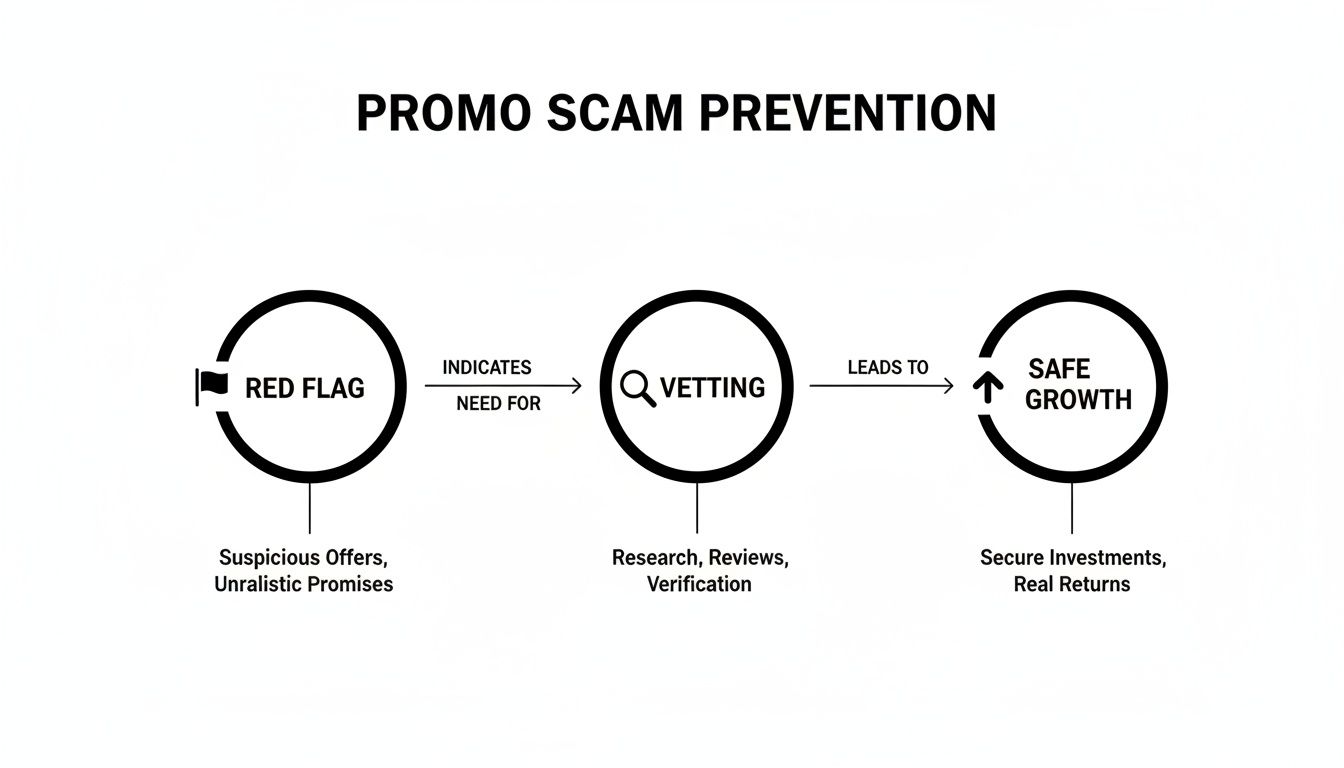
As the visual demonstrates, a healthy system is built on selectivity. You must protect the flywheel from bad actors to achieve real, sustainable results.
Building Strategic Feedback Loops
This is where the system becomes truly potent. A fully integrated system is not unidirectional; it creates feedback loops. Data and insights from one channel must inform your strategy on another. This is how you transition from execution to optimization.
You cease making assumptions and begin making calculated decisions based on audience behavior. It is the distinction between amateur and professional operation.
An integrated system means you're not just promoting a song; you're building an audience asset. Each cycle of the flywheel should leave you with a larger email list, more social followers, and richer audience data for your next campaign.
Here are practical examples of this in action:
PR Data to Better Ad Targeting: The blog feature generated traffic. Analyzing your website analytics reveals a high concentration of visitors aged 25-34 in Chicago. This provides a precise profile for a lookalike audience in your next Meta or TikTok ad campaign.
Spotify Insights to Smarter Social Content: Your Spotify for Artists dashboard shows an anomalous spike in listeners from Austin, Texas. This is an actionable signal. Create social content specifically acknowledging your Austin-based listeners to foster a deeper connection.
Email Clicks to Segmented Lists: Monitor click behavior within your newsletters. Users clicking on merchandise links have different interests than those clicking on tour dates. Segment them accordingly. Future communications can be tailored—merch announcements to one segment, ticket pre-sales to another—dramatically improving conversion rates.
By connecting these data points, your promotion evolves from a series of disparate tactics into an intelligent, cohesive engine that drives measurable, long-term career growth.
Forging Genuine Curator and Press Relationships
The era of mass, generic email blasts is over. The "spray-and-pray" method was always inefficient, but today it is a direct path to the spam folder. It devalues your time, the recipient's time, and can damage your professional reputation before a single note is heard.
When engaging with playlist curators, journalists, or radio programmers, every interaction must be executed with precision and personalization.
This is not about securing a single placement; it is about cultivating a robust professional network. View an influential music editor or a respected playlist curator not as a gatekeeper to be bypassed, but as a potential long-term strategic partner. One strong relationship with the right industry contact is infinitely more valuable than a thousand generic submissions.
The entire dynamic shifts when you move from a transactional mindset ("what can you do for me?") to a curatorial one ("I have something of value for your audience, and here is why"). This simple re-framing communicates respect for their work and immediately positions you as a professional peer.
The Anatomy of a Professional Pitch
Your pitch is your initial professional contact. It must be concise, confident, and direct. These contacts receive hundreds of emails daily; yours has mere seconds to prove its relevance.
An effective pitch is not a sales letter; it is a professional briefing that provides all necessary information for a swift, informed decision.
A proven framework for effective pitching:
A Personalized Opener: Reference their work specifically—a recent article, a particular playlist, or an artist they featured. This demonstrates that you have done your research.
Get to the Point (Fast): State your identity and purpose clearly. "My new single, '[Song Title],' releases on [Date], and I believe it would be an excellent fit for your '[Playlist Name]' playlist."
The "Why" (Your Hook): In one or two sentences, articulate why it is a fit. Compare your sound to 2-3 specific artists they have recently featured to provide an immediate sonic benchmark.
Essential Links: Always use private, pre-release streaming links (e.g., a private SoundCloud or Disco link). Include a link to your EPK and primary social channel. Never attach large audio files directly to an email.
Research and Personalization at Scale
Effective promotion is predicated on precise targeting. Before drafting a pitch, thorough research is mandatory. Identify the curators, writers, and programmers who are already active in your specific niche and command a genuinely engaged audience.
Building real connections is a game of quality over quantity. Ask any radio pro, and they'll tell you that 85% of placements come from direct, established relationships. Your entire outreach strategy needs to be built on this foundation of targeted, personal communication.
This personalization is your competitive advantage. Even when managing a large-scale campaign, each pitch must feel bespoke. A well-organized spreadsheet is indispensable for tracking contacts, their coverage areas, and key research notes. This is how you scale outreach without sacrificing the personal element that elicits a response.
This is where being an independent artist is a significant advantage. Your agility and ability to be personal are key strengths. In fact, indies are already capturing 35% of the $127 billion global recorded music market, and the artists seeing the most growth are overwhelmingly independent. You can see the trends shaping the indie scene and how your approach fits into the bigger picture.
The Art of the Follow-Up
Following up is a critical but delicate process. The goal is persistence, not annoyance.
A single, polite follow-up email sent 5-7 days after the initial pitch is standard professional practice. Frame it as a gentle reminder, not a demand for a response.
If there is still no reply, disengage and move on. A lack of response is rarely personal; it is a function of the extreme volume these professionals manage. By maintaining professionalism and respect, you keep the door open for future releases. Today's silence could become a future opportunity.
Your Professional Promotion Questions Answered
Even with a robust strategy, complex questions will arise during execution. For an artist operating as a business, addressing these correctly is critical—it’s about optimizing resource allocation, ensuring measurable growth, and making decisions that build a long-term career, not just a momentary release.
Let's address some of the most common strategic questions from professional musicians.
How Should I Budget for a Single Release?
While there is no universal figure, a strategic framework is essential. I recommend the 70/20/10 rule for budget allocation.
Allocate 70% of your budget to proven channels—strategies and platforms that have consistently delivered results for you in the past. This could be a specific type of ad campaign or a trusted PR partner. Dedicate 20% to experimentation. This is your R&D fund to test new ad platforms, pitch to adjacent genres, or explore new creator collaborations.
Reserve the final 10% as a contingency fund for opportunistic plays. An unexpected blog feature or a last-minute opening on a high-value playlist often requires the ability to act fast. For a professional campaign, this typically translates to a total budget ranging from several hundred to several thousand dollars per single.
How Do I Measure Playlist ROI Beyond Stream Counts?
Vanity metrics like raw stream counts are insufficient for measuring ROI. True return on investment is measured in audience growth and engagement. You must determine if streams are converting into tangible fanbase assets.
Focus on these key performance indicators instead of the stream counter:
Listener-to-Save Ratio: This metric reveals if listeners are actively incorporating your track into their personal libraries. A high save rate indicates deep resonance, not just passive background listening.
Follower Growth: Analyze your Spotify for Artists data. Did a playlist placement correlate with a measurable increase in followers? This is the clearest indicator of genuine fan acquisition.
Referral Traffic: Did the playlist drive listeners to investigate further? Use analytics to track traffic from Spotify to your website and social media profiles.
If a playlist generates thousands of streams but yields zero new followers or saves, it is a significant red flag for a low-quality or bot-driven placement. Real listeners engage beyond a single stream.
What if I Suspect Bot Activity?
If you detect anomalous activity, you must act decisively and immediately.
First, document everything meticulously. Take screenshots of the playlist, the corresponding data spikes in Spotify for Artists, and all communications with the promoter. Second, contact your distributor—whether DistroKid, TuneCore, or another partner—and report the issue with your evidence. Proactive reporting demonstrates your commitment to data integrity and protects your standing with them.
Should I Hire a Publicist or Go DIY?
This decision hinges on your specific campaign objectives and available capital.
If your goal is to build industry credibility and secure placements in established media outlets, a reputable publicist's network is invaluable. However, be prepared for a significant investment, as a professional PR campaign typically starts at $1,500-$5,000+.
Conversely, if your primary objective is driving streams and direct fan engagement through playlists and social media, a DIY approach, augmented by specialized platforms, can offer a better ROI. This model provides greater control and transparent tracking of every dollar spent.
For artists ready to take control of their playlisting strategy with professional-grade tools, SubmitLink offers a vetted network of authentic curators. Backed by industry-leading bot detection, our platform ensures your music reaches real listeners, helping you build a genuine audience while protecting your catalog. Find your next great placement at https://submitlink.io.


