.png)
A Guide to Music Promotion for Independent Artist Growth
- Jan 21
- 17 min read
A successful release campaign isn't built on last-minute hustle. For a professional independent artist, sustainable music promotion is a system built weeks, or even months, before a track hits streaming platforms. This is less about a frantic checklist and more about engineering a frictionless process that enables key industry players to support your music.
This foundational work is what separates career artists from hobbyists. It ensures every dollar of your budget and every ounce of your effort is allocated for maximum impact, protecting your investment and optimizing your music's reach.
Building a Professional Foundation for Your Release

If you've navigated a few release cycles, you know the pre-release phase is about methodical optimization. The objective is to create a seamless path for industry gatekeepers—playlist curators, journalists, A&R representatives, and potential collaborators. Your task is to make their decision to support you an absolute inevitability by anticipating their needs and eliminating any potential friction points that could stall your campaign's momentum.
Your digital infrastructure is the first point of audit. Before drafting a single pitch, ensure your artist profiles are claimed, polished, and reflect your professional standing.
Spotify for Artists: Profile verification is non-negotiable. It unlocks essential analytics and, critically, grants access to the official playlist submission tool. Ensure your biography is concise and compelling, your photography is high-resolution, and your "Artist Pick" is current.
Apple Music for Artists: This is of equal importance. Claiming this profile provides another stream of vital listener data and signals to the industry that you are a serious artist who understands the business landscape.
These are not vanity exercises. These platforms are your primary sources of performance data. Operating without them is akin to attempting a tour without a route—inefficient and destined to fail.
Crafting a Press Kit That Cuts Through the Noise
A folder of disparate links is not an EPK. A professional Electronic Press Kit (EPK) communicates a compelling narrative, packaged for an audience with zero time to spare. It must be hosted on your proprietary artist website for complete control and to ensure it remains current.
Assume the recipient of your EPK has less than 60 seconds to assess your viability. The presentation must be clean, concise, and impactful.
Your Electronic Press Kit isn't just a resume; it's your professional handshake. It must immediately answer "Who are you?" and "Why should I care?" while providing everything a curator or journalist needs without forcing them to hunt for it.
Your EPK must include a succinct biography that articulates your story, high-quality press photos (provide both landscape and portrait orientations), direct links to your music, and any notable press or achievements. Every element must reinforce your brand. Constructing this asset is a core component of a modern music marketing strategy for independent artists and sets the professional tone for all subsequent industry interactions.
The Critical Details of Digital Hygiene
Finally, we address metadata. Flawless metadata is the unsung hero of a seamless release. A single incorrect ISRC, mismanaged songwriter splits, or an erroneous release date can trigger a cascade of issues, from royalty holds to outright rejection by DSPs like Spotify or Apple Music.
Before submitting to your distributor, triple-check every data point.
This meticulous preparation—verifying profiles, perfecting your EPK, and ensuring metadata integrity—forms the professional bedrock of your career. It demonstrates respect for the business of your art, instantly positioning you as a more attractive partner for any industry stakeholder. When this foundation is solid, your promotional efforts build genuine momentum rather than simply managing crises.
Using Data to Find Your Ideal Listeners
Speculative marketing is the most expensive mistake in music promotion. For a serious artist, every dollar in your budget must have a defined purpose, and that purpose begins with knowing exactly who you're trying to reach. We must move beyond rudimentary demographics like age and location. The strategic advantage lies in understanding the psychographics, consumption habits, and digital ecosystems of your target audience.
This isn't about "finding" listeners in a broad sense. It's about mapping a direct path to cohorts who are already predisposed to your specific sound. By leveraging the right platforms, you can identify audience overlaps and listening behaviors that transform promotion from a guessing game into a calculated, strategic initiative.
Uncovering Insights with Analytics Platforms
Your deep dive into audience data begins with the tools you already have, augmented with professional-grade platforms. Your first stop is always Spotify for Artists. Consider this your mission control.
Navigate directly to the "Audience" tab. This is where you access raw intelligence on your existing listener base. While location, age, and gender are useful, the critical data resides in the "Fans Also Like" section.
This section is your strategic roadmap. It reveals the other artists your current listeners have in heavy rotation. These are your "seed" artists. Their audiences are neurologically primed to appreciate your music due to a shared sonic DNA. This isn't merely a list of bands; it's a blueprint indicating where your future fans are already congregating.
To go deeper, a platform like Chartmetric provides a more granular view. You can input a seed artist and access a comprehensive breakdown of their audience analytics, from specific playlist placements to social media engagement patterns. This is how you build a robust profile of your target listener—not just what they listen to, but where they discover new music and how they engage with artists online.
The objective is to evolve from a vague concept like "fans of indie rock" to a highly specific profile, such as: "25-34 year-old listeners in Berlin and Austin who follow Tame Impala, actively save tracks from Spotify's 'All New Indie' playlist, and engage with content from KEXP."
That level of precision is what makes your ad targeting lethal and your playlist pitching impossible to ignore.
Building Actionable Listener Personas
With this data aggregated, it's time to synthesize it into listener personas. A persona is a semi-fictional archetype of your ideal fan, constructed entirely from real-world data. This is not a static document; it is a living brief that should inform every promotional decision.
Develop two or three distinct personas. Assign each a name and a narrative based on your research.
Persona 1: "The Curator" Resides in a major cultural hub (e.g., Brooklyn or London), works in a creative industry, and discovers music through editorial playlists and trusted media outlets. They value authenticity and are likely to invest in vinyl and merchandise to support artists they connect with.
Persona 2: "The Casual Streamer" Consumes music primarily during their commute or at the gym. They are heavily influenced by algorithmic playlists like Discover Weekly. They may not follow you on social media, but they will reflexively save a track that resonates with them.
These personas become your strategic playbook. You will target high-tier blogs and tastemaker playlists to reach "The Curator." To engage "The Casual Streamer," you will execute broader Meta ad campaigns optimized for streams and saves.
This level of detailed targeting is more critical than ever. While over 50% of streamed music now comes from independents, the stark reality is that 77.8% of indie artists earn less than $15,000 annually. The market is saturated, with revenue concentrated at the top. With 67% of artists on Spotify having fewer than 1,000 monthly listeners, precision targeting is the only viable path to penetrating the noise.
By constructing these data-backed personas, you ensure that every component of your campaign—from ad creative to curator selection—is calibrated to resonate with an individual already primed to appreciate your work. As your campaign progresses, leverage tools that provide detailed playlist analytics and chat functionality with curators; this direct feedback loop is invaluable for refining your personas for subsequent releases.
Executing a Strategic Playlist Pitching Campaign
Having mapped your audience and constructed your listener personas, it's time to translate that research into action. Strategic playlist pitching is not a high-volume, low-yield broadcast to every available curator. That is an amateur tactic. A professional campaign is a methodical, targeted operation designed to place your music in front of precisely the right ears.
This is where your pre-release diligence pays dividends. You are no longer operating on assumptions; you are executing a calculated, scalable campaign designed to generate meaningful momentum. The strategy is to work in tiers, beginning with the most competitive placements and expanding outward to create a waterfall effect where each placement builds upon the last.
This simple framework is the backbone of any effective outreach. It's all about making sure every single pitch is informed by actual data.
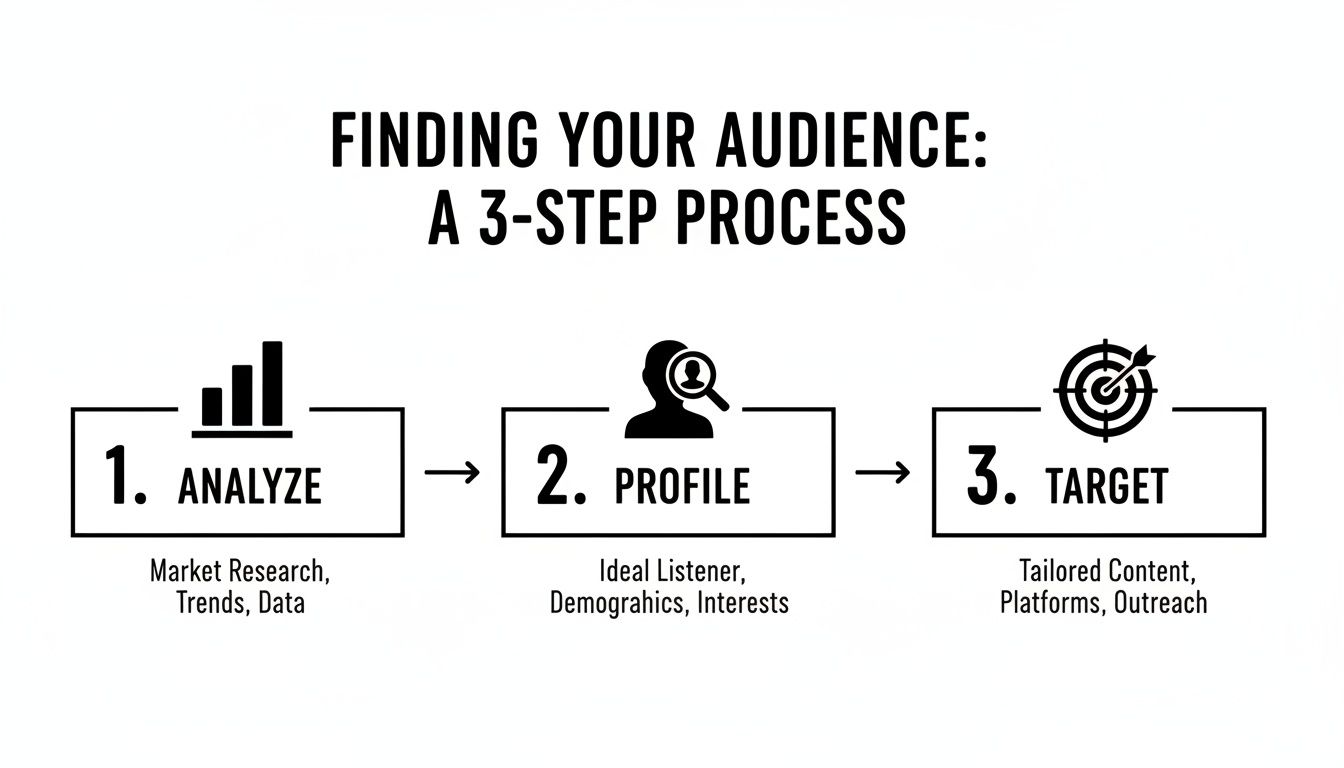
This Analyze, Profile, Target sequence maintains focus and efficacy, preventing the misallocation of resources on low-probability pitches.
The Tiered Pitching Workflow
Your pitching strategy must prioritize official channels before engaging with independent curators. This funnel-based approach maximizes your probability of securing career-altering placements from the outset.
Tier 1: The Spotify Editorial Pitch. This is your mandatory first action. You must submit your track via your Spotify for Artists dashboard at least three to four weeks prior to release. This represents your sole opportunity to be considered for major official playlists like New Music Friday, Lorem, or key genre-specific lists. Your pitch must be concise and impactful, providing essential context: the song's narrative, your marketing plans, and key metadata like genre, mood, and instrumentation.
Tier 2: Top-Level Independent Curators. With your editorial pitch submitted, you can begin targeting influential independent curators. These are established tastemakers who manage playlists with thousands of legitimate, engaged followers. A placement in this tier can be nearly as impactful as an editorial add and frequently captures the attention of Spotify's own editors. Identifying and successfully pitching these individuals requires diligent research and a personalized approach.
Tier 3: Micro-Curators and Niche Playlists. Finally, target the smaller, hyper-specific playlists that align perfectly with your listener personas. Do not underestimate their value. A playlist with 1,000 dedicated fans of your niche genre is often more valuable than one with 50,000 passive listeners. Securing multiple placements in this tier can create a powerful snowball effect, driving algorithmic activity and signaling to Spotify that your track is resonating within a specific cultural scene.
Side-Stepping Scams: How to Vet Curators and Avoid Fake Playlists
The independent playlisting ecosystem is fraught with risk, including scammers who use bots to inflate follower counts and deliver fraudulent streams. Engaging with these entities is a direct threat to your career, potentially resulting in your music being removed from Spotify or receiving a strike from your distributor.
Protecting your assets requires that you vet every playlist you pitch.
Tools like artist.tools are indispensable for this task. They provide the data necessary to identify red flags, such as a playlist's historical follower growth and the geographic location of its listeners.
Legitimate playlists exhibit steady, organic growth over time and have listeners in geographic locations that are logical for the music. A playlist that jumps from 1,000 to 50,000 followers overnight or has a majority of its listeners in a country completely unrelated to the genre is almost certainly a bot farm. Avoid it.
When vetting manually, be vigilant for these indicators:
Discrepant Follower-to-Save Ratios: Analyze the "Likes" (the heart icon) on a playlist. A list with 100,000 followers but only 50 likes is a significant red flag.
Generic Naming and Artwork: Be skeptical of playlists with generic titles like "Top Hits 2024" or "Viral Pop Songs" that use generic stock imagery. These are common fronts for bot operations.
Solicitation of Direct Payment: Any curator requesting payment via PayPal or Venmo for a "guaranteed placement" is operating a scam. Legitimate platforms act as a secure intermediary.
Choosing Your Playlist Pitching Channels
Multiple channels exist for delivering your music to curators, each with distinct advantages and disadvantages. Strategic allocation of resources across these channels is key to an efficient campaign.
Here is a breakdown of the primary channels:
Channel | Best For | Key Challenge | Success Metric |
|---|---|---|---|
Spotify for Artists | Securing official editorial placements. This is your highest priority. | Highly competitive with only one pitch opportunity per release. | Editorial placement, subsequent algorithmic playlist adds. |
Direct Email/Socials | Cultivating personal relationships with high-value, hard-to-reach curators. | Time-intensive, low response rates, and difficult to track at scale. | A personal reply, even a declination, is a positive outcome. |
Submission Platforms | Efficiently reaching a large volume of vetted, independent curators. | Can feel impersonal if pitches lack customization and strategic targeting. | High volume of quality placements, positive ROI. |
A balanced, hybrid approach is optimal. Utilize Spotify's official tool without fail, cultivate a small, curated list for direct outreach, and leverage a professional platform to manage the remainder of your campaign at scale.
Using Professional Tools to Manage Your Outreach
Attempting to manage a campaign involving dozens or hundreds of playlists via a spreadsheet is a recipe for operational chaos. This is where professional submission platforms become an essential component of your strategic toolkit.
Platforms like SubmitLink are purpose-built for this function. They provide access to a network of pre-vetted curators, significantly reducing the time required for fraud detection. Powered by the same bot-detection technology trusted by major distributors, it automatically flags suspicious playlists, allowing you to pitch with confidence and focus on crafting compelling narratives rather than performing forensic analysis.
Success on these platforms hinges on personalization. Avoid generic, copy-pasted messages. Address the curator by name, reference a specific song you appreciate on their playlist, and concisely articulate why your track is a strategic fit for their audience. This demonstration of due diligence shows respect for their work and dramatically increases your probability of success. For a more detailed breakdown, this guide on how to submit to Spotify playlists for indie artists provides a comprehensive overview of the process.
By combining a tiered strategy with rigorous vetting and the appropriate professional tools, your playlisting campaign will do more than generate streams—it will build a tangible, sustainable audience for your music.
Expanding Your Reach with PR and Influencer Marketing
While playlists place your song in listeners' ears, public relations and influencer marketing embed your name in their minds. This is the strategic shift from being another track on a list to building a compelling narrative around your artistic identity. It's the difference between a song that achieves a temporary spike in streams and an artist who cultivates a lasting cultural presence.
Consider this phase of your campaign as earning media, not merely purchasing it. By strategically weaving together targeted PR and authentic influencer partnerships, you elevate a single release into a cultural conversation, ensuring your story reaches the right audience in a manner that feels both authentic and deserved.
Crafting a Story That Connects
Journalists and bloggers are inundated with pitches for "great new music." What penetrates this noise is not just a song, but a compelling story. Before initiating outreach, you must define the unique angle for this specific release.
What makes this song noteworthy? Did you employ an unconventional recording technique? Is there a raw, personal narrative behind the lyrics? Did you engage in an unexpected collaboration? Your EPK provides the facts, but your pitch must deliver the narrative hook.
Consider these effective angles:
The Personal Narrative: Connect the song's themes to a potent real-life experience or a broader societal issue you are passionate about. Authenticity resonates.
The Process Narrative: Detail an innovative recording process or the use of unusual instrumentation. This is highly valuable content for technically-focused publications.
The Collaboration Narrative: Unpack the creative synergy and process between you and another artist. The dynamic between two creators is often a compelling story.
This story becomes the core of your entire outreach strategy. It provides a busy writer with a reason to engage and a pre-packaged framework for their article. You are not simply requesting a favor; you are providing value and making their job easier.
Building Your Media Hit List
With your narrative defined, it's time to construct a highly targeted list of media contacts. Broadcasting a generic press release to a broad, untargeted list is an inefficient use of resources. The focus must be on quality over quantity.
A highly effective starting point is your "Fans Also Like" section on Spotify. Identify the artists who appear there, then research the blogs and publications that provided their early coverage. If your listeners gravitate towards artists like beabadoobee, identify the writers who championed her music before her mainstream breakthrough. This provides a warm lead—you are approaching someone with a proven affinity for your sonic palette.
Maintain a tight, organized media list, comprising a strategic mix of:
Niche Blogs: Smaller, genre-specific outlets with highly dedicated and engaged readerships.
Regional Media: Local publications and radio stations in cities where you have an established listener base.
Tastemaker Journalists: Specific writers at larger publications known for breaking new artists.
Do not just pitch the publication; pitch the individual. Address your email to a specific writer, reference a recent article of theirs to demonstrate you've done your research, and clearly connect the dots between their beat and your music. This small degree of personalization signals professionalism and dramatically increases your response rate.
Tapping into Micro-Influencer Authenticity
While traditional PR builds credibility, influencer marketing can catalyze immediate, organic discovery, particularly on platforms like TikTok and Instagram. The strategy is not to target massive creators with millions of followers. The optimal approach for independent artists lies with micro-influencers—creators with 5,000 to 50,000 followers who have cultivated significant trust within a specific community.
The data supports this strategy. TikTok remains the primary engine for music discovery, and its users are active music consumers. They are 68% more likely to pay for music subscriptions and spend 46% more money on music than users of other platforms.
Your objective is to identify creators whose aesthetic and audience are a natural fit for your music. Seek out dancers, visual artists, filmmakers, or lifestyle creators who already utilize music similar to yours. For an indie-folk artist, a partnership with a creator specializing in cinematic travel content could be a perfect strategic alignment.
The key to success is granting creative autonomy. Do not provide a prescriptive brief. Provide the track and allow them to integrate it into their content in a way that feels organic to their style. This results in content that feels less like a paid advertisement and more like a genuine discovery, leading to significantly higher engagement and shares. A well-executed micro-influencer campaign doesn't just generate views; it embeds your music within new cultural communities and sparks the curiosity that drives traffic directly to your Spotify profile.
Getting Smart with Your Ad Spend and Reading the Results
While organic reach is valuable, predictable, scalable growth is achieved through intelligent, targeted ad spend. For a career-focused artist, paid advertising is not about chasing virality. It's a calculated investment in audience acquisition. The mission is to efficiently convert ad dollars into dedicated listeners.
This process is a continuous feedback loop. You execute targeted ad campaigns to initiate momentum, then analyze the resulting data to understand who responded. Those insights are then used to refine and optimize subsequent campaigns for greater efficiency and effectiveness.
A Practical Framework for Meta Ads
Meta (Facebook and Instagram) remains one of the most powerful platforms for driving qualified traffic directly to your Spotify profile. The key is to move beyond the "boost post" button and construct proper campaigns with a singular, clearly defined objective. For a new single, that objective is almost always driving traffic to your track on Spotify.
Your campaign setup requires precision. Utilize the listener personas you developed to build lookalike audiences. These can be based on your existing Instagram followers, your email list, or website visitors. This instructs the algorithm to find new users who exhibit similar behaviors and interests to your existing fanbase—a far more effective strategy than broad targeting of a similar artist's fans.
Next, focus on creative testing. You must A/B test all campaign elements.
Visuals: Run the same ad copy with multiple visual assets. Test a high-energy performance clip against a polished graphic with a press quote and a raw, behind-the-scenes video. Monitor your cost-per-click to identify which visual asset is most effective at capturing attention.
Ad Copy: Test different narrative hooks. One version might tell the story behind the song, while another could draw a comparison to a well-known artist. The data will quickly reveal which message resonates most strongly with your target audience.
Disregard vanity metrics like likes and reach. The only metric that truly matters is your cost-per-conversion. How much did you pay for a single user to click through to Spotify? An efficient campaign is relentlessly optimized to minimize this number.
Making Sense of Your Spotify for Artists Data
Post-release, your primary responsibility is to analyze the data within your Spotify for Artists dashboard. This is where you validate your strategy and gather intelligence for your next release. Do not simply glance at the stream count; a thorough dissection of the data is required.
Begin with the "Audience" tab. Did your Meta ads successfully reach your target demographic in the intended cities, such as Berlin and Austin? Occasionally, you will observe an unexpected spike in a city you didn't target. This is a significant finding, indicating a new pocket of potential fans to focus on in future campaigns.
Now, navigate to the "Music" tab and select your new single. The "Source of streams" section reveals the true performance story of your release.
Your profile and catalog: This represents your loyal fanbase—listeners who sought you out directly. A healthy percentage here is a positive indicator of core audience engagement.
Listener's own playlists and library: This is a critical engagement metric, indicating that listeners not only streamed your track but saved it. This is a powerful positive signal to Spotify's algorithm.
Algorithmic playlists: Placements on lists like Discover Weekly or Radio are not a matter of luck. They are a direct result of initial saves and streams from qualified listeners.
Editorial playlists: This represents the return on your official pitch through Spotify for Artists and can be a massive driver of new listener discovery.
User-created playlists: This is the direct result of your independent curator pitching efforts.
By analyzing the distribution of these sources, you can accurately assess which components of your promotional strategy delivered the highest ROI. If user-created playlists were the primary driver of streams, you know to allocate more resources to pitching in your next campaign. If algorithmic playlists provided a significant boost, it validates that your initial push successfully engaged the right audience. This is how you transform a one-off release into a strategic asset for long-term, sustainable growth.
Your Top Music Promotion Questions, Answered
Navigating the complexities of modern music promotion requires strategic foresight. As a professional artist, you need clear, actionable answers not just to foster growth, but to protect your intellectual property and career longevity.
Each release cycle generates new data and, consequently, new strategic questions. The objective is to move from a reactive posture to building a sophisticated, repeatable system. Let’s address some of the most critical challenges facing artists today.
How Do I Spot and Avoid Fake Playlists?
This represents one of the most significant risks in digital promotion. Engaging with a fraudulent playlist not only wastes your budget but can also contaminate your Spotify for Artists data with bot streams, placing your entire catalog at risk of removal.
Your most effective defense is to utilize a platform with integrated bot detection. I consistently recommend services that integrate with a tool like artist.tools, as they actively scan playlists for suspicious activity, acting as a security firewall for your music.
When vetting playlists manually, be vigilant for these red flags:
Anomalous Follower-to-Like Ratio: A playlist with 100,000 followers but only 50 "Likes" is a clear indicator of inorganic activity. Real listeners engage.
Generic Branding: Vague titles like "Top Hits 2024" coupled with stock photo artwork are common hallmarks of bot farms.
"Pay-for-Placement" Solicitations: If a curator contacts you directly requesting payment for a placement, cease communication. Legitimate platforms handle all financial transactions securely.
A pro tip: always investigate a playlist's "About" section on Spotify to view its monthly listener count and geographic data. If these numbers are wildly incongruent with the follower count, trust your professional judgment and avoid it.
What's a Realistic Budget for Promoting a Single?
The question of cost is central to any professional campaign.
For a serious, strategically-minded campaign, a realistic initial budget for a single ranges from $500 to $2,500. This allocation should be sufficient to cover professional playlist pitching, targeted PR outreach to key media outlets, and a focused, data-driven ad spend.
Do not view streaming revenue as your immediate return on investment (ROI). You will not recoup your marketing spend from royalties in the short term. The true ROI is measured in audience acquisition and data collection.
Instead, track metrics such as new monthly listeners, new followers, and track saves. A successful campaign might achieve a cost-per-new-follower of under $2. Each of those new followers represents a potential future customer for tickets and merchandise. That is the long-term value proposition.
How Can I Measure Growth That's Actually Real?
Anyone can purchase streams, rendering that metric alone largely meaningless. To accurately assess campaign efficacy, you must focus on the metrics that are difficult to manipulate with bots.
These are the key performance indicators that matter:
Follower Growth: This is your most valuable metric. A "Follow" is an explicit opt-in for future communication, a direct signal of fan conversion.
Save Rate: The percentage of listeners who save your track to their personal library is a critical indicator for the Spotify algorithm. A save rate exceeding 10% suggests strong audience resonance.
Listener-to-Follower Conversion: What percentage of listeners discovering you via a playlist are converting to followers? This ratio distinguishes passive plays from genuine fan creation.
Stream Sources: A healthy "Source of Streams" distribution in your Spotify for Artists dashboard is diverse. You want to see a balanced mix from listener playlists, algorithmic playlists, and your own artist profile—not a single, dominant source that may indicate inorganic activity.
Focusing on these engagement metrics provides an accurate picture of your campaign's impact and empowers you to make more intelligent, data-driven decisions for your next release.
Ready to execute a playlist campaign that is secure, effective, and built on professional trust? SubmitLink provides a direct connection to vetted curators, backed by the industry's most reliable bot detection. Find your next placement on SubmitLink and start building real, sustainable momentum.


