.png)
A Musician's Guide to Get More Spotify Streams
- Jan 16
- 17 min read
If you want to rack up more Spotify streams, you have to build momentum before your song ever comes out. The real work starts weeks in advance. Nailing your metadata, polishing your Spotify for Artists profile, and running a killer pre-save campaign are the big three. These steps are your way of telling Spotify’s algorithm, "Hey, pay attention to this track," right from the moment it drops.
Building Your Foundation for a Successful Release
Long before the first stream hits, the groundwork you lay can make or break your new track. Too many artists see release day as the starting line. It's not. It's the finish line of weeks of strategic prep. This pre-release phase is your chance to prime the pump, build real anticipation, and give Spotify every reason to serve your music to new ears.
The artists who consistently win treat this period as seriously as they treat the recording process. It’s not just about uploading an audio file; it’s about building a whole world around your song that pulls people in and makes them want to be a part of it.
Mastering Your Metadata and Identifiers
Think of your song's metadata as its digital passport. It's how Spotify figures out what your music is, who made it, and who’s going to love it. Mess this up, and you're basically invisible.
ISRC and UPC Codes: Your distributor will assign these, but it's on you to double-check them. An ISRC (International Standard Recording Code) is like a unique serial number for your specific recording, while a UPC (Universal Product Code) identifies the whole project (your single, EP, or album). These codes are non-negotiable for tracking streams and making sure you get paid.
Detailed Metadata: Don't just stop at the song title and your name. Fill out everything your distributor gives you a field for: songwriter credits, producer, featured artists, and especially the genre and sub-genre. Being precise here is huge. For example, tagging your track as "Synthwave" instead of just "Electronic" helps the algorithm find actual fans of that niche.
I see so many artists rush through the distribution form and skip these details. Take your time. Clean, comprehensive metadata is the single most important technical step for making sure your music gets found.
Building out your promotional assets is just as important. Before you even think about launching, you need to craft a solid content strategy to give your release the support it deserves.
Optimizing Your Spotify for Artists Profile
Your Spotify for Artists profile is your digital storefront. An empty or outdated profile screams inactivity, and it’s a missed opportunity to turn a casual listener into a real fan.
Update Your Bio and Photos: Write a bio that actually tells your story. Use high-quality, current photos for your profile and header. First impressions matter.
Artist Pick: This is prime real estate. Pin your new single, a playlist you're proud to be on, or upcoming tour dates. It’s the very first thing people see.
Canvas: This is a no-brainer. Add a short, looping visual (3-8 seconds) to your track. Spotify's own data shows that tracks with a Canvas get way more engagement—more shares, more playlist adds, more everything.
Merch and Concerts: If you’ve got merch, connect your Merchbar or Shopify store. If you're playing shows, link your ticketing provider. Give fans easy ways to support you beyond a simple stream.
The Power of Pre-Save Campaigns
A pre-save campaign is your single best tool for building hype and guaranteeing a flood of streams on release day. It lets your fans save your song to their library before it's out, which is a massive signal to Spotify.
That initial burst of activity is exactly what you need to trigger powerful algorithmic playlists like Release Radar and Discover Weekly.
Want a deeper dive into building that pre-release buzz? Check out a modern artist's guide to getting your music heard. When you push people to a pre-save link, you’re not just collecting saves—you’re organizing an audience that's ready to hit play the second your track is live.
How to Pitch Your Music to Spotify Playlists Like a Pro
Landing a spot on a great Spotify playlist can feel like striking gold. Suddenly, your music is in front of thousands of potential new fans, and the stream count starts climbing. But here's the reality: just blindly firing off your track to every curator you can find is a fast way to burn out. A smarter, more targeted approach is what really separates the artists who get placed from those who get lost in the noise.
First, you have to understand the lay of the land. Not all playlists are created equal, and each type requires a totally different game plan.
Editorial Playlists: Think of these as the holy grail—lists like RapCaviar or Today's Top Hits, curated directly by Spotify's internal team. A placement here can change everything overnight.
Algorithmic Playlists: You can't pitch to these directly. Playlists like Discover Weekly and Release Radar are unique to each user and are built by Spotify's algorithm based on listening habits. Your job is to feed the algorithm good data by driving listener engagement.
User-Curated Playlists: This is where the magic happens for most independent artists. These playlists are built by everyone from major brands and music blogs to everyday fans who are just passionate about a specific sound. This is your biggest opportunity.
Your pre-release work—getting your metadata right, polishing your artist profile, and running initial promotions—is what sets the stage for a successful pitch. It all works together.
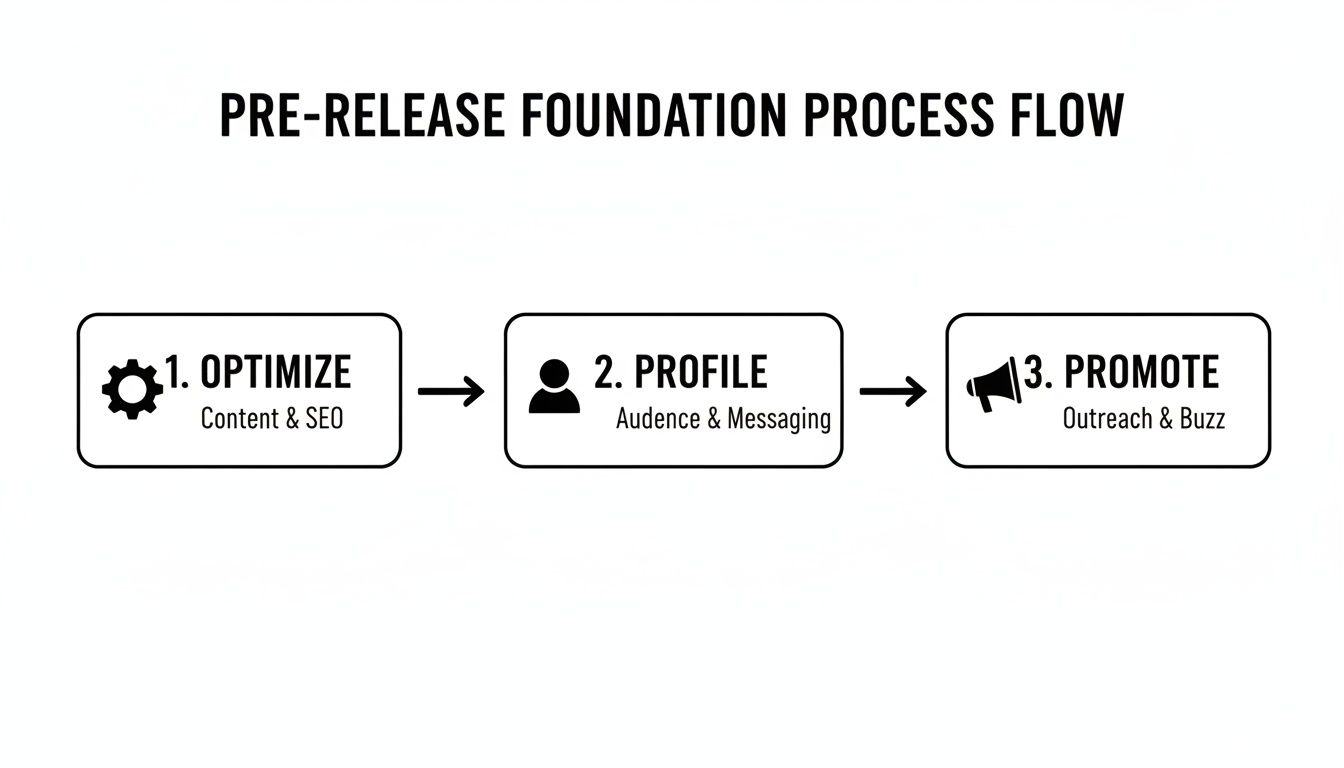
Think of it this way: a solid foundation makes your pitch much more compelling to curators.
Finding the Right Playlists and Curators
The sheer number of playlists on Spotify is almost hard to comprehend. We're talking about 8 billion playlists on the platform, with a staggering 1 billion new ones created in 2020 alone. Getting featured is a big deal; artists often see an immediate 20-50% spike in streams after a good placement.
With so many options, you have to be selective. Pitching your acoustic folk song to a "Beast Mode" workout playlist isn't just a waste of time; it shows you haven't done your homework. The real goal is to find playlists where your music genuinely belongs and where the audience is actually listening.
Don't get distracted by huge follower counts. A playlist with 5,000 engaged, genre-obsessed followers will do more for your career than a generic list with 50,000 passive listeners or—even worse—a bunch of bots.
A great way to start is by looking up artists who sound like you. Check out their profiles, see which user-curated playlists they're on, and start building a target list. Read the playlist titles and descriptions. Does the vibe match your music?
How to Spot a Bad Playlist (and Avoid Scams)
Unfortunately, where there's opportunity, there are also scams. The playlisting world has a dark side filled with bot-farms and fake streams. Getting on one of these lists can actually hurt you, sometimes even leading to your distributor taking your music down.
Watch out for these red flags:
"Guaranteed" Placements: No legitimate curator ever guarantees a spot. Curation is based on taste, not a transaction. If they're asking for money in exchange for a guaranteed add, run.
Weird Follower Growth: Use an analytics tool to check a playlist's history. If you see a sudden, massive jump in followers overnight, it's almost certainly bots.
Vague or Spammy Names: Playlists with generic, keyword-stuffed titles are often designed to trick artists, not to build a community of listeners.
No Human Behind the Curtain: Real curators are usually proud of their work. They'll have a social media presence, a blog, or some way to show they're a real person who loves music.
This is exactly why platforms like SubmitLink exist. They use sophisticated bot detection to vet every single curator on their platform, so you know you're pitching to real people with authentic audiences. It takes the guesswork out of the equation and keeps your music safe.
Crafting a Pitch That Actually Gets Read
Once you have a solid list of relevant, vetted playlists, it's time to write your pitch. And this is crucial: curators are absolutely swamped with emails. Your message has to be concise, professional, and personal to stand out.
A generic, copy-pasted email will get you sent straight to the trash folder. Show them you've actually listened to their playlist. Mention a specific song on it you like and briefly explain why your track would be a great fit. For a complete deep-dive on this, our guide on how to submit to Spotify playlists as an indie artist breaks it down even further.
At a minimum, your pitch needs:
A direct Spotify link to your song.
A quick, one-sentence description of the track's genre and vibe.
A personalized note about their specific playlist.
Keep it short. Make it easy for them. Your goal is to get them to click play, not to read your life story. Over time, building genuine relationships with a handful of great curators will be far more valuable than any single placement you land.
Playlist Pitching Channels Compared
There are a few different ways to get your music in front of curators. Here’s a quick rundown of the main channels artists use, along with a look at the pros and cons of each.
Pitching Method | Pros | Cons | Best For |
|---|---|---|---|
Direct Email/DM | Free; allows for deep personalization and relationship-building. | Extremely time-consuming; low response rates; hard to verify playlist quality. | Artists with a lot of time who are targeting a small, highly-curated list of dream playlists. |
Spotify's Official Tool | Free; direct line to Spotify's editorial team; influences Release Radar. | Highly competitive; zero feedback if rejected; only for unreleased music. | Every artist with an upcoming release. It's a non-negotiable step. |
Submission Platforms (e.g., SubmitLink) | Vetted curators; high response rates; streamlined process; protects from scams. | Usually requires a fee or credits; less personal than a direct email. | Artists who value their time and want to pitch to a wide range of legitimate playlists efficiently. |
PR Agencies/Pluggers | Leverage existing industry relationships; can secure high-profile placements. | Very expensive ($500-$5,000+ per campaign); results are not guaranteed. | Established artists with a significant budget looking for a major campaign push. |
Ultimately, a mix of these methods often works best. Use Spotify's official tool for every release, build personal relationships with a few key curators through direct outreach, and use a trusted platform to scale your efforts efficiently.
Promotional Strategies to Amplify Your Music
Alright, your track is live and your playlist pitches are out in the wild. Now the real work begins. Getting more streams isn't just a Spotify game; it's about building a promotional machine that pulls in listeners from every corner of your online presence.
Think of it this way: each channel, whether it's TikTok or your email list, is a tributary flowing into the same river. Your job is to keep those tributaries flowing, creating a constant stream of new listeners who don't just play your song once, but follow you, save your track, and add it to their own playlists. This is how you build sustainable growth, not just chase a one-time viral spike.
Go All-In on Short-Form Video
Right now, there's no better organic discovery tool for musicians than short-form video on TikTok and Instagram Reels. Period. A single, well-crafted video can drive thousands of new listeners straight to your Spotify, giving the algorithm the exact "active listener" signals it craves.
The trick is to make content about your song, not just post a clip of your song.
Start a Trend: Can you create a simple dance, a relatable skit, or a unique video concept using a key part of your track? The magic happens when other people feel inspired to make their own version.
Tell the Story: People connect with stories. Share the behind-the-scenes of how you made the song. Break down the meaning of the lyrics. Let people into your creative process.
Use Strong Hooks: You have three seconds to stop the scroll. Grab their attention immediately with a question, a controversial statement, or a visually arresting shot.
Don't forget that the "sound" on these platforms is a clickable link. When someone finds your audio on a Reel, they can tap it and see every other video using it, creating a powerful network effect that often leads them right back to Spotify to hear the full thing.
Get Smart With Paid Ads
Organic reach is fantastic, but paid ads give you control and predictability. When done right, platforms like Meta (Facebook and Instagram) let you put your music directly in front of your ideal listeners. For a new artist, a small ad budget is often the spark you need to get the algorithmic fire going.
So many artists make the mistake of running a lazy "link in bio" ad. Don't do that. Create engaging, 15-second vertical video ads that feel native to Instagram Stories or Reels. They will always outperform a static image or a repurposed music video clip.
When you're setting up your ad campaign, get granular with your targeting:
Lookalike Audiences: This is a game-changer. Upload your email list or a list of your Spotify followers, and Meta's algorithm will find new people with similar tastes and behaviors.
Interest Targeting: Go beyond targeting fans of superstars. Dig deeper and target listeners of artists in your specific sub-genre. Who are your true peers?
Geographic Targeting: Is your Spotify for Artists data showing a hot spot in a specific city? Run a targeted ad campaign just for that region to pour fuel on the fire.
You don't need a massive budget. Start small with $5-$10 per day and test different video clips and audiences. The goal is to find a winning combination that gets you a low cost per click to your Spotify profile, essentially buying streams from people who are primed to like your music.
Don't Sleep on Your Email List
Social media algorithms are fickle, but your email list is an asset you completely own. It's your direct line to your most passionate fans—the people who will drop everything to listen to your new song on release day.
Make building this list a constant priority. On your website, offer a free download, an exclusive demo, or a behind-the-scenes video in exchange for an email address.
When release day hits, that email list is your launch crew. A well-timed email can send a huge initial wave of streams, which is a critical signal to Spotify. This initial velocity helps trigger algorithmic playlists like Release Radar for your followers, creating a powerful ripple effect. If you're looking to scale your promo even further, you can explore the best music promotion services to complement your grassroots efforts.
Ultimately, a multi-channel approach is your best shot at getting more Spotify streams. Each piece—TikTok, paid ads, your email list—works together to weave a web of discovery, guiding new fans back to where it all counts: your music on Spotify.
Converting Listeners into Long-Term Fans
A single stream is just a thirty-second blip. A fan, on the other hand, can be with you for an entire career. The real game isn't just getting that first play; it's about turning that casual listener into someone who genuinely cares about what you do next. This is how you build something that lasts.
Your Spotify for Artists profile is your home base for making this happen. Think of it as your digital storefront. Every single piece of it needs to nudge people toward that one crucial action: a follow. When someone follows you, your new tracks land directly in their personal Release Radar playlist. That's a guaranteed stream from your most dedicated listeners, every single time.
Give Them a Reason to Stick Around
A bland, empty artist profile is a dead end. People might land there, listen to one song, and then just... leave. There’s nothing to grab them, nothing to explore. You have to give them a compelling reason to click around and hit that "Follow" button.
Here's how to make your profile sticky:
Your Artist Pick: This is the most valuable real estate on your page. Use it to pin your latest single, show off a playlist you were just added to, or even plug your upcoming tour dates. It’s the very first thing people see, so make it count.
A Living, Breathing Canvas: A track with a Canvas—that short, looping video—just feels more alive. Spotify's own data backs this up, showing that these tracks get way more engagement, from shares to playlist adds.
Merch on Deck: If you have a Shopify or Merchbar store, connect it directly to your profile. This is a no-brainer. It gives fans a direct way to support you with their wallets and turns them into walking billboards for your music.
You can also get creative beyond the usual merch. For example, you can learn how to monetize your audio content with early access and give your super-fans something exclusive.
The Hidden Power of a Steady Release Schedule
Want to know one of the most powerful signals you can send to both your fans and the Spotify algorithm? Consistency. Dropping a track every two years just won't cut it; you lose all momentum. A steady flow of new music keeps your audience hooked and tells Spotify you're an active artist worth paying attention to.
This doesn't mean you need to burn yourself out releasing a song every week. Find a rhythm you can actually stick to, whether that's a new single every 6-8 weeks or an EP every six months.
A consistent release schedule does more than just give your fans new music. It trains the algorithm to pay attention to you. Each new release is a new opportunity to trigger algorithmic playlists and re-engage your entire follower base.
This consistency builds anticipation. Your core fans learn your rhythm and start looking forward to your next release, making it a genuine event instead of just another song dumped online.
Team Up to Amplify Your Reach
Collaborating with another artist is easily one of the quickest ways to tap into a whole new audience. When you release a song with someone else, you're not just sharing a track—you're sharing fanbases.
The trick is to find artists in a similar sonic world but with their own distinct following. This makes the collaboration feel natural and puts your music in front of a fresh set of ears that are already likely to enjoy what you do.
A good collab is a win-win:
Cross-Pollination: Both of you introduce your followers to cool new music, creating a two-way street of discovery.
Playlist Power: When you both pitch the track to Spotify's editors, you literally double your chances of landing on major playlists.
Shared Hype: The promotional work is split. You've got two artists posting on socials, sending out emails, and driving people to the song.
Treat it like a true partnership. By working together, you create a moment that’s bigger than anything either of you could have pulled off alone, turning listeners from two separate worlds into shared, long-term fans.
Using Your Data to Fuel Sustainable Growth
Your Spotify for Artists dashboard is so much more than a vanity report card. Think of it as your strategic roadmap. Moving beyond the simple thrill of a rising stream count is where real, sustainable career growth actually begins. The data tells you not just what is happening with your music, but who is listening, where they are, and how they found you.
Mastering this data is the difference between blindly throwing money at promotion and making calculated investments that actually pay off. Every data point is a clue. Ignoring them is like trying to navigate a new city without a map—sure, you might get somewhere eventually, but it'll be by pure luck, not strategy.
Moving Beyond Surface-Level Metrics
The total stream count is the first thing everyone looks at, but honestly, it's often the least helpful metric on its own. To really understand your momentum and get more Spotify streams that matter, you need to dig deeper into the "Audience" and "Music" tabs of your dashboard.
These are the key metrics that paint a real picture of your progress:
Listeners vs. Streams: Are a few superfans playing your song on repeat, or are you actually reaching a lot of new people? A high streams-to-listeners ratio can signal a dedicated core audience (which is great!), but a consistently growing "Listeners" number is the real key to expansion.
Saves: This is a huge signal of listener intent. A "save" means someone liked your song enough to add it to their personal library. It’s one of the strongest positive signals you can send to Spotify's algorithm.
Playlist Adds: This shows you how many people have added your song to their own personal playlists. It's powerful social proof and a direct driver of long-term, organic streams.
Don't get obsessed with a single number. Look at the relationships between your data points. A spike in listeners from a specific playlist is good, but if it doesn't lead to a corresponding increase in saves or followers, that playlist might just be delivering passive plays, not creating actual fans.
Identifying Your True Sources of Growth
The "Source of Streams" section is basically your performance review. It tells you exactly which promotional efforts are working and which are falling flat. Understanding these sources is how you allocate your time and budget without wasting them.
For instance, you might see your song is getting plays from "Your Profile and Catalog." That means people are actively seeking you out—a fantastic sign. On the other hand, if you see significant streams from "Other Listener's Playlists," you can click in to see which user-curated lists are driving the most traffic. That insight is gold; it tells you exactly which curators to build relationships with for your next release.
Source of Streams | What It Means for You | Actionable Step |
|---|---|---|
Algorithmic Playlists | Your music's engagement is strong enough for Spotify to recommend it. | Keep driving active engagement (saves, shares) to fuel this further. |
Editorial Playlists | You've successfully pitched or been discovered by Spotify's curators. | Share this placement widely on social media to maximize its impact. |
Listener's Own Playlists | You're converting listeners into fans who are saving your music. | Encourage this behavior directly in your social content and email newsletters. |
Using Geographic Data to Plan Your Next Move
Never, ever underestimate the "Top Cities" and "Top Countries" data. This information is your global heat map, showing you precisely where your music is resonating most strongly. Are you seeing a surprise hot spot in a city you've never even thought about? That's a clear signal you shouldn't ignore.
This data has incredibly practical applications:
Tour Planning: Instead of guessing where to book shows, you can plan a tour around the cities where you already have a proven fanbase waiting for you.
Targeted Advertising: Run Meta ad campaigns specifically targeted to your top cities to amplify your existing momentum and build lookalike audiences.
Local PR and Radio: Reach out to music bloggers, local radio stations, and influencers in your top-performing regions. A little local love can go a long way.
In a world where about 60,000 new songs are uploaded to Spotify every single day, most of which never reach 1,000 streams, data is your biggest competitive edge. Yet, independent artists are making a massive impact, earning over $5 billion in royalties in 2024. This just shows that with a smart, data-informed strategy, it's absolutely possible to break through. You can learn more about these Spotify statistics and how they impact artists.
By regularly analyzing your performance and tweaking your strategy, you turn each release into a learning opportunity, ensuring your next launch is always more successful than the last.
Got Questions About Growing on Spotify? We've Got Answers.
As you start digging into a Spotify growth strategy, a lot of questions pop up. It's totally normal. Even with a solid plan, you're bound to hit a few roadblocks. Let's clear up some of the most common questions I hear from artists so you can stay focused and keep moving forward.
How Often Should I Be Releasing New Music?
This is probably the number one question I get, and there's no magic formula. You'll often hear that dropping a new track every 6-8 weeks is the sweet spot to keep the algorithm happy, and that's a decent benchmark. But the real goal here is sustainable consistency.
Don't ever let a deadline force you to release something you're not proud of. A rushed, half-baked track does way more harm than good. If listeners skip it, you're sending a flood of negative data to Spotify. The key is to find a release schedule you can actually stick to without burning out, one that allows you to consistently deliver quality music. That's what trains both your fans and the algorithm to pay attention when you have something new.
Are Paid Playlist Promotions a Scam?
It's a minefield out there, I get it. Tons of services will promise you the world for a small fee, but you often end up on bot-infested playlists that could get your music booted from Spotify for good. But not all paid services are the same. You have to distinguish between buying fake streams and paying for real promotion.
Genuine playlist pitching services don't sell placements; they sell access and opportunity. You're paying for a streamlined way to get your music in front of actual human curators who are looking for new tracks. It’s an investment in your time and outreach, not a guarantee of streams.
That’s where platforms like SubmitLink come in. They do the hard work of vetting every single curator to make sure they're legitimate and bot-free. This way, you know your music is being pitched to real people with real audiences. It's about targeted outreach, not faking the numbers.
Do I Really Need a Music Video for Every Single Song?
Absolutely not. A big-budget, cinematic music video can be an amazing centerpiece for a lead single, but it's just not realistic or necessary for every song you put out. A much smarter move is to create a variety of scalable video content.
Think short-form vertical video—the stuff that fuels TikTok, Instagram Reels, and YouTube Shorts. This is where you'll get the most bang for your buck. Try things like:
Raw Performance Clips: Just you and your instrument, or a simple playback performance.
Behind-the-Scenes Content: Tell the story of how the song came to be, the meaning behind a lyric, or a cool production trick you used.
Simple Lyric Videos: Create quick, text-based visuals that highlight the most powerful lines in your song.
This approach gives potential fans way more opportunities to discover you. It's about creating dozens of little doorways to your Spotify profile instead of one giant, expensive one that most people will never walk through.
Ready to connect with real playlist curators and keep your music safe from bots? At SubmitLink, we've built a trusted network to help artists like you get heard. Start pitching your music on SubmitLink today and see what a difference authentic promotion can make.


