.png)
A Professional Artist's Guide to the Spotify Popularity Index
- Feb 12
- 17 min read
Updated: May 6
The Spotify popularity score is a deceptively simple metric ranging from 0-100, but for the professional artist, it's one of the most actionable data points on the platform. Think of it less as a vanity number and more as a real-time credit score for your music—a signal that tells Spotify's algorithm how much current market heat your tracks are generating.
A strong, well-managed Spotify popularity score directly influences algorithmic visibility, opens pathways to influential playlists, and captures the attention of Spotify's editorial team. For artists building long-term, sustainable careers, it is a cornerstone metric for growing catalog value and maintaining discoverability.
Decoding the Spotify Popularity Score

For a professional artist, the Spotify popularity score is much more than a number—it's a vital sign for your music's health in a saturated marketplace. It functions as Spotify's internal barometer, indicating which tracks are resonating with listeners and gaining real traction. Understanding how it works is fundamental to building an intelligent release strategy and maintaining catalog vitality.
The score is calculated using a proprietary blend of recent listener behaviors. Total streams are one component, but the algorithm places greater weight on high-intent actions: saves, user playlist adds, and repeat listening. A rising score signals to Spotify's system that your track has genuine momentum, positioning it as a prime candidate for broader algorithmic amplification.
Why the Spotify Popularity Score Demands Your Attention
The popularity score directly impacts your music's discoverability. Tracks with strong, upward-trending scores are far more likely to appear in algorithmic playlists like Discover Weekly and Radio—systems responsible for a significant share of streams and new listener acquisition.
For an artist with a defined sound and a promotional budget, learning how to strategically influence this score should be a primary objective. It’s about feeding the algorithm the precise signals required to achieve your desired outcomes.
The competitive landscape is intensifying. In Q4 2023, Spotify's user base expanded to 751 million monthly active users, partly driven by major cultural events like Spotify Wrapped. For artists, this scale means that during peak engagement periods, a healthy popularity score is absolutely crucial for maintaining visibility. You can read more about Spotify's user growth and its strategic implications.
Your popularity score isn't a passive metric; it's an active signal you're constantly transmitting. Every stream, save, and playlist add from a legitimate listener informs the algorithm that your music warrants wider amplification.
To give you a clearer operational framework, here is a breakdown of what different score ranges generally indicate for your track's standing on the platform.
Spotify Popularity Score Ranges Explained
Popularity Score | What It Means for Your Track | Common Listener Engagement Level |
|---|---|---|
0-10 | Brand New or Inactive: The track is newly released with very little data or is an older track with almost no recent activity. | Very low; minimal streams and saves. |
11-30 | Emerging Niche: Gaining some initial traction, likely from a small, dedicated fanbase or a few micro-playlist adds. | Low but growing; listeners are discovering the track. |
31-50 | Building Momentum: The track is performing well, landing on user-generated playlists and showing consistent daily streams and saves. | Moderate; a solid listener base is forming. |
51-70 | Algorithmic Contender: Strong performance is triggering Spotify's algorithms. The track is likely appearing on Radio and Discover Weekly playlists. | High; a significant number of listeners are saving and repeat-playing. |
71-85 | Breaking Out: The track has significant viral or editorial playlist support, reaching a broad audience beyond the artist's core following. | Very high; widespread appeal and strong listener loyalty. |
86-100 | Global Hit: Dominating major editorial playlists and charts; one of the most-played tracks on the platform at the moment. | Elite; massive daily streams from a global audience. |
These are general benchmarks. What counts as a good Spotify popularity score depends on your career stage and genre, but this table provides a practical framework for assessing where your music currently stands.
A Framework for Strategic Growth
When you begin viewing the popularity index as a strategic lever, your entire promotional mindset shifts. Instead of merely chasing a high stream count, you focus on generating the right kind of engagement—the authentic, high-quality interactions the algorithm is designed to reward.
This strategic pivot involves several key principles:
Protecting Your Catalog: First and foremost, avoid any promotional services that utilize artificial streams. Spotify's systems are engineered to detect and penalize this activity, which can decimate your index score and even lead to takedowns. The risk is untenable.
Targeted Promotion: Allocate your budget toward campaigns and vetted playlisting services that connect you with real, engaged listeners who are genuinely likely to convert into long-term fans.
Measuring Campaign ROI: Track your index score before, during, and after any promotion. This provides a clear, data-backed method for evaluating campaign efficacy, allowing you to optimize your strategy for future releases.
By mastering this one metric, you transition from simply releasing music to strategically positioning it for success within Spotify’s ecosystem.
How Spotify Calculates the Popularity Score
To effectively influence your Spotify popularity, you must first understand what it isn't, it is not a cumulative total of your streams. Spotify's algorithm is far more sophisticated—it functions as a weighted calculation that heavily favors recency. Think of it less as a lifetime achievement award and more as a real-time relevance meter reflecting current listener activity.
While Spotify keeps the exact formula proprietary, industry analysis provides a clear picture of its core components. These are the signals that indicate genuine listener resonance, and understanding them is the foundation of any effective strategy to increase your Spotify popularity score.
The Core Factors Behind the Popularity Score
Spotify’s algorithm is a positive feedback engine. Raw stream numbers are merely the starting point; the critical data lies in what listeners do during and after listening.
These are the primary factors that influence the score:
Stream Velocity and Recency: This is the dominant factor. The volume of streams within a short, recent window is paramount. A track that accrues 1,000 streams today is algorithmically more valuable than one that received 10,000 streams six months ago.
Listener Completion Rates: The algorithm tracks listener drop-off. High completion rates—where users listen to the entire track—send a powerful signal that your music is engaging, not merely clickbait.
Save Rates and Library Adds: When a user saves your track or adds it to their personal playlists, it's a significant vote of confidence. This action signals a desire for repeat listening and is one of the most valuable engagement metrics.
Playlist Additions: This encompasses everything from a fan adding your track to their "Workout Mix" to a major Spotify editorial placement. All playlist adds are positive, but placements on active, popular playlists with authentic listeners send an exceptionally strong signal.
A track's Spotify popularity score is effectively a rolling snapshot of its recent performance—not a cumulative total—constantly refreshed with new listener data.
This is why a catalog track with millions of historical streams can score lower than a new release just beginning to gain traction. The entire system is engineered to reward fresh, current engagement over historical volume.
Understanding Score Decay
A crucial concept for any professional artist is algorithmic decay. This is the principle that the algorithmic value of a stream diminishes over time. A stream from yesterday is worth more than one from last week, which is significantly more valuable than one from last year.
This built-in decay ensures the popularity score reflects current trends, not historical performance—which is why sustained success requires a continuous strategy. Without a steady influx of fresh engagement—new streams, saves, and playlist adds—any track's score will naturally decline. For artists managing a catalog, this makes strategic reactivation campaigns essential for maintaining relevance within the algorithm.
Track Popularity vs. Artist Popularity
Finally, it is critical to understand that Spotify maintains two distinct scores for your profile.
Track Popularity: Each individual song in your catalog has its own score from 0 to 100, based solely on its individual performance. This is the metric you'll monitor closely during a new release cycle.
Artist Popularity: Your artist profile has an aggregate score. This is a weighted average of your entire catalog's performance, heavily influenced by your newest releases and your all-time most successful tracks.
The two are inextricably linked. A new single with a rapidly increasing track score will elevate your overall artist score. A high artist score, in turn, increases the likelihood that Spotify's algorithms will recommend your other songs to listeners, creating a powerful growth flywheel. To manage this effectively, you need to use playlist analytics to track these metrics and build a data-informed strategy.
How to Check and Interpret Your Spotify Popularity Score
A metric is only useful with context. Your goal isn't to reverse-engineer Spotify's algorithm—it's to transform your popularity score from a passive data point into an active strategic instrument. Knowing where to find it and how to read it is the first step toward making informed decisions that protect and grow your music's value.
You will not find the popularity index displayed within your standard Spotify for Artists For artists investing significant capital into their music, the objective must be long-term asset growth, not fleeting vanity metrics. This means allocating budget to tactics that build a genuine fanbase, cultivate listener loyalty, and protect your catalog from the material threat of fraudulent streams. The strategies below are designed to generate authentic momentum and convert your promotional spend into a rising
This flowchart illustrates the essential components that determine your score.
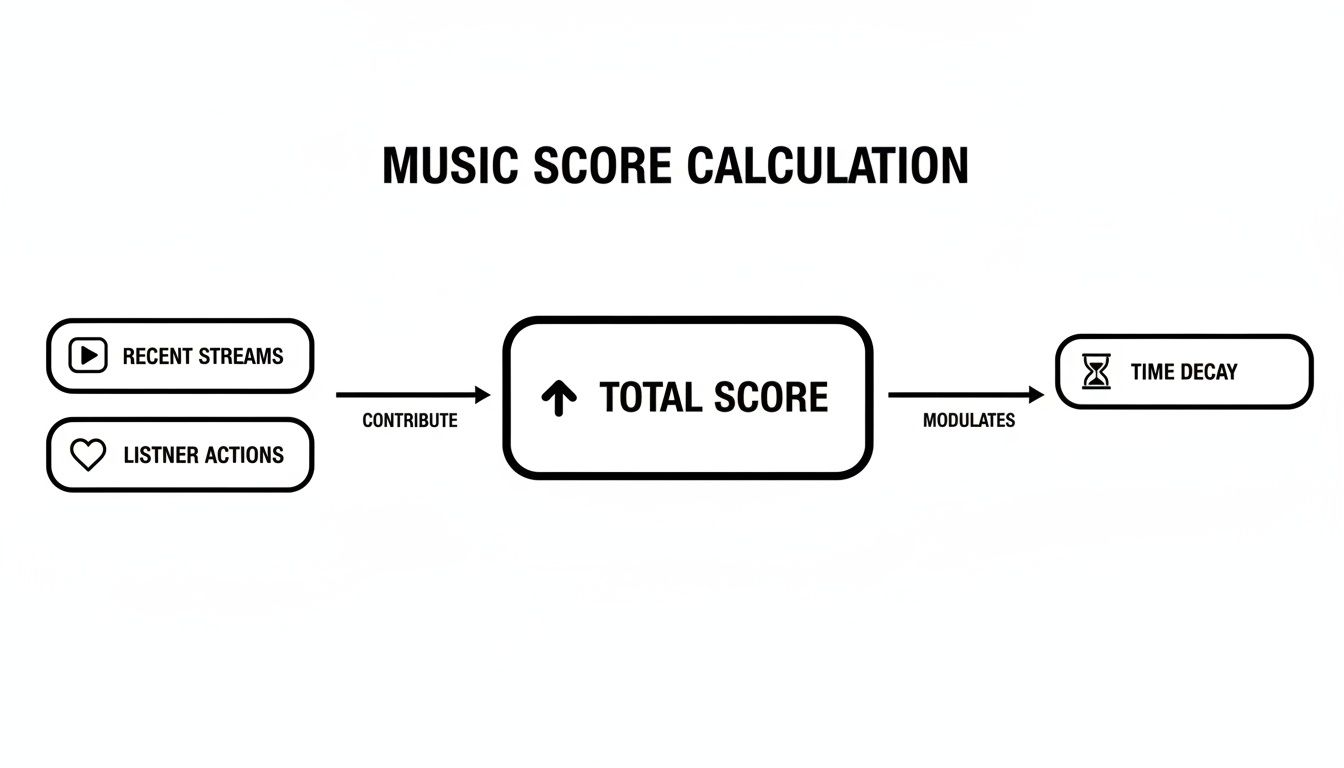
As shown, the score is a balance between momentum-building fresh streams and positive listener actions, counteracted by the constant pull of time decay. This dynamic makes sustained, strategic activity absolutely critical.
Benchmarking Your Performance
Your score does not exist in a vacuum. Its significance is directly related to your genre, career stage, and current promotional activities. A score of 45 could represent a significant achievement for a new single in a niche instrumental genre. However, for a major-label pop track with substantial ad spend, the same score might indicate a strategic misfire.
To derive meaning from your score, you must begin with benchmarking:
Analyze Your Peers: Identify artists with a similar sonic profile and audience scale. Examine their artist and track scores to establish realistic targets and competitive benchmarks.
Track Your Catalog: Monitor the scores across all your releases. This practice helps identify "sleeper hits" with long-term potential and signals when older tracks are losing momentum and may require a promotional refresh.
Establish Pre-Campaign Baselines: Before allocating budget to a playlist campaign or social media push, document the track's starting popularity score. This is your most important KPI for measuring the direct impact and ROI of your efforts.
Translating Score Changes into Actionable Strategy
Monitoring your score is not a passive exercise. It’s about identifying patterns and responding with calculated, strategic moves. Operate like a trader watching the market—every fluctuation is a signal informing your next action. Your goal is to convert these data points into tactical decisions that maximize your return on investment.
A change in your Spotify popularity index isn't just a result; it's a diagnostic tool. It reveals what the algorithm is rewarding and where your promotional budget is delivering the most impact.
Here’s how to interpret the three primary score movements and the appropriate strategic response:
A Rising Score: This is a clear positive indicator. It confirms that your current strategy is resonating with the algorithm. The combination of recent streams, saves, and playlist adds is generating real momentum. This is the time to increase investment. If a specific playlist campaign is driving the growth, consider allocating more budget to similar, vetted playlists. A rising score signals to the algorithm that your track is a strong performer, increasing its probability of placement in discovery engines like Discover Weekly and Radio.
A Stagnant Score: A flatlining score, particularly during an active campaign, is a red flag signaling the need for a tactical pivot. While you may be generating streams, they are not translating into the high-quality engagement—saves, shares, and repeat listens—that truly impacts the index. This is an opportunity to analyze your targeting. Are the playlists a genuine fit for your music? Is your ad creative resonating with the target audience? A stagnant score is a chance to refine your strategy before misallocating further budget.
A Falling Score: Outside of an active promotion, a gradual decline is normal due to algorithmic decay. However, a sudden, sharp drop is an alarm. It could indicate removal from a significant playlist or a cratering of listener engagement. This situation calls for a re-engagement campaign. Activate your mailing list or rally social media followers to drive dedicated fans back to the track. A small, targeted push can generate fresh positive signals and mitigate the decline.
Proven Strategies to Increase Your Spotify Popularity Score

Knowing your popularity score is step one. Strategically influencing it is what separates professional artists from amateurs. This isn't about chasing viral moments; it's about executing a deliberate, sustainable plan that generates the authentic listener engagement Spotify’s algorithm is designed to identify and reward.
For artists investing significant capital into their music, the objective must be long-term asset growth, not fleeting vanity metrics. This means allocating budget to tactics that build a genuine fanbase, cultivate listener loyalty, and protect your catalog from the material threat of fraudulent streams. The following strategies are designed to generate authentic momentum and convert your promotional spend into a measurably rising Spotify popularity index.
Engineer Your Pre-Release for Maximum Velocity
The initial 48 hours post-release are critical. A powerful initial surge sends an unambiguous signal to Spotify's algorithm that your song has market viability. Your entire pre-release strategy must be architected to maximize this early momentum.
This extends far beyond simply distributing a pre-save link. A professional rollout involves a coordinated campaign designed to drive a concentrated wave of saves, follows, and first-day streams.
Segment Your Audience: Avoid a one-size-fits-all approach. Leverage your email list and social media data to create targeted pre-save campaigns. Messaging for your most dedicated fans should differ from that for more casual listeners.
Incentivize Action: Provide a clear value exchange. Exclusive content, behind-the-scenes access, or early access to merchandise can convert a passive follower into an active pre-saver. Frame the pre-save as a meaningful event.
Coordinate All Efforts: If you are working with a PR team, influencers, or other partners, ensure all parties are aligned. All promotional activity must be synchronized to launch on release day, creating a massive, unified impact.
This initial velocity acts as the launch fuel for your track. A strong launch can be the difference between a song that languishes in obscurity and one that is picked up by Spotify's powerful discovery engines like Release Radar and Discover Weekly.
Execute Smart and Vetted Playlist Pitching
Playlist pitching remains a highly effective channel for growth, but it is fraught with risk. Quality must always supersede quantity. For a professional artist, a placement on a botted playlist isn't just a waste of budget—it can lead to stream removal, a collapsed popularity score, and even a takedown notice from your distributor. This is an unacceptable risk.
True algorithmic growth is driven by placements on active, engaged playlists where real listeners discover, save, and repeat your music. The objective isn't merely streams—it's genuine fan conversion.
This is precisely why utilizing a platform with robust, integrated vetting is non-negotiable. Services that employ sophisticated bot detection, such as the artist.tools technology that powers SubmitLink, are essential for protecting your investment and reputation. These systems continuously scan for suspicious activity, ensuring your music is presented exclusively to authentic audiences.
When pitching, diversify your efforts across a portfolio of playlists:
Niche Genre Playlists: Target smaller, meticulously curated playlists that align perfectly with your sound. Listeners on these playlists have a much higher probability of converting into genuine fans.
Mood & Activity Playlists: Think beyond genre classification. Pitching to playlists like "Focus Flow," "Workout Beats," or "Late Night Vibes" can secure a steady, long-term stream of engaged listeners.
Micro-Influencer Playlists: Identify and engage with tastemakers in your scene. A placement on a respected creator's playlist provides powerful social proof and access to a highly engaged audience.
Securing legitimate placements generates the precise signals—saves, library adds, and high listener retention—that directly boost your Spotify popularity index. It’s a cornerstone for building a durable following, and you can explore this further in a strategic playbook for acquiring Spotify followers that expands on this philosophy.
Run Sophisticated Ad Campaigns
Playlisting is not the only viable channel. Targeted ad campaigns on platforms like Meta (Facebook/Instagram) and TikTok are a powerful way to drive new listeners directly to your Spotify profile. However, a simplistic "Listen Now" ad is no longer sufficient.
Your campaigns must be engineered to attract high-intent listeners—individuals who are likely to do more than listen for 30 seconds and exit.
Focus on ad creative and funnels that encourage deeper actions. For instance, instead of driving traffic directly to the stream, run a campaign that directs users to a smart link or landing page where they can save the track and follow your artist profile in a single action. This strategy prioritizes valuable, long-term engagements over passive listening, feeding the algorithm much richer data. This is how you convert your ad budget into a lasting asset that elevates both your track and overall artist popularity scores.
Comparison of Promotional Tactics
To visualize how these components integrate, this table breaks down how different promotional channels influence the metrics most critical to Spotify's algorithm.
Promotion Channel Impact on Popularity Index
Promotional Tactic | Primary Metric Influenced | Why It Matters Strategically | Best For |
|---|---|---|---|
Pre-Release Campaigns | Saves, First-Day Streams | Creates initial velocity that triggers algorithms like Release Radar. | Launching a new single with maximum impact. |
Vetted Playlist Pitching | Streams, Saves, Library Adds | Builds a foundation of genuine listener engagement and long-term discovery. | Sustainable growth and reaching new, relevant audiences. |
Social Media Ads | Follows, Profile Visits, Saves | Drives high-intent traffic directly to Spotify, converting casual listeners into followers. | Building your core fanbase and retargeting engaged listeners. |
Content Marketing (TikTok/Reels) | Off-Platform Discovery | Creates viral potential and drives organic searches for your song and artist name on Spotify. | Sparking curiosity and capturing cultural moments. |
A strong promotional plan integrates a mix of these tactics. Each channel reinforces the others, creating a feedback loop that consistently signals to Spotify that your music warrants wider attention.
Common Myths That Hurt Your Spotify Popularity Score
Navigating the world of Spotify promotion often means wading through a morass of misinformation. For a professional artist with a defined budget and a reputation to uphold, succumbing to these myths is not a simple mistake—it's a significant liability. These misconceptions can lead to wasted capital, a diminished standing with the algorithm, and even punitive action from your distributor.
Sustainable growth is predicated on intelligent, informed decisions. This starts with dismantling the dangerous myths that promise shortcuts but ultimately lead to strategic dead ends. Understanding what not to do is as crucial as knowing what works. It enables you to invest your time and budget wisely and protect the long-term viability of your music.
Myth 1: All Streams Are Created Equal
This is the most pervasive and destructive myth in the industry: a stream is a stream. Nothing could be further from the truth. Spotify's algorithm is exceptionally sophisticated at differentiating between genuine listener engagement and low-quality, passive plays.
Consider the data signals. When an authentic listener discovers your song, saves it, adds it to a personal playlist, and listens repeatedly, they are sending a cascade of positive signals to Spotify. This is the behavior that materially drives up your Spotify popularity index.
Conversely, a stream from a fraudulent, bot-driven playlist where an account plays your track for precisely 31 seconds is, at best, algorithmically worthless. At worst, it’s a massive red flag. Spotify’s system is engineered to detect this artificial activity, and a sudden influx of these low-quality plays can actively damage your score and flag your account for fraud. Every dollar of your promotional budget must be aimed at generating real actions from real listeners, not just inflating a play count.
Myth 2: You Can Buy a High Popularity Score
This is another dangerous fallacy: that a high popularity score can be purchased directly. You will encounter services promising to skyrocket your numbers with thousands of "premium" streams. Do not engage. This is a fast track to disaster. You are not purchasing popularity; you are paying for fraudulent activity that puts your entire career at risk.
Spotify is constantly refining its bot-detection systems, which are the same class of technology that distributors like DistroKid use to police their platforms. When a track is flagged, the consequences are swift and severe:
Stream Removal: The artificial plays you paid for will be purged from your count, nullifying any temporary boost.
Popularity Score Crash: Your index score will plummet as Spotify penalizes you for the inauthentic activity.
Takedown Notices: Your distributor may issue a takedown notice for the track. Repeated offenses can lead to the removal of your entire catalog.
Authentic popularity is earned through genuine connection with listeners. There are no shortcuts. To fully grasp the dangers, it's essential to understand the mechanics of avoiding fake playlists and protecting your growth.
Myth 3: Playlist Position Is All That Matters
Securing a placement on a major playlist feels like a significant win, but the reality is far more nuanced. The actual position of your track and the playlist’s true engagement level are what determine the outcome.
Being track #150 on a playlist with millions of followers may sound impressive, but it could yield negligible streams if listeners rarely scroll that far. Worse, if the playlist is populated by bots, the follower count is entirely meaningless.
The true value of a playlist is not its follower count; it's the quality of listener engagement it generates. A placement on a smaller, highly-curated niche playlist can be far more powerful for your popularity index than a low slot on a huge, disengaged one.
Your objective should be to secure placements on playlists where your music is a perfect fit for the audience. This is how you convert listeners into fans who save your track, explore your profile, and demonstrate the high-intent behaviors that build a sustainable career, not just a temporary statistic.
Frequently Asked Questions About the Spotify Popularity Score
Even established artists have questions about how the Spotify popularity score works. It appears simple on the surface but is driven by complex, recency-weighted mechanics. Below are answers to the most common questions from artists focused on strategic career growth.
How Quickly Does the Spotify Popularity Score Update?
Spotify's data processing is relatively rapid. The Popularity Index updates approximately every 24 hours.
This is significant because it provides near-real-time feedback on your campaigns. If you launch an effective promotion, you should see a corresponding movement in your score within 24-48 hours.
The magnitude of the change, of course, depends on the quality and volume of the engagement. A major campaign driving thousands of authentic streams, saves, and playlist adds will create a much larger impact than a minor one. The algorithm rewards sustained momentum. A steady stream of activity over several days will always build a more durable score than a single, transient spike.
Does a Low Score on an Old Track Hurt New Releases?
No, not directly. Spotify's algorithm assesses each track on its own merits. An older song in your back catalog with a score of 5 will not negatively impact the initial assessment of a new single.
However, your overall Artist Popularity score functions differently. That score is a weighted average of your entire catalog's performance, heavily skewed towards your newest and most popular tracks.
Therefore, a successful new release can absolutely elevate your entire artist profile. A higher artist score signals to Spotify's algorithm that you are a relevant artist, increasing the likelihood that it will recommend all of your music, including your back catalog. The optimal strategy is to focus resources on maximizing the success of each new release. As you acquire new fans, they will naturally explore your older material, lifting those scores organically over time.
A low score on an old track isn't a liability; it's an opportunity. A successful new single acts as a rising tide that can lift your entire catalog, bringing fresh listeners to assets released years ago.
Is It Better to Target One Large Playlist or Multiple Smaller Ones?
This is a classic strategic question. For building a sustainable career, the answer is almost always to target multiple, well-vetted smaller playlists. Diversification mitigates risk.
Landing on a massive playlist can generate a significant, high-volume spike in streams. This may look impressive for a day or two. But if the playlist's audience is not a good match for your music, you will see high skip rates. High skip rates are a negative signal to the algorithm and can actively harm your track's standing. A flood of low-quality streams is more detrimental than no streams at all.
Conversely, securing placements on several smaller, niche playlists provides a consistent flow of high-quality plays from listeners who are genuinely interested in your specific sound. This sends a much stronger positive signal to Spotify. It demonstrates that your music resonates consistently with a dedicated audience, which is precisely the pattern the algorithm is designed to identify and amplify. That is the foundation of long-term growth.
How Can I Protect My Popularity Score from Fake Streams?
Protecting your music from fraudulent streams comes down to one core principle: rigorous diligence in selecting your promotional partners. Every dollar you allocate to promotion is an investment. Entrusting it to a disreputable service is not just a waste of capital—it is actively hazardous to your career.
The only effective defense is to work exclusively with platforms and services that are transparent about their commitment to authenticity and utilize third-party bot detection.
Stick to Vetted Networks: Only use services that are transparent about using powerful bot-detection systems, like artist.tools, which is the same tech trusted by major distributors like DistroKid.
Monitor Placements: Reputable platforms will actively scan playlists for fraudulent activity and alert you if your track lands on a compromised list before significant damage occurs.
Demand Authenticity: Prioritizing real listeners generates the signals that matter—saves, shares, and repeat plays. This is the only safe and effective methodology for increasing your popularity score.
There are no shortcuts in this area. Due diligence is the only way to ensure your promotional budget is building your career, not putting your music at risk of penalties or takedown by Spotify.
Ready to grow your Spotify popularity the right way? SubmitLink connects you with over 600 vetted playlist curators, all backed by the industry-leading bot detection of artist.tools. Protect your catalog, get real feedback, and find the authentic audience your music deserves. Start your next campaign with SubmitLink.


