.png)
A Strategic Guide to Promoting Independent Music
- Feb 9
- 15 min read
Effective music promotion doesn't start on release day. It begins with a meticulously planned pre-release strategy designed to present your work to curators, journalists, and strategic partners as a professional, high-value asset.
This is not about simply creating an online presence; it's about architecting a digital identity optimized for industry engagement and audience conversion.
Laying the Groundwork: Your Pre-Release Foundation
Before allocating budget to paid media or playlisting campaigns, your foundational assets must be impeccable. Consider this the cost of entry. Every digital touchpoint—from your Spotify bio to your press photos—must communicate a cohesive and professional brand narrative. This level of polish is non-negotiable in today's saturated market.
And it is saturated. The independent music sector is no longer a niche; it's a dominant force. The US industry is projected to reach $668.5 million in 2025, distributed across over 8,712 businesses. This market has expanded by over 20% annually since 2020. Increased volume necessitates a more sophisticated and professional approach to achieve meaningful cut-through.
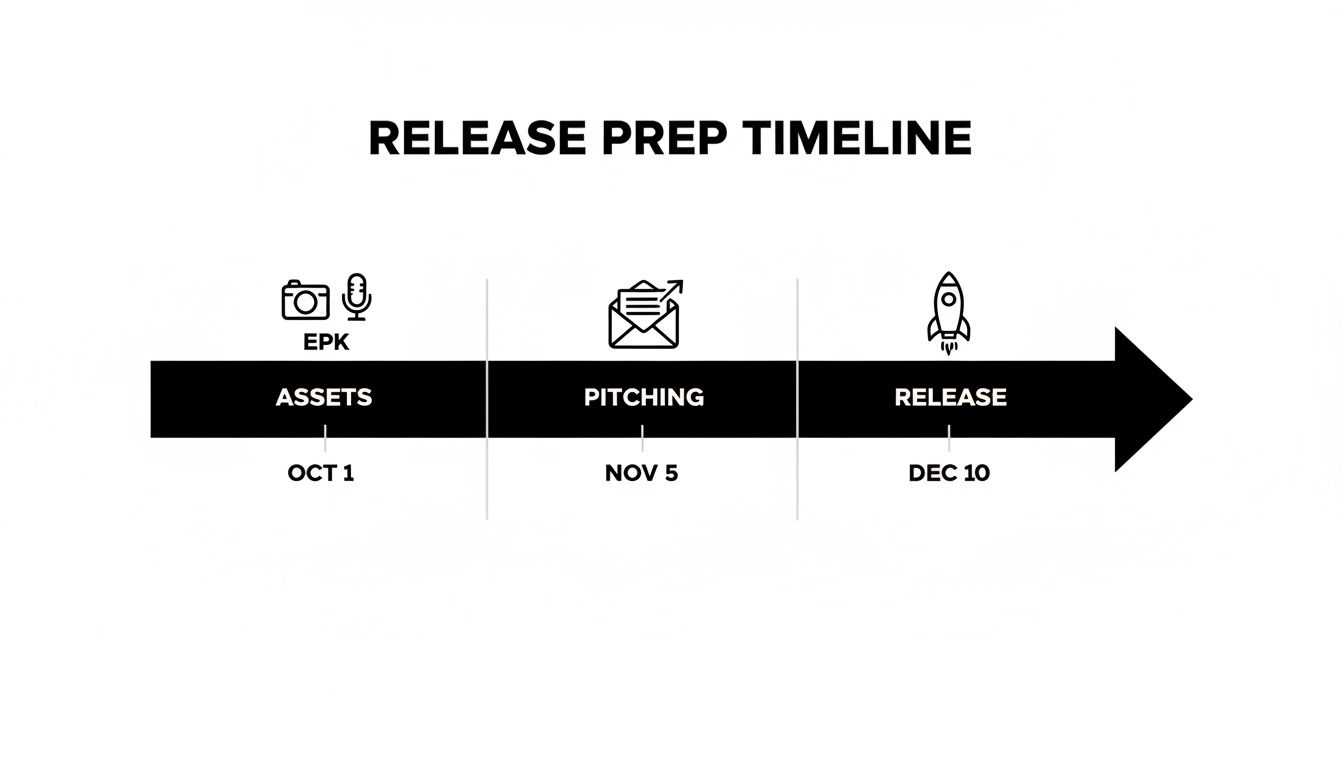
This timeline illustrates the interconnected phases of a professional release cycle. Asset creation, strategic pitching, and the release itself are integrated components of a single, fluid campaign.
Optimize Your Digital Shopfront
Your Spotify for Artists profile is your primary digital real estate. For a curator, journalist, or potential fan, it is often the first point of contact. The impression it makes in the initial seconds is critical and can determine whether they engage further.
Your profile must project "professional artist," not "emerging hobbyist."
Professional, High-Resolution Imagery: Your header and profile picture must be high-resolution and aligned with your current brand identity. Sub-par, unprofessional photos are an immediate credibility killer.
A Narrative-Driven Bio: Your bio should be a dynamic asset, updated to reflect the narrative of your latest release and recent career milestones. You have 1,500 characters; use them to articulate your story and value proposition.
Strategic Feature Utilization: Leverage the "Artist Pick" feature to prominently display your new single. Curating and featuring public playlists of your own is also a sophisticated move, signaling your active engagement within a broader musical community and showcasing your influences.
A meticulously maintained Spotify profile does more than project professionalism. It provides positive signals to Spotify's algorithm, indicating you are an active artist, which can directly enhance your platform visibility.
This strategic mindset must be applied consistently across all digital channels. Every post, story, and interaction should reinforce the professional world you are constructing around your music.
Assemble a Killer EPK
Your Electronic Press Kit (EPK) is your professional calling card and résumé. It is engineered to provide a busy industry contact with every necessary asset to feature your work, eliminating friction and back-and-forth communication.
A disorganized or incomplete EPK signals unpreparedness. It must be clean, comprehensive, and intuitively navigable.
An effective EPK must contain:
A Suite of Press Photos: Provide both portrait and landscape options in high resolution to accommodate various media formats.
Secure, Private Streaming Links: Use a professional platform like SoundCloud or Disco to provide a private, pre-release link to your music. Ensure the experience is seamless.
Essential Information: Your professional bio, key career highlights, and direct links to your social and streaming profiles must be immediately accessible.
For a detailed blueprint on constructing an EPK that commands attention, review our guide on how to create an EPK that optimizes your professional reach. Securing this foundation ensures that your outreach efforts are received by professionals who view you as a peer.
Release Promotion Timeline Strategic Overview
This table outlines the promotional lifecycle into distinct, manageable phases. Use it as a framework to build your own release strategy, ensuring all critical operational steps are covered.
Phase | Timing (Weeks Before Release) | Key Activities & Focus | Critical Tools |
|---|---|---|---|
Phase 1: Foundation & Assets | 8-6 Weeks | Finalize masters, create artwork, shoot press photos, write bio, build EPK. | DAW, Graphic Design Software, Pro Camera, Google Docs |
Phase 2: Distribution & Pitching | 6-4 Weeks | Upload to distributor, submit to Spotify Editorial, begin pitching to long-lead press/blogs. | DistroKid/TuneCore, Spotify for Artists, Email Client, SubmitLink |
Phase 3: Social & Content Buildup | 4-1 Weeks | Plan and create social content (teasers, BTS), engage community, run pre-save campaigns. | Canva, CapCut, Social Schedulers, Feature.fm/Hypeddit |
Phase 4: Release & Amplification | Release Week | Go live, execute social media plan, pitch to short-lead playlists/radio, run targeted ads. | SubmitLink, Social Media Ads Managers, Email Marketing Service |
Phase 5: Post-Release Momentum | 1-4 Weeks After Release | Analyze data, follow up with contacts, thank supporters, promote new playlist adds/press. | Spotify for Artists, Social Media Analytics, Spreadsheets |
This timeline-based approach transforms promotion from a reactive scramble into a proactive, well-orchestrated campaign designed to build momentum and maximize your music's market impact.
Getting Your Music on the Right Playlists
With your assets finalized and digital presence optimized, the focus shifts to strategic music placement. This phase requires a data-driven approach to playlisting, moving beyond indiscriminate outreach to surgical targeting and professional relationship-building.
An untargeted, high-volume approach is the most inefficient allocation of time and capital. Every hour and every dollar invested must contribute to measurable, sustainable growth—not transient vanity metrics. This requires a systematic process: identify appropriate curators, verify their legitimacy, and execute professional outreach.
Finding Curators Who Will Actually Vibe with Your Music
The primary objective is to identify playlists that are an authentic fit for your specific sound. Pitching an indie folk track to an EDM curator is a waste of resources and immediately signals a lack of due diligence.
Targeted research is paramount. Platforms like SubmitLink are purpose-built for this precision. They allow you to filter thousands of verified playlists by genre, sub-genre, mood, and keywords. This is your first line of defense against wasted effort, ensuring you engage only with curators actively seeking music within your niche.
Some platforms leverage AI to match your track’s sonic characteristics with a curator’s placement history, which can uncover highly relevant, niche opportunities that manual searches might miss.
Remember, the objective is not placement on any playlist; it is placement on the right playlists. A single placement on a well-aligned playlist with an engaged audience of 5,000 active listeners provides more value than ten placements on irrelevant lists with 50,000 bots.
Spotting Fakes: Vetting Playlists for Quality
Once a shortlist of potential playlists is compiled, the verification process is critical. In an ecosystem where fraudulent streams can trigger takedowns from distributors, your entire catalog is at risk. Diligence here is not optional.
This is where robust analytics become indispensable. SubmitLink integrates with artist.tools, the same bot-detection technology trusted by major distributors like DistroKid. This serves as a crucial safety net, flagging fraudulent playlists before you commit your budget.
When evaluating a playlist, look for these tell-tale red flags:
Discrepant Listener-to-Follower Ratio: A playlist with 100,000 followers but only a few hundred monthly listeners is a strong indicator of an inactive or bot-driven audience.
Questionable Audience Geographics: If the audience is heavily concentrated in territories known for click farms, proceed with extreme caution.
Anomalous Growth Patterns: Playlists exhibiting sudden, inorganic spikes in followers are likely inflated with fake accounts. Look for a steady, organic growth curve.
Investing in tools that provide this level of transparency is not an expense; it is an investment in the long-term integrity of your career. It ensures your budget drives streams from legitimate listeners with the potential to become long-term fans.
How to Write a Pitch That Curators Won't Ignore
With your research and vetting complete, the final step is the pitch itself. Curators are inundated with submissions. Your communication must be concise, professional, and respectful of their time.
An effective pitch is not a lengthy plea; it is a clean, professional introduction that is direct and to the point. State who you are, what your music sounds like, and, most importantly, why it is a specific fit for their specific playlist.
A simple, effective template:
Personalize the Introduction: Use the curator's name and reference their playlist. This demonstrates genuine research. "Hi [Curator Name], I'm an admirer of your 'Midnight Drive' playlist—your curation of artists like The War on Drugs is excellent."
Provide a Concise Introduction: Introduce yourself and your track in one or two sentences. "My new single, '[Track Name],' aligns with that atmospheric, driving aesthetic, and I believe it would resonate with your audience."
Ensure Seamless Access: Provide a direct, private streaming link and a professional closing. "You can listen here: [Private Link]. Thank you for your time and for curating such a quality collection of music."
This process is a repeatable, professional system. For a more exhaustive look, our guide on how to submit music to playlists and unlock higher streams provides more advanced strategies. By treating playlisting as the professional discipline it has become, you transform a speculative activity into a reliable growth engine.
Protecting Your Catalog from Promotional Scams
As your music gains traction, it will inevitably attract fraudulent operators. The music promotion landscape contains a significant underbelly of bot farms and pay-for-play schemes that can result in your music being flagged or removed by digital service providers.
Investing in promotion is essential, but every dollar must be directed toward legitimate activities that generate authentic engagement. A sudden, massive spike in streams may provide a temporary ego boost, but it risks takedowns, withheld royalties, and long-term damage to your professional reputation. The objective is to build a genuine audience, not to rent a fraudulent one.
Identifying the Hallmarks of a Scam
Fraudulent promotional services have become sophisticated, often mimicking the branding and language of legitimate marketing agencies. However, key red flags are almost always present upon closer inspection.
The most prevalent tactic is the guarantee of placements. Any entity promising placement on a major playlist for a fixed fee is selling a modern form of payola, which is a direct violation of the terms of service of every major streaming platform. Legitimate curation is based on musical merit, not financial transactions.
To be unequivocally clear on the ethics: You are paying for a professional's service—their time, expertise, and network access—not for a guaranteed result. Reputable platforms facilitate connections with curators; they do not sell playlist slots.
Another significant warning sign is a lack of transparency. If a service cannot provide detailed reporting on which playlists were pitched or data on their curators' performance history, you should disengage immediately.
Critical Metrics to Analyze
Your most effective defense against fraudulent promotion is your own data. Your Spotify for Artists dashboard is the ultimate source of truth and should be monitored diligently before, during, and after any campaign.
Pay close attention to these indicators:
Unnatural Stream Velocity: An overnight surge of thousands of streams from a single playlist with a low follower count is a classic indicator of bot activity.
Suspicious Listener Locations: If you are a US-based artist and your new listeners are predominantly from a country known for click farms, this is a major red flag.
Poor Save and Follower Ratios: This is a critical diagnostic. Bots generate streams; authentic listeners save tracks and follow artists. If your stream count is high but your save rate is near 0% and your follower growth is stagnant, those streams are almost certainly illegitimate.
These metrics reveal whether your promotional spend is connecting with actual human listeners. For a more detailed analysis, consult our guide on how to detect fake Spotify playlists and avoid scams.
Your Best Defense is a Vetted System
Navigating this landscape independently is both time-consuming and fraught with risk. Working with a platform that actively polices its own network is not a luxury—it is a necessity for any serious artist.
Services like SubmitLink provide this essential layer of security by integrating bot detection directly into their platform. It utilizes the same technology from artist.tools trusted by major distributors like DistroKid, meaning it continuously flags and removes fraudulent playlists from its network. This built-in protection allows you to pitch to verified, high-quality curators with confidence, ensuring your investment is secure.
Ultimately, intelligent music promotion is about making strategic investments. By learning to identify scams, obsessing over your data, and utilizing trusted platforms, you ensure every dollar spent contributes to building a genuine, lasting connection with real listeners—the only sustainable foundation for a long-term career.
Integrating Paid Media and Public Relations
While significant playlist placements or viral moments are valuable, they are often transient. To build sustainable momentum, a more holistic strategy is required. This is where paid media and public relations converge to create a powerful promotional flywheel.
Consider the synergy: a positive blog review provides credible social proof for a targeted ad campaign. That ad campaign drives qualified listeners to your Spotify profile, which in turn signals positive engagement to the platform's algorithm. This interconnected promotional ecosystem can elevate a standard single release into a pivotal career moment.
Architecting Your Promotional Budget
For a professional artist, a promotion budget is a strategic investment, not discretionary spending. Each dollar should be allocated to a specific objective, whether that's targeting playlist curators, executing lookalike audience ad campaigns, or securing key press features.
Before deploying capital, define your primary objective. Are you focused on increasing Spotify followers, driving traffic to a music video, or building credibility with industry tastemakers? Your primary goal will dictate your budget allocation.
For a key single, a balanced budget allocation might look like this:
Targeted Playlist Pitching (30%): This is your foundational investment. Capital is allocated to trusted platforms like SubmitLink to place your music directly before legitimate curators who can impact your trajectory.
Social Media Advertising (50%): This typically represents the largest share. These funds are used for highly targeted campaigns on Meta (Instagram/Facebook) and TikTok, focusing on users whose data profiles mirror your existing fanbase.
Public Relations Outreach (20%): This allocation is for retaining a freelance publicist or dedicating resources to secure features in respected music publications and online journals.
This model ensures a multi-pronged approach, simultaneously driving streams while building a credible narrative and professional reputation around your music.
Crafting Ad Creative That Converts
Your ad creative serves as the initial touchpoint between a potential fan and your music. It must be compelling enough to interrupt their scrolling behavior. Generic, low-effort ads are an ineffective use of funds; your creative must feel authentic and sonically arresting.
Short-form video is the dominant format. A visually engaging 15-second clip from a music video or a professionally shot live performance will consistently outperform a static graphic. The audio is paramount—ensure the song's hook is present within the first three seconds.
Your call-to-action (CTA) must be singular and unambiguous. Do not dilute the message by asking users to listen, follow, and pre-save. Select one clear objective per ad, such as "Listen on Spotify" or "Watch the Full Video." This minimizes friction and maximizes the conversion rate.
Mastering the Art of the PR Pitch
While advertising drives volume, PR builds your narrative. A feature in a trusted outlet like Stereogum or Earmilk provides third-party validation that cannot be purchased. Securing this coverage requires a different skillset—one focused on building professional relationships, not mass emailing.
Your pitch should be concise, professional, and personalized. Demonstrate that you are familiar with the journalist's work by referencing a recent, relevant article. Always include a link to your EPK and a private streaming link to the music. Never attach MP3 files directly to an email.
When pitching a journalist, you must implicitly answer their primary question: "Why should my audience care about this artist right now?" Your narrative is your hook. Frame it around your unique value proposition—your distinct sound, compelling backstory, or the narrative behind the song.
This professional approach is more critical than ever. The industry has fundamentally shifted, with independent artists now at the forefront. Projections show that indies will account for over 50% of all global music streams by 2025. With indie music revenues reaching $2.5 billion and growing by 25% annually, the opportunity is immense. These are not vanity metrics; they are indicators of a multi-billion-dollar sector driven by artists who effectively promote their work. You can read more about the rise of independent artists and the changing streaming landscape.
By strategically integrating paid media, social content, and PR, you create a self-reinforcing campaign that drives sustainable growth and solidifies your position in the industry.
Analyzing Campaign Data to Fuel Your Growth
The initial release activity has subsided. While streams continue to accrue, the most critical phase of your campaign has just begun: data analysis. The performance data from your release is the most valuable asset you have for optimizing future strategies.
This is the point where you move beyond vanity metrics like raw stream counts. Sustainable growth is derived from understanding the behavior behind the listening data. An effective campaign does not just generate plays—it provides a strategic roadmap for your next release, enabling you to refine targeting, optimize ad spend, and build a scalable career.
Key Performance Indicators That Actually Matter
Reframe the primary question from, "How many streams did I get?" to "What was the qualitative outcome of those streams?" Focus on metrics that signal genuine audience connection and long-term potential.
Your Spotify for Artists and distributor dashboards are your primary sources for this data.
Focus on these core metrics:
Listener-to-Follower Conversion Rate: This is arguably the most telling indicator of audience resonance. If 10,000 listeners result in only 50 new followers, there is a disconnect. A high conversion rate indicates that your music is compelling enough to inspire a desire for future engagement.
Save Rate: A track save is a direct signal to Spotify's algorithm that a user values your music enough to add it to their personal library. It is a powerful vote of confidence. A strong benchmark to target is a save rate of over 10% relative to your total listeners.
Playlist Adds by Listeners: This represents the pinnacle of organic growth. When a user adds your song to their own playlist, it demonstrates deep engagement and utility. It is a powerful indicator of a track's longevity and cultural resonance.
These metrics provide a far more nuanced and actionable story of your campaign's success than a simple stream count. They differentiate which promotional channels delivered listeners from which delivered fans.
Diagnosing What Worked and Why
With your core data compiled, the next step is attribution. The goal is to draw clear lines between your promotional actions and their resulting outcomes. Did the Meta ad campaign drive saves, or merely passive streams? Did a specific playlist placement correlate with a spike in new followers?
Consolidating this data can be accomplished with a simple post-campaign report in a spreadsheet.
Promotional Channel | Investment ($) | Streams Generated | Saves | New Followers | Notes / Key Takeaways |
|---|---|---|---|---|---|
SubmitLink Campaign | $150 | 35,000 | 4,100 | 850 | High save rate from indie-pop lists indicates strong genre alignment. High ROI. |
Meta Ads (Campaign A) | $200 | 25,000 | 900 | 150 | Generated significant reach but low engagement metrics. Re-evaluate creative/targeting. |
PR Outreach | $300 | 5,000 | 750 | 200 | Lower volume but exceptionally high-quality traffic and conversion rates. |
This type of analysis provides actionable intelligence. In this example, the SubmitLink campaign delivered the highest ROI for building a core audience, validating the targeted playlisting strategy. The Meta ads generated volume but lacked depth, suggesting a need to refine the ad creative or audience parameters for the next cycle.
Treat your post-campaign report as a strategic playbook. It transforms expenditure into intelligence, ensuring each subsequent investment is more efficient and effective than the last.
This data-driven methodology is how professional artists compete. The independent music publishing market is now a global force valued at €2.57 billion, commanding a 26.3% market share—larger than any single major label. The sector has grown by over 105% since 2018, and with 70% of new music originating from independents, a sophisticated, data-backed strategy is the primary vehicle for capturing market share. You can explore more data from the global independent music publishing market here.
By meticulously analyzing your results, you move from hoping for success to engineering it. You identify which curators champion your music, which ad copy resonates with your target demographic, and how to allocate your budget for maximum impact. This feedback loop is the engine of sustainable growth, transforming every release into a launchpad for the next.
Pro-Level Questions from Artists
Even experienced artists have nuanced questions regarding the optimization of music promotion. Here are answers to some of the most critical questions for professionals looking to maximize their investment and protect their assets.
What's a Realistic Budget to Promote a Single?
For an established independent artist, a strategic promotional budget for a key single typically falls between $500 to $5,000+. The final figure is dictated by the campaign's specific objectives.
An initial budget of $500-$1,000 can effectively fund a high-impact, targeted playlisting campaign via a trusted service, coupled with a focused social media advertising flight.
A mid-tier budget of $1,000-$2,500 allows for the expansion of these activities to include a micro-influencer campaign or a short-term retainer with a boutique PR firm to target key online publications.
Budgets exceeding $2,500 can support a more comprehensive PR campaign, larger ad spends with multi-variant A/B testing, and the creation of professionally produced short-form video content. The core principle is to allocate capital to channels with clear, attributable ROI.
Is Paying for Playlist Consideration a Good Idea?
To be clear: you should never pay for a guaranteed placement on a playlist. This is payola, a direct violation of Spotify's terms of service, and a hallmark of a fraudulent promotion service.
However, the standard and ethical industry practice is to invest in quality submission platforms where you pay for consideration, not for placement.
The model is analogous to a submission fee for a film festival. You are compensating a professional curator for their time and expertise to formally review your work. The placement itself must be earned on the merits of the music, which maintains the integrity of the ecosystem.
Services that charge a nominal fee, typically $2-$5, for a curator to review a submission fall within this ethical framework. The key is to partner with platforms that rigorously vet their curator network, integrate fraud detection, and provide transparent campaign analytics.
How Can I Turn Streamers into Actual Fans?
Converting a passive listener into a dedicated fan—an individual who invests in merchandise and live tickets—requires a deliberate, multi-platform strategy.
Optimize Your Spotify Profile as a Central Hub: Your profile is your digital flagship. Utilize the Canvas feature for engaging short-form video, maintain a current and compelling bio, and ensure prominent links to your social channels and merchandise store.
Utilize Retargeting in Ad Campaigns: Move beyond acquisition-focused ads. Implement retargeting campaigns aimed at users who have recently streamed your music. This is a powerful strategy to reinforce your brand and drive them from passive listening to an active "follow."
Build Owned-Audience Channels: An email list is your most valuable marketing asset, providing a direct communication channel immune to algorithmic changes. Incentivize sign-ups from your social channels by offering exclusive value—pre-sale codes, private content, or merchandise discounts. This is the foundation of building a sustainable community.
Ready to execute a professional playlist campaign that is both data-driven and secure? With SubmitLink, you gain access to a network of over 600 vetted curators, all protected by the same bot-detection technology trusted by DistroKid. It's time to connect with the right listeners, receive honest feedback, and build a genuine audience. Start your next campaign on submitlink.io today.


