.png)
How Much Does Spotify Pay Artists? A Professional Guide to Streaming Royalties
- Feb 11
- 14 min read
There is no single, fixed answer to how much Spotify pays per stream. Instead, artists earn a variable rate that generally falls between $0.003 and $0.005 per stream.
Consider this payment less a salary and more a dividend from a global revenue pool. Your earnings represent your proportional share of the platform's total revenue for a given month.
Understanding Your Potential Spotify Earnings
For any professional artist, a firm grasp of streaming financials is non-negotiable. It informs revenue forecasting, strategic goal-setting, and promotional budget allocation. While the precise per-stream rate fluctuates, industry averages provide a reliable framework for financial modeling.
Your payout is determined by a complex "pro-rata" system, which we will detail later. For now, the critical concept is that your revenue is a function not only of your stream count but also of your share of all streams across the platform that month.
From Streams to Gross Revenue
To translate abstract rates into tangible figures, consider that 1,000 streams often yields approximately $4. Achieving the milestone of one million streams can generate around $4,000.
If a track gains significant traction and reaches 100 million streams, it could produce roughly $400,000. A global hit accumulating one billion streams could generate in the vicinity of $4 million—all gross figures before distributors, publishers, and other rights holders take their respective shares.
The core concept to master here is "streamshare." Your income is contingent not just on your music's performance, but on the total volume of streams across the entire platform in a given period. If your streams increase by 10% while total platform streams grow by 20%, your effective per-stream rate could decrease.
For more efficient financial planning, the following quick-reference table illustrates potential gross revenue based on a common average payout, offering a tangible benchmark for setting strategic goals.
Estimated Spotify Payouts at Different Stream Milestones
This table illustrates potential earnings before any splits, calculated using an average rate of $0.004 per stream.
Total Streams | Estimated Gross Revenue (Before Splits) |
|---|---|
10,000 | $40 |
100,000 | $400 |
500,000 | $2,000 |
1,000,000 | $4,000 |
5,000,000 | $20,000 |
These figures are, of course, estimates. The actual revenue is influenced by a multitude of dynamic factors.
To model more personalized financial scenarios, you can input your own data and explore different outcomes using our Spotify royalties calculator. It is a valuable tool for translating stream counts into potential earnings.
Decoding Spotify's Pro-Rata Royalty System
To truly master your streaming revenue, you must look beyond the simplistic per-stream rate. The engine driving your payments is the pro-rata royalty system, also known as "streamshare." Understanding this model is imperative for any artist managing their career as a business.
In essence, each month Spotify aggregates revenue from Premium subscriptions and advertising into a single global pool. You are not paid a fixed rate per listen. Instead, you receive a percentage of that total pool, determined by your proportion of the total streams on the platform.
If your music constituted 0.01% of all streams in a given month, you receive 0.01% of that net revenue pool. Conceptualize your earnings as a dividend and your streams as your shares in the enterprise.
This diagram illustrates the flow from a single stream to the global pool and, finally, back to the rights holders.
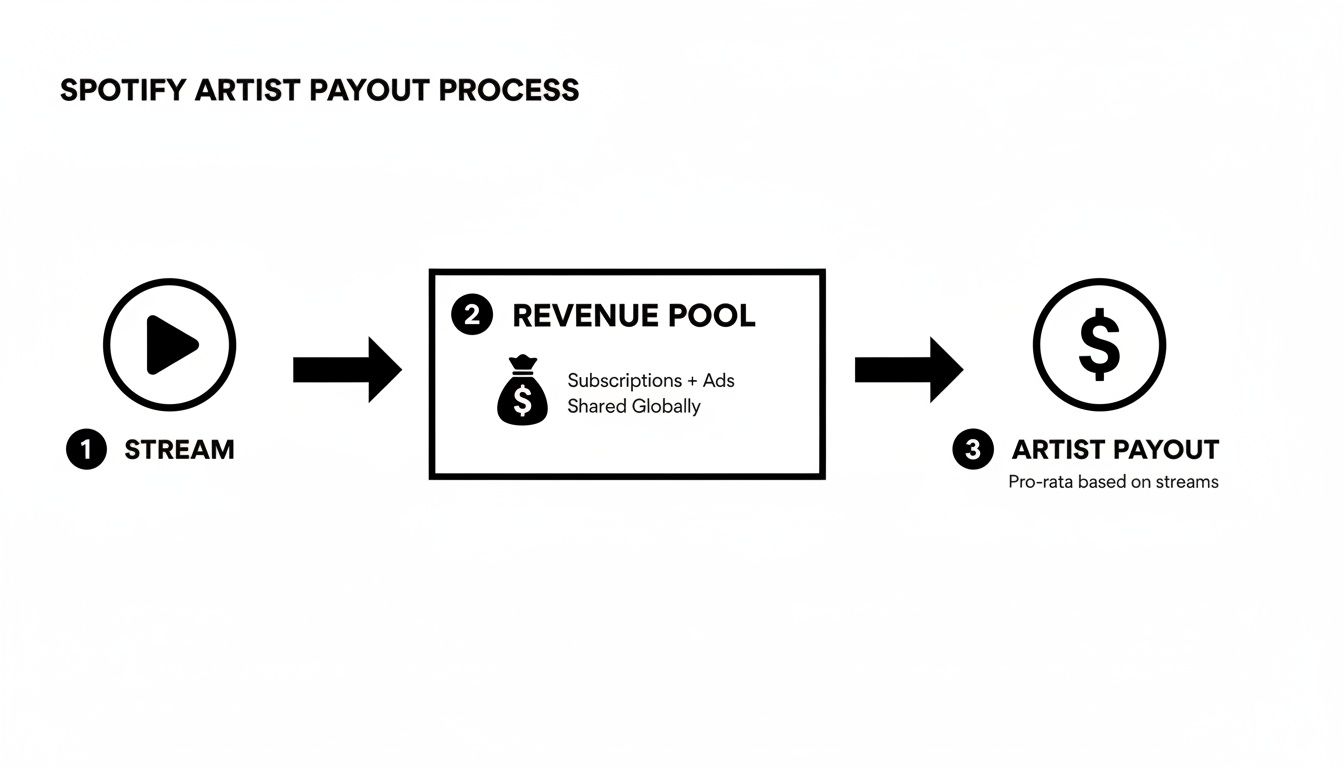
This model clarifies that you are receiving a proportional slice of a collective pie, not engaging in a direct cash-for-play transaction.
What Constitutes an Eligible Stream?
Not every play registered in your dashboard generates revenue. For a stream to be considered "eligible" and contribute to your streamshare, it must meet several criteria designed to filter out fraudulent and low-engagement activity.
Duration: The listener must engage for at least 30 seconds. Anything less is not monetized.
Listener Type: The stream must originate from a legitimate user, whether on a free or Premium plan. Spotify’s algorithms actively identify and discard plays from bots and other illegitimate sources.
Authenticity: The play must be intentional. A track on a muted device or looped excessively in a suspicious manner is likely to be flagged and demonetized.
This framework is precisely why your per-stream rate fluctuates monthly. Your stream count may increase, but if the total number of streams on Spotify grows at a faster rate, your share of the revenue pool could diminish, thereby reducing your per-stream rate.
The Pro-Rata Model in Action
The scale of this system is immense. In 2023, Spotify paid out a record $9 billion to the music industry—the largest annual payment from any single retailer in history. The platform directs nearly 70% of its revenue to rights holders, a figure generated by over 600 million users. As listenership grows, so does the payout pool, but the pro-rata model ensures your portion is always relative to your share of total listening. You can review the specifics of Spotify's record-breaking payouts on their official newsroom.
This collective model, however, is not without its detractors. It inherently favors artists with massive global audiences, as their vast stream counts command a disproportionately large share of the revenue pool. This reality fuels the industry-wide dialogue about alternative remuneration models.
The User-Centric Payout Debate
As a professional artist, you are likely aware of the user-centric model. It represents a fundamentally different approach to revenue distribution and is a critical component of the ongoing industry conversation.
In a user-centric system, a subscriber's monthly fee is divided exclusively among the artists they personally streamed. If you listened to only ten artists in a month, your entire subscription (less Spotify’s share) would be allocated among those ten, weighted by your listening frequency.
Proponents favor this model for creating a more direct financial link between fan and artist. However, implementing it at Spotify’s scale presents significant challenges, from data processing complexities to the potential impact on niche genres. For the foreseeable future, Spotify remains committed to the pro-rata system, but the user-centric debate is a key driver in the evolution of streaming economics.
Key Factors Determining Your Per-Stream Rate
We have established that the "pro-rata" system determines how the revenue pool is divided. Now, we must examine why your effective rate fluctuates. The per-stream rate in your distributor's dashboard is not a fixed number; it is a calculated average of millions of individual plays, each with a slightly different value.
Understanding the variables that influence this rate is essential for accurate income forecasting and developing a sophisticated release strategy.
It is more effective to view your streams not as uniform units, but as a diverse portfolio. A stream from a Premium subscriber in New York is a blue-chip asset—stable and high-value. A play from an ad-supported user in a developing market is more akin to a growth stock; it contributes to the bottom line, but its individual worth varies significantly.
The value of each stream is ultimately determined by who is listening, where they are located, and the agreements governing your rights.
Listener Subscription Tier
This is the most significant variable. Whether the listener is a paying Spotify Premium subscriber or a user of the free, ad-supported tier has a profound impact on revenue. A stream from a Premium user is always worth considerably more.
Premium subscribers contribute their monthly fees directly to the royalty pool, increasing its size and value. Listeners on the free tier generate revenue only through ad impressions, which is far less consistent and yields a much smaller per-listener contribution.
Consider your listener breakdown a critical financial metric. If 80% of your audience subscribes to Premium, your average per-stream rate will be dramatically higher than that of an artist with an identical stream count whose audience is 80% ad-supported.
Geographic Location of the Listener
The geographic origin of your streams has a direct and measurable impact on your earnings. Streams from countries with high subscription prices and robust advertising markets—such as the United States, the UK, or Switzerland—pay out at a significantly higher rate.
This is because the revenue pool in those regions is larger. A greater number of users paying higher subscription fees results in more capital to be divided among the artists receiving plays there.
Conversely, streams from emerging markets with lower subscription fees and developing ad revenue will have a lower value. This is why a sudden viral surge in a new territory can sometimes cause your average per-stream rate to decrease, even as your total streams are increasing. A global hit is valuable, but a hit concentrated in high-payout territories is financially optimal.
Your Distribution Agreement
The revenue Spotify pays out for your master recordings does not flow directly to your bank account. It is first routed to your distributor, and the terms of your agreement with them dictate your net share.
These agreements vary widely:
Commission-Based: Many distributors, including TuneCore and CD Baby, retain a percentage of your royalties, typically between 9-15%.
Flat Fee: Some services charge an annual fee for unlimited distribution and pass on 100% of the royalties they collect from digital service providers.
Label Deals: If you are signed to a record label, the royalty split is governed by your contract, which usually involves a far more complex and bespoke arrangement.
It is crucial to be intimately familiar with these terms. A 15% commission may seem nominal, but on $10,000 in gross earnings, it represents $1,500 in unrealized revenue.
Master and Publishing Royalty Splits
Finally, it is essential to remember that every stream generates royalties for two distinct copyrights: the master recording (the specific audio file) and the publishing (the underlying composition).
Spotify pays royalties for both, but the funds flow through separate channels. As the recording artist, your primary income derives from the master rights, which are collected by your distributor. If you are also the songwriter, you are owed publishing royalties. This revenue is collected and paid out by a different entity, such as a publisher or a Performance Rights Organization (PRO) like ASCAP or BMI. This fundamental split is a core component of understanding the complete financial picture.
The Real Cost of Fraudulent Streams
For a professional artist, fraudulent streams are not merely an inconvenience—they are a direct threat to your business. The entire discussion of "how much does Spotify pay" is rendered moot if your plays are artificial. The issue is not simply the non-payment for these streams; the greater risk lies in the consequences of detection.
Spotify's algorithms for identifying artificial streams are highly sophisticated, and the repercussions are swift and severe. Your distributor is obligated to take action, which can have a lasting negative impact on your career and finances.
The penalties range from significant administrative burdens to career-altering setbacks.
The Financial and Career Penalties
Distributors are on the front lines of fraud detection and are under immense pressure from Spotify to maintain platform integrity. When bot activity is traced to an artist's profile, they must act decisively to protect their commercial partnerships.
Here is what you could face:
Withheld Royalties: The most common penalty is a complete freeze on your earnings. Upon suspicion of fraud, a distributor can lock down all royalties—not just for the track in question—pending an investigation that can last for months.
Channel Strikes: Repeated offenses will result in "strikes" against your account. Accumulate too many, and you risk being blacklisted by your distributor, making future releases with them exceptionally difficult.
Complete Takedown: In severe cases, your distributor may remove your entire catalog from all streaming platforms. This action erases your digital presence, destroys algorithmic momentum, and forces a complete rebuild of your online footprint.
The primary danger of bot activity is not the lost revenue from a single misguided campaign. It is the existential risk of having your entire catalog—your most valuable asset—de-platformed. A single promotional misstep can escalate into a full-blown catastrophe.
Learning to identify the warning signs is your most effective defense.
Identifying the Red Flags of Stream Fraud
Bot activity leaves a distinct and unnatural digital footprint. By monitoring your Spotify for Artists data, you can detect it early. For a more comprehensive analysis, you can consult our complete guide on how to detect fake Spotify playlists and avoid scams.
Maintain vigilance for these tell-tale indicators:
Sudden, Unexplained Spikes: An explosive, inorganic jump in plays is a major red flag. If it cannot be attributed to a significant press feature, sync placement, or viral social media moment, its origin is suspect. Organic growth is always attributable; bot activity is not.
Geographically Illogical Listenership: If your analytics indicate that 90% of your streams are originating from a single, random city where you have no established fanbase and have conducted no promotion, it signals a problem. A genuine audience is almost always geographically distributed.
Zero Profile Engagement: Examine your listeners. Bot-driven accounts are empty shells—they lack profile pictures, do not follow other artists, and never create their own playlists. A surge of streams from these ghost listeners is a clear indicator of artificial activity.
Perfectly Identical Play Counts: This is a subtle yet powerful sign. Investigate the playlists featuring your music. If every song on a particular playlist has nearly identical play counts, it is likely being manipulated by a looping script. Real listeners exhibit varied behavior.
Protecting your assets means proactively avoiding these scenarios. It is therefore crucial to partner with services that prioritize genuine listener growth. Vetted platforms like SubmitLink utilize advanced bot detection to flag high-risk playlists before your music is submitted, ensuring you connect only with real listeners who can become long-term fans. This approach shifts the focus from chasing vanity metrics to building a sustainable, royalty-generating career.
Proven Strategies to Maximize Your Spotify Revenue
Understanding Spotify's payment structure is foundational, but applying that knowledge to drive growth is the critical next step. For a serious artist, the objective is not to chase vanity metrics or a singular viral moment. It is to build a sustainable business by systematically increasing your 'streamshare' and cultivating an audience that generates consistent revenue.
This requires a focused strategy built on three core pillars: strategic playlisting, genuine audience engagement, and diligent protection of your promotional budget. Mastering these pillars will convert your investments of time and capital into tangible career momentum and, critically, reliable income.
Pillar 1: Strategic Playlist Pitching
The objective of playlisting is not merely to acquire streams, but to acquire the right streams. A placement on a massive playlist may yield a significant spike in numbers, but if the listeners do not convert into a lasting fanbase, the long-term value is negligible. The professional approach is to prioritize quality and relevance over raw follower counts.
Identify curators who specialize in your specific genre, mood, and sonic aesthetic. These individuals are gatekeepers to an audience already predisposed to your music. A single stream from a genuine fan acquired through targeted pitching is exponentially more valuable than ten passive plays.
Here, a trusted platform becomes an indispensable asset. A service like SubmitLink connects you directly to a network of vetted, verified curators, mitigating the risk and inefficiency of cold outreach. Its smart matching and detailed filters enable you to focus your pitches on playlists where your music has the highest probability of not just placement, but meaningful impact.
The most powerful playlist placements are those that convert listeners into followers who save your music and explore your back catalog. This is how a single placement can compound into a long-term revenue stream.
Pillar 2: Building Your Owned Audience
Spotify's algorithmic playlists, such as Release Radar and Discover Weekly, are powerful drivers of streams. Unlike editorial playlists, they cannot be pitched to directly. Instead, placement is earned through fan activity. This is the essence of building an "owned" audience on the platform.
Your Spotify for Artists profile is your command center for this initiative. Every listener action—a follow, a pre-save, an addition to a personal playlist—sends a positive signal to the algorithm. The more of these signals you generate, the greater your likelihood of being featured in these high-engagement, personalized playlists.
The following actions are key performance indicators for the algorithm:
Drive Follows: A follow instructs Spotify to include your new releases in that user's Release Radar. It is the most direct method to ensure your core audience is served your new music upon release.
Promote Pre-Saves: Encouraging fans to pre-save an upcoming single is another powerful algorithmic trigger, signaling pre-release demand to the platform.
Optimize Your Profile: A polished, professional, and current artist profile encourages deeper engagement. Utilize the Artist Pick feature, write a compelling biography, and curate your own artist playlists to provide more value to visiting fans.
By focusing on these engagement metrics, you initiate a powerful feedback loop: your promotional efforts drive follows and saves, which trigger the algorithm, which leads to more playlist placements, which introduces you to new listeners who then follow and save your music. You can find more tactics in our proven playbook for increasing your Spotify streams.
Pillar 3: Protecting Your Investment
Every dollar spent on promotion is an investment in your career. Protecting that investment means ensuring it drives legitimate, royalty-generating streams from real listeners. As established, fraudulent streams not only yield zero revenue but can also lead to your music being flagged or removed by your distributor.
This makes your choice of promotional partners a critical business decision. You must select partners who offer transparency and employ robust fraud detection systems.
When evaluating a service, ask direct questions. How are curators vetted? What systems are in place to detect bots? A legitimate partner will provide clear answers, as this is their core value proposition. SubmitLink, for example, utilizes the same bot detection technology trusted by major distributors to actively flag suspicious playlists and protect artists. This shields your investment and ensures your budget is allocated toward building a sustainable career—not inflating vanity metrics that jeopardize it.
Your Top Spotify Royalty Questions, Answered
Let's address the questions that frequently arise when artists begin analyzing their royalty statements. Understanding the system is one matter, but interpreting the data from your distributor can present a new set of complexities.
Consider this the final component of your financial literacy. We will clarify common points of confusion, enabling you to make more informed strategic decisions.
Why Does My Per-Stream Rate Change Every Single Month?
This is the most common inquiry from artists. The confusion stems from the expectation that a "rate" is a fixed value. On Spotify, it is a calculation, not a price, and it is re-calculated monthly.
The fluctuation is caused by these dynamic variables:
The Global Revenue Pool Changes: Spotify's total revenue from advertising and subscriptions fluctuates. A strong Q4 holiday season can increase the pool, while a slower summer may cause it to contract.
Total Global Streams Change: Aggregate listening habits are constantly shifting. If your streams increase by 5%, but total platform streams grow by 10%, your relative "streamshare" has decreased, which reduces your effective rate.
Your Listener Profile Shifts: The geographic and subscription-tier composition of your audience is critical. A sudden influx of listeners from a country with lower subscription fees can decrease your average per-stream payout, even as your total streams are rising.
In simple terms, your per-stream rate is not a fee. It is a reflection of your music's market share within the entire Spotify ecosystem during a specific 30-day window. It is always a moving target.
How Do I Get Paid for Mechanical and Performance Royalties?
Every stream generates two types of royalties for the composition: mechanical royalties for the right of reproduction, and performance royalties for the right of public performance.
Spotify pays these royalties, but they are rarely routed directly to you as the recording artist. This revenue follows a different path.
Mechanical royalties are typically directed to a collection society—such as The MLC in the United States—which then pays your publisher. Performance royalties are administered by Performance Rights Organizations (PROs) like ASCAP, BMI, or SESAC, which then pay the songwriter and publisher.
This is why the statement from your distributor only reflects earnings from the master recording. Your songwriting revenue appears on separate statements, often on a different payment schedule, from these other collection entities.
Do Streams from Playlists like Release Radar Pay Less?
No. From a purely financial standpoint, a stream is a stream. A monetized play from an algorithmic playlist like Release Radar has the same value as one from an editorial playlist like Today's Top Hits, provided both listeners are in the same territory and on the same subscription plan.
The strategic difference is what matters. Algorithmic plays are often more valuable for long-term career growth. They place your music before listeners who are statistically predisposed to become genuine fans.
These are the listeners who save your track, follow your profile, and explore your catalog. These actions provide the algorithm with positive data, leading to a virtuous cycle of more streams and discoveries. The objective is not just to generate plays, but to acquire plays from listeners who will convert into a sustainable audience. Algorithmic playlists are one of the most effective tools for achieving this.
Maximizing your Spotify revenue requires more than just understanding the data—it demands intelligent, targeted promotion. SubmitLink connects you with a network of vetted, authentic playlist curators, ensuring your marketing budget is invested in building a real, engaged audience. Protect your music from fraudulent activity and build a sustainable career by placing your tracks before the right listeners. Discover real curators and grow your streams with SubmitLink.


