.png)
A Strategic Guide on How to Find a Playlist on Spotify
- Feb 8
- 12 min read
For the professional artist, navigating Spotify's playlist ecosystem requires more than just searching for a genre. It demands a strategic approach focused on three core environments: editorial, algorithmic, and high-quality user-generated playlists. The objective is to secure placements that generate genuine listener engagement, not just inflated stream counts.
This guide details professional methodologies for playlist discovery and submission, ensuring your promotional budget is invested in sustainable, career-advancing growth.
Beyond the Search Bar: A Curator-Minded Discovery Process

When significant capital has been invested in your music, playlisting ceases to be a lottery and becomes a calculated initiative. The primary goal is not arbitrary placement but securing positions on playlists that align precisely with your music's genre, mood, and target demographic.
This requires adopting the mindset of a curator.
Instead of generic searches for "indie chill" or "melodic house," analyze a playlist's sonic narrative. Assess its thematic cohesion. Does one track transition logically to the next? Answering these questions is fundamental to identifying curators who will understand—and advocate for—your sound.
The Spotify Playlist Ecosystem: Three Core Types
The Spotify landscape is vast. With over 80 million tracks competing for listener attention, a focused strategy is paramount. Success hinges on understanding the three distinct playlist categories and the appropriate approach for each.
This table provides a strategic overview:
The Three Core Spotify Playlist Types
Playlist Type | Curator | Artist Impact | Strategic Approach |
|---|---|---|---|
Editorial | Spotify's in-house team of music experts. | Significant exposure, instant credibility (e.g., RapCaviar, Today's Top Hits). | Pitch via Spotify for Artists. A low-probability outcome. |
Algorithmic | Spotify's proprietary recommendation algorithm. | Highly personalized and potent. Discover Weekly and Release Radar are key growth drivers. | Indirect. Fueled by listener data (saves, adds, skips) from other playlist sources. |
User-Generated | Independent curators, brands, and influencers. | The most accessible and targeted channel for cultivating a niche audience. | Direct outreach, rigorous vetting, and relationship cultivation. This is your sphere of influence. |
While each type has a role, the professional artist's resources are most effectively allocated to the user-generated category. This is the primary vector for building tangible momentum.
The Optimal Strategy for Career Artists
Realistically, securing a major editorial placement as an emerging artist is a low-probability event. Therefore, your strategic focus should be on high-quality, user-curated playlists. These lists often command dedicated, highly engaged audiences who trust the curator's taste implicitly.
A placement on a respected user-curated playlist accomplishes two critical objectives: it exposes your music to a receptive audience and generates the precise listener data required to activate Spotify's algorithmic discovery systems.
Consider the 4 billion+ user-generated playlists as your primary proving ground. Gaining traction here signals to the algorithm that your track warrants inclusion in algorithmic lists like Discover Weekly. This is a foundational step upon which many of the best music promotion strategies are built.
This initial groundwork is indispensable for building momentum. We will now explore the actionable techniques—from advanced search operators to professional vetting tools—that translate this strategy into measurable results.
Mastering Advanced In-App Search Techniques
Simply inputting "indie rock" into the Spotify search bar is an inefficient use of time, yielding thousands of low-quality playlists. However, with the correct operators, that same search bar becomes a precision tool. For the serious artist, mastering these commands is the difference between speculative outreach and surgically targeting the right curators.
Approach it not as a search, but as a directive to Spotify’s algorithm. You are not casting a wide net; you are spearfishing for ideal placements. These techniques are not mere "hacks"—they are fundamental skills for identifying playlists that will connect your music with real, engaged listeners.
Combining and Excluding Keywords
The first step is to master two powerful search operators: exact-match quotes and exclusion hyphens. These are your primary tools for filtering out irrelevant results.
Use Quotes for Exact Phrases: If your genre is "deep melodic house," search for . This operator compels Spotify to return only playlists containing that exact phrase in the title or description, eliminating ambiguous "melodic" or "house" lists that lack specificity.
Use the Minus Sign to Exclude Terms: Refine your search further by specifying what you don't want. For example, a search for will retrieve playlists within the electronic genre while deliberately omitting the often-oversaturated EDM category.
Combining these operators amplifies their power. A query like immediately narrows the focus to curators who understand your specific aesthetic. This simple refinement can save hours of sifting through unsuitable playlists.
Mastering these operators shifts you from passively hoping for a match to actively commanding Spotify’s search algorithm. This control is critical for building an efficient and effective outreach plan.
Reverse-Engineering Success
One of the most effective strategies is to analyze where stylistically similar artists are gaining traction. This is not about imitation; it is about following a proven path to curators already predisposed to your sound.
First, compile a list of 5-10 artists who operate within your specific niche. Select peers who are slightly ahead in their career trajectory and demonstrating tangible growth, not global superstars.
Navigate to their artist profiles on Spotify and locate the "Discovered On" section. This is a public ledger of the playlists driving new listener discovery for that artist.
Analyze these playlists. Do they have a substantial follower base? Is the content updated regularly? This process provides a pre-vetted list of high-value targets who are demonstrably receptive to new music in your genre.
Then, extend your research. Click on the curator's profile to see what other playlists they manage. This investigative step can transform a single playlist discovery into an entire ecosystem of relevant curators for your outreach network. It is a strategic, data-driven method to find a playlist on Spotify.
You’ve now leveraged advanced search operators to compile a list of promising playlists. The next stage is the most critical: vetting.
This is where due diligence is paramount. A miscalculated placement can waste your budget and, more damagingly, compromise your standing with Spotify and your distributor. This is about distinguishing between a genuine, thriving listener community and a fraudulent list of bots.
Do not be swayed by high follower counts. A playlist with 50,000 followers is worthless if they are not authentic. The metric that matters is genuine engagement.
This flowchart provides a simple mental model for filtering your search results down to a manageable list of playlists worthy of further investigation.
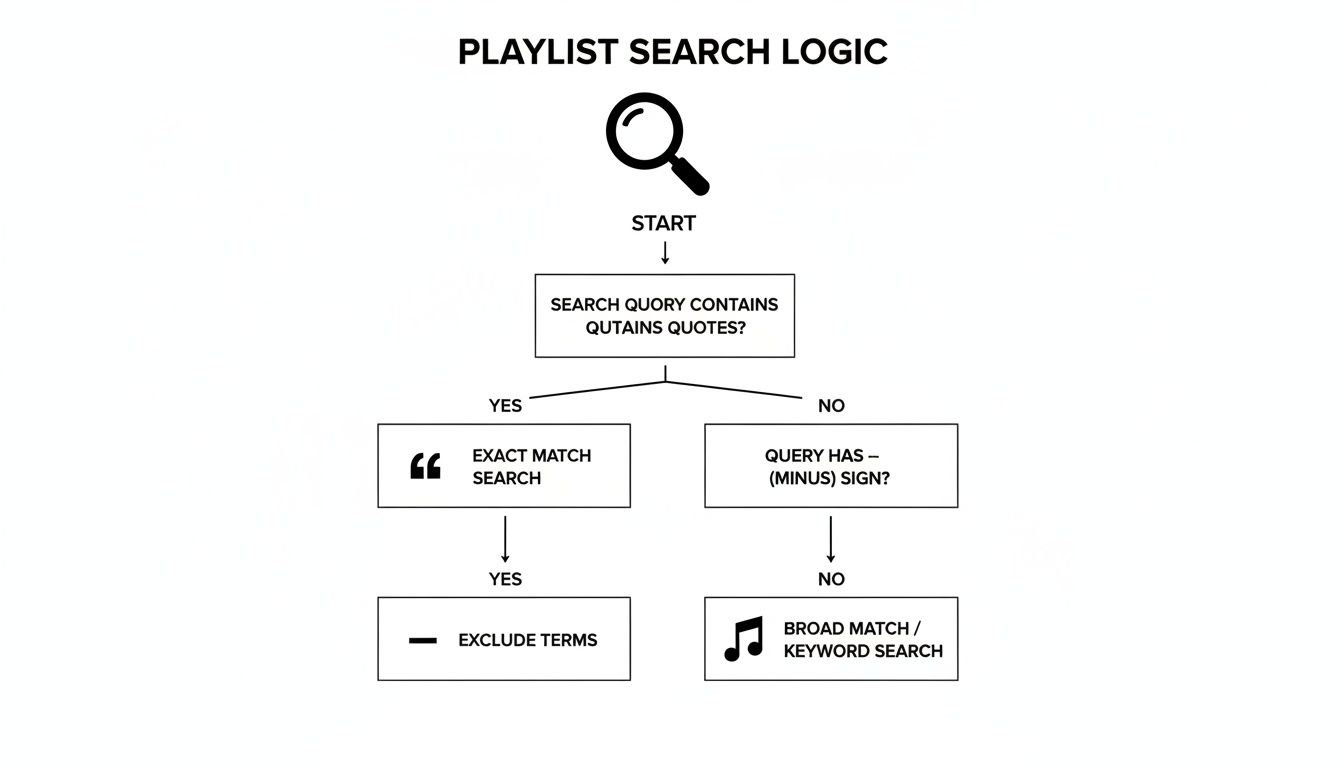
Think of this as a refining process. You begin with a large volume of raw results and apply specific filters to eliminate low-quality options, leaving only high-potential targets for deeper analysis.
Red Flags of a Fraudulent Playlist
Identifying fraudulent playlists is a non-negotiable skill for any career artist. A placement on such a list can corrupt your listener data and trigger flags within Spotify's algorithmic systems. It is a liability you must avoid.
Here are the definitive indicators of a fraudulent playlist:
Anomalous Follower Growth: Legitimate playlists grow organically over time. A chart depicting a sudden, vertical spike in followers is a primary red flag indicating artificial inflation.
Generic, Uninspired Branding: Playlists with generic titles like "Chill Vibes 2024" or "Top EDM Hits" paired with stock photography often lack a committed curator. Professional curators invest in building a unique brand identity.
Discrepant Listener-to-Follower Ratio: This is the most critical diagnostic. Examine the profiles of artists currently on the playlist and check their "Discovered On" section. If the playlist claims 100,000 followers but its tracks are only generating a few hundred streams, you have identified a bot farm. The numbers are incongruous.
A healthy, legitimate playlist will always demonstrate a clear correlation between its follower count and the stream velocity of its featured tracks. A significant disparity is an unequivocal sign of an inauthentic audience.
Assessing a Curator's Legitimacy
Once you have filtered out the obvious fakes, you must assess the professionalism of the curator. A valuable curator is not merely a list-maker; they are a tastemaker with an established audience that trusts their selections.
Look for markers of professionalism. Is there a clear contact method in the playlist description? Do they maintain a presence on other professional platforms, such as social media or a dedicated website? Legitimate curators are typically transparent and accessible because they are actively seeking new music. You can explore this topic further in our guide on avoiding fake playlists and growth risks.
The Spotify landscape has evolved dramatically. With over 4 billion total playlists, manual discovery of quality curators is a significant challenge. The platform’s catalog now exceeds 126 million tracks, with over 100,000 new songs uploaded daily. Meanwhile, the average listener engages with only about 41 artists per month.
This data underscores why a meticulous vetting process is essential. It ensures your outreach efforts are directed toward legitimate opportunities that contribute to tangible career growth.
Using Third-Party Tools to Streamline Your Outreach
Manual playlist discovery, while a valuable skill, is not a scalable strategy for a professional artist. Your time is your most valuable asset, and allocating hundreds of hours to manual research is not an efficient allocation of resources.
This is the precise function of third-party platforms. View them not as an expense, but as a strategic investment in your career infrastructure. These tools are engineered to filter out noise, eliminate redundant tasks, and connect you directly with vetted curators actively seeking new music. The core principle is efficiency.
Calculating the Return on Your Investment
Consider the time required to manually identify and properly vet 100 legitimate playlists. For a knowledgeable professional, this still represents 20-30 hours of focused labor. A reputable platform can condense this entire workflow, liberating your time for creative pursuits.
However, the primary value proposition extends beyond time savings to risk management. The most significant benefit is protection against fraudulent playlists and bot farms. A professional-grade platform vets its curators and integrates bot detection, safeguarding your catalog from the damage a fraudulent placement can cause. This assurance is a critical component of the investment.
A single placement on a botted playlist can contaminate your listener data, trigger flags from your distributor, and negate months of authentic audience development. Utilizing a vetted platform is an essential risk mitigation strategy for your Spotify presence.
By engaging with pre-screened curators, you ensure your promotional budget is directed toward reaching authentic listeners with the potential to become long-term fans. The objective is sustainable growth, not the pursuit of transient, vanity metrics.
To clarify the distinction, let's compare the two approaches.
Manual Vetting vs Platform-Based Vetting
Factor | Manual Search & Vetting | Third-Party Platform |
|---|---|---|
Time Investment | 20-30+ hours per campaign. A significant operational burden. | 1-2 hours per campaign. Enables immediate focus on pitching. |
Risk of Bots | High. You bear the full responsibility for identifying red flags and avoiding fraudulent actors. | Low. The platform performs initial screening and continuous monitoring. |
Curator Access | Limited. Reliant on cold outreach with traditionally low response rates. | Direct. Guaranteed submission review and established communication channels. |
Data & Insights | Minimal. You are forced to speculate on a playlist's performance and authenticity. | Rich. Access to acceptance rates, engagement data, and curator performance history. |
Scalability | Poor. It is logistically impractical to execute consistent, large-scale campaigns. | High. Facilitates efficient management of multiple releases and a repeatable workflow. |
As illustrated, while a manual approach is feasible, a dedicated platform provides a distinct professional advantage by making your outreach process more efficient, secure, and effective.
Key Features of an Effective Platform
Not all playlisting services are created equal. As a professional, you require more than a simple contact directory. You need a suite of tools that facilitates a strategic, data-driven promotional approach.
The following features should be considered non-negotiable requirements for any platform you evaluate:
Integrated Bot Detection: The platform must employ a robust system for identifying and flagging fraudulent playlists and suspicious curator activity. This is your primary defense mechanism.
Advanced Filtering Options: The ability to segment the curator database by genre, sub-genre, mood, follower count, and curator engagement metrics is essential for precision targeting.
Direct Submission Channels: A streamlined process that guarantees curator review is a critical efficiency driver. It eliminates the inefficiencies of cold emailing and ensures your pitch is seen.
Transparent Curator Metrics: Seek platforms that provide performance data, such as a curator's acceptance rates, average response times, and listener engagement analytics. This data allows for informed, strategic decision-making.
This data-first approach distinguishes a speculative pitch from a calculated promotional campaign. To see these principles in action, you can review the capabilities of a modern playlist submission platform.
Ultimately, the right tool doesn't just help you find a playlist; it helps you build a scalable, repeatable system for connecting your music with the right audience, consistently.
Building Relationships with Playlist Curators

Discovering a high-quality playlist is merely the initial step. The critical work begins with your outreach. Securing a placement is not a one-time transaction; it is the starting point of a professional relationship. For the artist focused on a sustainable career, the objective is to convert a single submission into a reliable professional network.
This necessitates abandoning generic, templated outreach. Your pitch must immediately demonstrate that you have done your research and respect the curator's time and aesthetic judgment. Your goal is to be a memorable professional whose communications are valued.
A personalized approach is not a courtesy; it is a strategic advantage. It signals that you understand their curatorial vision and genuinely believe your music contributes value to their playlist, rather than simply being another track seeking exposure.
Crafting a Professional and Effective Pitch
Before drafting any correspondence, you must thoroughly analyze the target playlist. This means more than a cursory listen. Immerse yourself in its sonic identity, flow, and intended audience. Identify specific tracks you appreciate and articulate why your song would be a complementary addition. This research is the bedrock of an authentic pitch.
When initiating contact, maintain brevity and professionalism. Curators are inundated with daily submissions. A lengthy, unfocused email will be summarily discarded.
An effective pitch contains a few essential components:
A Clear Subject Line: It must be simple and scannable. "Playlist Submission: [Artist Name] - [Track Name] for [Playlist Name]" is an effective format that aids in organization and retrieval.
A Concise, Personalized Introduction: Name the playlist and briefly state what you admire about it. Referencing a specific track on their list is definitive proof of your due diligence.
The Justification ("The Why"): This is your core value proposition. In one or two sentences, explain why your track is a strong fit. Connect it to the playlist's mood, genre, or its potential to sequence well with another track.
The Correct Links: Provide a direct Spotify link to your track exclusively. Do not attach audio files or link to other streaming platforms. Remove all friction from the listening process.
This direct, professional approach establishes your credibility and positions you as an artist who understands industry etiquette.
Remember the curator's primary obligation is to their audience, not yours. Your pitch succeeds when it demonstrates how your music enhances their playlist and serves their listeners.
Following Up and Building Long-Term Connections
After sending your pitch, exercise patience. Allow the curator adequate time for review. A polite follow-up is acceptable, but it must be concise. A single check-in one to two weeks later is sufficient.
If your track is added, your work continues. Share the playlist on your professional social channels and tag the curator. This act of reciprocity demonstrates that you view the placement as a partnership.
If your track is not selected, a brief "thank you for your time and consideration" can leave a lasting positive impression. The long-term objective is to build a network of curators who are familiar with your name and artistic signature. This ensures future submissions are received as warm introductions rather than cold pitches. This is how you transform a simple playlist search into a powerful component of your career infrastructure.
Your Top Playlist Questions, Answered
Navigating Spotify playlisting is a matter of strategy, not just volume. Here are answers to common questions, designed to help you execute a more intelligent and effective outreach campaign.
How Can I Tell if a Playlist Is Full of Bots?
Identifying a fraudulent playlist is essential for protecting your investment and data. The most significant red flag is an anomalous, sudden spike in followers. Authentic playlists exhibit steady, organic growth.
Another definitive indicator is a severe discrepancy between follower count and stream count. If a playlist has 100,000 followers but its tracks average only a few hundred plays, its audience is not authentic.
Also, be wary of generic branding. Playlists with titles like "Top Hits 2024" and stock photo cover art often signal low-effort, potentially fraudulent operations. The most reliable method is to use a trusted third-party platform with integrated bot detection to eliminate this risk.
Should I Chase Huge Editorials or Focus on Smaller Playlists?
While securing a placement on a major editorial like New Music Friday offers significant exposure, these opportunities are exceptionally competitive and largely outside of an artist's direct control. A more sustainable and effective long-term strategy is to consistently target high-quality, user-curated playlists within your specific niche.
These independent playlists are managed by passionate curators with dedicated, trusting audiences. Securing placements on these lists generates authentic listener data, which in turn signals to the Spotify algorithm that your music is resonating. This organic momentum is precisely what captures the attention of Spotify's internal editorial teams.
A targeted campaign aimed at dozens of quality independent playlists will almost always yield better long-term results than banking everything on a single editorial long shot. It's about building a groundswell, not just hoping for a lightning strike.
What's the Right Way to Contact a Curator?
The governing principle is to adhere to their stated submission process. Most professional curators will specify their preferred contact method, be it a dedicated submission form or an email address in the playlist description. Respecting their workflow is the first sign of professionalism.
Under no circumstances should you use unsolicited direct messages on social media. This is widely considered unprofessional and is an inefficient method of outreach. When you pitch, ensure your communication is concise, personalized, and direct. State the specific playlist, briefly justify the fit, and always include a direct Spotify link.
When Should I Start Pitching My New Song?
Timing is critical. For official Spotify editorial consideration, you face a strict deadline: you must submit your unreleased track via your Spotify for Artists dashboard at least one week before its release date. This is non-negotiable.
For all independent, user-curated playlists, outreach can commence the moment your track is live. The professional standard is to have your target list of curators researched, vetted, and organized prior to release day. This allows you to execute your campaign immediately and capitalize on crucial early momentum.
Ready to streamline your outreach and connect with vetted curators? SubmitLink offers a transparent, data-driven platform with integrated bot detection to protect your catalog and maximize your promotional budget. Stop guessing and start building real connections at https://submitlink.io.


