.png)
Upload Songs to Spotify: A Professional's Guide to Distribution and Growth
- Feb 6
- 16 min read
To upload songs to Spotify, you must partner with a music distributor. This is a non-negotiable step in the digital supply chain. Distributors act as the essential intermediary, taking your mastered audio, artwork, and metadata, then formatting and delivering it to Spotify and other digital service providers (DSPs) according to their stringent technical specifications.
For the professional artist, this is more than a simple file transfer; it's a critical business decision that impacts your revenue, data integrity, and long-term catalog management.
Your Pre-Upload Checklist for a Flawless Spotify Release
A professional release is built on a foundation of meticulously prepared assets long before you log into your distribution portal. Finalizing and correctly formatting every component is non-negotiable for a seamless and strategically sound launch.
This process isn't merely about avoiding technical rejections from Spotify or last-minute complications. It is about positioning your release for maximum impact and ensuring every element of your project reflects the high standards of your music. It is the operational difference between an amateur upload and a strategic career move.
You must deliver a complete, professional package that meets the precise standards of Spotify's ecosystem—from audio fidelity down to the last pixel of your cover art.
Mastering Your Audio for Streaming
The master file you deliver to your distributor is the definitive version of your work. As an artist with industry knowledge, you understand that a mix that performs well in a studio or club environment will not automatically translate to streaming platforms.
DSPs like Spotify utilize loudness normalization to ensure a consistent listening experience. This process can penalize masters that are pushed too loud by reducing their gain, which often results in a loss of dynamics and a lifeless sound on the platform.
For optimal results on Spotify, your audio files must adhere to these specifications:
File Format: Always deliver in a lossless format. WAV or FLAC are the industry standards. A 16-bit, 44.1 kHz WAV file is the professional benchmark, though 24-bit is also widely accepted.
Loudness Target: Master your track to peak no higher than -1.0 dBTP (decibels true peak). A loudness target of approximately -14 LUFS (Loudness Units Full Scale) is the optimal level to avoid digital clipping and prevent Spotify's algorithm from compressing your track's dynamic range.
The misconception that "louder is better" is particularly detrimental in the streaming era. A dynamic, well-balanced master at -14 LUFS will sound more powerful and clear on Spotify than a compressed, brick-walled track at -8 LUFS that is attenuated heavily by the platform's normalization process.
Organizing Critical Release Metadata
Your metadata is the foundational data set for your release. It contains all the information that identifies ownership, assigns credit, and, most importantly, directs royalty payments. Inaccurate or incomplete metadata is the primary cause of release delays and royalty disputes.
Before beginning the upload process, consolidate all of this information in a single, accessible document.
Your essential metadata checklist:
ISRC Codes: The International Standard Recording Code is a unique identifier for each individual recording. Your distributor can assign these, but managing your own is a best practice for catalog control.
Songwriter and Publisher Info: This is absolutely critical for proper royalty allocation. List every songwriter, their ownership splits (percentages), and their respective publisher information. Errors here directly impact payments.
Explicit Content Tags: Tag tracks with explicit lyrics accurately. Mislabeling can result in removal or restricted visibility.
Organizing this information in advance streamlines the upload process and prevents critical errors that can have significant financial consequences. This data is also essential for executing effective promotional campaigns, such as pre-saves. You can learn more about how to pre-save on Spotify and maximize your release day impact in our strategic guide.
Preparing Your Visual Identity
Your cover art serves as the primary visual representation of your release. It must capture attention and communicate your brand identity instantly while adhering to Spotify's strict technical requirements.
An image that performs well on social media may be rejected by your distributor if it fails to meet these specifications.
Ensure your artwork complies with the following to avoid delays:
Dimensions: A perfect square, minimum 3000 x 3000 pixels.
Resolution: A minimum of 300 DPI for sharpness.
Format: JPG or PNG.
Color Profile: The RGB color space is required.
Beyond the technical specifications, your artwork must be free of extraneous information such as website URLs, social media handles, or third-party logos. The focus must be on high-quality, original imagery that represents your music. Visual consistency across your catalog is key to building a recognizable brand on the platform.
Choosing the Right Distributor for Your Career Stage
Your distributor is more than a delivery service to Spotify; it is a core strategic partner. For a professional artist, the selection process must extend beyond a simple cost analysis. You are not just looking for a way to upload songs; you are making a strategic decision that affects your data, support infrastructure, and the long-term health of your catalog.
While many artists begin with services like DistroKid or TuneCore, the criteria for an optimal partner evolve as a career progresses. You require a distributor that can scale with your growth, offering sophisticated analytical tools and a support team that understands the complexities and urgencies of the music industry.
This is not about minimizing upload fees. It’s about selecting a partner who will help protect your revenue, provide actionable insights, and streamline the management of a growing body of work.
Beyond the Standard Fee Models
Once your catalog generates consistent revenue, the flat annual-fee model can become limiting. It may seem counterintuitive, but a distributor that operates on a percentage-based royalty commission can be a more strategic choice for an established artist. This is because a commission-based structure often unlocks a higher tier of service and a more collaborative partnership.
When a distributor's revenue is tied to your success, their incentives are aligned with yours. This shared-risk model often translates to more proactive support and access to exclusive opportunities.
For instance, boutique or invite-only distributors provide an invaluable level of service. Imagine encountering a takedown notice or a metadata conflict just before a major release. With a basic service, you might face a multi-day wait in a support queue. A premium partner, however, could provide a direct line to a dedicated representative who can resolve the issue within hours. That level of responsiveness is indispensable when promotional campaigns and release schedules are at stake.
Your distributor is one of the most critical relationships in your career. When evaluating options, ask yourself: "Does this service function like a utility, or does it feel like a partner invested in my growth?" A low-cost entry point can become a significant liability if it compromises your time, data, and peace of mind.
Key Differentiators for Professional Artists
When moving beyond entry-level services, the comparison points shift from fees to features. A distributor designed for serious artists should function as a mission control center for your entire catalog.
Here’s what truly matters:
Granular Analytics: You require more than total stream counts. Look for distributors offering deep dives into listener demographics, geographic performance data, and track-level playlist analytics. This is the data that informs tour routing and marketing expenditure.
High-Touch Support: When issues arise, you cannot afford to wait. The best distributors offer dedicated support contacts who understand the urgency of the music business. Test their support response time before committing.
Flexible Catalog Management: As your discography expands, its complexity increases. You need robust tools to manage royalty splits, execute bulk metadata updates, and navigate complex rights management scenarios.
Sync and Publishing Administration: Top-tier distributors often provide integrated services for sync licensing and publishing administration. This streamlines your operations and opens additional revenue streams without onboarding another partner.
To help you evaluate how different distributors align with a professional artist's needs, I've compiled a comparison of key players in the space.
Distributor Comparison for the Professional Artist
This table outlines leading distributors that cater to career artists, offering tools that extend beyond simple distribution to facilitate strategic growth.
Distributor | Best For | Royalty Split | Key Features | Support Level |
|---|---|---|---|---|
Established independents with a growing catalog and team. | 15% commission (no annual fees). | In-depth analytics, sync licensing, physical distribution, automated royalty splits. | Dedicated account reps and personalized support. | |
Professional artists and labels seeking global reach and marketing support. | Varies (custom deals). | Global marketing teams, comprehensive data analysis, video services, dedicated label management. | Full-service team with direct contact points. | |
Artists focused on securing long-term digital and physical distribution. | 9% commission on digital sales. | Pro Publishing administration, physical distribution options, one-time setup fee per release. | Standard email and phone support. | |
Curated artists with proven traction and significant growth potential. | 15% commission (invite-only). | A&R team, funding opportunities, detailed streaming analytics, high-level playlist pitching. | Dedicated team support for rostered artists. |
Ultimately, selecting the right partner to upload your music is a long-term investment in your career. By prioritizing the quality of their data, the responsiveness of their support, and the depth of their services, you can build a partnership that genuinely facilitates your growth.
Mastering Spotify for Artists and Release Timelines
Once your distributor ingests your music, the strategic work begins. Submission is merely the handoff; your subsequent actions determine whether a release achieves its potential or becomes lost in the digital noise. This phase is about optimizing your Spotify presence well before your release date.
First, claim your Spotify for Artists profile. This is not a perfunctory task—it is your command center. Verifying your profile unlocks a suite of essential tools, from listener data and profile customization to the single most important promotional feature: editorial playlist pitching. Neglecting this is equivalent to operating without analytics or a promotional strategy.
Setting Up Your Profile for Success
Your Spotify profile is your digital headquarters on the platform. An incomplete or generic profile signals to curators and potential fans a lack of professional commitment. Before pitching, ensure every element of your profile is polished and strategically aligned with your brand.
Begin with a concise and compelling artist bio. This is your professional narrative, an opportunity to convey your story effectively. Next, upload high-resolution artist photos that reflect your current branding. Finally, verify that all social media and website links are connected and functional.
These details create a cohesive brand experience for anyone discovering your music, facilitating the conversion of casual listeners into engaged followers.
This journey from emerging artist to established professional often means your operational needs and team structure will evolve.
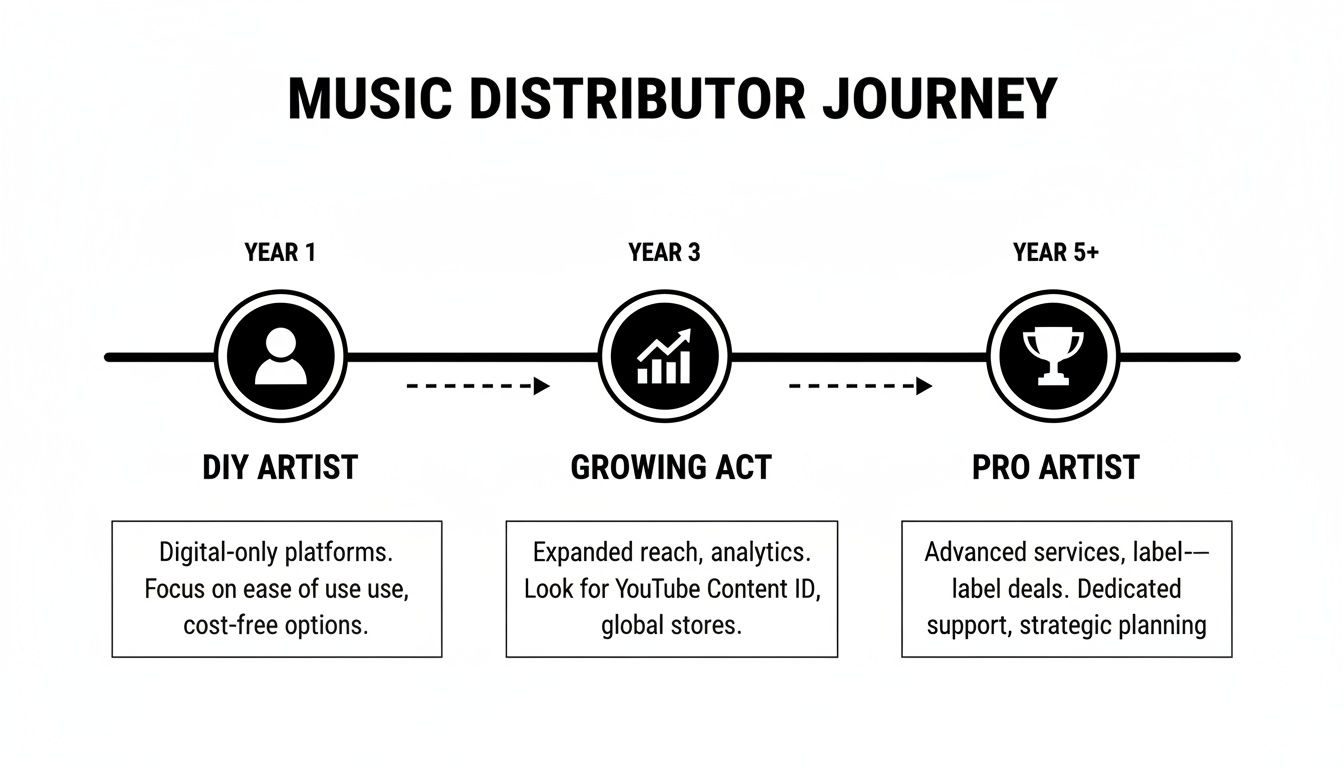
As this illustrates, artists often transition from basic distribution to more strategic partnerships that provide the infrastructure and support required for career acceleration.
The Professional Release Timeline
Timing is a critical strategic element. For a professional, the upload date and the release date are distinct milestones on a well-planned calendar. Releasing a track immediately upon completion is a novice error that forecloses major promotional opportunities.
Your timeline is your most powerful strategic asset. The industry standard is to deliver your music to your distributor a minimum of four to six weeks before your official release date. This buffer is not arbitrary; it is a non-negotiable component of a professional release strategy.
This lead time accomplishes two critical objectives:
It resolves technical logistics. It provides ample time for your distributor to process all assets, deliver them to Spotify, and troubleshoot any unforeseen metadata or technical issues without jeopardizing your release date.
It opens the editorial pitching window. Most importantly, it guarantees your track will appear in your Spotify for Artists dashboard with sufficient time to craft a detailed, thoughtful pitch to Spotify’s editors.
Do not be misled by a distributor's "48-hour delivery" promise. That is a measure of technical processing speed, not a strategic timeline. A four-week minimum provides the necessary buffer to execute a professional rollout and gives your music a legitimate opportunity to be considered by editors.
Pitching to Spotify Editorial Playlists
The single most important action you can take after your music is ingested by Spotify is to pitch it directly to their editorial team. This is your one opportunity to present your music to the human curators behind career-making playlists like New Music Friday, Lorem, and hundreds of others.
When completing the pitch form, context is paramount. Editors review thousands of submissions daily. A generic, low-effort pitch is functionally equivalent to no pitch at all.
Your pitch must concisely communicate:
The narrative behind the song: What is the concept? What was the inspiration? Provide a compelling hook.
Your marketing plan: Detail your promotional activities. Are you launching a music video? Executing a social media campaign? Have you engaged a publicist? Demonstrate that you are investing in the release's success.
The sonic and emotional landscape: Be specific. Do not use broad terms like "Indie." Tag precise genres, moods, and instrumentation. This data helps their system—and the editors—accurately categorize your song for placement.
Mastering the art of the pitch is a core competency for any modern artist. For a more detailed analysis, review our complete guide on how to get on Spotify editorial playlists. The pitch tool is not a lottery; it is a professional channel for providing editors with the context they require to champion your music.
The Professional's Playbook for Spotify Promotion
Securing distribution to Spotify is the foundational step. Gaining traction is an entirely different discipline. Too many artists upload their music and passively await discovery, but organic growth is largely a myth in today's saturated market. For a career artist, a strategic, well-funded promotional plan is not a luxury—it is an operational necessity.
Consider the competitive landscape: over 60,000 new songs are uploaded to Spotify daily. This constant influx of content transforms the platform from a launchpad into a fierce battleground for listener attention.
Your track competes with approximately 2.2 million other new songs each month. It is therefore unsurprising that an estimated 87% of tracks on the platform fail to reach 1,000 lifetime streams. This intense saturation is precisely why a passive "upload and pray" strategy is ineffective. To gain visibility, you must be strategic, and that means leveraging playlists. You can see more stats on Spotify's competitive landscape via Appinventiv.
This is the point where you transition from hope-based marketing to executing a data-driven playlisting campaign, moving beyond your immediate network to access the established audiences of third-party curators.
What a Real Playlisting Campaign Looks Like
A successful campaign is a calculated investment. It begins with identifying playlists that are a precise match for your music's genre, mood, and target listener demographic. Pitching a quiet folk ballad to a high-energy workout playlist is a misallocation of resources and time.
The objective is not merely to accumulate streams, but to acquire the right streams. A strong placement on a well-aligned playlist generates positive signals for Spotify's algorithm. This can trigger inclusion on Discover Weekly, Release Radar, and Spotify Radio, converting a short-term promotional push into long-term, algorithmic growth.
The anatomy of a professional campaign includes:
Deep Research: Look beyond follower counts. Utilize analytics tools to assess a playlist's monthly listener growth, track addition frequency, and genre consistency.
Tiered Budgeting: Diversify your investment. Allocate your budget across a mix of smaller, highly-engaged niche playlists and a few larger, more established ones to mitigate risk and broaden your reach.
Personalized Outreach: Curators receive hundreds of pitches daily. A generic, templated message will be ignored. Address them by name, reference their playlist specifically, and articulate exactly why your song is a strong fit for their audience.
View your promotional budget as an investment in data acquisition. Every campaign, successful or not, yields valuable insights about your audience. Each dollar spent is tuition for understanding who your true fans are and where they consume music.
How to Spot the Fakes and Protect Your Music
The playlist promotion landscape includes many legitimate, passionate curators. However, it is also rife with fraudulent actors selling fake, bot-driven streams that can result in your music being removed from Spotify or your entire artist account being flagged.
Protecting your career requires the ability to differentiate credible partners from fraudulent ones. Legitimate curators build their reputation on taste and trust; scammers operate on deception.
Be vigilant for these common red flags:
"Guaranteed Placement" Promises: No legitimate curator can guarantee placement. Their role is to consider your music for its merit, not to sell a slot. If an offer seems too good to be true, it is.
Pay-for-Placement Models: A modest fee for a curator's time to review your music is a standard industry practice. However, a significant fee for a guaranteed spot on a playlist is often indicative of a payola scheme that likely uses bots to inflate its perceived value.
Vague Audience Acquisition: If a curator cannot provide a clear explanation of how they built their audience (e.g., through a blog, social media advertising, a community), be highly skeptical. Many fraudulent playlists consist of bots following other bots.
Anomalous Listener Data: Analyze the artists on the playlist. If you see unknown artists with millions of streams alongside others with only a few hundred, it is a massive warning sign of bot activity.
Finding a Secure Path to Real Listeners
Navigating this complex environment independently is both risky and time-consuming. This is why platforms that vet their curators and provide a layer of security have become indispensable for professional artists.
A service that actively screens playlists and employs robust bot detection is no longer a perk—it is a critical risk management tool.
For example, platforms like SubmitLink are built on a foundation of trust and security. By integrating powerful bot detection systems like artist.tools—the same technology used by major distributors like DistroKid and UnitedMasters—it can identify and flag suspicious playlists before you invest. This functions as a shield, protecting your budget and ensuring your music reaches real listeners.
Investing in a secure platform allows you to focus on the strategic aspects of promotion—identifying the right curators and building genuine relationships—while the technology mitigates the risk of fraud. This ensures every stream is from a potential fan, not a bot, enabling the sustainable, long-term growth of your career.
Protecting Your Catalog from Takedowns and Fake Streams
Getting your music onto Spotify is a significant milestone, but the work of a professional artist continues long after release day. Once your catalog is live, you enter a new phase: active protection. As your body of work grows, so does your exposure to fraudulent streams, botted playlists, and unscrupulous promoters.
These are not minor inconveniences; they are serious threats that can lead to takedowns, frozen royalties, and even account termination by your distributor. Protecting the integrity of your music is an essential component of catalog management.
The Real Damage of Fake Streams
Artificial streams do more than inflate play counts; they contaminate your data and mislead Spotify's algorithm.
Bots do not exhibit genuine listener behavior. They do not save tracks, follow artist profiles, or explore your catalog. This influx of low-quality engagement sends negative signals to Spotify, essentially teaching the algorithm that listeners who play your music are not engaged. This can cripple your chances of landing on critical algorithmic playlists like Discover Weekly and Release Radar. You end up paying for a "service" that actively undermines your music's potential for organic discovery.
Your objective isn't just to upload songs to Spotify; it's to build a sustainable career on the platform. Every stream should originate from a real human who has the potential to become a long-term fan. Bot activity is the antithesis of this, creating a data trail that actively works against your growth.
For serious artists who rely on metrics to make strategic decisions, this data corruption is a significant liability. Spotify is enforcing its policies against this activity with increasing rigor, removing 75 million fraudulent tracks in 2023 alone.
Red Flags of Fraudulent Promotion
Developing the ability to identify fraudulent services is a critical business skill. These services prey on artists seeking rapid results, but their promises are empty and carry substantial risk. You must know how to detect fake Spotify playlists and avoid these common scams.
These are the classic warning signs:
Guaranteed stream counts: This is the most significant red flag. No legitimate curator can promise a specific number of streams. Authentic promotion is about exposure, not purchasing a block of plays.
Prices that are too good to be true: Offers of thousands of streams for a nominal fee are invariably fulfilled by bots. Authentic promotion that reaches real listeners requires a real investment.
Vague answers about their audience: Fraudulent operators are evasive when questioned about their audience sources. A legitimate promoter will be transparent about their community-building methods, whether through a blog, paid ads, or an email list.
Anomalous playlist data: Scrutinize the playlists they offer. The presence of unknown artists with millions of streams alongside artists with a few hundred is a classic indicator of bot activity. Legitimate playlists exhibit more organic-looking data.
Using Technology as Your Shield
Navigating this landscape without support is high-risk. This is why savvy artists utilize platforms with integrated bot detection. These tools act as a filter, vetting curators and flagging suspicious playlists before any financial commitment is made.
For instance, SubmitLink integrates directly with artist.tools, the same bot detection system trusted by major distributors like DistroKid and UnitedMasters. This provides a critical layer of security, automatically flagging playlists that exhibit signs of bot activity.
By leveraging a secure platform, you can ensure your marketing budget is directed toward building a genuine fanbase, not jeopardizing your entire catalog. It is about investing in long-term, sustainable growth rather than short-term vanity metrics that can lead to platform removal.
Common Questions (and Straight Answers) About Getting Your Music on Spotify
Even seasoned artists encounter challenges with Spotify's ecosystem. Mastering the details can be the difference between a release that connects and one that fails to gain traction. Here are direct answers to the most common questions from professional musicians.
How Long Does It Really Take to Upload to Spotify?
While some distributors offer 48-hour delivery, this is a technical timeline, not a strategic one. For a professional release, you must deliver your final assets to your distributor at least four to six weeks prior to your release date.
This lead time is not for processing; it is for promotion. This buffer creates the crucial window needed to pitch your track to Spotify’s editorial team via Spotify for Artists. Rushing this process forfeits your best opportunity for major playlist consideration.
Can I Switch Distributors Without Losing My Streams?
Yes. Artists migrate between distributors frequently as their career needs evolve. The process requires careful execution to prevent the loss of stream counts or temporary removal of your music.
The key is to obtain all of your metadata from your current distributor—particularly your ISRC codes and original release dates—and provide it to your new partner. They will use this data to map the new delivery to your existing tracks on Spotify.
Critical advice: Do not issue a takedown request to your old distributor until your new distributor has confirmed that the redelivery is complete and the tracks have been correctly linked. This ensures your music remains live and your stream counts stay intact.
What if I Get a Takedown Notice?
A takedown notice is a serious issue that can halt your momentum and jeopardize your catalog. The most common cause is artificial streaming activity, typically originating from a fraudulent third-party promotional service.
When Spotify's system flags bot activity, it can remove your track and freeze associated royalties. If this occurs, contact your distributor immediately for a full report. To prevent this, exercise extreme diligence when engaging promotional services. Exclusively use platforms that offer transparent, integrated bot detection to ensure you are building a real audience, not acquiring fake streams that risk a ban.
How Much Does Spotify Actually Pay Per Stream?
There is no fixed per-stream payout rate. The rate is a dynamic figure influenced by multiple variables, including the listener's subscription type (Premium vs. ad-supported), their geographic location, and the specific terms of your distributor's agreement with Spotify.
On average, rates typically fall between $0.003 and $0.005 per stream. However, fixating on this number is a distraction. The strategic goal is to generate high-quality streams from engaged fans in high-value territories. This is what builds a sustainable income and signals to the Spotify algorithm that your music is worth amplifying.
Is Playlist Promotion Actually Worth the Money?
For any artist serious about growth, strategic playlist promotion is not just "worth it"—it is a necessity. Between 60,000 and 150,000 new tracks are uploaded to Spotify daily. The stark reality is that 99.5% of all streams are concentrated on the small fraction of songs that exceed 1,000 plays annually.
The challenge is significant: only about 14% of artists on the platform achieve more than 10 monthly listeners. You can find more on these sobering music streaming statistics on ExplodingTopics.com. A passive "upload and hope" approach is a formula for obscurity.
A well-placed playlist feature does more than accumulate streams; it feeds Spotify's algorithm positive engagement data, significantly increasing your probability of landing on powerful algorithmic playlists like Discover Weekly and Release Radar. Treat it as a strategic investment, not a game of numbers. Use a secure platform to connect with verified curators, ensuring you are reaching real listeners.
Ready to grow your audience on Spotify without risking your catalog? SubmitLink connects you with a vetted network of thousands of real playlist curators. Our platform, powered by the same artist.tools bot detection trusted by DistroKid, flags risky playlists to protect your music, ensuring every dollar you spend builds a genuine fanbase. Find your perfect playlist and start your next campaign at https://submitlink.io.


