.png)
A Strategic Guide to Spotify Curated Playlists for Artists
- Feb 7
- 15 min read
For the professional artist, Spotify curated playlists are not a lottery ticket; they are an integral component of a sophisticated and sustainable career strategy. The objective is to move beyond the mindset of chasing virality and into a disciplined approach of consistent, targeted audience development. This is not merely about accumulating streams; it's about refining your brand's digital footprint and providing Spotify's algorithm with the precise data needed to identify and engage your core audience.

Why Curated Playlists Are a Professional Imperative
Once an artist has established a market foothold, playlisting evolves from a tool of pure discovery to one of strategic cultivation. With a foundation already in place, the focus shifts to architecting a comprehensive ecosystem around your music. Every playlist placement must serve a deliberate purpose, whether it's penetrating a hyper-specific niche aligned with your sound or signaling to the algorithm that your work belongs alongside established artists in your genre.
This strategic shift is paramount. Disregard the pursuit of placements on massive, generic lists that yield transient, low-engagement stream spikes. The primary goal is to secure positions on playlists that deliver the right listeners—individuals who will save your track, follow your profile, and explore your catalog. This is the distinction between a fleeting moment and sustained career momentum.
Beyond Streams: Brand Alignment and Data Optimization
An effective playlisting strategy is fundamentally about two key business objectives that transcend raw stream counts:
Reinforcing Your Artistic Brand: Every playlist possesses a distinct sonic identity and cultural context. A placement on a respected "Dark Academia" or "Lofi Jazz" playlist does more than generate plays; it contextualizes your music and solidifies your position within a specific cultural scene. It functions as a powerful third-party endorsement.
Training the Algorithm: High-quality placements provide invaluable data for Spotify's recommendation engine. When a Bon Iver enthusiast saves your track from an "Indie Folk" playlist, you are directly informing the algorithm: "Listeners with this taste profile also engage with my music." This data directly influences your probability of being featured on high-value algorithmic playlists like Discover Weekly and Radio.
Your Spotify for Artists dashboard becomes your central analytics hub for this process. It is the repository for this critical data, enabling you to monitor listener demographics, acquisition sources, and playlist performance. This allows you to translate raw data into actionable intelligence for your career.
The Scale of the Opportunity
The volume of listening occurring within playlists underscores their strategic importance. Spotify hosts over 4 billion playlists, each meticulously constructed around a specific theme, mood, or listener archetype.
Notably, approximately 17% of all user playlist listening is personalized, merging editorial selections with AI-driven recommendations. This hybrid model creates a powerful channel for connecting artists like you with highly engaged audiences primed for music discovery. For a more granular analysis, the latest Spotify statistics offer compelling insights into contemporary listener behavior and content engagement.
As a professional, your time and capital are finite resources. Treat playlist pitching as you would any targeted marketing campaign. Establish clear objectives, define your key performance indicators (KPIs), and focus on measurable return on investment. The objective is to ensure every submission contributes to building a durable career.
So you are prepared to secure placements for your music on Spotify playlists. Excellent. However, indiscriminately distributing your track to every available curator is an inefficient allocation of resources. A professional artist recognizes that each pitch must be a calculated, strategic action, not a broadside. It's about identifying the right Spotify curated playlists—those that align precisely with your sonic identity and strategic goals.
The critical task is not simply finding playlists, but performing due diligence on their vital metrics. It is essential to analyze listener engagement, growth trajectories, and stream origins. A playlist with 500,000 followers is superficially impressive, but if only 1% of that audience is actively listening, it is an ineffective channel. Conversely, a niche playlist with 5,000 dedicated fans can yield followers who will save your music, follow your profile, and anticipate your next release.
In today's saturated market, this level of analysis is non-negotiable. Furthermore, do not underestimate the influence of user-generated content. User-created playlists account for a significant 36% of all listening hours on Spotify, making them 2.5 times more impactful than all other curated playlists combined. With over 100,000 new tracks uploaded daily, these smaller, passionate curators are often the drivers of authentic, long-term discovery. You can explore these trends further through Spotify listening analytics from Soundcharts.com.
Look Beyond Follower Counts
To identify playlists with genuine influence, you must look beyond surface-level metrics. Follower count is a vanity metric; the real value lies in active, engaged listeners who will provide meaningful data and potential long-term fandom.
This is where data-driven analysis becomes crucial. Utilizing a professional tool like SubmitLink grants access to the historical data required for a thorough assessment. The goal is to identify curators with a proven track record of supporting artists within your specific subgenre, ensuring your music is placed in a context where it can resonate.
When vetting a playlist, focus on these key indicators:
Follower Growth Velocity: Is the follower count increasing at a natural, consistent rate? A sudden, anomalous spike often indicates bot activity, whereas organic growth suggests a healthy, well-managed playlist.
Listener Engagement Ratio: What is the ratio of monthly listeners to total followers? A high ratio signifies an active and engaged audience.
Track Addition Frequency: Does the curator maintain playlist freshness? A stale playlist with no recent additions typically suffers from low engagement.
A successful placement is not a one-time stream spike; it is a strategic connection with an audience that understands and values your artistic direction.
A targeted playlist with 10,000 engaged listeners in your niche is infinitely more valuable than a generic list with 100,000 passive followers who will never convert into actual fans.
To aid in this vetting process, I've developed a concise checklist. Before committing to a submission, use these criteria to ensure you are not allocating resources to an ineffective channel.
Playlist Health Checklist
Before investing time or capital in a pitch, this health check can prevent significant inefficiencies. Use this table to evaluate the key metrics that distinguish a high-impact playlist from a low-value one.
Metric | What to Look For | Red Flag |
|---|---|---|
Follower Growth | Steady, organic increases over time. | A sudden, massive spike in a short period. |
Listener-to-Follower Ratio | A high ratio (e.g., 20%+ of followers are monthly listeners). | A very low ratio, indicating a passive or fraudulent audience. |
Curator Activity | Regular updates (weekly or bi-weekly). | The playlist hasn't been updated in over a month. |
Track Diversity | A mix of emerging and established artists. | Dominated by major label artists or suspicious, unknown tracks. |
Genre Cohesion | The playlist has a clear, consistent sonic identity. | A random assortment of genres lacking a coherent theme. |
Attention to these details is what separates a strategic campaign from speculative efforts. A few minutes of rigorous analysis can dramatically impact your outcomes.
Building Your Tiered Target List
An intelligent pitching strategy involves creating a balanced portfolio of opportunities, not concentrating all efforts on a single type of playlist. This approach builds a support structure for your release, with different playlists serving distinct strategic functions.
I recommend organizing target lists into three tiers. This framework optimizes the allocation of budget and effort, providing each release with a solid foundation and a clear trajectory for growth.
Your Strategic Playlist Tiers
Reach Playlists: These are your high-risk, high-reward targets. They possess massive followings (100,000+) and are often managed by major brands, influential media outlets, or publications. A successful placement is transformative, but the probability is low. Allocate a minimal portion of your budget and effort here.
Target Playlists: This is the core of your campaign, where the majority of your resources should be focused. These playlists typically have between 10,000 and 100,000 followers and are precisely aligned with your genre. They are curated by respected figures within their niche, offering an optimal balance of significant impact and a realistic chance of placement.
Safety Playlists: These are your foundational placements. They are smaller, hyper-niche playlists (typically under 10,000 followers) where your track is an undeniable fit. The acceptance probability is much higher, and these placements provide the crucial early data—saves, streams, and low skip rates—that signals to the Spotify algorithm that your track is resonating with a core audience.
This tiered system creates a cascade effect. The initial engagement from safety playlists generates the social proof required to appeal to curators of your target playlists. A strong performance on those target lists, in turn, can capture the attention of curators managing the high-profile reach playlists. This transforms playlisting from a game of chance into a structured, strategic marketing campaign.
Crafting a Pitch That Curators Actually Read
Having identified your target list of Spotify curated playlists, the next challenge is securing the curator's attention. A well-crafted pitch can initiate a valuable, long-term professional relationship, whereas a generic, mass-emailed message is a direct route to the trash folder—or worse, a blacklist.
Consider every communication as a reflection of your professional brand. Influential curators receive hundreds of submissions daily. Your objective is to penetrate this noise with a pitch that is professional, concise, and demonstrably personalized. This is not about volume; it's about precision and demonstrating due diligence.
The Anatomy of a Winning Pitch
Disregard long, narrative emails. A busy curator requires three pieces of information immediately: who you are, what your song sounds like, and why it is a specific fit for their playlist. Anything extraneous is noise.
Respecting their time is the cornerstone of an effective pitch.
A Clear, Scannable Subject Line: Eliminate ambiguity. A standardized format like "Submission: Artist Name - Track Title (Genre/Vibe)" is optimal. It provides all essential information pre-open.
The Personal Touch: Always address the curator by name and reference their playlist. Demonstrate that you have listened by explaining why your track is a suitable fit. Referencing 1-2 other artists on their playlist proves you understand their curation and are not engaging in a scattershot campaign.
The Core Pitch: Describe your track in one or two succinct, impactful sentences. Avoid clichés. Instead, provide a clear sonic picture: "A melancholic indie-folk track with Bon Iver-style harmonies and a driving rhythm reminiscent of The National." This immediately conveys the track's character.
This targeted approach demonstrates that you value their curation and view your music as a genuine contribution to their playlist's identity.
Give Them the Context They Need
While the music is paramount, the narrative and momentum surrounding it can make your submission compelling. This essential context should be provided professionally and efficiently—not within the body of the email, but through a well-organized Electronic Press Kit (EPK).
Your EPK is your professional digital resume, a centralized resource for curators, bloggers, and A&R representatives. If you need to develop or refine your EPK, our guide on how to make an electronic press kit that industry gatekeepers actually want provides a comprehensive walkthrough.
An artist with momentum is an artist worth investing in. Mentioning recent press coverage, notable collaborations, or strong early fan engagement can be the decisive factor that prompts a curator to listen.
In the pitch email, include one or two key highlights to capture their attention. A concise mention like "Recently featured on Hype Machine" or "Supported by BBC Introducing" adds significant weight and signals that you are an artist with trajectory.
Nailing the Timeline and Follow-Up
Effective playlist pitching is a proactive component of your release schedule, not a last-minute effort. Initiate outreach 2-4 weeks prior to the release date. This provides curators with ample time to review, consider, and schedule your track.
Your plan must include a follow-up protocol. A single, polite follow-up email approximately one week after the initial pitch is acceptable if you have not received a response. Frame it as a brief reminder and perhaps note the upcoming release date. Further attempts can be perceived as overly aggressive.
Remember, the goal extends beyond a single placement on a Spotify curated playlist. It is about cultivating a network of industry professionals who believe in your music. Every interaction should be conducted with professionalism and respect, fostering relationships that yield support for your current and future releases.
Vetting Curators and Protecting Your Catalog from Bots
Not all Spotify curated playlists are legitimate, and navigating this landscape requires diligence. For a professional artist, a single placement on a bot-driven playlist can have consequences far beyond a wasted investment. It can corrupt your listener data, damage your standing with distributors like DistroKid or UnitedMasters, and even lead to your music being removed from the platform.
Protecting your catalog is not a mere "best practice"—it is a critical component of risk management in your career.
Fortunately, fraudulent playlists often exhibit clear, identifiable markers. Bot farms, built for scale, leave a trail of tell-tale signs that a discerning eye can easily detect. Your objective is to connect your music with authentic human listeners, not to trigger algorithmic red flags that can impede your progress.
Identifying the Telltale Signs of a Bot Farm
Avoiding fraudulent actors begins with a healthy skepticism and a series of quick verification checks. Before pitching any playlist or engaging in a paid campaign, conduct a thorough assessment.
An authentic curator builds an audience over time through trust and taste. A bot farm acquires its numbers through artificial means.
This decision tree provides a simple framework for your strategy, contingent on your access to professional tools and the current size of your fanbase.
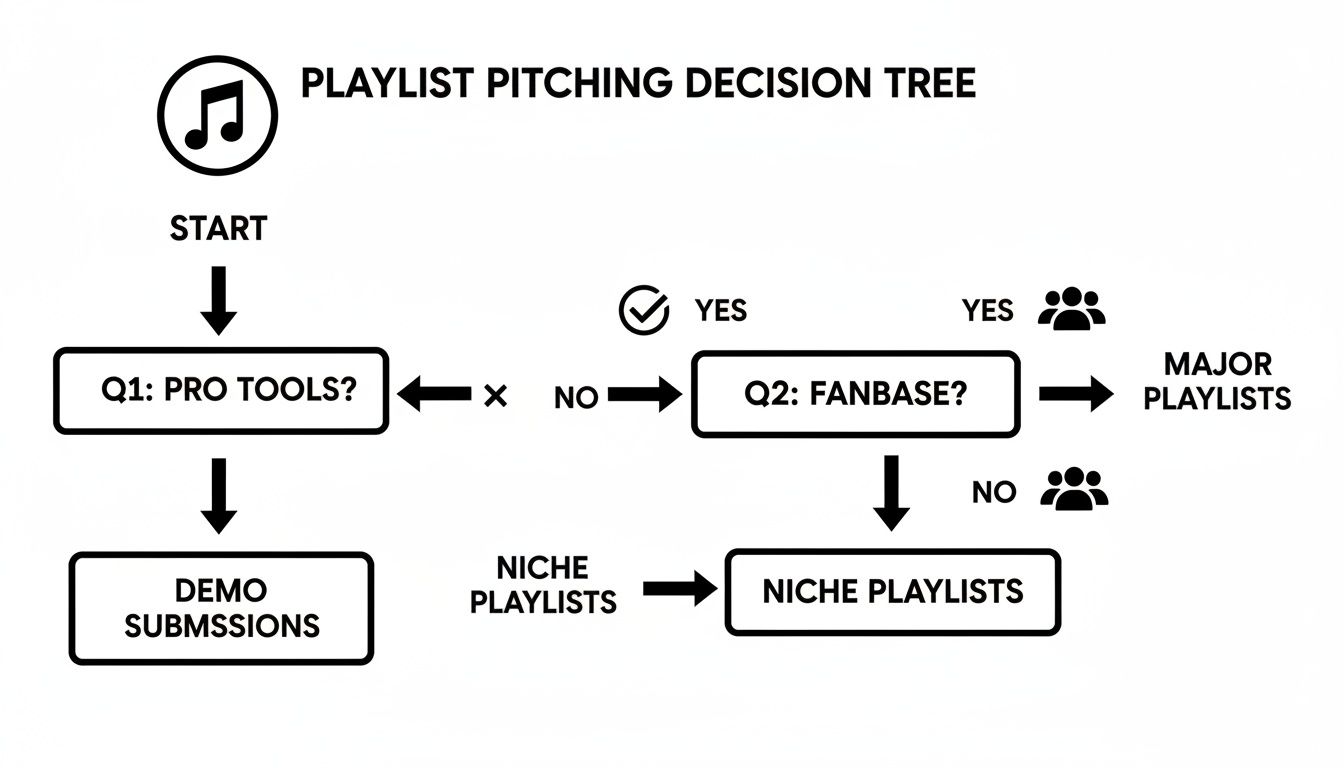
As the chart illustrates, the right tools and an established audience are significant determinants of where to focus your resources for optimal outcomes.
Here are the critical warning signs to watch for:
Anomalous Follower-to-Stream Ratios: This is a primary indicator. A playlist with 50,000 followers where tracks receive only a handful of streams is highly suspicious. Real audiences generate plays.
Generic Branding and Artwork: Bot farms often use stock imagery and generic, keyword-heavy titles like "Top Hits 2024" or "Chill Lofi Vibes." A legitimate curator typically invests in a distinct brand and aesthetic.
Bizarre Listener Locations: If a playlist is ostensibly targeted at a US indie audience but its top listener cities are in Vietnam and Bangladesh, it is almost certainly a bot farm. This data is available on a curator's Spotify profile under the "About" section.
Lack of a Human Presence: A credible curator is usually a passionate music enthusiast with a verifiable social media presence, blog, or website. If the playlist owner is entirely anonymous, proceed with extreme caution.
Your Spotify for Artists data is a strategic asset. A bot-driven placement will contaminate your audience insights with fraudulent data, making it impossible to identify your true fans or their locations. This undermines your ability to plan tours, execute targeted advertising, and make informed career decisions.
Why Bot Detection and Platform Integrity Matter
The risk of fraudulent streams necessitates the use of trusted platforms. Services like SubmitLink incorporate powerful, distributor-grade bot detection systems that continuously monitor and flag suspicious playlist activity. This provides a crucial layer of security for your music and your investment.
These systems identify patterns of non-human playback behavior that are invisible to the naked eye. For a more detailed examination of this issue, please refer to our guide on avoiding fake playlists and their growth risks.
You are seeking curators who are genuinely invested in music discovery. An excellent curator becomes a partner in your career, not a mere transaction. When you identify curators who are passionate about your genre and have cultivated a real, engaged community, the results—in streams, saves, new followers, and algorithmic boosts—are tangible and sustainable.
Legit Curator vs. Bot Farm Comparison
To provide absolute clarity, this table breaks down the key distinctions between a valuable curator and a fraudulent bot farm. This framework will help you efficiently filter out low-quality opportunities and concentrate your efforts effectively.
Characteristic | Legitimate Curator | Bot Farm / Fake Playlist |
|---|---|---|
Growth Pattern | Gradual, organic follower growth over months or years. | Sudden, massive spikes of thousands of followers in a single day. |
Audience Engagement | High save rates and a healthy listener-to-follower ratio. | Near-zero saves and extremely low listener-to-follower numbers. |
Genre Focus | A clear, consistent theme and sonic identity. | A chaotic assortment of unrelated genres and random trending tracks. |
Transparency | Publicly available contact info or a clear social media presence. | Completely anonymous with no verifiable identity. |
Artist Roster | A mix of emerging and established artists in a specific niche. | Filled with unknown artists or even illegally used major label tracks. |
Ultimately, protecting your music is as vital as promoting it. By applying this critical lens to every Spotify curated playlist you consider, you ensure your marketing budget is directed toward building an authentic audience and safeguarding the long-term health of your artistic career.
Measuring Your ROI and Building Curator Relationships
Securing a placement on a quality Spotify curated playlist is not the conclusion of a campaign; it is the beginning of the analytics phase. For the professional artist, the work shifts from pitching to analysis, evaluating performance, and converting a one-time placement into a durable industry connection.
A single placement is a transaction. A sustainable career is built on a network of advocates who champion your music. By analyzing the data from each campaign, you can refine your strategy for subsequent releases and, with professional follow-through, transform a curator into a long-term partner.
Tracking the Metrics That Actually Matter
Your Spotify for Artists dashboard is your mission control. While monitoring the stream count is tempting, this single metric provides an incomplete picture. The true return on investment (ROI) is measured by listener behavior—actions that signal genuine engagement and provide positive data to Spotify's algorithm.
To accurately assess a placement's impact, focus on these key performance indicators (KPIs):
Saves and Save Rate: This is arguably the most critical metric. A "save" indicates a listener has added your song to their personal library, a strong signal of affinity. A high save rate (saves divided by listeners) demonstrates that your music is resonating powerfully.
Playlist Adds: Monitor how many users add your song to their own playlists. This signifies fan conversion and creates a long-tail discovery effect that continues to generate streams long after the initial campaign.
Follower Conversion: Measure how many listeners from a specific playlist convert to followers of your artist profile. This metric reveals whether you are turning passive listeners into a dedicated audience for future releases.
Audience Demographics: The "Audience" tab provides invaluable data. Did the placement connect you with listeners in your target markets? Does the demographic data align with your expectations? This intelligence is crucial for planning tours and targeted advertising.
A placement that generates 10,000 streams with a 30% save rate is significantly more valuable than one yielding 50,000 streams with a 2% save rate. The former builds algorithmic momentum; the latter is a temporary, low-impact spike.
The Art of Professional Follow-Through
Approximately one to two weeks after your track is added to a playlist, it is time for a professional follow-up. This simple, yet often overlooked, step can differentiate you from countless other artists. A concise, professional thank-you note leaves a lasting positive impression.
Keep your follow-up brief and to the point. Mention the playlist by name and express your gratitude for the support. If you have compelling data to share—such as a notable increase in saves or new followers from a target city—include it. This demonstrates that you are an engaged professional who recognizes their contribution to your success.
This small gesture maintains your visibility and facilitates future collaboration. The next time you have a release, that curator is far more likely to remember you and prioritize your submission. To further optimize your promotional efforts, consult our in-depth guide on strategic music promotion on Spotify.
From Placement to Partnership
The ultimate objective is to cultivate a core group of curators who consistently support your work. Human curation remains a dominant force on Spotify; listeners have created nearly 9 billion playlists, demonstrating that authentic, human-to-human connection is essential for discovery. You can read more about how human curation shapes listening habits at Spotify Newsroom.
Keep these key curators informed. Consider establishing a private mailing list exclusively for them, providing early access to new music, tour announcements, or other significant developments. Treat them as valued industry partners.
When your next single is ready, your outreach will no longer be a cold pitch. You will be contacting a trusted colleague who is already invested in your artistic journey. This is how you transform the relentless cycle of pitching into a sustainable strategy built on genuine professional relationships.
Pro Artist FAQs: Budgeting, Algorithms, and Brand Integrity
Even seasoned artists have nuanced questions about navigating Spotify's playlisting ecosystem. Beyond the fundamentals lie the long-term strategic considerations: sustainable growth, intelligent capital allocation, and ensuring artistic vision remains uncompromised. Let's address some of these advanced-level concerns.
What’s a Realistic Budget for a Playlist Campaign?
There is no universal figure; budget allocation depends on the strategic priority of the release and your current career stage. The most effective approach is to think in terms of a diversified investment portfolio.
I advise artists to allocate the majority of their budget, approximately 60-70%, to their core "target" playlists. These offer the highest probability of reaching a receptive, high-engagement audience.
Another 20-30% should be dedicated to "safety" playlists. These foundational placements are crucial for generating initial momentum and providing the algorithm with positive early data signals. The final 10% can be reserved for "reach" playlists—high-risk, high-reward opportunities. This tiered investment model establishes a solid base while allowing for calculated upside potential. For an emerging independent artist, this might translate to several hundred dollars, whereas a more established artist might invest several thousand into a priority release.
How Long Does It Take to Actually See an Algorithmic Impact?
Algorithmic influence is a marathon, not a sprint. A quality placement provides an immediate lift in streams, but the ultimate goal is to trigger Spotify’s proprietary algorithmic playlists, such as Discover Weekly and Radio. This is not an instantaneous process.
Typically, you can expect to see algorithmic amplification after your track has demonstrated consistent, positive engagement signals for 2-4 weeks. These signals include high save rates, low skip rates, and adds to user-generated playlists.
Consider each quality placement and positive listener action as a piece of evidence submitted to the algorithm. The more compelling your case file, the sooner Spotify's powerful recommendation engine will begin to work on your behalf.
Consistency is paramount. A single placement is an anomaly. A sustained campaign across multiple releases is what effectively trains the algorithm to understand and locate your ideal audience, driving long-term, organic growth.
Can Landing on Too Many Playlists Actually Hurt My Brand?
Yes, absolutely. This is a common pitfall. The pursuit of stream volume can tempt artists to submit to any Spotify curated playlist that will accept them. However, if you are a gritty indie rock act, a placement on a generic "Chill Morning Coffee" playlist is detrimental.
While it may generate streams, they will come from a misaligned audience, resulting in high skip rates and negative signals to the algorithm. More importantly, it dilutes your brand identity. When A&Rs, managers, or potential superfans research your project, they will find a scattered and incoherent set of placements that fails to tell a compelling story about who you are as an artist.
Every playlist placement should function as a strategic endorsement that reinforces your sound, your scene, and your artistic identity. Protecting your brand integrity is as critical as pursuing a higher stream count.
Ready to move from speculative pitching to targeted curator outreach? SubmitLink connects you with a vetted network of playlist curators, protected by the same bot detection technology trusted by major distributors. Find your ideal partners, protect your catalog, and build the relationships that drive sustainable career growth. Get started with SubmitLink today and take control of your Spotify strategy.


