.png)
How Do You Find Playlists On Spotify: A Professional Artist's Guide
- Feb 13
- 11 min read
For an established artist, finding the right playlists on Spotify isn't about casting a wide net; it's a calculated strategic investment. Your approach should hinge on specific objectives: are you cultivating a niche audience, triggering algorithmic discovery, or securing a major industry co-sign? A professional-level strategy moves beyond the numbers game and focuses on ROI.
Moving Beyond Basic Playlist Discovery
With a defined sound and an allocated budget, you understand that playlisting is a strategic operation, not a lottery. Your time is a valuable asset, and a scattergun approach yields scattered, unquantifiable results. The key is to understand the three distinct playlist ecosystems on Spotify and focus your resources where they will generate the most significant impact for your career. Each playlist category serves a specific function within a well-architected growth plan.
The Three Playlist Ecosystems
Spotify's discovery framework is built on three pillars. Mastering the function of each is non-negotiable for any serious artist.
Editorial Playlists: These are the apex of playlisting. Curated by Spotify's internal teams, they offer unparalleled exposure and the kind of industry validation that catalyzes career momentum. Placement is highly competitive, requiring a formal pitch through your Spotify for Artists dashboard.
Algorithmic Playlists: Comprising lists like Discover Weekly and Release Radar, these are data-driven and cannot be pitched to directly. You earn placement by generating strong early engagement signals—high save rates, playlist adds, and low skip rates—from other sources.
User-Generated Playlists: This is the foundational layer. Created by independent curators, brands, and dedicated tastemakers, these are the most accessible playlists. They are your primary tool for stimulating the algorithm and building a loyal, niche audience with precision.
This diagram illustrates how these three distinct ecosystems interoperate.
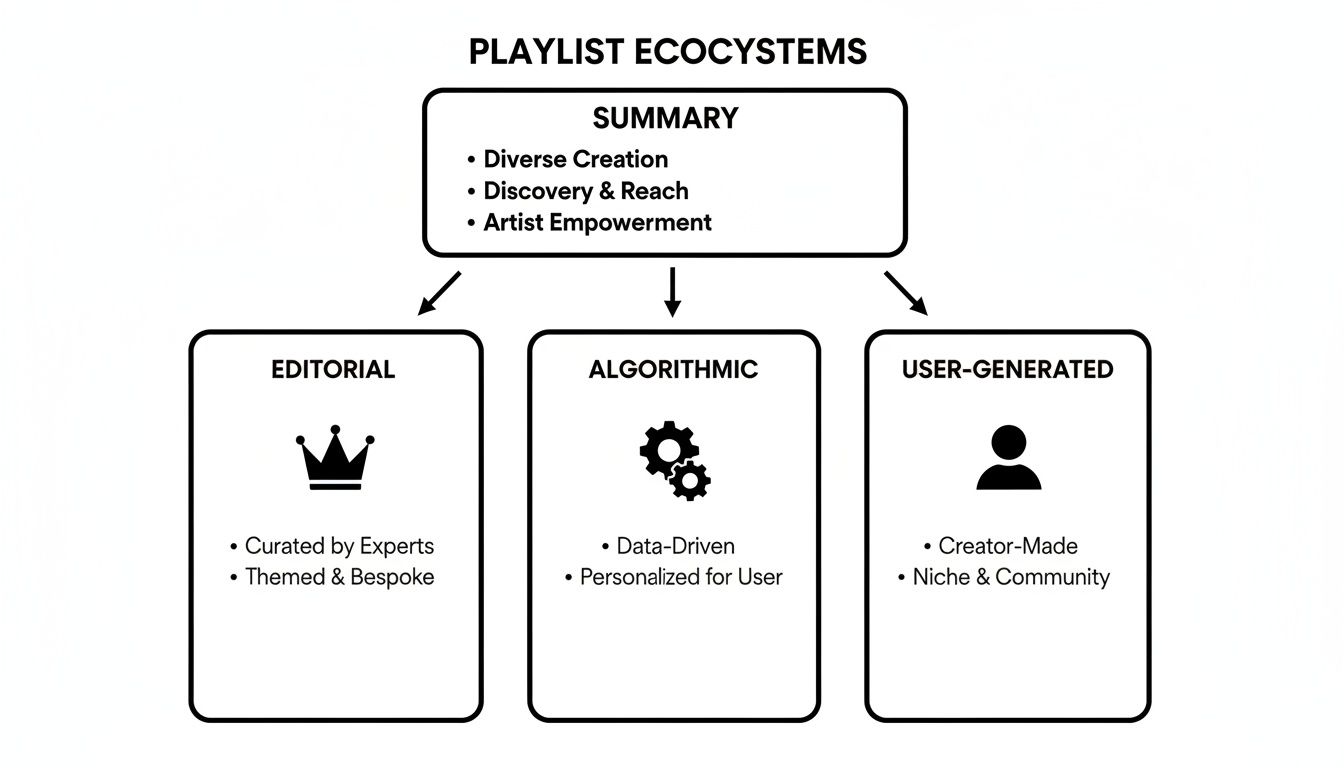
As you can see, each category—editorial, algorithmic, and user-generated—offers a different leverage point for audience development.
To contextualize the user-generated landscape, Spotify hosts over 4 billion such playlists. It's a vast ocean of opportunity. Yet, a striking 14% of all artists on the platform never surpass 10 monthly listeners. This data underscores why a deliberate, analytical approach to playlist discovery and pitching is exponentially more effective than relying on passive algorithmic discovery.
Your primary focus should be on high-quality, user-generated playlists. They are the most reliable mechanism for generating the organic data signals that activate the algorithms and, in turn, capture the attention of editorial gatekeepers.
Before deploying resources, it's crucial to compare these ecosystems from a strategic standpoint. The following table breaks down the ROI considerations for targeting each.
Strategic Playlist Ecosystem Comparison
Playlist Type | Primary Goal | Vetting Difficulty | Potential Impact |
|---|---|---|---|
Editorial | Industry validation, massive exposure | High (requires formal pitch, editor approval) | Very High (can be career-changing) |
Algorithmic | Sustained discovery, fan activation | N/A (earned through listener data) | High (consistent, long-term growth) |
User-Generated | Niche audience building, triggering algorithms | Medium (requires research and outreach) | Varies (from moderate to high, cumulative effect) |
Each ecosystem demands a distinct methodology. Your pitch to an indie curator will differ significantly from your formal submission to Spotify's editorial team. The following sections will detail the specific tactics required to master each of these domains, starting with the powerful tools already at your disposal.
Get Good at Spotify's Own Search Tools
Before allocating budget to third-party platforms, it's essential to master Spotify's native search functionality as a powerful initial reconnaissance tool. Many artists overlook its potential, but a sophisticated command of the search bar can uncover valuable, niche opportunities. This is an exercise in data collection, not just casual browsing.
Think beyond single-term searches. The true utility lies in combining keywords to pinpoint specific listener contexts. Your objective isn't to find the largest playlists, but the most relevant ones—those curated by individuals with a demonstrated affinity for your sonic signature.
Mix Genre with a Vibe: Instead of a broad term like "Indie Folk," use specific search strings. Try or You will surface playlists curated for a specific moment, whose listeners are typically more engaged.
Find Active Curators: Append time-sensitive phrases to your queries. A search for or will instantly filter out dormant playlists. You need curators who are actively managing their lists, as they are the most likely to review submissions.
Reverse-Engineer Artists Like You
One of the most efficient and effective tactics is to analyze the playlist placements of analogous artists in your space. Their placements serve as a pre-vetted list of curators who are already receptive to your sound profile.
First, identify 3 to 5 artists who are sonically similar but perhaps slightly more advanced in their career trajectory. Navigate to their Spotify profiles and begin your analysis. You are looking for two specific data points:
The "Discovered On" Section: This is a critical data source. It displays the public playlists (both user-generated and editorial) driving the most traffic to that artist. These are proven fits for your musical style.
The "Related Artists" Hub: Do not limit your analysis to a single profile. The "Related Artists" section provides a map of your sonic neighborhood. Click through to each related artist and repeat the process, examining their "Discovered On" section.
This process is akin to building a network map for your musical niche. You begin with a single artist, then branch out, charting the entire ecosystem of curators and listener communities relevant to your sound.
By investing time in this foundational research, you are not searching randomly; you are building a highly targeted list of curators for outreach. You are replacing guesswork with data—a consistently winning strategy.
Getting on Algorithmic and Editorial Playlists
While targeting user-generated playlists is a fundamental strategy, the ultimate prize for many artists is placement on Spotify's proprietary algorithmic or editorial lists. These can seem opaque, but they are not entirely beyond your influence. For any artist willing to analyze the data, understanding the mechanics of these playlists is the key to sustainable, long-term growth.
These playlists are discovery engines. Within Spotify's three-tiered ecosystem, a massive 17% of all streams originate from personalized algorithmic lists like Discover Weekly and Release Radar. With 66% of users listening to them regularly, they are a formidable driver of new fan acquisition. While you cannot pitch them directly, you can absolutely create the conditions necessary for them to feature your music. Additional industry statistics and insights can be found at Soundcamps.com.
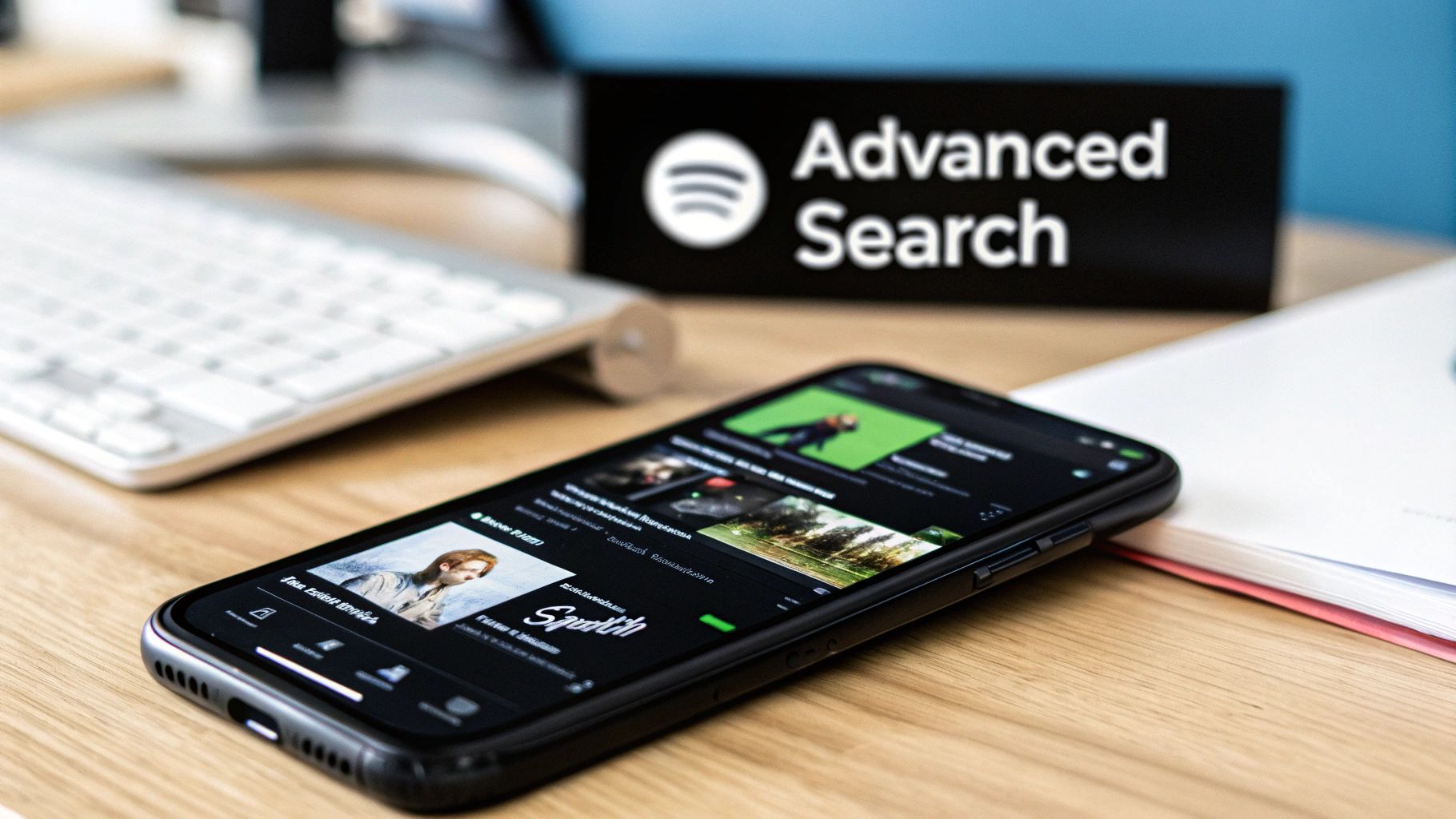
It’s an indirect strategy, but the logic is sound: secure high-quality engagement on smaller, authentic user playlists, and you will begin sending the precise signals that Spotify’s algorithm is designed to detect.
How to Trigger the Algorithm
At its core, Spotify’s algorithm seeks specific listener behaviors—actions that validate a track's resonance. The initial 48-72 hours post-release are critical for transmitting these signals with maximum impact.
Your campaign should be focused on driving these key metrics:
Saves: A user saving your track to their library is a strong indicator of affinity, far more potent than a simple stream.
Playlist Adds: This is an even more powerful signal. When a listener adds your song to one of their own playlists, it communicates to Spotify that the track has high replay value.
Low Skip Rate: This metric is crucial. The algorithm penalizes tracks that are skipped within the first 30 seconds. A low skip rate demonstrates immediate listener engagement.
This is precisely why an initial campaign focused on legitimate, well-vetted user playlists is so vital. Placements on lists with real, engaged listeners are the most effective way to generate these organic signals and get your music into algorithmic circulation. To delve deeper into these metrics, consult our guide on the Spotify Popularity Index.
Consider your initial user-playlist campaign as providing the kindling. The algorithm detects the smoke from genuine listener engagement and adds the fuel, propelling your track into Discover Weekly and Release Radar.
Nailing Your Editorial Pitch
Unlike the algorithm, you have one direct opportunity to engage with human editors via your Spotify for Artists dashboard. This pitch must be professional, concise, and compelling.
Ensure your pitch efficiently communicates:
Instrumentation: What are the key instruments featured?
Moods & Genres: Be specific. Select up to three that accurately define your sound.
Cultural Context: Where are you from? What scenes or cultures influenced the track?
The Narrative: This is your closing argument. In 150 words or less, articulate the story behind the song. What makes it unique, timely, or a perfect fit for a playlist like "Mellow Morning," "New Music Friday," or "Indie Chillout"?
A successful pitch doesn't just describe a song; it frames it as a culturally relevant piece of art that aligns with a specific listener's moment. Provide the editors with clear, compelling metadata and a sharp narrative, and you facilitate their decision-making process—significantly increasing the likelihood of placement.
Using Professional Platforms for Efficient Outreach
Manual research on Spotify is a viable starting point, but its scalability is limited. As a professional artist, your time is your most critical resource; expending hundreds of hours on manual curator discovery is an inefficient allocation of capital. This is where dedicated professional platforms become an indispensable part of your toolkit.
These services function as a central command for your playlisting operations, aggregating vast databases of user-generated playlists into a single, searchable interface. The primary benefit is the elimination of time-consuming contact discovery, which often yields dead ends. The necessary data is centralized and accessible.
Pinpoint Ideal Targets with Advanced Filtering
The true power of these platforms lies in their advanced filtering capabilities. You can move beyond broad keyword searches and begin to isolate curators who are actively seeking your specific sonic profile.
Imagine you have released a new cinematic ambient track. A professional platform allows you to segment its database to find the ideal targets.
Genre & Subgenre: Instantly filter for playlists tagged with "Ambient," "Cinematic," or "Instrumental Focus."
Mood: Refine the search further by filtering for moods like "Contemplative," "Ethereal," or "Melancholic."
Follower Count: You can set a specific range, such as 5,000 to 25,000 followers, to target the sweet spot of established yet accessible playlists.
This level of precision ensures your time and budget are deployed against the highest-potential opportunities. You are no longer guessing; you are making targeted, data-backed decisions. If you are ready to begin this process, you may find our guide on how to submit to Spotify playlists for indie artists useful.
Safeguard Your Career with Integrated Vetting
Beyond efficiency, the most critical function of a professional platform is risk mitigation. The playlisting landscape is unfortunately populated with fraudulent actors who use bot farms to inflate their metrics. A placement on such a list can corrupt your analytics with artificial streams, jeopardize your standing with your distributor, and even lead to your music being removed from the platform.
A reputable platform does more than connect you with curators; it acts as a firewall for your catalog. It is an investment in the long-term health and integrity of your artistic career.
Platforms like SubmitLink, for example, are built upon sophisticated bot detection systems. Their technology continuously scans for red flags—anomalous follower spikes, disproportionate listener-to-save ratios, and other indicators of inorganic activity.
Using a platform that vets playlists isn't just about finding more opportunities faster. It’s about securing the right partners and building your career on a solid foundation of authentic listeners, thereby protecting your music from the significant risks of fraudulent playlists.
Vetting Curators and Protecting Your Music
Playlist discovery is the first step. The critical work begins with vetting. This requires shifting from an artistic mindset to that of a data analyst. Anyone can create a playlist; the onus is on you to protect your music, your budget, and your professional reputation from bad actors.
This is not an optional step; it is your primary line of defense. A placement on a bot-driven playlist can corrupt your data, create issues with your distributor, and cause tangible harm to your career. Every potential playlist target requires rigorous due diligence before you commit to a pitch.
Identifying Red Flags and Bot Activity
A legitimate playlist exhibits signs of organic engagement. A fraudulent one, conversely, typically leaves a trail of anomalous data. Your role is to identify these red flags before they can negatively impact your music.
Execute the following checklist for every potential target:
Lopsided Follower-to-Stream Ratio: If a playlist has 50,000 followers but its constituent tracks are receiving only a few hundred plays, this is a significant anomaly. The disparity indicates fake or inactive followers.
Questionable Artist Profiles: Analyze a few artists currently on the playlist. Are their monthly listeners proportional to their own follower counts? An artist with 500 followers and 300,000 monthly listeners is a massive red flag, almost certainly indicative of their numbers being inflated by a botted list.
Sudden Growth Spikes: Examine the playlist's follower growth trajectory. Legitimate playlists grow organically over time, not by tens of thousands of followers in a single day. Certain third-party tools can help you track a playlist’s follower history.
A genuine, engaged audience leaves a data trail—saves, shares, and organic listener growth for the artists they discover. A bot farm leaves behind nothing but empty metrics.
This type of analysis transforms your playlist outreach from a simple creative task into a strategic business decision. It is how you ensure that your investment of time and capital translates into authentic fan acquisition. For a more detailed analysis, review our guide on avoiding fake playlists and growth risks.
Distinguishing Legitimate Fees from Payola Scams
The topic of payment for playlists requires careful distinction. As a professional artist, the line is unambiguous: Never pay for a guaranteed placement. This is payola, a direct violation of Spotify's terms of service, and the primary business model for fraudulent operators.
What is a legitimate industry practice, however, is paying for a service. This may be a platform that facilitates curator discovery, vets playlists on your behalf, and guarantees that a curator will review your track. Here, you are compensating for the technology and the curator's time—not purchasing a placement.
Reputable platforms are transparent about this distinction. Their value proposition is the service they provide, not a promised placement. This model protects you and ensures your music is reviewed by real people actively seeking new artists.
Your Professional Playlist Pitching FAQ
Even for seasoned professionals, playlisting can be a dynamic and complex field. The following addresses some of the most common questions that arise during a strategic outreach campaign.
How Many Playlists Should I Pitch for a New Release?
It is tempting to maximize outreach volume, but a targeted approach consistently outperforms a high-volume, low-quality one. Do not dilute your time or budget with a scattershot strategy.
Instead, I recommend focusing on a highly curated list of 30-50 thoroughly vetted playlists for a new single. This allows for personalized pitches and simplifies performance tracking. The objective is not placement on any playlist, but on the right ones—those with authentic, engaged listeners who align with your target demographic.
What Is a Realistic Budget for a Playlist Campaign?
A playlist campaign should be treated as a core marketing expenditure, not a speculative one. Utilizing a reputable submission service where each pitch costs between $2 to $5, a focused campaign targeting 50 playlists will require a budget in the $100 to $250 range.
This is an investment in data, guaranteed reviews from active curators, and, critically, a safeguard against fraudulent activity. The "free" approach often consumes dozens of hours with negligible results. A dedicated budget secures efficiency and access to a verified network.
A professional campaign budget is an investment in efficiency and security. You're paying for access to a vetted network and guaranteed reviews, which protects your catalog and ensures every dollar is spent on legitimate opportunities.
How Can I Tell if a Playlist's Listeners Are Real?
Identifying a fraudulent playlist requires analyzing for signs of genuine human activity. This is a matter of data forensics.
First, investigate the artists already on the playlist. Are their monthly listener counts proportional to their follower numbers? If an artist shows 500,000 monthly listeners but only 500 followers, that is a significant anomaly.
Next, examine the playlist's growth history if your tools provide it. Legitimate playlists exhibit steady, organic growth. An abrupt increase of 10,000 followers overnight is almost invariably a sign of bots. The most effective defense is a platform with integrated bot detection that can analyze listener data and flag such fraudulent activity on your behalf.
Should I Pay for Playlist Placements?
To be unequivocal: you should never pay directly for a guaranteed placement on a playlist. This practice is defined as payola, it violates Spotify's terms of service, and it is the modus operandi of virtually every scammer.
However, paying a professional service that connects you with legitimate curators for a review of your track is an entirely different and accepted industry practice. In this model, you are paying for the platform’s technology, its vetting process, and the curator's time to listen—not the placement itself. This maintains ethical standards and ensures your music receives genuine consideration.
Ready to connect with a network of verified curators and protect your music from fake streams? With SubmitLink, you can target thousands of legitimate playlists with confidence. Find your perfect playlist match on submitlink.io today.


