.png)
How to Find Spotify Playlists That Actually Grow Your Music
For any professional artist, finding Spotify playlists is just the starting point. The real goal is to get on the right playlists—the ones that build a career, not just a temporary stream count. This means treating your playlisting efforts like a balanced investment portfolio, focusing on four core ecosystems: Editorial, Algorithmic, Third-Party Influencer, and Niche User-Generated.
Thinking Beyond Basic Playlist Discovery
As an artist with a defined sound and a promotional budget, your playlisting strategy has to be as sharp as your music. Forget the old spray-and-pray approach of mass submissions. It’s time to think like an investor, allocating your time and money where they'll deliver real, measurable results.
Every type of playlist serves a different function. Some are designed for broad exposure, giving you immediate reach. Others are strategic assets, working behind the scenes to trigger Spotify’s powerful algorithms and build a loyal audience. Knowing the difference is crucial for protecting your investment and ensuring every placement drives your career forward.
The Four Pillars of a Smart Playlist Strategy
A sophisticated promotional campaign doesn't rely on a single channel. Instead, it diversifies across four key areas, each with its own strategic value.
Editorial Playlists: Curated directly by Spotify's own team, these are the apex placements. Securing one grants massive reach and instant industry credibility. They're also incredibly competitive and notoriously unpredictable.
Algorithmic Playlists: This is where you find sustainable, long-term growth. Lists like Discover Weekly and Radio are automatically generated based on listener data—things like saves, shares, and adds to personal playlists. The objective is to secure placements that spark this genuine engagement, which in turn feeds the algorithm.
Third-Party Influencer Playlists: Run by established brands, music blogs, and professional independent curators, these lists often require a budget for placement. They offer direct access to specific, highly engaged audiences, but require diligent vetting to ensure they are legitimate and will deliver a positive return on investment.
Niche User-Generated Playlists (UGP): These are strategic, high-value assets. Smaller, independent playlists built around very specific moods, genres, or activities won't deliver massive stream volume overnight, but they connect your music with truly passionate fans. This creates the high-quality engagement signals that Spotify’s algorithm values.
This decision tree helps visualize how to align your primary objective—whether it's broad exposure or long-term growth—with the appropriate playlist ecosystem.
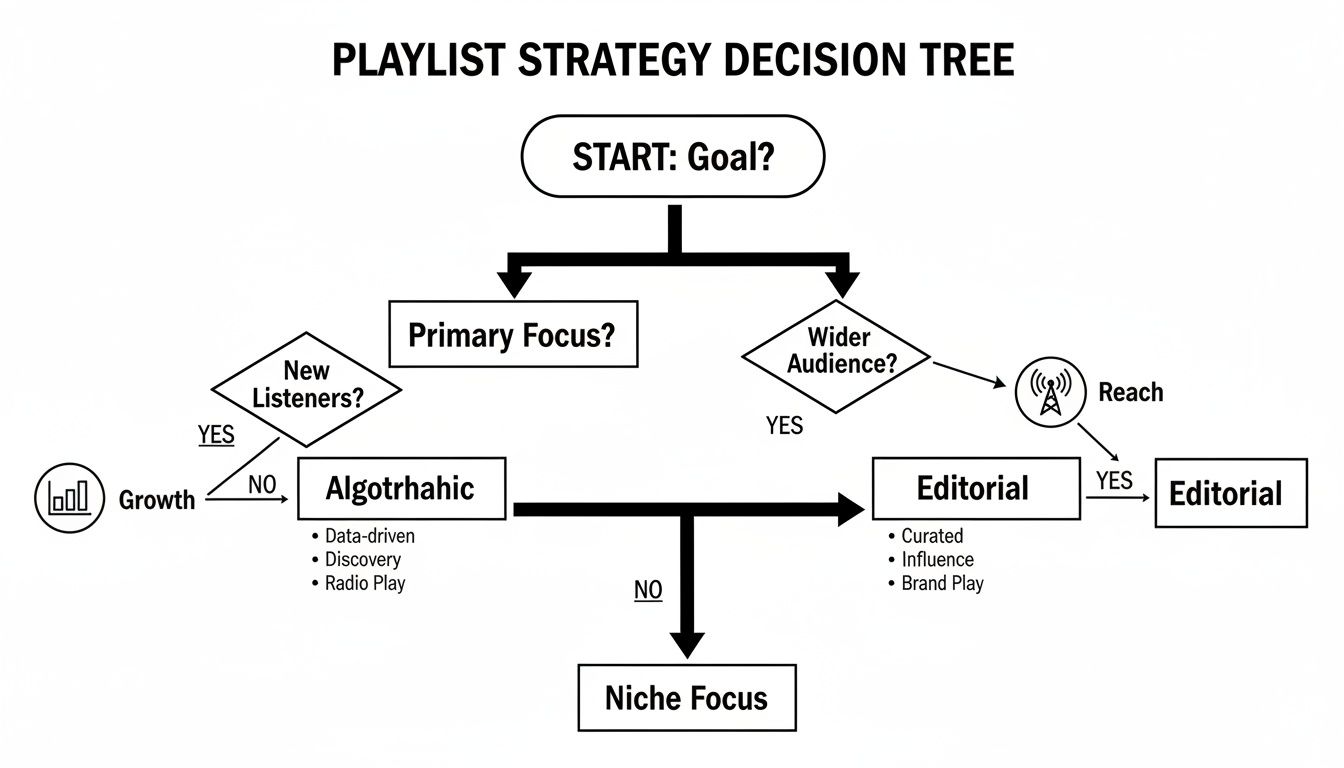
As you can see, the strategy branches depending on whether you're pursuing immediate impact (Editorial) or building a foundation for compounding growth (Algorithmic).
A mature playlist strategy recognizes that editorial placements are often the result of momentum built elsewhere. By focusing on quality user-generated and third-party lists, you create the listener engagement data that makes your track attractive to both Spotify’s algorithms and its human editors.
The most powerful campaigns integrate these elements. You might invest in a placement on a significant influencer playlist to create initial velocity. That velocity leads to saves and shares, which helps your track get picked up by algorithmic playlists. All that activity finally puts your song on an editorial curator's radar. This transforms playlisting from a game of chance into a calculated business initiative.
A Strategic Look at Spotify Playlist Types
To execute this effectively, you must understand what each playlist type contributes to your campaign. This table breaks down the four main categories, showing you where to focus your resources based on your goals.
Playlist Type | Strategic Value | How to Access | Key Performance Indicator (KPI) |
|---|---|---|---|
Editorial | Maximum reach, credibility, and industry validation. A "big win" placement. | Official pitch through Spotify for Artists. Highly competitive. | Total Streams & Listeners: Measures raw exposure and immediate impact. |
Algorithmic | Sustainable, long-term growth driven by listener data. High listener conversion. | Indirectly, by getting placements on other lists that generate saves, shares, and adds. | Save Rate: Shows how many listeners are adding the track to their own library. |
Third-Party | Targeted access to specific niche audiences. Often a paid placement for guaranteed reach. | Direct outreach, submission platforms like SubmitLink, or PR agencies. | Return on Investment (ROI): Did the cost of the placement generate enough streams/followers to be worthwhile? |
User-Generated | High-quality data signals from passionate fans. Builds foundational momentum. | Direct outreach, searching Spotify for niche keywords. | Listener-to-Follower Conversion: Are people who hear you on these lists following your artist profile? |
Ultimately, a diversified portfolio approach is optimal. Use paid placements to create initial velocity, fan-made playlists to generate high-quality data signals, and allow that momentum to attract the algorithms and editors who can turn it into a career-defining moment.
Vetting Curators to Protect Your Investment
So, you've identified a list of Spotify playlists that seem perfectly aligned with your music. Now, the critical work begins. In an industry flooded with artificial streams and bot activity, a poor placement does more than just waste your budget—it can actively damage your career.
Distributors are cracking down on artificial streams. A single misstep could get your music flagged, leading to takedowns or even penalties across your entire catalog. This isn't just about finding places to submit your tracks; it's about building a network of promotional partners you can trust.
Learning to Read a Playlist’s Vitals
Before considering a pitch, you need to perform due diligence on the playlist's health. Don't be deceived by large follower numbers; they are trivial to fake. The true story is in the data—data you cannot see just by looking at the Spotify app.
A healthy playlist has a history of organic growth and real, consistent listeners. An unhealthy one is riddled with signs of bot activity, and once you know what to look for, these red flags become obvious.
Here are the biggest indicators of a fraudulent playlist:
Sudden Follower Jumps: Did a playlist escalate from 1,000 to 50,000 followers in a week? This is almost certainly botted. You want to see a gradual, steady increase over months.
Suspiciously Uniform Playlists: Examine the curator’s profile. If they manage dozens of playlists in completely disparate genres—"Lofi Beats," "Heavy Metal Anthems," "Country Roads"—and they all have nearly identical follower counts (e.g., 25,142), avoid them.
Huge Follower Count, Tiny Audience: A playlist with 100,000 followers should have a significant number of monthly listeners. If it has only a few thousand, it means the "audience" is either fraudulent or completely disengaged.
Streams Without Saves: Bots are effective at generating plays, but they don't behave like real fans. If you observe a track getting thousands of streams from a playlist but almost no saves or adds to personal libraries, those streams are likely artificial.
Tools like SubmitLink can be invaluable here. Their systems are engineered to detect bots automatically, flagging high-risk playlists so you don't waste your time or capital. It's an essential layer of security for any serious artist.
Doing Your Homework on the Curator
Beyond the playlist's data, you're investing in the person behind it. A professional curator is a music enthusiast and a business partner who is transparent about their operations. Your job is to determine if their digital footprint aligns with that description.
Treat this like a background check for a key business partner. A curator who only exists as a name on a Spotify playlist is a significant risk. You need to see evidence that they're a real, active member of the music community.
A professional curator's reputation is their most valuable asset. They actively build and protect it through transparent communication, a consistent digital presence, and a clear passion for the music they feature. If you can't find any trace of this, proceed with extreme caution.
Your background check should be thorough. Are they just a name, or do they have a music blog, a YouTube channel, or an active social media presence dedicated to their brand? A solid online footprint is a good sign they're invested in the long term, not just a quick profit.
For a much deeper look into spotting fakes, check out our guide on avoiding fake playlists and their growth risks. It’s packed with actionable advice.
Gauging Professionalism and Communication
Finally, pay close attention to how the curator presents themselves. This is often the most telling sign. Legitimate curators understand they are running a business and providing a service, and their behavior reflects that.
Here's what professionalism looks like:
Clear Submission Guidelines: They will specify exactly how they want to receive music. If the instructions are vague or non-existent, it's a sign of an amateur or a scam.
Transparent Pricing: If it's a paid service, the costs and deliverables should be crystal clear. Any ambiguity around payment is a major red flag.
Professional Communication: When you reach out, are their replies timely and professional? Grammatical errors, high-pressure sales tactics, or overly casual language can be signs of a scammer.
By combining a hard look at the data with a thorough background check on the curator, you stop being a hopeful artist and start acting like a savvy investor. This careful approach not only protects your music and your budget but also helps you build a network of quality partners who will actually help you grow.
Crafting a Pitch That Curators Actually Read

So you've identified the perfect playlist. You've vetted it, you know it's legitimate, and your track is a perfect sonic match. Now comes the challenging part: getting the curator to actually listen.
Let's be realistic—the curators behind popular playlists are inundated with submissions. They receive hundreds of pitches daily. Sending a generic, copy-pasted email is the fastest way to have your music ignored.
Your outreach needs to function less like a lottery ticket and more like a professional proposal. You're not just asking for a favor; you're offering them a high-quality track that will enhance their playlist for their listeners. It’s a mutually beneficial proposition.
This requires a concise, professional pitch that captures their attention, respects their time, and makes it incredibly simple for them to understand why your song belongs on their list.
The Anatomy of a High-Impact Pitch
A great pitch is built on two things: personalization and professionalism. It proves you've done your research, you understand the playlist's aesthetic, and you can clearly articulate why your song fits. Every word matters.
Here's what you absolutely need to include:
A Personal Touch: Start by naming the specific playlist. Mentioning a track you genuinely like on it demonstrates you're a real fan, not a bot.
A Quick Intro to Your Song: Think of it as an elevator pitch. In a sentence or two, describe the genre, mood, and sound. Comparing it to one or two well-known artists provides an instant frame of reference.
The "Why": This is the most critical part. Connect the dots for them. Why does your song fit their playlist and their audience?
A Clean Finish: Make their life easy. Provide a single, direct Spotify link. No attachments, no long biographies, no walls of text.
Look, your goal isn't to tell them your life story. It's to give the curator just enough information to get them curious, understand the fit, and hit "play" with a good feeling about your track. Brevity is the ultimate sign of respect for their time.
A Practical Framework for Your Outreach
Let's walk through a real-world example. Think of this less as a rigid template and more as a guide to keep your message clear, persuasive, and to the point.
The Subject Line: This is your first impression. Make it easy for them to see what your email is about at a glance.
Good:
Bad:
The Pitch Itself:
The Hook: "Hi [Curator Name], I’m a big fan of your 'Indie Chill Vibes' playlist—the Bon Iver 'Holocene' placement is perfect. I have a new track I think would fit right in."
The Context: "My new single, 'Distant Lights,' is an atmospheric indie-folk song, in the vein of The National or early Iron & Wine. It's driven by a melancholic piano and ambient textures."
The Value: "The song’s reflective mood feels like a natural fit for the late-night, contemplative feel of your playlist. I think listeners who enjoy artists like Phoebe Bridgers and Sufjan Stevens would connect with it."
The Call to Action: "You can listen here: [Spotify Link]. Thanks for your time and for curating such a great list. Best, [Your Name]."
This entire pitch is under 100 words. It's direct, respectful, and provides everything they need. It shows you're a professional who understands their world, not just another artist spamming their inbox.
Final Polish for Maximum Impact
Your voice should always sound human, but a little polish goes a long way. Before hitting send, consider running your pitch through a tool like Hemingway Editor or Grammarly. They are excellent for catching rambling sentences or passive voice, helping you make your message as tight and powerful as possible.
This isn't about sounding robotic; it’s about removing any friction that might prevent a busy curator from reading your pitch.
If you want to dive even deeper into the nuts and bolts of the submission process, our complete guide on how to submit music to Spotify playlists and get heard is an excellent next step.
Ultimately, once you find the right Spotify playlists, a thoughtfully crafted pitch is what turns a long shot into a real opportunity. It elevates your submission from just another request to a professional proposal that a curator will actually be happy to open.
Scaling Your Outreach Safely With Platforms
Let’s be direct: manually finding, vetting, and pitching hundreds of playlists is not a sustainable growth model if you’re serious about your music career. When you're managing multiple releases, your time is your most valuable asset. You need a workflow that’s both scalable and safe. This is where a hybrid strategy comes in, pairing Spotify's own tools with specialized third-party platforms.
The concept is to leverage each tool for its strengths. You use Spotify for Artists for your direct line to editorial teams and for deep analysis of your listener data. Simultaneously, you engage a vetted submission service to execute targeted, high-volume campaigns across the vast landscape of user-curated playlists.
This isn't just about saving time; it's about maximizing impact. It allows you to build crucial early momentum with independent playlists while you keep your eye on the major editorial prize, all within a system that protects your music.
The Spotify for Artists and Third-Party Synergy
Think of Spotify for Artists as your official channel to Spotify’s own editorial team. It’s the only official way to get your unreleased music in front of them, making it a non-negotiable step for any release. But its real power extends far beyond that initial pitch.
The data inside Spotify for Artists is your command center. It tells you precisely where your streams are coming from, showing you which playlists are driving real fans and which are delivering empty numbers.
This is where a platform like SubmitLink becomes a strategic partner. A professional service acts as your ground team, running campaigns across thousands of verified independent playlists.
Vetted Reach: These platforms provide access to a huge network of curators that would take years to build on your own.
Built-in Protection: The best services have bot detection integrated into their systems. This is a crucial filter that protects your music from fake playlists that could jeopardize your relationship with your distributor.
Efficiency: Instead of writing hundreds of emails, you can launch a full campaign in minutes, targeting playlists by genre, mood, and even listener demographics.
This synergy lets you find Spotify playlists at a scale that manual methods simply cannot match. All the while, the data from Spotify for Artists helps you refine your targeting for the next campaign.
A Workflow That Actually Works
So, what does this hybrid model look like in practice? Here’s how you can structure a professional release cycle.
The Pre-Release Pitch: Submit your track to Spotify's editors through your Spotify for Artists dashboard at least two weeks before its release. This is your one opportunity for day-one editorial consideration.
Launch the Ground Campaign: On release day, use a platform to push your track out to a portfolio of user-generated and influencer playlists. This isn't a spray-and-pray approach; it's a calculated move targeting lists with a history of real engagement.
Analyze and Adjust: As your song gains playlist adds, live inside your Spotify for Artists data. Monitor which playlists are delivering not just streams, but also saves, shares, and new followers. These are your high-value assets.
Build Your Network: When a playlist drives excellent results, take note of that curator. Many platforms facilitate direct communication, allowing you to build genuine professional relationships for future releases.
The professional artist’s mindset is to treat playlisting as a data-driven marketing channel, not a lottery. By combining a broad, safe outreach platform with the granular analytics of Spotify for Artists, you turn promotional spend into a predictable and optimizable investment.
This approach transforms your promotional efforts from a series of one-off pitches into a sophisticated, continuous cycle of outreach, analysis, and optimization. If you’re evaluating your options, our guide to the best music promotion services is a great place to start.
Keeping Pace in a Fast-Moving Music World
This kind of strategic, platform-driven approach is more critical than ever. The lifecycle of a hit song is compressing, which means your window to gain momentum is shrinking. A recent industry report found that songs now hit one billion streams on Spotify 14 times faster than they did a decade ago. While that’s a testament to Spotify’s growth, it also means that slow-burn strategies are no longer viable. You need to make an immediate, targeted impact from day one. You can read more about these music industry trends here.
By integrating these powerful tools, you stop just finding Spotify playlists and start strategically engineering a release campaign. You’ll get more out of your promo budget, keep your catalog safe, and make smarter, data-driven decisions that build a real, lasting career.
Measuring Performance and Calculating Your ROI
Allocating a budget to a playlist campaign without measuring the results is simply a shot in the dark. Once your track lands on a playlist, the real work begins. This is where you shift from spending money to making a strategic investment, and it’s all about tracking what actually happens next. We're not just watching the stream count go up; we're digging into the data to understand the true return on your investment (ROI).
Your home base for all of this is your Spotify for Artists dashboard. It’s where you’ll learn to look past the vanity metrics and zero in on the numbers that signal real, sustainable career growth. Sure, a million streams from a passive, lean-back playlist might look impressive on paper, but they often do far less for you than a thousand streams from a list full of highly engaged fans.
The key is learning to tell the difference.
Look Beyond the Stream Count
Raw stream numbers are just the beginning of the story. To truly determine a playlist's impact, you must analyze what listeners are doing after they hear your song. The best placements generate active engagement—the exact kind of behavior that catches the attention of Spotify's algorithm.
Inside your Spotify for Artists account, navigate to the "Music" tab, select your track, and then click into the "Playlists" section. This is where you get a clear breakdown of which lists are actually driving listeners to your music.
Forget the raw stream count for a moment and focus on these KPIs:
Saves: This is a crucial metric. A "save" means someone liked your song enough to add it to their personal library or one of their own playlists. It’s a direct signal to Spotify that your track has genuine appeal and isn't just background noise.
Listener-to-Follower Conversion: Are the people streaming your song from a particular playlist also hitting that "Follow" button on your artist profile? A high conversion rate here is a clear indicator that the playlist's audience is a perfect match for your music.
Audience Demographics: Go to the "Audience" tab. Do the listeners coming from that new playlist placement align with your existing fanbase? A great placement should either strengthen your core demographic or expand it in a meaningful way—not dilute it with off-target listeners.
The real endgame for any third-party playlist placement is to generate enough positive data signals—especially saves and personal playlist adds—to get your track picked up by Spotify's own algorithmic playlists like Discover Weekly and Radio. That's where you find long-term, organic growth.
Adopting this data-first mindset helps you quickly identify which curators are true partners in your growth. It separates the playlists that deliver real fans from those that just offer a temporary, fleeting bump in streams.
Calculating Your Campaign ROI
Once you have a handle on the performance data, you can begin calculating the ROI of your paid placements. This is what empowers you to make smart, business-minded decisions about where to allocate your budget for future releases. While a highly detailed, dollar-for-dollar calculation can get complicated, a simple cost-per-result formula provides all the clarity you need.
Let’s run through a quick scenario. Imagine you spent $100 on a campaign that landed you on five playlists. After two weeks, you dive into your Spotify for Artists data.
Here's a simple way to break down the results:
Calculate Cost Per Stream: If the campaign brought in 20,000 new streams, your Cost Per Stream is $0.005 ($100 / 20,000 streams).
Calculate Cost Per Save: If those streams led to 1,000 saves, your Cost Per Save is $0.10 ($100 / 1,000 saves).
Calculate Cost Per Follower: If you gained 200 new followers from the campaign, your Cost Per Follower is $0.50 ($100 / 200 followers).
This kind of analysis reveals the true value. You might run another campaign that delivers more streams for the same price, but if its Cost Per Save or Cost Per Follower is significantly higher, you'll know it was a less effective investment in building your actual fanbase.
Identifying Your High-Performing Partners
This entire process isn't about scoring a one-off win; it’s about building a trusted network of curators who you know can deliver results time and time again. By tracking these metrics consistently, you’ll build a go-to list of your most effective promotional partners.
For your next release, you won't be guessing. You'll know exactly who to reach out to first and can invest your budget with confidence. This data-driven strategy also gives you the proof you need to stop working with curators whose playlists just don't deliver meaningful engagement. It transforms your approach from a hopeful search for Spotify playlists into a calculated business strategy built for growth.
Common Questions from Professional Artists

Even with a robust strategy, questions will arise as you begin deploying your budget into campaigns. Let's address a few of the most common ones from artists who are serious about optimizing their playlisting spend. These are the nuances that separate an adequate campaign from an exceptional one.
Should I Prioritize Playlists with More Followers?
Instinct says yes, but the real answer is: not necessarily. A huge follower count is one of the most misleading metrics in playlisting. A playlist with 500,000 followers looks impressive on the surface, but it can be completely useless compared to a niche playlist with 5,000 dedicated fans who represent your ideal target audience.
What you should be seeking is engagement. A smaller, active list will drive more saves, more shares, and more artist follows than a massive, passive one. Those are the signals that tell Spotify's algorithms your music is worth pushing. It is always more valuable to find a home with a small, dedicated tribe than to get lost in a massive, indifferent crowd.
How Much of My Release Budget Should Go to Playlisting?
This is a classic "it depends" question, but a solid starting point is to allocate 20-40% of a single's promotional budget specifically for playlisting. This assumes you are also investing in social media advertising, public relations, or other marketing efforts.
For any artist serious about growing on Spotify, playlisting has to be a cornerstone of your budget. It's where the listeners are. The goal isn't just to spend money, but to get a return on it—find what works and double down on the curators who actually move the needle for you.
If your primary objective is to trigger Spotify’s algorithmic playlists like Discover Weekly, you might increase that percentage. Conversely, if you're promoting a tour, more of that budget might be directed toward geo-targeted ads. The key is to be flexible. Let the data guide your future budget allocations.
Can a Bad Placement Really Hurt My Career?
Yes, absolutely. This should not be taken lightly. A few years ago, a placement on a botted playlist was merely a waste of money. Now, it can cause real, lasting damage. Spotify and its partner distributors, like DistroKid and UnitedMasters, are aggressively penalizing artificial streaming activity.
Getting your track on just one fraudulent playlist can trigger serious consequences:
Your track can be removed from Spotify entirely.
Your royalties may be withheld indefinitely for that track.
You could receive a strike from your distributor. Too many strikes can result in being dropped from their platform.
This is why vetting every single playlist is non-negotiable. The allure of cheap, high-volume streams is a trap. The risk to your reputation and your entire catalog is simply not worth it. Every time you find Spotify playlists, your first step must be to verify their legitimacy.
Ready to connect with a network of vetted, high-impact curators without the guesswork? SubmitLink offers access to hundreds of verified playlists, all screened with top-tier bot detection to keep your music safe. Stop the manual grind and start building campaigns that deliver real, measurable growth. Find your next placement with SubmitLink today.


