.png)
How to Submit Music to Spotify Playlists and Get Heard
Before you can even think about getting your music onto a Spotify playlist, you've got to get your house in order. This isn't just about the music itself; it's about making sure your track and your entire artist profile are polished, professional, and ready for the spotlight. Getting this prep work right before you pitch to anyone is the difference between getting noticed and getting ignored.
Setting the Stage for Your Spotify Pitch
Think of your track and profile as your digital storefront. A rushed release with a half-baked profile tells curators and even Spotify's own editors that you're not taking this seriously. This foundational work isn’t just for show—it directly influences how algorithms and human curators categorize and consider your music.
It’s like setting up the pieces on a chessboard before a big match. A strong opening move dramatically improves your odds. For an artist, this means nailing three things: the production quality of your song, your artist branding, and the technical data tied to your release. Don’t even think about skipping this part.
Polish Your Track and Your Profile
Let's start with the obvious: the music has to be incredible. A song with a muddy mix or a weak master will get skipped instantly, no matter how good your pitch is. You have to invest in a professional finish so your track can stand up sonically next to major label releases. This is not the place to cut corners.
At the same time, give your Spotify for Artists profile a serious audit. It’s your EPK, your business card, and the very first place a curator will go to learn more about you.
High-Resolution Images: Your profile and header photos need to be professional and on-brand. No blurry phone pics.
Compelling Artist Bio: Write a bio that actually tells your story. Keep it fresh with recent news or upcoming shows.
Social Media Links: Make it easy for people to find you. Link up your Instagram, X (Twitter), Facebook, or whatever platforms you're active on.
Artist Pick: Use this feature! Pin your new single, a tour announcement, or a playlist you’re featured on. It shows your profile is active and you're engaged.
A complete and visually sharp Spotify for Artists profile does more than just share info—it builds trust. It signals to curators that you're a professional who gets the importance of branding.
The Critical Role of Metadata
This is the part everyone forgets, but it's the engine that makes your track discoverable. Your song's metadata tells Spotify everything it needs to know, from who wrote it to how to pay you. Mess this up, and you could face payment problems, get passed over for playlists, or just confuse the algorithm.
Before you even upload to your distributor, it's a good idea to get a handle on the legal side of things. Properly managing your rights from day one is critical, and learning how to license music for your creative projects can prevent huge headaches later on.
Double-check these key metadata points before you hit "submit":
Songwriter and Publisher Credits: Make sure they're 100% accurate so everyone gets paid correctly.
ISRC and UPC Codes: These are the unique digital fingerprints for your track and the overall release.
Release Date: Set this strategically to give yourself a proper runway for pitching.
This meticulous prep is just one of many proven strategies for getting on Spotify playlists. When your assets are locked in, you make it incredibly easy for a curator to say "yes." This groundwork is the foundation for every pitch you'll send.
Pitching to Spotify's Official Editorial Team
This is the big one. Pitching your music directly to Spotify's editors is your one, official shot at landing on career-defining playlists like New Music Friday, Lorem, or RapCaviar. It's completely free and happens right inside your Spotify for Artists dashboard.
Think of it as your direct line to the people who can change everything for your music. But with thousands of songs hitting their desks every single day, your pitch can't just be good—it has to be perfect. This isn't just about filling out a form; it's about making a compelling case for your art. You only get one chance per song, so let's make it count.
Nailing The Submission Details
Before you even get to the creative part of the pitch, you have to nail the data. This info is what Spotify's system uses to get your track in front of the right editors—the ones who actually specialize in your sound. Rushing this step is a huge mistake.
Genre Selection: You get to pick up to three. Be honest. If you make dreamy indie folk, don't tag it as "Pop" just because you think it's more popular. An editor looking for the next pop hit will immediately dismiss a track that doesn't fit, and you'll have wasted your shot.
Mood & Style: You can choose up to two moods (like "Chill," "Energetic," or "Melancholy") and add styles like "Acoustic." This is your chance to add more flavor and context for the curator.
Instrumentation: What did you use to make the song? Be specific and select everything from "Electric Guitar" to "Synth Bass" or "Drum Machine." This data is gold for curators of niche instrumental or genre-specific playlists.
Think of these tags as your song's first impression. They're the keywords an editor might use when searching for that perfect track to complete their playlist. Precision and honesty are your best friends here.
Writing a Pitch That Connects
Okay, now for the most important part. You have 500 characters to tell the story behind your song. This is your moment to connect with a real person on the other side of the screen.
A lazy pitch like "check out my new single" is a guaranteed way to get overlooked. You need to be concise, personal, and give them a reason to care. This is where you can learn more about how to get on Spotify editorial playlists by digging into what makes a story stick.
A winning pitch weaves together a few key elements. You need to hook the editor with the story, show them you're serious about promoting it, and highlight anything that makes the track special.
The table below breaks down what a powerful pitch looks like in practice.
Anatomy of a Winning Editorial Pitch
A breakdown of the essential components for a powerful pitch in your Spotify for Artists submission.
Component | Why It Matters | Best Practice Example |
|---|---|---|
The Hook | Captures immediate attention with the song's core story or inspiration. | "Written on a cross-country road trip after a breakup, 'Sunset Drive' is about finding freedom in solitude." |
Marketing Proof | Shows editors you're actively working to promote the music, making their placement more impactful. | "Supported by a music video premiere on a major blog and a targeted Instagram ad campaign." |
Key Highlights | Adds credibility and context. Mentions of collaborators, album plans, or unique production techniques. | "It's the lead single from my upcoming EP, produced by John Doe (known for his work with Artist X)." |
Emotional Context | Briefly explains the mood or feeling, connecting the song to potential playlist themes. | "It has a hopeful yet melancholic feel, perfect for late-night driving or reflective playlists." |
Ultimately, you want to show the editor that you're a professional artist with a plan, not just someone throwing music at the wall to see what sticks.
The Importance of Timing
Timing is everything. You absolutely must submit music to Spotify playlists for editorial consideration at least 7 days before its release date. No exceptions.
But let's be real—the sweet spot is 14 to 21 days in advance.
This lead time is critical. It gives the editors enough time to actually listen among the flood of daily submissions. More importantly, submitting early guarantees your track will land on the Release Radar playlists of everyone who follows you, even if you don't get an editorial nod. Submitting last-minute means you miss out on both of these massive opportunities. Get your release schedule locked in early and make this pitching window a top priority.
Connecting with Independent Playlist Curators
Beyond Spotify’s own editorial team, there’s a massive, influential world of independent curators. These are the real music heads—the bloggers, influencers, and die-hard fans who build loyal followings around their specific tastes. Landing a spot on their playlists can be just as game-changing as an official placement, often plugging you directly into a super-engaged, niche audience that’s hungry for new music.
Unlike the structured, formal process for editorial playlists, this is all about hustle. It’s a ground game of research, relationship-building, and crafting the perfect pitch. You have to be willing to put in the hours to find the right people who will genuinely connect with your sound.
Finding the Right Curators for Your Music
Think of yourself as a playlist detective. The mission isn't just to find the biggest playlists; it's to find the right ones. A placement on a highly-curated playlist with 5,000 followers in your exact sub-genre is worth far more than a spot on a generic list with 100,000 followers where your track will just get lost in the noise.
Start your search right inside the Spotify app. Use keywords that actually describe your music, like "sad indie folk," "80s synthwave revival," or "lofi beats for coding." Keep an eye out for playlists created by individual users, not the ones made by big brands or Spotify itself.
When a playlist looks promising, it’s time to do some digging:
Scan the Description: Curators who are open to new music often leave their contact info right in the playlist description. An email address or an Instagram handle is your green light to reach out.
Check Out Their Socials: If you find their social media profile, see how they operate. Do they interact with artists? Do they post about their playlist updates? This will give you a good sense of their vibe and whether they're legit.
Look for Other Projects: Many curators are also music bloggers, YouTubers, or run small indie labels. A quick Google search of the curator's name or the playlist title can often lead you to their other platforms, giving you more ways to connect.
Here’s a pro tip: Don't immediately chase the playlists with millions of followers. Instead, focus on curators in the 1,000 to 20,000 follower range. They're usually more accessible, genuinely passionate about discovery, and aren't completely buried in submissions.
How to Vet Playlists and Avoid Red Flags
Let’s be real: not all playlists are created equal. The independent space has its fair share of fakes—playlists propped up by bots to inflate follower counts. Getting on one of these can actually hurt your artist profile. Spotify's algorithm can flag your track for suspicious activity, and you could even get your music pulled down.
Before you submit music to Spotify playlists, you need to learn how to spot the fakes. Always do a quick audit.
Key Red Flags to Watch For:
Weird Follower-to-Stream Ratios: Take a look at the songs already on the playlist. If it has 50,000 followers but most tracks have fewer than 1,000 plays, that’s a huge red flag. The engagement just doesn't add up.
Generic Playlist Titles: Be skeptical of playlists with vague, keyword-stuffed names like "Top Hits 2024" run by some random user. Real curators tend to get more creative with their branding.
"Pay for Placement" Schemes: If a curator promises you a guaranteed spot on their playlist for a fee, run the other way. That’s payola, and it's a direct violation of Spotify's rules. Legitimate services might charge a fee to review your submission, but they never guarantee placement.
A healthy playlist has real, engaged listeners. The stream counts on the tracks should feel proportional to the follower count. If something feels off, trust your gut and move on.
Crafting Your Outreach Pitch
Okay, so you've found a solid list of legit, relevant curators. Now it's time to reach out. Your goal here is to cut through the noise of the hundreds of other emails they get every single day. A generic, copy-and-paste message is a one-way ticket to the trash folder. Personalization is everything.
Keep your email or DM short, respectful, and make it obvious that you've actually listened to their playlist.
Here’s a simple, effective structure:
A Personalized Subject Line: Something clear like "Music Submission: [Your Song Name] for [Playlist Name]" works. Even better is to show you've done your homework: "Loved [Artist Name] on your playlist - thought you might like this."
The Personal Connection: Start by telling them what you like about their playlist. Mention a specific song you discovered through them. This instantly shows you're a real person and not just another spammer.
The Quick Pitch: In one or two sentences, describe your track. Mention the genre and mood, but most importantly, explain why it’s a great fit for their specific playlist. Connect the dots for them.
A Clear Call to Action: Give them a direct Spotify link to your song. Don't attach MP3s or send them to a landing page with a dozen different links. Make it one-click simple for them to listen.
This approach isn't just a submission; it's an introduction. You're building a real connection with a tastemaker who could become a long-term supporter of your music. Treat them with respect, and you'll dramatically improve your chances of getting heard.
Getting Help: A Look at Playlist Submission Platforms
Let's be real: reaching out to curators one by one is a grind. While that manual approach is fantastic for building real relationships that last, it eats up a massive amount of time. That's where playlist submission platforms come in, offering a more direct line to hundreds, or even thousands, of vetted curators.
Think of these services as a bridge. Instead of spending your days hunting down contact info, you get access to a curated database of playlist creators, saving you a ton of legwork. But here's the crucial part: this convenience comes with a huge warning. The world of playlist promotion is absolutely littered with scams that can do serious, lasting damage to your music career. Knowing how to spot a powerful tool versus a costly mistake is a skill you have to learn.
How These Platforms Actually Work
Most submission services fall into a few common buckets. There's no single "best" one—the right choice for you really depends on your budget, what you're trying to achieve, and how hands-on you want to be.
Pay-Per-Submission: This is the most popular model. You pay a small fee, usually just a few bucks, to get your track in front of a single curator. You’re paying for their time and consideration, not a guaranteed spot on their playlist.
Subscription Services: Some platforms, like SubmitHub, run on a subscription model. You pay a monthly or annual fee for a certain number of submission credits or full access to their network. If you're releasing music constantly, this can be a smart, cost-effective move.
Free Submissions: A handful of platforms offer free ways to submit. It's tempting, of course, but be prepared for much lower response rates and intense competition. We break down the good, the bad, and the ugly of this approach in our guide to free Spotify playlist submission.
The single most important thing to remember is that you are paying for consideration, not a placement. Any service promising a playlist spot for cash is engaging in payola. That's a direct violation of Spotify's rules and a massive red flag.
Spotting the Scams and Dodging the Bots
The absolute biggest danger when using third-party services is getting tangled up with fake, bot-driven playlists. These scams promise you massive stream counts, but the "listeners" are just server farms—not real people. Landing your music on one of these lists can be catastrophic.
Spotify's algorithm is frighteningly good at sniffing out fake streams. If your track gets flagged, it could be yanked from the platform entirely, your royalties could be frozen, and your distributor might even slap a strike on your account. Enough strikes, and they could pull your whole catalog.
Protecting yourself starts with knowing what a fake playlist looks like.
Here are the classic red flags of a scam:
Instant Adds: A real curator needs time to actually listen to the music. If your track gets added seconds after you submit it, a bot did it.
Generic Feedback: One-word replies like "Cool!" or "Nice vibe" mean no one really listened. A passionate curator will often give you specific thoughts.
Weird Follower-to-Stream Ratios: This is the easiest check. A playlist with 80,000 followers where every song only has a few hundred streams is a dead giveaway. The followers are fake.
Zero Vibe: Take a look at the curator's profile and the playlist itself. A real, popular playlist has a distinct brand and an active, engaged community around it. Fake ones just feel... empty.
Picture your new song being one of over 100,000 tracks uploaded to Spotify every single day. It’s a harsh reality. Without playlists, your music gets lost. In fact, a staggering 65% of all streams on Spotify originate from playlists. This is why a service like SubmitLink can be so effective, connecting artists to over 600 legitimate curators and boasting an impressive 21% average share rate—well above the typical 10-14% you see elsewhere. Others, like artist.tools, are built specifically to detect and flag these fraudulent playlists, helping you avoid the takedowns that crush so many artists.
How to Choose a Service You Can Trust
A legitimate platform will always be transparent and put quality over quantity. As you explore your options, you might also want to look into the best content distribution platforms to see how they fit into your overall release strategy.
When you’re vetting a service to submit music to Spotify playlists, look for these green flags:
Vetted Curators: The service should have a clear, strict process for approving curators to make sure they're real people with real, engaged listeners.
Fraud Detection: The best platforms are constantly scanning for bots and booting fraudulent playlists from their system.
Clear Pricing: You need to know exactly what you’re paying for. Hidden fees or confusing credit systems are a bad sign.
Guaranteed Review: Good services often guarantee a curator will listen and provide feedback within a certain window. If they don’t, you should get your credit back.
Putting your budget into the right platform can genuinely accelerate your growth and connect you with a real audience. But walking into this blind is a risk you just can't afford to take. Do your homework, trust your gut, and always, always prioritize the long-term health of your artist profile over the empty promise of quick streams.
How to Measure Your Playlist Success
Getting your track onto a playlist isn't the finish line; it's the starting gun. The moment your song goes live, the real work begins. Your goal shifts from just getting on the list to proving your music belongs there. Measuring what happens next is absolutely critical, not just to see if your hard work paid off, but to understand what actually resonates with listeners.
Think of your Spotify for Artists dashboard as mission control. It stops being just a pitching tool and becomes your analytical powerhouse, giving you a raw, unfiltered look at how your music performs in the wild. Flying blind is a rookie mistake. Sure, you might see the stream count go up, but you won't know why or how to make it happen again.
Decoding Your Spotify for Artists Data
Once you land a placement, your dashboard is going to light up with new data. It's easy to get overwhelmed by all the graphs and numbers, but a few key metrics tell the most important part of the story. Paying attention to this feedback loop is a non-negotiable part of the process.
Here’s where to focus your attention first:
Streams & Listeners: This is the most obvious one. You're looking for a clear, undeniable spike in both daily streams and unique listeners right after your track gets added. That initial jump is your confirmation that the playlist is active and driving real traffic.
Stream Sources: This little pie chart is pure gold. It shows you exactly where your streams are coming from. In a healthy campaign, you'll see a big slice of that pie labeled "Other listeners' playlists" or "Spotify editorial playlists."
Saves: This is probably the most powerful signal you can send to Spotify's algorithm. A "save" is when someone adds your song to their personal library or one of their own playlists. It’s a massive vote of confidence.
Audience Demographics: Don’t sleep on this. Check out the age, gender, and location of your new listeners. This intel is invaluable for fine-tuning future marketing, whether you're targeting social media ads or just understanding your core fanbase.
This decision tree gives you a stark look at the two paths your music can take when you're working with playlisting services.
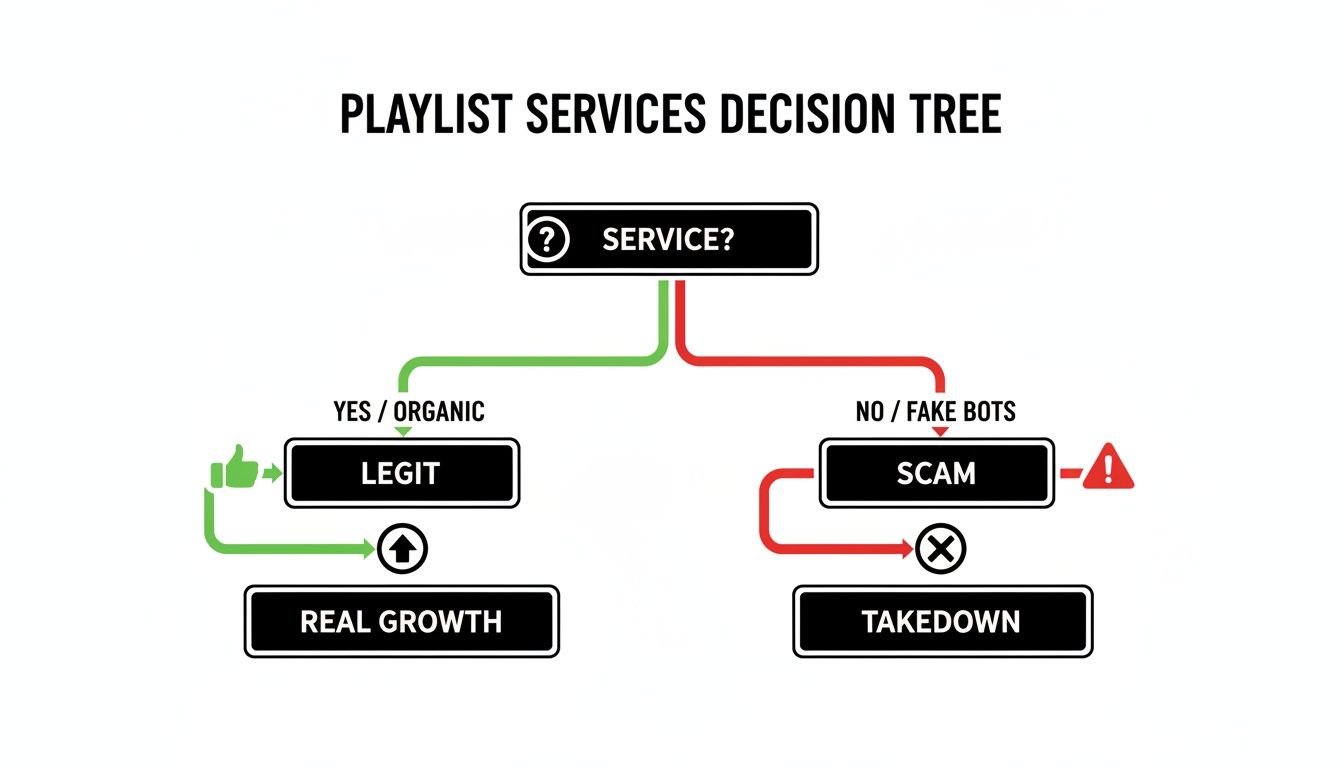
The right choice leads to genuine, sustainable growth. The wrong one can get you penalized or even have your music taken down.
The Two Metrics That Matter Most: Save Rate and Skip Rate
While big stream numbers feel great, Spotify’s algorithm is far more interested in actual listener engagement. Two data points, above all others, tell the algorithm if your song is a hit or a miss with a playlist's audience: the save rate and the skip rate.
The save rate is simply the percentage of listeners who save your track after hearing it. A high save rate screams to Spotify that your song has genuine appeal and staying power. There aren't any official benchmarks, but from what I've seen, a save rate of 10% or higher is considered very strong.
A high save rate is your direct line to algorithmic playlists like Discover Weekly. When real users save your song, it signals to Spotify that it should show your track to more people with similar tastes.
On the flip side, the skip rate is the percentage of people who hit "next" before the 30-second mark. This is a huge red flag for both curators and the algorithm. A high skip rate signals a bad fit for the playlist, and if it's bad enough, a curator will yank your track to protect their own playlist's integrity. Aiming for a skip rate under 20-25% is a great goal.
Turning a Placement into a Partnership
The data tells you what's going on, but what you do next is what really counts. The final piece of the puzzle is nurturing the human connection you've made with the curator. This is how a one-off placement becomes a long-term relationship.
After your track has been on the playlist for a few days and you've got some data, it's time to follow up.
First, send a simple thank you. A short, genuine email or DM thanking them for the placement goes a surprisingly long way.
Next, share a quick performance highlight. Keep it brief and to the point. Something like, "Hey, just wanted to say thanks again for adding my track to 'Indie Chill.' It's getting a great response from your listeners with a 15% save rate so far!" This move immediately shows you're a professional who pays attention.
Finally, keep them in your network. Add them to a personal list of key contacts. The next time you have a single ready for release, you can reach out with a friendly, familiar intro instead of starting from scratch.
This kind of professional follow-up solidifies your reputation as a serious artist who values support. It’s this final step that elevates you from being just another submission in the inbox to a trusted collaborator, making that next placement so much easier to land.
Common Questions About Spotify Submissions
Diving into the world of Spotify promotion can feel a bit like the Wild West. You'll hear a lot of conflicting advice, and it's easy to wonder what's real, what's a waste of time, and what could actually hurt your career.
Let's cut through the noise. I've been in these trenches, and I've seen what works and what doesn't. Here are straight answers to the questions that pop up most often when artists are trying to get their music onto playlists.
How Long Does It Take to Get on a Spotify Playlist?
This is the big one, and the honest answer is: it depends entirely on who you're pitching to. The timeline for an official Spotify editorial playlist is worlds apart from an independent curator.
If you're aiming for an official editorial placement, there’s a hard and fast rule: you have to pitch your track through your Spotify for Artists dashboard at least 7 days before your release date. If they decide to add your song, you'll almost always see it go live on release day. Miss that 7-day window, and you've missed your shot for that specific track. No exceptions.
Pitching to independent curators is a different ballgame.
Doing it yourself: If you're cold-emailing curators, you're on their schedule. It could be days, weeks, or you might just hear crickets. Patience is your best friend here.
Using a platform: This is usually the faster route. Many submission services give curators a deadline to listen and give feedback, often within a week or so.
Should I Pay for Playlist Placements?
Let's be crystal clear about this, because it's a make-or-break issue. You should never, ever pay a curator directly for a guaranteed spot on their playlist. That's called "payola," and it's a blatant violation of Spotify's rules. It’s a surefire way to get your music pulled and your account flagged.
However, paying for a submission service or for a curator's consideration is a completely different—and legitimate—part of the modern music industry.
When you use a reputable platform, you're not buying a placement. You're paying a small fee that covers the platform's tech (like bot detection) and compensates the curator for their time to actually listen and provide a thoughtful review. You're paying for a fair shot, not a guaranteed add.
What Happens If I Land on a Fake Playlist?
This is one of the biggest pitfalls for emerging artists. A sudden, massive jump in streams might feel like a win, but if it comes from a botted playlist, it can do serious, lasting damage to your artist profile.
Spotify's algorithms are constantly hunting for this kind of fake activity. If they find your track on a playlist driven by bots, the fallout can be brutal:
Your track gets removed. Spotify might just pull the song from the platform entirely.
You lose your royalties. Any money generated from those fake streams will be clawed back.
Your distributor gets mad. Services like DistroKid or TuneCore will issue a "strike" against you. Rack up too many of those, and they can drop you and remove your entire catalog.
This is exactly why working with services that have robust fraud detection is non-negotiable. Protecting your music from fake streams isn't just a good idea; it's essential for building a real career.
How Many Playlists Should I Pitch To?
When you’re just starting out, it’s so tempting to cast the widest net possible and hit up hundreds of curators. Trust me, the "spray and pray" method is a waste of your time and energy. The real secret to playlisting success is quality over quantity.
Your time is much better spent building a carefully curated list of playlists that are a perfect match for your specific sound. A placement on a smaller, niche playlist with 5,000 highly engaged listeners who love your genre is infinitely more valuable than getting lost on a generic list with 500,000 passive listeners who will probably just skip your track.
As a starting point, focus on building a targeted list of 20 to 50 playlists. Do your homework on every single one. Listen to the songs they feature. Get a feel for the curator's taste. Make sure their audience is your audience. A focused, personal approach will always beat a generic mass blast.
Ready to connect with real, vetted curators and skip the risk of fake playlists? SubmitLink gives you a transparent platform to reach hundreds of legitimate playlists with confidence. Our system is backed by industry-leading bot detection to protect your music, ensuring every submission is a safe and strategic investment in your growth. Start your next campaign with SubmitLink today.


