.png)
Independent Music Promotion: A Strategic Framework for Esteemed Artists
- Feb 5
- 17 min read
Independent music promotion is no longer about simply being heard; it's the strategic discipline of cultivating a dedicated audience and driving sustainable growth without the backing of a major label. For the established artist, this means evolving beyond foundational tactics. It's time to implement a professional, investment-backed promotional system that not only optimizes reach but also protects your music catalog and builds a durable career.
Forget chasing ephemeral "hacks." The objective is to construct a repeatable engine for growth.
Moving Beyond Foundational Music Promotion
This guide presumes you have mastered the fundamentals. Your music is professionally mixed and mastered, you are proficient within your distribution platform, and you have an established social media presence. This playbook is not for novices; it’s for serious artists who operate their music as a business and are prepared to invest in scalable, long-term growth.
The critical shift is from executing scattered promotional pushes to architecting a durable promotional framework. This strategy transforms each release into a career-building asset rather than a fleeting moment. We will bypass rudimentary advice and delve into the methodologies for structuring a professional release that builds tangible momentum, protects your investment, and yields measurable results.
The Modern Independent Artist's Opportunity
The independent music sector is experiencing unprecedented expansion. It has evolved from a niche segment into a dominant force, offering more viable pathways to a sustainable career than ever before. However, this growth presents a dual challenge.
The U.S. Independent Label Music Production industry is projected to reach $668.6 million in revenue by 2025, and the number of independent music companies has grown by over 20% annually since 2020. This signifies immense opportunity, but it also creates an intensely crowded market. The potential for success is greater, yet the barrier to entry is lower, resulting in a higher noise floor. Distinction now requires a sophisticated, data-driven strategy. You can review more data on the indie music market growth from IBISWorld.
Success today is not defined by a singular viral event. It's about engineering an interconnected system where public relations efforts inform ad targeting, playlist placements cultivate your core audience, and data analytics dictate your next strategic move.
Adopting a CEO Mindset
To thrive in this environment, you must operate as a CEO, not merely as a creator. Every decision—from your pre-release timeline to your capital allocation—must be deliberate and data-backed. This principle is the foundation of this guide. You will be provided with actionable frameworks to:
Structure a Professional Release Cycle: Move from chaotic launches to methodical campaigns that build genuine anticipation and maximize algorithmic favor from day one.
Maximize Your Budget: Learn to strategically allocate funds across PR, digital advertising, and vetted playlisting services like SubmitLink to ensure every dollar generates a tangible return.
Protect Your Catalog: I will guide you on how to navigate the promotional landscape safely, avoiding the fraudulent streams and bot farms that can trigger takedowns and damage your professional reputation.
Many artists stagnate in a cycle of low-investment, low-return activities. To transcend this, you must adopt an investor's mindset toward your own career. This table contrasts the common DIY approach with a more strategic, professional framework.
Strategic Promotion Investment Framework
Promotion Area | Common DIY Approach (Low ROI) | Strategic Investment (High ROI) | Key Metric for Success |
|---|---|---|---|
Playlist Pitching | Mass-pitching to free or unvetted curators. | Utilizing vetted services; cultivating direct curator relationships. | Listener-to-follower conversion rate. |
Digital Ads | Boosting posts with undefined audience targeting. | Executing targeted conversion campaigns (e.g., for Spotify pre-saves). | Cost Per Follower/Pre-Save. |
Public Relations | Sending email blasts to generic press lists. | Retaining a targeted micro-PR campaign or publicist for specific niches. | Placements in publications your target demographic actually consumes. |
Content Creation | Creating content reactively without a cohesive strategy. | Batch-creating high-quality, on-brand content aligned with the release narrative. | Audience engagement rate and content shareability. |
The conclusion is clear: "free" or "cheap" initiatives often incur greater costs in wasted time and negligible results. A strategic, targeted investment, even a modest one, will consistently deliver a superior return and contribute to building a sustainable career.
Architecting Your Pre-Release Campaign Timeline
A successful release is not an event; it's the culmination of carefully orchestrated momentum. For the professional artist, the weeks preceding a launch are a meticulously planned sequence of strategic actions designed to engage algorithms, activate your core audience, and capture the attention of industry gatekeepers. Treating this period as an afterthought is the single most critical error that can undermine an otherwise exceptional track.
Consider the pre-release window as the period when your music's narrative takes shape. It is the difference between releasing a single into a void and launching it to an audience primed with anticipation. Let's outline a robust six-week framework that encompasses asset creation, targeted outreach, and momentum building.
This timeline illustrates the exponential growth of the independent music sector—a crowded but opportunity-rich landscape.
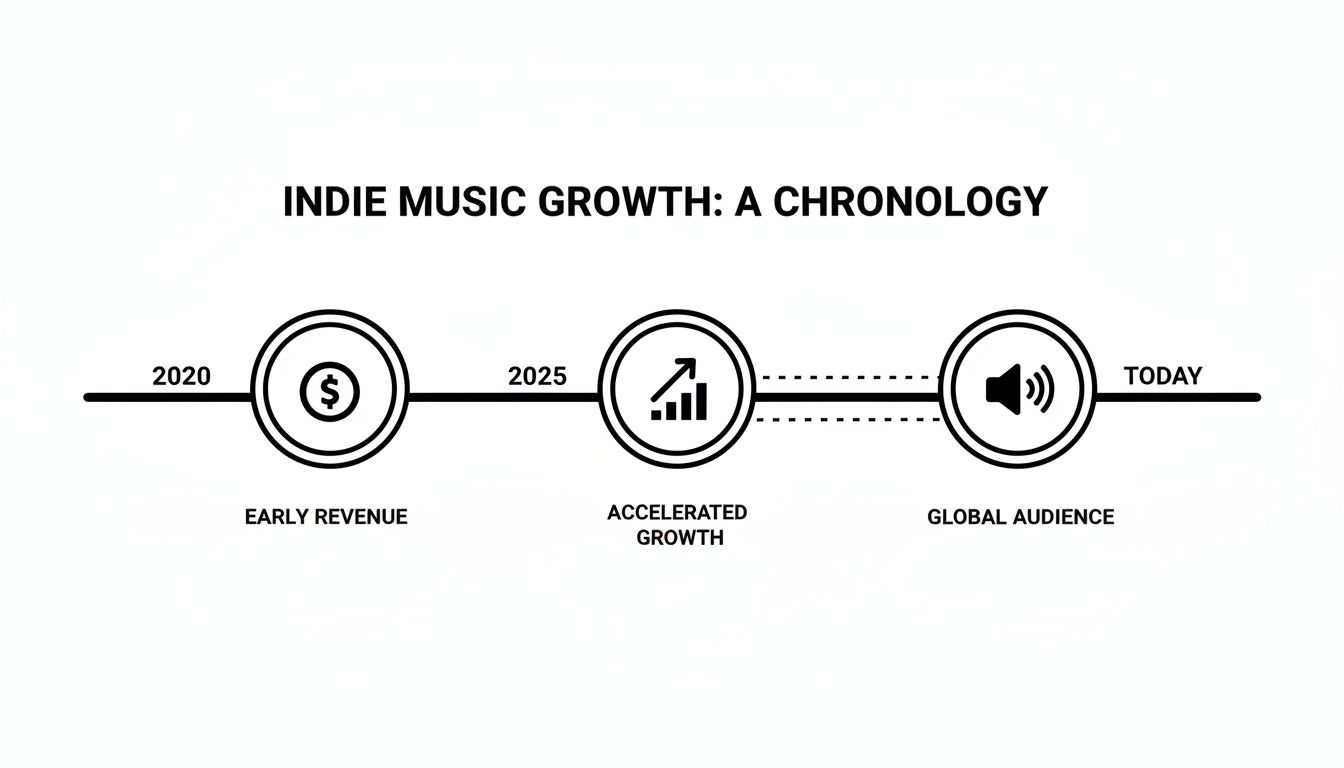
This growth is precisely why a professional, structured campaign is no longer a luxury but a necessity for cutting through the noise and securing market share.
The Six-Week Countdown: A Flexible Framework
This is not a rigid template but a strategic framework. Adjust the timing based on your specific operational needs. If you are collaborating with a PR agency requiring a longer lead time or coordinating a complex music video production, adapt this timeline accordingly.
Weeks 6-5 Before Release: Foundational Asset Preparation
This phase is dedicated to preparation. Every component of your promotional toolkit must be finalized before initiating any outreach. A rushed press kit or an incomplete biography signals a lack of professionalism to curators and journalists.
Finalize Your Master & Artwork: Secure the final audio master and high-resolution cover art. This is a non-negotiable prerequisite for all subsequent steps.
Update Your EPK: Your Electronic Press Kit is your professional calling card. Refresh it with new press photos, an updated biography that articulates the narrative of this specific release, and current links to your professional profiles.
Deliver to Your Distributor: Upload your single to your distributor (e.g., DistroKid, TuneCore) and set the official release date. This initiates the delivery process to digital service providers like Spotify, making it available for pitching.
Weeks 4-3 Before Release: Strategic Outreach Initiation
With your assets finalized, it is time to begin outreach. The objective is to introduce your music to key gatekeepers well in advance of its public release.
Pitch to Spotify's Editors: This is a critical step. Access your Spotify for Artists account and submit your track for editorial consideration. Compose a concise, compelling pitch detailing the song's genre, mood, and any relevant narrative. While Spotify's minimum lead time is seven days, the professional standard is three to four weeks.
Initiate Curator and PR Campaigns: Begin pitching to independent playlist curators and music publications that align with your genre and brand. Ensure your EPK is presented as a clean, direct link within your communications. For a deeper analysis of this process, consult our guide on how to build a strategic framework for Spotify pre-save campaigns.
Develop Your Content Calendar: Map out your social media content for the entire campaign on a week-by-week basis. Define the narrative you will use to build anticipation among your audience.
A common tactical error is delaying outreach. Curators and editors at publications like Stereogum or Earmilk operate on advanced content schedules. A pitch received during release week is almost invariably a pitch that is disregarded.
Weeks 2-1 Before Release: Cultivating Audience Anticipation
The focus now shifts toward your audience. While private pitching continues, your public-facing campaign must accelerate to convert passive followers into active listeners.
Your primary objective is to build public anticipation.
Launch Your Pre-Save Campaign: Disseminate your pre-save link across all channels—social media, email lists, and digital communities. Frame it not merely as a link, but as an exclusive opportunity for your most dedicated supporters.
Schedule Your Social Content: Utilize a scheduling platform to deploy the content you have planned. This frees up your time for meaningful engagement with your community as the launch approaches.
Deploy Teaser Content: Release short audio snippets, behind-the-scenes visuals, or lyric excerpts. The goal is to generate intrigue and maintain a consistent reminder that a new release is imminent.
By release day, this methodical approach ensures that all components of your independent music promotion strategy are synchronized. Your pitches have been given adequate time for consideration, your audience is primed, and your content is strategically deployed, setting the stage for an impactful launch.
Navigating Playlist Pitching and Curator Outreach
Playlist pitching is a cornerstone of any robust independent music promotion strategy, but the landscape is fraught with risk. For every legitimate, taste-making curator, there are numerous fraudulent networks operating bot farms. A placement on such a list can trigger an artificial streaming flag, leading to the removal of your music from streaming platforms. For a professional artist, a takedown is not a minor inconvenience—it is a direct threat to your catalog and your business.
This reality demands a surgical approach focused on quality over quantity, with catalog protection as the paramount concern. True success is not measured by the volume of playlist adds, but by securing placements on high-value, genre-specific playlists with verifiably engaged audiences. This is the path to acquiring listeners who convert into long-term fans, rather than generating empty streams that offer no lasting value.
Vetting Curators and Protecting Your Catalog
The first principle of modern playlisting is to assume no playlist is legitimate until proven otherwise. A playlist with 100,000 followers may appear valuable, but if those followers are bots, a placement can trigger a "red flag" from your distributor for artificial streaming. Catalog integrity must be your top priority.
A systematic vetting process is essential. Analyze a playlist’s listener-to-follower ratio; a significant disparity is a classic indicator of a fraudulent operation. Additionally, monitor for sudden, inorganic spikes in follower growth—another tell-tale sign of purchased, non-human followers.
The most significant threats are not small, inactive playlists. They are the large, professionally marketed networks that offer "guaranteed placements" for a fee. These are often sophisticated bot farms capable of inflicting irreparable damage to your standing on platforms like Spotify.
Platforms such as SubmitLink were engineered to address this issue. They employ bot detection systems trusted by major distributors like DistroKid to rigorously vet every curator in their network. This creates a secure environment where your focus can remain on the music and your pitch, rather than the legitimacy of a potential placement. You can explore this topic further in this professional artist's guide to building a Spotify curator playlist strategy.
Understanding the distinction between legitimate promotion and high-risk services is critical. This table outlines the key red flags.
Safe vs. Risky Playlist Promotion Tactics
Characteristic | Safe Promotion (e.g., Vetted Platforms) | Risky Promotion (e.g., Fiverr Gigs) |
|---|---|---|
Placement Guarantee | No guarantees. Placement is based on musical merit and curator discretion. | Often promises "guaranteed placement" on multiple lists for a flat fee. |
Follower Engagement | Playlists exhibit a healthy listener-to-follower ratio. | Extremely low listener counts despite high follower numbers. |
Follower Growth | Growth is organic and steady over time. | Abrupt, massive spikes in followers indicate they were purchased. |
Audience Location | Listeners are from expected markets (e.g., US, UK, Canada). | Listeners are concentrated in known bot-farm locations. |
Curator Transparency | Curators are often identified, with links to social profiles. | Curators are anonymous or operate under generic brand names. |
Vetting Process | Platforms actively screen playlists for bots and fraudulent engagement. | No vetting process. Anyone can list a playlist, regardless of authenticity. |
Ultimately, safe promotion is about earning placement on a real playlist with real listeners. Risky services sell a shortcut that often leads to a dead end.
Crafting Pitches That Build Relationships
Once you have identified a portfolio of safe, relevant curators, your outreach must be as refined as your music. A generic, mass-produced email is the fastest route to the trash folder. Curators are inundated with submissions; your task is to distinguish yourself by demonstrating that you have done your research.
A simple, effective approach:
Be Specific: Reference their playlist by name and mention a specific track you admire. This demonstrates genuine interest rather than a spam-based approach.
Provide a Concise Narrative: In one or two sentences, convey the story behind your song. What was its inspiration, or what emotion does it evoke?
Ensure Readability: Use short paragraphs and clean formatting. Always provide a single, direct streaming link—never an attachment.
The objective extends beyond securing a single placement; it is about cultivating a genuine, long-term professional relationship. If a curator adds your track, express your gratitude and share their playlist with your audience. This simple gesture can transform a one-time placement into a reliable source of support for future releases.
Understanding the Competitive Landscape
The independent music sector is a formidable force, now commanding 34% of the global music distribution share. While this growth is encouraging, it also intensifies the competition for listener attention. The data is sobering: over 53% of artists on Spotify have fewer than 500 monthly listeners, and 20% of artists have under 1,000 streams on their most popular song. These figures underscore that relying solely on algorithmic discovery is an insufficient strategy. Intelligent, well-executed outreach is the catalyst for breaking through the noise.
This intense competition is precisely why a meticulous, professional approach to playlisting is non-negotiable for any artist focused on building a sustainable career. Every pitch, every placement, and every relationship is a strategic asset.
Allocating Capital: How to Budget Your Music Promotion
For the independent artist, every dollar allocated to promotion must generate a return. A strategic, well-structured budget is not merely an expense sheet; it is your most powerful tool for converting a new release into a measurable success. The objective is not to spend more, but to invest intelligently, directing capital toward the channels that will drive meaningful results.
The principle is straightforward: your budget should be a direct reflection of your strategic goals.
If your objective is to expand your Spotify following, the majority of your capital should be allocated to targeted Meta advertising and pitching to reputable playlisting services. If securing press coverage is the priority, those funds would be redirected toward a focused micro-PR campaign.
This strategic allocation prevents capital waste on ineffective tactics and ensures every dollar contributes to tangible growth. It is the distinction between simply releasing music and strategically investing in your career.
The Financial Reality for Indie Artists
Before outlining budget models, it is important to acknowledge the financial landscape. The economic reality for independent artists remains challenging. As of 2025, a significant 77.8% of independent musicians earn less than $15,000 annually from their music.
With 63% of indie artists citing streaming as their primary income source, you are reliant on per-stream payouts that are exceedingly difficult to scale without a robust promotional plan. This creates a paradox: the primary obstacle for artists is not a lack of exposure, but securing the capital required to effectively market their music. You can review the complete data in this 2025 music industry report.
This is precisely why a meticulously planned budget is not optional—it is essential for survival and growth in a hyper-competitive market.
Sample Budget Breakdowns for a Single Release
Let's move to practical application. The allocation of your budget will invariably depend on your genre, audience, and release objectives. However, these frameworks provide a solid starting point for any artist committed to achieving measurable results.
The Balanced Growth Budget ($1,000)
This is a versatile model for artists seeking steady, multi-channel growth. It balances new listener acquisition, social proof generation, and the creation of high-quality campaign assets.
Vetted Playlist Pitching ($300): Allocate toward a trusted platform like SubmitLink. The goal is to reach approximately 75-150 curators who are an ideal match for your sonic profile. This investment aims to secure initial organic streams and stimulate the Spotify algorithm.
Targeted Meta Ads ($400): This covers a two-week, conversion-focused ad campaign. Dedicate the first week to driving traffic to your pre-save link, then pivot on release day to direct users to Spotify.
Content Creation ($200): High-quality visuals are non-negotiable. Use this capital for a short visualizer, professional photography, or a suite of on-brand social media graphics that align with the song's aesthetic.
Micro-PR Outreach ($100): This is not for a large-scale press campaign. It is for submitting to a curated list of highly relevant music blogs or engaging a small, targeted PR service. One or two quality placements are sufficient to generate valuable social proof.
Treat your budget as a dynamic document, not a static one. If your Meta ads are delivering an exceptionally low cost-per-conversion, be prepared to reallocate funds from another area to capitalize on what is proving effective.
The Audience Acquisition Budget ($1,000)
This model is for artists with a singular objective: to aggressively increase monthly listeners and follower counts on streaming platforms. It necessitates front-loading investment into advertising that drives traffic directly to your music.
Targeted Meta Ads ($600): A larger ad spend allows for more extensive A/B testing of creative assets and audiences. You can run concurrent campaigns targeting different demographics or building lookalike audiences from your existing fanbase.
Vetted Playlist Pitching ($400): A significant investment here substantially increases the probability of landing on multiple influential playlists. This can create a compounding effect, driving a consistent flow of streams and maintaining positive algorithmic signals.
In this approach, PR and elaborate content are deprioritized. The entire strategy is engineered to funnel as many new listeners as possible to your profile, with ads and playlists serving as a potent combination. It is an aggressive strategy but can be highly effective for artists with an established brand who are ready to scale rapidly. The key is to monitor your metrics meticulously and optimize campaigns based on real-time data.
Beyond Playlists: Leveraging Ads and PR for Sustained Growth
Securing playlist placements is an excellent starting point, but it is a single component of a comprehensive promotional strategy. For genuine, sustainable growth, you must move beyond this tactic and integrate paid advertising and strategic public relations. This is how you transition from "boosting posts" to engineering a sophisticated promotion engine for your music.
Conceptualize this as a feedback loop. A quality blog placement generates credibility and social proof, which in turn enhances the efficacy of your advertising. The data from a successful ad campaign can reveal what resonates with your audience, providing a new angle for your next press pitch. Each element reinforces the others, creating a cycle of escalating momentum.
Building High-Conversion Ad Audiences on Meta
A common mistake among artists is wasting capital on Meta (Facebook and Instagram) ads with overly broad targeting. The objective is not to acquire cheap clicks, but to identify individuals who will convert into Spotify followers and long-term fans.
To achieve this, you must master two of the most powerful tools in digital advertising: custom and lookalike audiences.
Custom Audiences: These represent your "warm" leads. These audiences are constructed from individuals who have already engaged with your brand—your email subscribers, Instagram profile interactors, or viewers of your past music videos. Their existing familiarity makes them significantly more likely to take the desired action.
Lookalike Audiences: This is where you achieve scale. Once you have a robust custom audience (e.g., an email list of 1,000+ engaged fans), you can instruct Meta's algorithm to find new individuals with similar demographic and behavioral profiles. This allows you to reach a vast yet highly relevant pool of potential fans who are statistically predisposed to appreciate your music.
Pro tip: Construct your "seed" audience from your most engaged supporters. Analyze your Instagram insights to identify users who consistently engage with your content. While you cannot target them individually, you can build a lookalike from a broader custom audience of all Instagram engagers. The algorithm will be heavily influenced by the behavior of your super-fans, resulting in a higher-quality lookalike.
Crafting a Narrative That Resonates with Journalists
Public relations for an independent artist is not about securing a cover story in Rolling Stone. It is about achieving a feature in a respected, niche music publication that your ideal listener consumes daily. A single premiere on a blog like Earmilk or Stereogum can hold more weight with your target demographic than a fleeting mention in a mainstream outlet.
The key is a compelling narrative. Music journalists receive hundreds of emails daily that simply state, "here's my new track." They require a story, not just a song. Your pitch must effectively answer these questions:
What is the compelling story behind this song?
What makes your perspective unique within the current cultural landscape?
Why is this song relevant now within your specific genre?
This narrative must be supported by a professional package, namely a polished and well-organized Electronic Press Kit (EPK). You can learn what industry gatekeepers expect by consulting our guide on how to make an electronic press kit that gets noticed.
Identifying the Right Publications for Your Sound
Distributing a generic email to a large press list is an inefficient strategy that guarantees being ignored. Your outreach must be surgical. Invest time in researching publications that are deeply invested in your specific subgenre. A thoughtful placement on a smaller, passionate blog is far more valuable than a hundred rejections from outlets that were never an appropriate fit.
Target Publication Identification
Genre Category | Potential Blog Targets | Rationale |
|---|---|---|
Indie / Alternative | Stereogum, Pigeons & Planes, Gorilla vs. Bear | Known for breaking emerging artists and possess a dedicated indie readership. |
Electronic / Dance | Resident Advisor, Dancing Astronaut, Your EDM | Authoritative sources that provide comprehensive coverage of electronic music. |
Hip-Hop / R&B | Rap Radar, This is RnB, Elevator | Deeply embedded in the culture and serve as go-to platforms for new talent discovery. |
Pop / Singer-Songwriter | Popjustice, The FADER, Neon Music | Cover a spectrum from mainstream trends to emerging artists with a unique voice. |
Once you secure a placement, the work continues. Maximize its value. Share screenshots on social media, extract compelling quotes for ad copy, and add the publication's logo to your EPK and website. This creates a powerful perception of momentum that attracts more listeners and industry attention, transforming a single press hit into a career-building asset.
Analyzing Data to Inform Your Next Campaign
The release of a song is not the end of a campaign; it is the beginning of the data analysis phase. For any artist serious about building a sustainable career, this post-release deep dive is where you distill the intelligence that will optimize your next strategic move.
This process transforms raw numbers into a competitive advantage. Bypassing this step is equivalent to navigating without a map, relying on guesswork for future endeavors.
The objective is not merely to track stream counts. It is to understand who is listening, where they discovered your music, and which promotional activities yielded the highest return on investment. This is the foundation upon which a durable career in music is built.
Decoding Your Primary Data Sources
Your most valuable insights are typically found across three key platforms. Proficiency in navigating each dashboard is essential for constructing a holistic view of your release performance.
Spotify for Artists: This is your mission control for listener analytics. Pay close attention to the Source of Streams data. Was discovery driven by algorithmic playlists like Discover Weekly, an editorial placement, or user-generated playlists? This reveals your primary discovery channels.
Your Distributor's Backend: Whether you use DistroKid, TuneCore, or another service, their analytics dashboard provides your financial performance data. Here, you can identify which platforms are generating revenue and uncover unexpected geographic hotspots.
Ad Dashboards (Meta, TikTok): It is easy to be distracted by vanity metrics like likes and shares. The critical metric is your Cost Per Result. Whether your objective was a pre-save, a new Spotify follower, or a merch store click, this figure quantifies the cost of each conversion. It is the ultimate measure of your advertising efficiency.
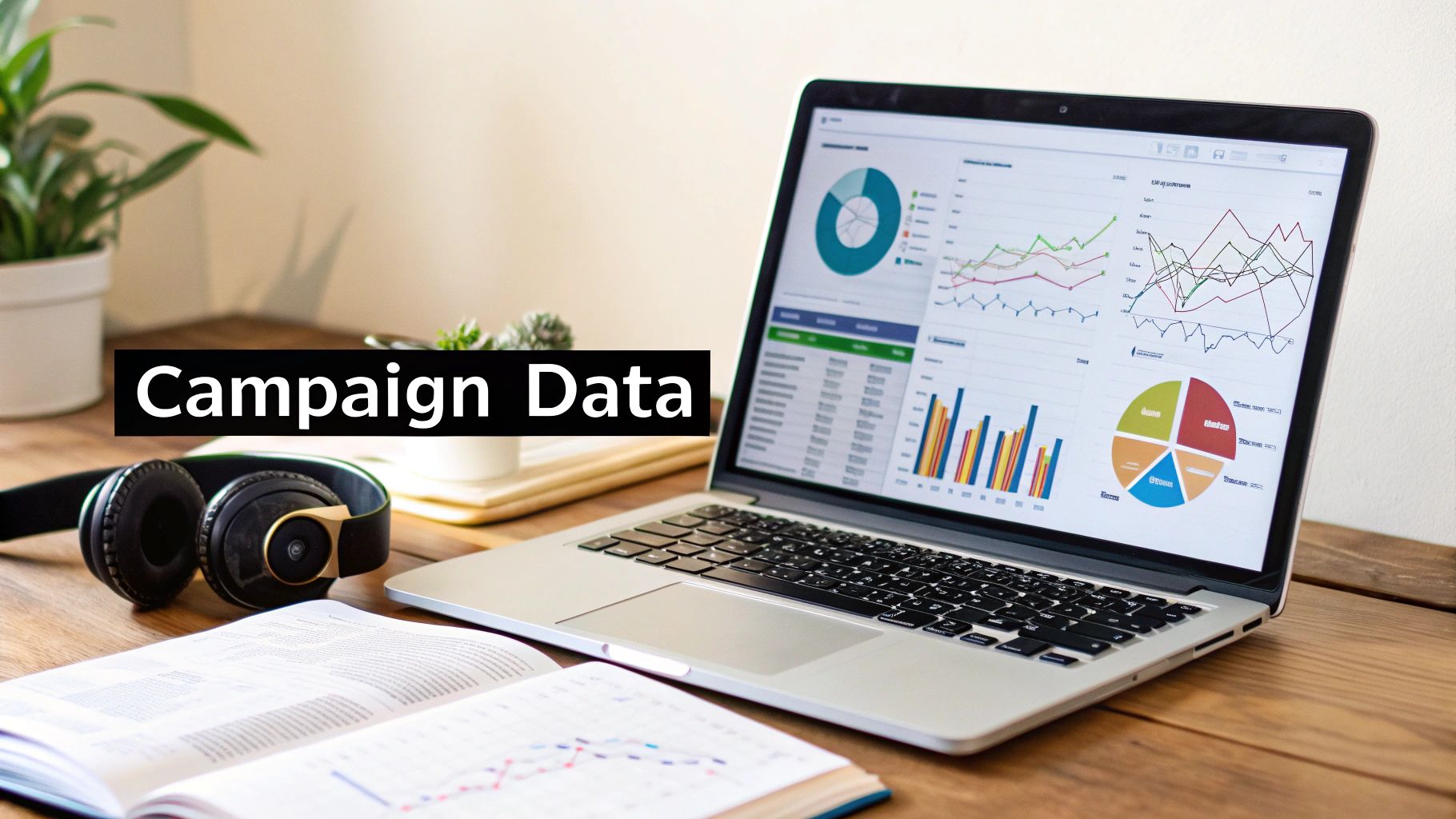
Analyzing your artist dashboard provides immediate access to top listener locations, demographic breakdowns, and even affinity data showing what other artists your fans listen to. This is invaluable intelligence for refining the targeting of your next ad campaign.
Conducting a Post-Campaign Debrief
After a release has been active for several weeks and the data has stabilized, it is time for a formal debrief. This process is not about complex reporting; it is about asking targeted questions to derive actionable insights.
A post-campaign debrief transforms data from a simple report card into a strategic playbook. It’s the process that ensures you don't make the same mistakes twice and double down on what truly works.
Consolidate your key metrics from all sources into a single document. Analyze what occurred, but more importantly, investigate why it occurred.
Key Debrief Questions
What Was the Strongest Stream Source? If a single independent playlist drove a significant volume of streams, that curator should be prioritized for your next release.
Which Ad Creative Performed Best? Determine whether a video clip or a static graphic yielded the superior result. Document the exact visuals, copy, and call-to-action that produced the lowest cost-per-conversion to create a blueprint for future ads.
Did PR Placements Impact Listenership? Correlate any noticeable spikes in streams or saves with the dates your blog features were published. This helps distinguish which publications have an audience that genuinely converts, versus those that offer only vanity placements.
This analysis constitutes your strategic feedback loop. By systematically answering these questions after every release, you cultivate an evolving promotion strategy that becomes progressively more intelligent, efficient, and effective.
A Few Common Questions
What constitutes a realistic budget for promoting a single?
For a professional, impactful push on a new single, a budget between $500 and $1,500 is a realistic and effective range. This level of investment allows for a multi-channel campaign that can generate significant traction.
Within this budget, you can execute a balanced strategy incorporating targeted advertising, robust playlist pitching, and the creation of professional content. Attempting a campaign with less than $500 severely constrains your options, typically limiting you to a single promotional channel and capping your potential reach.
Your budget is not a cost; it is a strategic tool. The objective is to invest in an integrated campaign where ads, playlists, and content work synergistically. This amplification effect produces a superior return on investment.
As an example, a $1,000 budget could be allocated as follows:
$400 for Meta ads to acquire and build your core audience.
$300 to pitch your track to vetted, legitimate playlist curators.
$200 for a high-quality visualizer or other video assets.
$100 for targeted micro-PR to secure select blog placements.
This allocation model demonstrates a diversified approach, creating multiple touchpoints to engage potential fans across different platforms.
What is the optimal approach for international music promotion?
The optimal approach is data-driven, not speculative. Do not target a country based on anecdotal evidence or personal preference. Instead, focus your resources where your music is already gaining traction.
Access your Spotify for Artists dashboard and analyze your audience geography. Identify the top 3-5 countries where you have an existing listenership. This is your strategic starting point. Allocating budget to a market with zero existing listeners is an inefficient use of capital.
Once your priority markets are identified, you can execute a targeted strategy:
Geo-Target Your Ads: Implement specific ad campaigns on Meta or TikTok that are exclusively served to users in those countries. When possible, incorporate localized language or cultural references to enhance resonance.
Source Regional Curators: Research influential blogs and playlists that are prominent within those specific markets. A placement on a significant German playlist holds more value than a dozen US placements if Germany is your second-largest market.
This data-first methodology ensures that every dollar spent internationally builds upon existing momentum. You are fanning a flame, not attempting to start a fire from scratch.
Ready to implement a safer, more effective playlisting strategy? With SubmitLink, you can connect with a network of vetted curators, protect your catalog with industry-leading bot detection, and access the authentic feedback required for strategic growth.


