.png)
How to Make an Electronic Press Kit That Industry Gatekeepers Actually Want
- Feb 4
- 15 min read
Knowing how to assemble an electronic press kit is one thing, but turning it into a powerful tool that actually opens doors is a different game entirely. Think of your EPK less as a digital resume and more as your secret weapon for landing playlist features, catching a manager's eye, and convincing booking agents that you're a solid investment. In a sea of new artists, your press kit has to scream professionalism and potential in less than a minute.
Why Your EPK Is Your Most Valuable Professional Asset

As an artist with an established career, you're past the basics. You don't need a primer on what an EPK is; you need to leverage its immense strategic value in the current music business. Your press kit is no longer just a folder of assets—it's your advance team, shaping high-level perceptions long before anyone presses play.
The hard truth is that the industry gatekeepers you need to reach—playlist curators, A&R reps, and agents—are completely inundated. Time is their most precious commodity, and your EPK is the first filter they use to separate serious contenders from the noise. It is a direct reflection of your professionalism and signals you're prepared for significant career moves.
Adopting a Strategic Mindset
The real shift happens when you stop seeing your EPK as a static document and start treating it like a dynamic marketing tool. Every single element must have a purpose. This isn't about compiling every review or accomplishment; it's about curating a narrative that proves you have momentum and a clear trajectory.
Your press kit should anticipate the tough questions and answer them before they're even asked:
Is this artist professional? A clean design, polished copy, and logical layout provide an immediate "yes."
Do they have a defined brand? Your visuals and bio need to tell a cohesive, compelling story.
Is there an existing audience? Key streaming numbers, press clippings, and audience data provide the proof.
What is the ROI? Your EPK needs to make a strong business case for why you are a smart investment.
An unfocused EPK suggests an unfocused artist. A meticulously crafted one signals that you are not just a creator, but a professional partner ready for significant opportunities. It’s the difference between being perceived as a hobbyist and a career artist.
Making an Immediate Impact
The fight for attention is brutal. With around 150,000 new songs hitting streaming platforms every single day, a stellar first impression isn't just beneficial—it's essential. Most industry professionals will give your submission a quick 30 to 60-second scan before moving on. That tiny window is where a polished EPK can make or break an opportunity.
This is especially true when you consider that only about 19% of artists on Spotify ever hit 1,000 monthly listeners. For more on building an EPK that grabs attention right away, you can discover more insights here.
This guide is built to move beyond simple checklists. We’re going to dive into the strategy behind assembling an EPK that doesn't just get opened—it gets results.
How to Build an EPK That Actually Gets You Noticed

Many artists treat their press kit like an obligatory assignment—a checklist of assets to dump into a folder. That’s the quickest way to get an email archived. Your EPK should function less like a folder and more like a narrative. It's your professional calling card, and every single component, from your photos to your bio, must work in concert to tell a compelling story about you as an artist.
The goal isn't just to have the assets; it's to curate them with obsessive detail. This is what separates professionals from amateurs. A great EPK shows a promoter, blogger, or agent that you’re not just talented, but also a serious professional they can rely on.
Your Photos Are Your First Impression
Long before anyone clicks play on your music, they’ll see your photo. This is your visual handshake, so make it a firm one. Avoid throwing a random assortment of pictures into a Dropbox folder. A strategic selection is required.
Your Main Press Shots: These are your primary assets. Invest in a professional photographer and aim for at least three to five exceptional, high-resolution photos that encapsulate your brand. Ensure you have both vertical and horizontal options—bloggers and editors will appreciate the consideration.
In-Action Live Photos: These are your proof of concept. They show you can connect with a crowd and command a stage. Select photos that capture raw energy and genuine moments, not just static performance shots. This is what sells tickets.
Be ruthless in your curation. If a photo is dated, low-resolution, or misaligned with your current brand, cut it.
Your Bio Isn't One-Size-Fits-All
A long, rambling bio is a death sentence for a busy industry professional. You need to have the right version ready for the right context, so they can grab exactly what they need in seconds.
The Elevator Pitch (under 50 words): Your lightning-fast intro. Think festival lineup blurb. It needs to nail your genre, your unique selling proposition, and a significant recent win. Quick and punchy.
The Standard Bio (around 150 words): Your go-to for most press and booking inquiries. It provides essential background, touches on your sound and influences, and lists a few key accomplishments.
The Full Story (400+ words): For the deep dive—your website's "About" page or a dedicated feature article. Here, you can elaborate on your artistic journey, the themes behind your music, and your future direction.
Having these three versions polished and ready to deploy makes you look incredibly prepared.
How to Present Your Music and Videos
Your music is the main event, but its presentation is critical. You must anticipate the needs of different industry roles and make access effortless.
For your music, showcase 2-3 of your absolute best tracks. Don't send your entire catalog. For a playlist curator, an embedded private SoundCloud or Disco link is perfect for instant listening. For a radio professional, you'll need a link to download broadcast-quality WAV files. Provide both.
Video requires the same targeted approach.
Official Music Videos: These demonstrate your creative vision and prove you can deliver a high-quality product. This is what you send to music blogs for a premiere.
Live Performance Videos: This is what gets you booked. Agents and talent buyers need to see your stage presence. A simple, well-shot video of you delivering a powerful live performance can be more valuable than a slick music video.
A professional EPK is an exercise in strategic exclusion. The assets you choose not to include are just as important as the ones you do. Every photo, track, and video should be your absolute best, directly supporting your current career goals.
The technical specifications of your files are non-negotiable. Sending a low-res photo or a poorly formatted audio file screams amateur. This focus on quality and targeted outreach is the core of any modern music marketing strategy.
To help you get everything right, here's a quick-glance table with the specs every professional expects.
Essential EPK Asset Specifications
Getting the technical details right is crucial. A file that's too small, the wrong format, or poorly named can get your submission instantly dismissed. This table breaks down exactly what you need for each core asset.
Asset Type | Required Format(s) | Technical Specifications | Strategic Note for Professionals |
|---|---|---|---|
Press Photos | JPEG, PNG | 300 DPI for print, 72 DPI for web. Min. 2400px on the longest side. | Provide a mix of landscape and portrait. Name files clearly (e.g., ArtistName_Press_2024_1.jpg). |
Music Tracks | MP3, WAV | MP3: 320 kbps for streaming. WAV: 16-bit, 44.1 kHz for broadcast. | Embed a private SoundCloud link for easy listening. Offer WAVs via a direct download link (Dropbox/Google Drive). |
Artist Bio | PDF, DOCX | N/A | Provide downloadable files for all three bio lengths (short, medium, long) in a single folder. |
Video Files | MP4, MOV | 1080p (1920x1080) minimum. H.264 codec preferred. | Host on YouTube/Vimeo for easy embedding. Keep a downloadable file link ready for specific requests. |
Brand Assets | PNG, AI/EPS | Transparent background PNG for logos. Vector format (AI/EPS) for scalability. | Include both black and white versions of your logo to ensure versatility for promoters. |
Nail these specs, and you're already ahead of most artists, presenting a package that is professional from top to bottom.
Weaving Your Story with Professional Copy

While your music is the product, your copy is the pitch. The language in your EPK is the connective tissue that transforms a collection of files into a compelling narrative. It’s the difference between being another email in a crowded inbox and a project that demands attention.
Forget vague advice about "telling your story." Your goal here is far more strategic. You need to write copy that not only captures your artistic identity but also frames you as a serious professional—someone worth investing in. Every word should build a compelling case for your position in the market.
Go Beyond the Standard Artist Bio
Your artist bio isn't a resume; it's your mission statement. It needs to be sharp, evocative, and tailored to the reader. While having multiple lengths is a good start, the substance is what matters. An effective bio connects your sound, background, and accomplishments into a powerful, undeniable narrative.
Most bios are ineffective. Here's a common example of what to avoid.
Before:
Jane Doe is a singer-songwriter from Austin, TX. She has been playing music since she was a child and released her debut EP last year. Her music blends folk and indie-pop influences, and she has played at several local venues.
This is factually correct but completely devoid of impact. It explains what Jane does, but gives no reason to care.
After:
Emerging from Austin’s vibrant indie scene, Jane Doe crafts intricate indie-pop soundscapes rooted in classic folk storytelling. Her critically noted debut EP, ‘Fading Signals,’ earned praise for its "hauntingly precise lyricism" (Austin Chronicle). Drawing comparisons to artists like Phoebe Bridgers and Bon Iver, Doe’s work explores themes of modern isolation with a sound that is both intimate and expansive.
See the difference? This version is a pitch. It immediately establishes an identity, uses a press quote for credibility, and offers artist comparisons as a sonic shortcut. It's not just a bio; it's a hook.
Write Song Descriptions That Matter
The song descriptions in your EPK have one crucial job: to provide context that encourages a deeper listen. This is not the place to rehash lyrics or state the obvious. Instead, offer a look behind the curtain. Discuss the creative spark, the song's central theme, or a production detail that makes the track unique.
You're essentially guiding their ear.
Highlight the sonic landscape: "Built around a driving Moog bassline and layered vocal harmonies, 'Midnight Drive' captures the hypnotic energy of a city after dark."
Share the thematic core: "This track is a raw look at the tension between ambition and burnout, written during a single, caffeine-fueled session in a Brooklyn apartment."
Provide a production insight: "We intentionally recorded the drums in a cavernous warehouse to give the track its signature booming, industrial feel."
These details don’t just inform; they invite the listener into your world, making the music more memorable.
Frame Your Press Quotes for Maximum Impact
Press quotes provide critical social proof. However, a long, disorganized list of compliments can look cluttered and unprofessional. The key is curation. Hand-pick only the most powerful and authoritative quotes that support your current narrative.
Don't just list praise. Present your press mentions like evidence. Group them by theme or lead with your biggest win to establish immediate credibility.
For example, instead of a random list, organize your quotes this way:
Acclaim for Live Performance:
"A magnetic stage presence that feels both vulnerable and commanding." – Live Music Weekly
"The most compelling live act we've seen this year." – MusicScene Magazine
This approach is clean, professional, and easily scannable for a busy agent or promoter. When you treat every piece of text as a strategic tool, you build an EPK that doesn't just display your work—it sells it.
Show Your Work: Using Metrics to Prove You're a Smart Bet
Your music and your story get you in the door, but for decision-makers, the numbers do the talking. Think of your metrics as hard proof of your momentum, audience, and potential. A booking agent, label A&R, or manager isn't just betting on your art—they're investing in a business. Your analytics are the business case they need to see.
This is where you adopt an entrepreneurial mindset. You must frame your data to tell a story of growth and make a powerful case for your future. The goal is to showcase the key performance indicators (KPIs) that prove you have a real, growing fanbase ready to be mobilized.
Turn Analytics Into a Story of Growth
Raw numbers without context are noise. The key is to select the right data points and present them in a way that signals upward trajectory. Instead of just stating a follower count, focus on what the numbers say about your audience connection.
Which data points prove your project is a solid investment?
Monthly Listener Growth: A simple graph showing a consistent 20% month-over-month increase in Spotify listeners is far more compelling than a single, static number. It proves you understand how to build momentum.
Audience Demographics: Highlighting that 60% of your listeners fall into the coveted 18-24 age bracket tells a promoter you can bring a specific, valuable crowd to their venue.
Top Cities & Countries: A significant listener base in London or Los Angeles is critical information for an agent looking to book shows in those markets.
Social Media Engagement Rate: A 12% engagement rate on Instagram with 5,000 followers is infinitely more impressive than a 1% rate with 50,000. It proves you've built a real community, not just a list of passive accounts.
Industry gatekeepers are always looking for low-risk, high-reward opportunities. When you present your data clearly in your EPK, you de-risk their decision by proving an engaged audience already exists.
Make these figures easy to digest. Use bullet points, bold key numbers, or even a simple infographic. You want the key takeaways to be understood in seconds. For a deeper dive on this, check out our guide on how to get more Spotify listeners.
Highlight Your Wins and Social Proof
Beyond your own analytics, third-party validation is paramount. This is where you display external signals that prove your music is connecting with the wider industry. As with your data, be selective.
Focus on achievements that signal professional recognition and real-world traction:
Key Playlist Placements: Don't list every playlist. Spotlight the ones that matter—placements on major Spotify Editorial lists or influential user-curated playlists with significant followings (e.g., "Indie Chill Vibes," 250k followers).
Press Clippings and Syncs: A glowing quote from a respected music blog or a mention that your track was featured in a popular web series adds a massive dose of credibility.
Key Performance History: Instead of a laundry list of every open mic, highlight significant shows. Did you sell out a headline gig? Perform at a notable festival? Open for a well-known artist? That's the relevant information.
The global music copyright market hit $47.2 billion in 2024, and the industry is constantly evolving. Artists who can clearly demonstrate their value with hard numbers—like streaming velocity, audience location, and growth rate—are best positioned to attract attention from labels and publishers. You can find more insights on where the industry is headed on Synchtank.
By carefully curating and framing your data, you transform your EPK from a simple resume into a powerful investment pitch. You’re not just showing them your music; you’re showing them your business is ready for the next level.
Choosing the Right EPK Format for Your Goals
You’ve gathered your best assets—the photos, the bio, the killer tracks. The final piece of the puzzle is the delivery mechanism. Sending your electronic press kit isn't an afterthought; it’s a strategic decision that demonstrates your understanding of the industry and respect for the recipient's time.
The format you choose—a slick webpage, a classic downloadable PDF, or a hosted service—should be a deliberate choice that matches your specific goal and your audience.
Professionals don't just pick one format. They maintain multiple versions of their EPK, deploying the right tool for the right job. A festival programmer reviewing hundreds of submissions has different needs than a music supervisor looking for a track to sync.
The Dynamic Web-Based EPK
A dedicated page on your artist website is the modern gold standard. Think of it as a living document. You can update it instantly with new press, tour dates, or streaming milestones as they happen.
This format allows you to embed music players and high-definition videos directly, creating a seamless experience. For general outreach to blogs, A&R scouts, or anyone you want to impress with a polished presentation, the web-based EPK is your primary tool. Plus, you can use analytics to see who is engaging with your kit and which assets they're focusing on.
Your web EPK is your digital flagship. It’s where you present the most complete and immersive version of your artistic brand, making it ideal for passive discovery and initial introductions where a strong first impression is everything.
Not sure which numbers to lead with? This decision tree can help you determine what to highlight based on your current audience data.
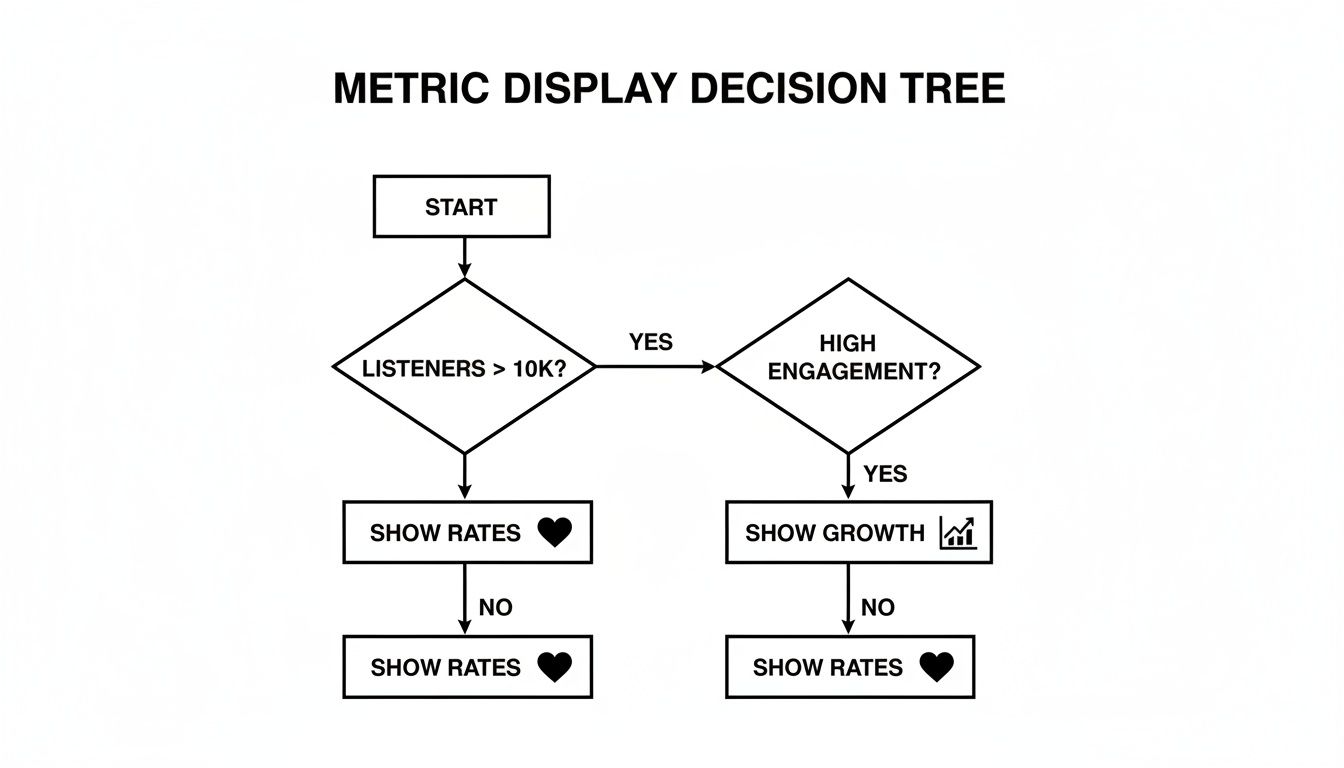
As you can see, it’s all about leading with your strongest data. If you have explosive growth, showcase it. If your engagement rates tell a more compelling story, put those front and center.
The Concise and Tactical PDF
Despite the advantages of a website, the downloadable PDF remains an essential tool. Many formal opportunities—festival applications, grant submissions, or specific venue booking requests—explicitly ask for a PDF attachment. Ignoring this simple instruction is one of the fastest ways to get your submission discarded.
A professional PDF EPK must be:
Concise: Keep it to one or two pages, max. This is a summary of your most crucial information.
Visually Clean: Use a simple, branded layout that’s easy to read and looks professional.
Optimized: The file size should be under 10MB. You don't want to clog someone's inbox.
Treat the PDF as a professional one-sheet, not your life story. It should include links to your streaming profiles, videos, and your full website EPK, acting as a gateway for deeper exploration. This format is perfect for targeted pitches where a specific document has been requested.
Leveraging Hosted EPK Services
A third option is to use a specialized platform built to host EPKs. These services often provide sleek, pre-made templates that ensure all essential information is presented professionally. They can be an excellent middle ground, offering more dynamic features than a static PDF without the need to build a custom webpage from scratch.
This approach is particularly useful for artists who need a professional kit quickly or lack web design resources. The main benefit is convenience and a standardized layout that industry contacts are accustomed to. These platforms are designed with the promoter, agent, or journalist in mind, ensuring a smooth and predictable user experience. To get a better handle on these tools, you can explore some of the best sites for music promotion.
Ultimately, your EPK is a reflection of your business acumen. The industry is always changing, and your value extends beyond the music itself. By 2026, independent artists are increasingly seeing their owned audiences—like email and SMS lists—as their most valuable assets. This is a direct response to social media's 'pay-to-play' model, pushing a return to channels that artists control.
A forward-thinking EPK doesn't just showcase your music; it hints at your strategy for building a sustainable career. Choosing the right format proves you understand the context of the conversation and respect the other person's workflow—a subtle but powerful signal of your professionalism.
Common Questions from Professional Artists
Once you’ve mastered the fundamentals of your EPK, more strategic questions arise. You move beyond asset gathering and start thinking about leverage. How do you use this tool to actually open doors?
Here are some of the most critical questions from artists who are leveling up their careers, along with direct answers.
How Often Should I Update My Electronic Press Kit?
Your EPK should be a living part of your career, not a static file. As a rule of thumb, review and refresh it quarterly to ensure all information is current and relevant.
However, that’s just the baseline. You must update it immediately following any significant career development.
Update your EPK when you:
Release a new single, EP, or album.
Secure a strong piece of press coverage from a respected outlet.
Hit a new streaming milestone (e.g., crossing 1 million total streams or 100k monthly listeners).
Release a new music video or high-quality live performance video.
Furthermore, if you are pitching for a specific opportunity, such as a festival slot or a sync placement, you must tailor it. The assets you'd show a rock festival promoter are entirely different from what you’d send a curator for a chill-out electronic playlist.
Should I Include Social Media Counts If They Are Not High?
Yes, but they must be framed correctly. The industry is savvy—raw follower counts are increasingly seen as a vanity metric. It's about audience connection. If your numbers aren't massive, shift the focus from quantity to quality.
Don't just list a follower count. Instead, highlight your engagement rate and audience demographics. A highly engaged community of 2,000 true fans is far more valuable to a promoter than 20,000 passive followers who don't interact.
Here's how to position it in your EPK: "Cultivated a dedicated Instagram following with an average post engagement rate of 15%." This single sentence communicates that you understand what actually matters—audience loyalty—and that you know how to manage a community. For any potential partner, that's a sign of low risk.
This approach positions you as a shrewd marketer, not just an artist chasing vanity metrics.
What Is the Biggest Mistake Artists Make with Their EPKs?
The single most damaging mistake is a complete lack of curation. Too many artists treat their EPK as a digital junk drawer, including every song, photo, and blog mention they’ve ever received. This overwhelms the recipient and signals a lack of professional judgment.
A truly professional press kit is defined by what you choose to leave out.
It should only feature your absolute best, most relevant work, carefully selected to support your current goals. Every element—from your main photo to the featured track—must serve one purpose: to prove you are a professional, ready-for-the-next-level artist. If an asset doesn't advance that narrative, cut it.
Is a PDF or a Website Link Better for an EPK?
The correct answer depends on the context of the submission. A professional artist must have both ready to deploy.
Website Link (Your Go-To): In most cases, a link to a dedicated EPK page on your website is the preferred method. It’s dynamic, allows for embedded media, and you can even track engagement. It provides a superior, more controlled user experience.
PDF (Your Tactical Tool): That said, many formal applications—for festivals, grants, or specific venue bookings—still require a PDF. You must follow their guidelines precisely. Have a clean, concise, and compressed PDF (under 10MB) on standby, ready to attach whenever it’s requested.
The best practice is to lead with your website link in outreach but always defer to the recipient's specific request. Having both prepared demonstrates professionalism and preparedness.
Ready to get your music in front of the right curators? SubmitLink connects you with a vetted network of playlist curators who are actively looking for new tracks. With our AI-powered matching and bot detection trusted by industry leaders, you can pitch with confidence, track every submission, and build a real audience. Join over 36,000 artists and start your next campaign.


