.png)
AI music's share of Spotify playlist marketing is falling: What 17,353 SubmitLink records show
- 4 hours ago
- 15 min read
AI-involved campaign share fell from 35.6% to 19.8% in seven months. That runs against the expectation that AI music would keep gaining ground in playlist promotion.
AI music now appears regularly in the submissions sent to playlist curators. On SubmitLink, though, its share of Spotify playlist marketing has been falling.
This analysis covers 17,353 SubmitLink records from January through July 2026: 15,087 playlist campaign submissions and 2,266 individual pitches sent directly to curators. Campaign activity gives us the cleanest month-to-month comparison. AI involvement fell every month, from 35.6% in January to 19.8% in July. We found nearly the same decline when we counted each track once and when we gave every artist equal weight.
Curator decisions also differed. In the latest 30 days, curators placed 15.4% of the AI-involved submissions they decided on, compared with 25.7% of non-AI submissions. AI appeared more often in free promotion than in paid promotion. This may be an early promotion wave cooling off as creators run into the same problems every musician faces: finding an audience and paying to reach it.
Every figure in this report comes from SubmitLink activity. The report does not estimate Spotify's catalog or the music industry as a whole. The data also cannot separate cooling interest from changes in release schedules, customer mix, or promotion economics.
Key findings
AI's share of campaign activity fell every month, from 35.6% in January to 19.8% in July. AI campaign volume fell 38% while non-AI volume rose 40%, and the result held when we counted distinct tracks or gave each artist equal weight.
About one in five recent playlist campaigns involved AI. Of 2,079 submissions in the latest 30 days, 411 involved AI.
AI's share of net submission revenue fell from 36.6% to 13.5%. In July, AI appeared in 22.3% of free campaigns and 16.2% of paid campaigns.
Curators accepted 15.4% of recent AI-involved submissions, compared with 25.7% of non-AI submissions. The AI acceptance rate did not fall steadily across all seven months.
Nine of the 159 curators with AI decisions made only three playlist placements across 1,587 AI tracks reviewed.
The 34 accounts promoting both AI-involved and non-AI releases averaged 6.7 campaigns. AI-only accounts averaged 2.7, and non-AI-only accounts averaged 2.4.
What "AI music" means in this report
People often use "AI music" to mean a song generated entirely from a prompt. This report uses a broader definition.
Using information supplied through digital music services, the dataset separates tracks into two groups: AI-involved and non-AI. "AI-involved" can describe:
an entirely AI-generated track;
AI-generated vocals or instrumentation;
one or more AI-generated stems;
AI-assisted songwriting, arrangement, or production; or
AI tools used during mixing, post-production, or mastering.
These uses involve very different amounts of human input. This report groups them together.
SubmitLink currently believes fully generated songs make up most of the AI-involved group. We did not count the subtypes, so that view remains background context. Every percentage below uses the broader definition of AI involvement, including partial AI use.
Spotify's policies also recognize different degrees of AI use. Its planned credits can distinguish AI-generated vocals, instrumentation, and post-production. Spotify says it does not lower a track's ranking solely because AI was used. Its enforcement targets impersonation, spam, and deception. Spotify's AI protections and disclosure policy
Methodology and scope
This report uses aggregated, read-only SubmitLink platform data. We do not identify any artist, curator, track, or playlist.
Item | Definition |
Data as of | July 31, 2026, Toronto time |
Trend window | January 1 through July 31, 2026 |
Seven-month data used | 17,353 activity records: 15,087 campaign submissions and 2,266 individual direct-to-curator pitches |
Campaign data used | 15,087 submissions from playlist campaigns that launched or finished; drafts were excluded |
Current campaign window | The preceding 30 days: 2,079 campaign submissions |
AI share | AI-involved submissions divided by AI-involved plus non-AI submissions |
Counting unit | One campaign submission counts once. A direct pitch counts once for each curator it was sent to, so one track pitched separately to 15 curators produces 15 direct-pitch records. |
Account-level analysis | Customer activity is grouped by SubmitLink user account. An account may belong to an artist, manager, label, team, or another representative, and may promote more than one Spotify artist. |
Primary trend | Campaign-only activity, which keeps the monthly counting unit consistent |
Breadth checks | The share of distinct campaign tracks involving AI and an artist-weighted calculation in which every Spotify artist has equal total influence |
Curator acceptance rate | Playlist placements divided by placements plus declines; expired or refunded submissions are shown separately |
Curator outcome window | Curator responses completed during the same 30-day period |
Curators included | Curators active on SubmitLink as of July 31 and their past campaign decisions |
We assign each campaign or direct submission to the month when the customer created it. The January to July window gives us a consistent 2026 dataset for comparing AI and non-AI activity.
This is a descriptive analysis. It does not control for genre, release quality, campaign budget, playlist selection, artist history, or other factors that can affect a curator's decision. A difference between AI and non-AI campaigns does not prove that AI caused the outcome.
Finding 1: AI's campaign share fell every month from January through July
Campaigns are the cleanest monthly comparison because each submission counts the same way. AI involvement lost share in every month we studied.
Campaign month | Campaign submissions analyzed | AI-involved | Non-AI | AI share |
January 2026 | 1,923 | 684 | 1,239 | 35.6% |
February 2026 | 1,750 | 569 | 1,181 | 32.5% |
March 2026 | 2,082 | 672 | 1,410 | 32.3% |
April 2026 | 2,380 | 749 | 1,631 | 31.5% |
May 2026 | 2,621 | 725 | 1,896 | 27.7% |
June 2026 | 2,170 | 581 | 1,589 | 26.8% |
July 2026 | 2,161 | 427 | 1,734 | 19.8% |
Seven-month total | 15,087 | 4,407 | 10,680 | 29.2% |
The result changes little when prolific artists and repeatedly promoted tracks have less influence:
Campaign trend measure | January 2026 | July 2026 | Change |
Campaign submissions | 35.6% | 19.8% | -15.8 points |
Distinct campaign tracks | 36.5% | 21.0% | -15.5 points |
Artist-weighted campaign activity | 28.7% | 16.5% | -12.2 points |
The distinct-track measure counts each Spotify track once per month. The artist-weighted measure gives every artist equal weight. Both measures are limited to SubmitLink, and both show that a few prolific artists or repeatedly promoted tracks did not create the decline.

From January to July, AI campaign submissions fell 38% and distinct AI tracks fell 45%. Non-AI submissions rose 40%, while distinct non-AI tracks rose 18%. AI's share fell in free campaigns, from 35.8% to 22.3%, and in paid campaigns, from 35.4% to 16.2%.
Platform activity and spending moved the same way
The broader view includes direct pitches sent separately to individual curators. It moved in the same direction as the campaign data.
Month | Activity records analyzed | AI-involved | Non-AI | AI share of activity | AI share of net submission revenue |
January 2026 | 2,506 | 1,007 | 1,499 | 40.2% | 36.6% |
February 2026 | 2,087 | 642 | 1,445 | 30.8% | 27.5% |
March 2026 | 2,305 | 698 | 1,607 | 30.3% | 30.8% |
April 2026 | 2,627 | 772 | 1,855 | 29.4% | 26.7% |
May 2026 | 2,890 | 759 | 2,131 | 26.3% | 21.9% |
June 2026 | 2,467 | 628 | 1,839 | 25.5% | 20.4% |
July 2026 | 2,471 | 491 | 1,980 | 19.9% | 13.5% |
Seven-month total | 17,353 | 4,997 | 12,356 | 28.8% | 25.4% |
AI's share of recorded activity fell 20.3 percentage points. Its share of net submission revenue fell 23.1 points. Net revenue is the amount charged after promotional credits, before fulfillment and platform costs. In July, AI accounted for 19.9% of activity but only 13.5% of revenue. Customers spent a smaller share of their submission budgets promoting AI-involved music.
January's 40.2% combined figure needs some context. Thirty-two customers sent the month's 297 AI-involved direct paid pitches, and the five most active customers produced 74.7% of them. Counting each customer and track combination once lowers the figure to 37.3%. Excluding direct paid pitches gives 35.4%, close to the campaign result of 35.6%.
Removing repeated customer, track, and curator combinations barely changes the figure, bringing it to 39.6%. January's high figure came from concentrated direct-pitch activity, while repeated records had little effect. For that reason, this report uses campaign and breadth-adjusted measures as its main trend lines.
A rough projection
Straight-line scenarios based on different combinations of the January to July campaign data put AI at roughly 8% to 16% of campaign submissions by January 2027. Excluding January barely changes that range, so the concentrated direct-pitch activity did not create the result.
Treat this range as a scenario. Seven months cannot establish seasonality, and a straight-line decline cannot continue forever. Every window we tested points down, but the calculation needs to be updated as new months come in.
Finding 2: AI was substantially more common in free promotion
AI music accounted for 19.8% of SubmitLink's recent campaign activity. It appeared more often in free promotion.
30-day campaign type | Submissions analyzed | AI-involved | Non-AI | AI share |
Paid campaigns | 862 | 141 | 721 | 16.4% |
Free campaigns | 1,217 | 270 | 947 | 22.2% |
All campaigns | 2,079 | 411 | 1,668 | 19.8% |
In this batch of SubmitLink campaign data, a curator could expect roughly one AI-involved track for every four non-AI tracks. AI represented 22.2% of free campaign submissions and 16.4% of paid campaign submissions. That 5.8 percentage-point difference means AI was about 35% more prevalent in the free campaign pool.
The pattern also appears when campaign and direct submissions are separated in July:
July promotion route | AI share of free submissions | AI share of paid submissions | Difference | Relative concentration in free submissions |
Playlist campaigns | 22.3% | 16.2% | +6.1 points | 38% higher |
Direct-to-curator submissions | 27.8% | 16.4% | +11.4 points | 70% higher |
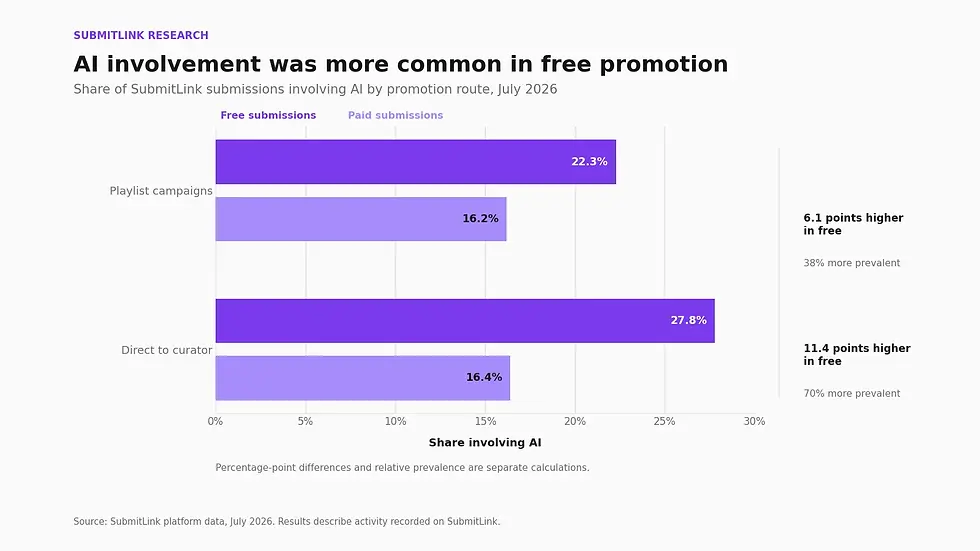
Both routes show the same pattern, so the structure of one SubmitLink product is unlikely to explain all of it. The data does not tell us why a customer chose free or paid promotion.
Paid campaigns made up 34.2% of campaign activity among AI-only accounts, compared with 43.6% among non-AI-only accounts. When AI-only accounts paid, they spent an average of $16.68 per campaign, compared with $20.60 among non-AI-only accounts. The AI-only average was about 19% lower.
Accounts promoting only AI-involved music may have smaller marketing budgets, be less willing to pay for promotion, or use free campaigns to test releases before spending.
Customers promoting more tracks may also be dividing one budget across a larger catalog. We did not measure those motives. Differences in experience, genre, geography, release strategy, or customer mix could produce the same pattern.
Accounts promoting both types ran far more campaigns
Account campaign mix in the latest 30 days | Accounts | Campaigns | Campaigns per account | Paid campaigns | Net revenue per account | Average spend per paid campaign |
AI-only | 112 | 307 | 2.7 | 105 | $15.63 | $16.68 |
Mixed AI and non-AI | 34 | 229 | 6.7 | 84 | $35.18 | $14.24 |
Non-AI-only | 643 | 1,543 | 2.4 | 673 | $21.57 | $20.60 |
Among these 789 accounts, 18.5% promoted some AI-involved music. The 34 accounts promoting both types averaged 6.7 campaigns, almost three times the non-AI-only average.
Their higher revenue per account came alongside far more campaign activity even though they spent less per paid campaign. Net revenue here is the amount paid after promotional credits; fulfillment and platform costs remain.
The mixed group has only 34 accounts, which is too few for a customer value forecast. Some may belong to managers, labels, or teams promoting multiple artists. Because SubmitLink does not verify account roles, the finding describes account behavior only. It also shows the problem with assigning one permanent campaign label to an account. Some frequent customers promoted both AI-involved and non-AI releases, so the track is the more useful unit.
Finding 3: The curator gap widened, but AI acceptance did not fall steadily
AI status is available for many earlier campaigns, which lets us compare curator decisions by month. An acceptance means that the curator placed the track on a playlist. We divide placements by placements plus declines. Expired and refunded submissions do not count in that rate.
Month curator responded | AI placement-or-decline decisions | AI acceptance rate | Non-AI acceptance rate | Difference for AI |
January 2026 | 1,960 | 20.0% | 21.0% | -1.0 points |
February 2026 | 1,846 | 23.9% | 24.9% | -0.9 points |
March 2026 | 2,234 | 18.8% | 23.7% | -4.8 points |
April 2026 | 2,102 | 22.3% | 24.8% | -2.5 points |
May 2026 | 1,751 | 23.9% | 29.5% | -5.5 points |
June 2026 | 1,700 | 25.2% | 30.0% | -4.8 points |
July 2026 | 828 | 15.0% | 25.7% | -10.7 points |
AI's acceptance rate moved between 18.8% and 25.2% from January through June, with no steady decline. Non-AI performance improved more consistently. The difference was about one percentage point in January and February, then roughly five points in May and June. July brought a sharp drop for AI and the widest difference in the series.

The free and paid mix does not explain the latest difference. Among paid campaigns, AI and non-AI acceptance rates were 23.9% and 25.0% in January, only 1.1 points apart. In July they were 21.0% and 33.7%, a difference of 12.7 points. Acceptance rates for free campaigns were close to zero for both groups, so they did not drive the paid-campaign result.
Recent AI-involved campaigns fell further behind non-AI campaigns, but the seven-month data does not show a continuous decline in curators' willingness to place AI music. Track quality, genre, artist mix, targeting, and the curators active in each month may have contributed.
During the latest 30-day window, curators completed 6,432 outcomes in the AI and non-AI campaign dataset. They either placed the track, declined it, or did not decide before the submission was refunded.
Track group | Completed outcomes | Playlist placements | Declines | Refunds | Acceptance rate among placement-or-decline decisions | Refund rate | Average time to outcome |
AI-involved | 1,171 | 124 | 680 | 367 | 15.4% | 31.3% | 101.1 hours |
Non-AI | 5,261 | 966 | 2,791 | 1,504 | 25.7% | 28.6% | 95.2 hours |
The acceptance rates differed by 10.3 percentage points. The observed AI acceptance rate was about 60% of the non-AI rate. The comparison includes 4,561 placement or decline decisions.
AI campaigns had a refund rate 2.8 points higher and took an average of 5.9 hours longer to reach a final outcome. These differences are smaller than the acceptance gap and may reflect the mix of campaigns and curators.
Curators do accept some uses of AI. The group covers many levels of AI involvement, and SubmitLink does not grade a track's quality or the amount of human contribution. Across this set of responses, however, curators were more selective with tracks identified as AI-involved.
Finding 4: Nine curators repeatedly declined AI-involved tracks
The curator-level results were highly uneven.
"AI avoidance" has a specific meaning in this report. It describes a curator who repeatedly declined AI-involved tracks while remaining more willing to place non-AI music. One rejection is not enough. SubmitLink requires repeated decisions and a large difference between the curator's AI and non-AI behavior.
On July 31, SubmitLink had 1,487 active curators. Across the full response history, 159 current or former curators had placed or declined at least one AI-involved campaign. Nine met the repeated-avoidance standard.
Those nine curators had collectively recorded:
3 playlist placements;
1,584 declines; and
a 0.2% acceptance rate among tracks they either placed or declined.
The other 150 curators had 3,797 playlist placements and 12,288 declines involving AI music, for a 23.6% acceptance rate.
The selection rule partly determines those figures, so they do not predict every future decision. Within the available history, the selected curators almost never placed AI-involved music. A platform can avoid those curator and track pairings without applying the same preference to every curator. Curators still need explicit preference controls. They should not have to accuse an artist of using AI based on the sound of a track.
Groover, another music submission platform, takes a similar approach. It permits AI-generated submissions, lets curators opt out, and advises them not to infer AI use from sound alone. Groover describes AI-generated music as "extremely marginal" on its platform.
That description and SubmitLink's 19.8% figure cover different populations, time periods, and definitions. Groover focuses on prompt-based tracks with little direct human involvement, while this report uses a broader AI-involvement category. Groover's curator AI-music policy
Why might AI music's promotion wave be cooling?
SubmitLink recorded a contraction in AI-involved promotion. Its cause remains uncertain.
One possibility is that AI lowered the barrier to producing a release while audience building stayed just as hard.
The number of accounts running an AI-involved campaign fell from 230 in January to 150 in July. The non-AI account count rose from 576 to 689. Generating a song does not solve curator approval, listener retention, marketing budgets, or artist identity. We need a longer series to tell a cooling wave from a seasonal change.
The spending data is consistent with a budget explanation, though it cannot confirm one. AI declined faster in paid campaigns, appeared more often in free options, and had lower average spend per paid campaign. That pattern could come from tighter budgets, more testing before purchase, or one budget spread across more releases. A change in customer mix could produce the same result, and the data reveals nothing about anyone's finances or motives.
AI acceptance did not fall steadily through June. Non-AI performance improved and pulled away before the sharper July gap. Recent AI-involved submissions may be becoming less competitive relative to other music in the marketplace. Testing that explanation against growing opposition to AI would require genre, targeting, track quality, and active-curator comparisons.
Comparing SubmitLink with streaming-platform data
Public AI music statistics tend to count different parts of the market:
new tracks delivered to a streaming service;
tracks or artists already present in a catalog; or
listener streams and recommendations.
SubmitLink measures music that artists actively market to independent playlist curators. The percentages from these sources are not directly comparable because each source studies a different population.
Deezer reported that fully AI-generated tracks exceeded 50% of its new daily deliveries at peak in June 2026, an average of about 90,000 AI tracks per day. Those tracks accounted for only 1% to 3% of listening on Deezer, a large gap between supply and attention. Deezer's June 2026 AI-upload report
AI-involved music represented 19.8% of SubmitLink's recent playlist campaign dataset. That is far below Deezer's share of new deliveries and far above its AI share of streams. The comparison is imperfect because the platforms and definitions differ. Even so, the numbers suggest that much of the AI music entering streaming catalogs never receives active promotion, and less of it earns sustained listening.
A June 2026 research preprint examined a different Spotify dataset and found that 93% of the AI music it identified received few or no plays and was rarely recommended. The authors warn that AI detection is imperfect. The same limitation applies to any attempt to identify AI involvement across a large music catalog. An Empirical Analysis of AI Slop in Music Streaming
Spotify said it removed more than 75 million spammy tracks in the 12 months before September 2025. It also introduced a system meant to stop recommending tracks linked to mass uploads, duplicates, SEO abuse, and artificially short tracks. At the same time, Spotify supports AI-use disclosures and says it treats music equally regardless of the tools used to make it. Spotify's AI protections and spam policy
These policies still permit creative uses of AI while targeting impersonation, fraud, undisclosed automation, and mass-produced spam.
Practical implications for artists, curators, and platforms
For artists promoting AI-involved music
The observed acceptance rate of 15.4% suggests a narrower curator market. Careful targeting may work better than sending a high volume of pitches.
Describe the role of AI precisely. A generated vocal, an AI-produced stem, a mastering tool, and a fully generated track give a curator very different information.
Spotify has put more attention on artist identity, credits, behind-the-scenes context, and human editorial as the supply of music grows. An artist can explain who directed the work, why the song exists, and what the human contribution was. Spotify on artist identity and human editorial in 2026
Judge a campaign by more than playlist placement alone. Saves, repeat listening, profile visits, listener quality, and retention show whether the exposure built an audience.
For a broader framework, see SubmitLink's guide to running a Spotify promotion playlist campaign and its overview of bot-conscious Spotify playlist promotion.
For curators and submission platforms
Curators should be able to state whether they accept AI-involved music. Platforms can use that preference to prevent known mismatches before a paid or time-sensitive review begins.
Curators need more specific disclosure than a single AI label. Fully generated music and AI-assisted mastering are different creative acts, and specific disclosures make better matching possible.
Platforms also need more than one rejection before deciding that a curator avoids AI. SubmitLink looks for a sustained difference between AI and non-AI decisions before acting on the pattern.
What this report cannot tell us
The findings do not answer:
what percentage of Spotify's catalog is AI-generated;
what percentage of all Spotify playlist pitches involve AI;
whether AI caused a curator to decline a particular song;
whether a track was fully generated or used AI for one production step;
whether AI-involved tracks are artistically better or worse;
whether the decline reflects cooling AI hype, artists encountering promotion barriers, a changing customer mix, or seasonality;
whether the latest monthly decline will continue; or
whether SubmitLink users represent the wider population of recording artists.
The scope is narrow by design. This report covers AI involvement in SubmitLink's Spotify playlist marketing activity and the curator decisions recorded on the platform.
Conclusion
AI-involved music still makes up a substantial part of the Spotify playlist marketing seen on SubmitLink, but its share is falling. In the latest 30-day window, it appeared in one in five campaigns. It was more common in free promotion and had a lower curator acceptance rate than non-AI music.
An early promotion wave may be cooling as creators encounter ordinary problems with audience building and marketing budgets. The data cannot tell us whether an AI music bubble has burst or whether AI creation itself is declining. It also cannot extend SubmitLink's trend to the rest of the industry.
Better disclosure and explicit curator preferences would allow more accurate matching without treating every use of AI the same way. The next update should test whether the decline continues and whether matching by curator preference improves campaign outcomes.
Frequently asked questions
What percentage of music submitted for Spotify playlist marketing uses AI?
In the 30 days ending July 31, 2026, SubmitLink analyzed 2,079 Spotify playlist campaign submissions. Of those, 411, or 19.8%, involved AI. The figure describes SubmitLink activity and does not estimate the entire industry.
Is AI-generated music allowed on Spotify?
Spotify says music is treated equally regardless of the tools used to create it, but it prohibits unauthorized impersonation and targets spam, deception, and artificial streaming. Spotify is also adding more detailed AI-use credits based on information supplied through music-industry partners.
Do Spotify playlist curators accept AI music?
Some do. On SubmitLink, curators placed 124 AI-involved campaign submissions on playlists during the latest 30 days. Curators accepted 15.4% of AI tracks they either placed or declined, compared with 25.7% for non-AI tracks. Nine curators showed a particularly consistent pattern of declining AI-involved music, while many others did place it.
Are fully AI-generated songs and AI-assisted songs counted together?
Yes. SubmitLink's report uses a broad AI-involvement category that can include fully generated music as well as AI contributions to vocals, instrumentation, stems, production, post-production, or mastering. The analysis does not publish a subtype breakdown.
Is AI music becoming more common in playlist promotion?
Not in SubmitLink's recent data. AI represented 35.6% of analyzed campaign submissions in January 2026 and 19.8% in July. Its share of distinct campaign tracks fell from 36.5% to 21.0%, while an artist-weighted measure fell from 28.7% to 16.5%. Combined campaign and direct activity moved from 40.2% to 19.9%. January's combined result was higher because a small number of customer accounts sent many direct pitches. We need a longer observation period before assuming that the declines will continue.
Does using AI cause lower playlist acceptance?
The two were associated in this dataset, but the analysis cannot establish cause. Curators accepted AI-involved campaigns at a lower rate, while genre, track quality, whether the campaign was free or paid, targeting, artist history, and other factors may contribute to the difference.


